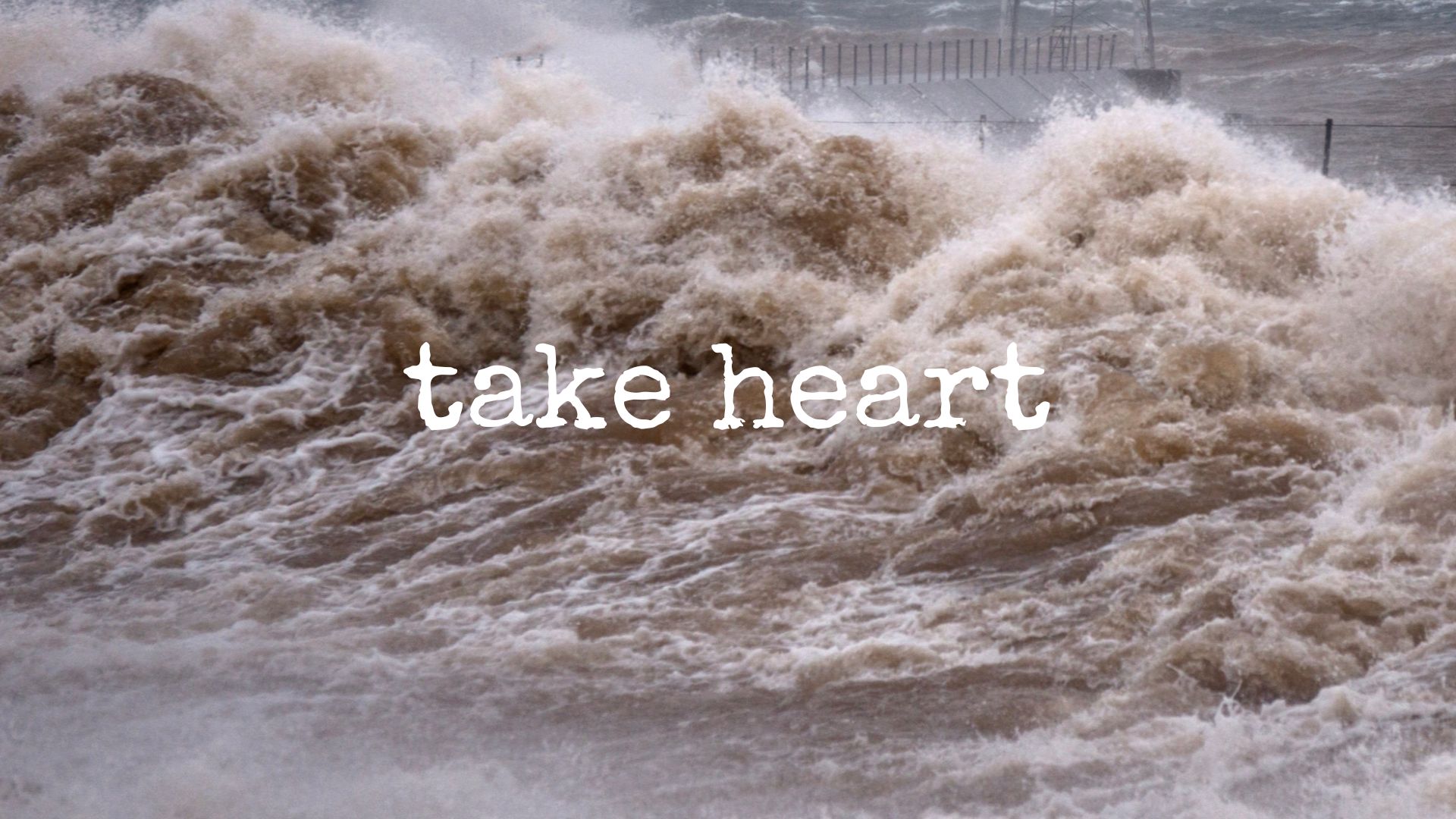
take heart
The gospels aren’t strings of stories as much as one long story we keep breaking into smaller episodes to try and understand. Sometimes it helps to connect things again, as I tried to do last Sunday looking at Jesus walking on the water.
___________________________
If you’re keeping score from last week, you may notice that our reading this morning started with the two extra verses we read last week. I did that because the transition is important to notice, and also to remind us that we are in the middle of a series of events that have even more significance when we understand them together—and it will go into next week as well.
Remember that we began with the execution of John the Baptist, which was done on a whim by King Herod. When Jesus got the news, he was devastated and tried to get away by himself to grieve and pray by sailing across the Sea of Galilee (which is really by a lake) to a wilderness area. The problem was that people had begun to see him as someone who could help them in their grief and need and they just kept coming. They walked around the lake and were waiting for him. So he helped them, and ended up feeding them.
Then he sent the disciples back across the lake, sent the crowds home, and finally got some time alone. And it’s here we pick up the story again.
It was night by the time the disciples started their voyage. Some of them fished for a living, so they knew how to go out at night; it was still a little precarious, but they knew what they were doing and no one seemed to think there would be a problem. But there was. The Sea of Galilee was small, but was well-known for its storms, and in the middle of the night, one of them blew in leaving the disciples to sail into a headwind that didn’t allow them to make much progress.
Jesus, meanwhile, finished his time of prayer and Matthew is very matter of fact about the way he talks about Jesus going out to meet his disciples. He says, “Very early in the morning Jesus came to his disciples, walking on the lake.”
Imagine being one of the people in the boat who was fighting the headwind only to look up and see someone coming across the water. Matthew says they thought it was a ghost and were so frightened that they screamed.
And Jesus said, “Be brave! It’s me.” Some translations say, “Take courage.” One delivers those words as, “Take heart,” which is what the English word courage means. “Take heart. Be brave. Keep sailing, even into the wind. I’m here.”
Then Peter said, “If it’s you, tell me to come to you,” and Jesus did.
May I remind you: the storm was still going on. The headwinds were blowing and the waves are waving, but Peter climbed out of the boat at Jesus’ invitation and started towards him, but the wind knocked the courage right out of him and he started to sink. Jesus had to pull him up and they both got in the boat. Then Jesus said, “You with so little trust. Why did you waiver?”
Then the storm settled and the disciples said, “You really are who you say you are.” And they made it to shore in time for breakfast.
But this isn’t the first place in the story where we have been reminded that life isn’t safe or predictable. Go back to John the Baptist’s death, where this story started. That John was not well-liked by the royal empire was no surprise. He knew we could get in trouble for speaking truth to power, and he knew who God had called him to be. But the reason he was murdered popped up suddenly like the storm on the Sea of Galilee. Herod became enchanted with the way his niece danced at his birthday party (there’s all kind of issues in that sentence) and made a drunken promise to give her anything she wanted. Her mother, Herodias, told her to ask for the head of John the Baptist on a silver platter, and Herod was too embarrassed—no, too cowardly—to back down, so John ended up dead.
Life isn’t always safe. Or predictable.
Perhaps that is why we spend a good deal of energy and thought on making our lives stable and secure for ourselves and our loved ones. That’s not a bad thing in and of itself. Stability often gives us what we need to grow and thrive. It can also give us a sense that we’ve got things under control.
But we can’t plan for every contingency. Sometimes we forget how little we can actually control until some kind of storm hits and we’re in the middle of it. In those moments we are reminded we can’t do it alone. The disciples had only recently faced that lesson when Jesus told them to feed the crowd and all they could find were five loaves of bread and a couple of fish. They learned of God’s abundance as they trusted Jesus and passed out the food and there was more than enough to go around.
Now they were alone on a stormy sea in the middle of the night, unable to get where they were going and they saw Jesus who said, “Take heart! It’s me.”
Another of the things that gets lost in translation that is worth noting here is the verb that gets translated “It’s me,” is the same one used when God is telling Moses to go to Pharoah and tell him to let the Hebrew people go and Moses says, “Whom shall I say sent me?” God answers, “Tell him I AM sent you.” It almost means tell him the verb “to be” sent you—the source of life itself. Matthew was making a connection between the way God took care of the Hebrew people in their tragedy and Jesus’ presence in the storm, and Matthew’s Jewish readers would have caught that. Can we hear that message this morning in the middle of our storms?
Tragedies are not evidence of God’s absence, or of God’s punishment, but they are places where we can become most aware of God’s sustaining love. God is with us whether we notice or not. When life is going smoothly and we feel like we can handle it on our own, God is still with us, even if we don’t notice it. God doesn’t show up when the storm starts; God never left. The little boat full of disciples finding Jesus in the storm is yet another picture of what Matthew has been saying through his whole gospel, and we have been repeating:
God is with us and we are with each other.
There’s another layer to the whole courage thing that’s worth noticing, and that comes when Peter asks if he can walk out to meet Jesus and Jesus tells him to come on. Peter stepped out bravely and then faltered when the wind hit him and Jesus had to get him back in the boat. Then Jesus said, “You with little trust. Why did you waiver?”
Jesus wasn’t correcting Peter. In fact, I think his words were directed at all of the disciples. He was talking to everyone in the boat, as if to say, “You have a little trust, that was a good start. Don’t stop there. Keep risking. Keep sailing.”
Beyond what was happening on the boat, Jesus was calling them to live courageous lives of love, just as he had challenged them to trust that some bread and few fish could feed a multitude. We also know that the weeks and months that followed led to Jesus’ death at the same hands of those who murdered John. Life didn’t get easier, but the disciples’ trust got deeper, even as they continued to falter at times.
God is calling us to courage as well. Whatever the storm or the situation, however life feels right now, “Take heart! Don’t waiver.”
Someone described our life of faith this way: we fall down and we get up. That doesn’t cover everything, but it’s pretty good. Getting up takes courage. Jesus calls us to keep getting up, to keep trusting. But what does trust look like? How do we do it?
Sometimes it is risking failure, like Peter did when he got out of the boat. Sometimes it is continuing into the headwind, to keep getting up day after day, like the disciples. Sometimes, it may be getting away to pray, to listen, to create space so God can speak. Sometimes it means having the courage to ask for help. Sometimes, it’s just getting out of bed in the morning. Whatever the storm, trusting means living like we take God seriously.
Life is hard. Trusting is hard. But take heart. God is with us and we are with each other. Amen.
Peace, Milton