
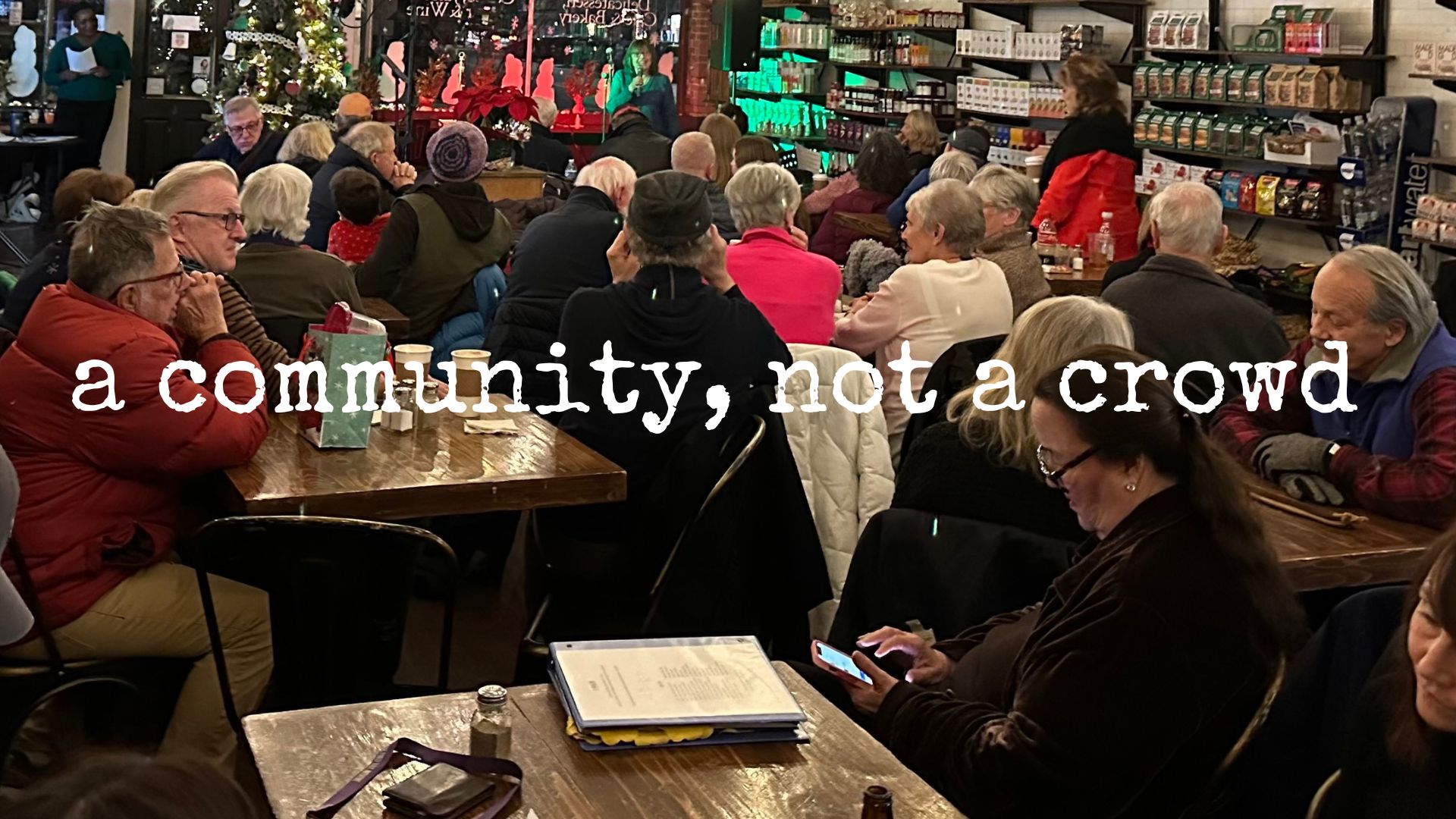
a community, not a crowd
Thanks to one of the commentators I read this week, the question that has been rolling around in my brain after reading our passage for today is this: What’s the difference between a crowd and a community?
They are both words we use to describe collections of people, and we know they are not synonyms, but I had not seen them set in contrast so clearly.
As you can probably guess, the first thing I did was to dig into the etymology of both words. The root word of crowd is an old English word that meant “to press or to crush;” in fact, the word crowd replaced the word press as a way of describing a large group of people. Just reading the definitions brought back memories of times I have felt pressed by a multitude at a concert or a ball game, or even a festival or fair. Even for a claustrophobic extrovert like me, those weren’t pleasant experiences.
The word community comes from a French word that meant “commonness or everybody,” which still could be a whole bunch of people, but they have reason to be connected, which holds the possibility of relationship. A community might mean everyone on the same neighborhood, or those who share similar goals or hopes.
We are a community.
Jesus saw the crowd that followed him, so he turned to his disciples, which is to say he saw the needs of the crowd and turned to his community to meet them. That sounds all well and good, but then we look at the list of names Matthew gives us, and we can see that Jesus’ idea of what made for true community was not what most people would have expected. Even though some of the names are familiar to us, we don’t really know much about any of them, and we do know that they were not the only ones following Jesus. Here’s what we do know:
- Philip, Bartholomew, Thaddaeus hardly show up anywhere else.
- Matthew, who worked for the Roman government, and Simon the Canaanite or Zealot, who was committed to overthrowing Rome, would probably not have hung out together if it weren’t for Jesus.
- Peter ended up denying that he even knew Jesus, Judas betrayed him, and Thomas was honest about his struggle to believe.
No one on the list had any political power or societal influence. They were laborers and workers. None of them was rich or influential. They were also people who would not have found each other on their own, in many respects, and being grouped together meant they had to deal with their differences. None of them had power, or influence, or connections. All of them belonged. Even Judas.
The significance of the list of twelve names is less about who was named than the picture it paints of the kind of community Jesus sought to foster, which wasn’t one centered around his power, but one that dispersed it, that shared it, that empowered everyone.
(And I want to underline here that they were not the only disciples. In fact there are several others, particularly women; Luke names Mary Magdalene, Joanna, and Suzanna. In that sense, Jesus’ sense of who belonged in community included more than even the gospel writers fully understood.)
Matthew listed the names because they were the ones Jesus “gave authority over unclean spirits to throw them out and to heal every disease and every sickness.” That’s a lot of authority. In fact, his words show that Jesus was imagining they would go and do all of the things that Jesus had been doing, and we know from our reading of Matthew so far that Jesus’ miracles were about more than just physical healing. Those who suffered skin diseases, for example, were banished from society. Healing meant they could come home.
Jesus called the disciples to turn crowds into communities, to help to break the systems that divided people and invite them to healing and wholeness, both individually and collectively. And to do that, they had to do the same thing Jesus had done when he went to Matthew’s house for dinner: go where the people were, rather than waiting for them to come to the disciples.
It’s quite a sendoff, yet here’s the thing: Matthew doesn’t record anything about either their going or their return. His gospel stays with what Jesus was doing, which is curious because the commissioning kind of begs for a follow up report, and there’s not one. That could be because things didn’t go well and Matthew didn’t want to record a failure, but that doesn’t really make sense because he does record things like Peter’s denial and Judas’ betrayal. Perhaps it is that Jesus wasn’t sending them on one journey but laying out for them how they should spend their lives. He gave them authority to create community. He wanted them to grasp that God could work through them to break down relational and systemic barriers that kept people from feeling whole just like he did. And that could happen anytime and anywhere. They didn’t have to go somewhere far away to find chances to foster healing and build community; they could do it right where they were.
Or perhaps it was because Jesus wasn’t laying out a strategic plan for growth that would mushroom every time another group went out. By the time we get to the end of Matthew’s gospel, we will hear Jesus tell these same people and the others who were not named that they were to go out into the whole world to spread the good news, but even then he didn’t lay it out best practices that could be replicated everywhere.
Maybe there’s no account of their return because the work is ongoing. Remember, Jesus didn’t send them far. In fact, he told them to stay close and not to go to other nations. That’s not because he was trying to be exclusive. He was telling them to start building a beloved community right where they were, which might be harder to do than doing it somewhere else they don’t know you already. He wasn’t asking them to do something that could be completed; he was asking them to change the way they looked at their world and at their ability to have an impact on it.
Let’s go back to our question: What’s the difference between a crowd and a community?
Maybe the corollary question is: How do we turn crowds into communities?
That makes me think of something that happened about a year after we moved to Connecticut. Ginger took her mother, Rachel, to get her driver’s license, which meant they spent the better part of an afternoon at the DMV in Old Saybrook. On Rachel’s eightieth birthday. The room was filled with people waiting to hear their number called. No one was talking to anyone other. They were a crowd, and a bit of a surly one at that. After they finally got what they needed and were preparing to leave, Ginger stopped in the middle of the room and said, “This is my mother Rachel and today is her eightieth birthday and she just moved here from Durham, North Carolina. She has spent it standing in line at the DMV. Can we at least sing ‘Happy Birthday’ to her?”
And they did. For a few moments, a roomful of strangers—a crowd—became a community, a pop-up choir, united in celebration for someone they didn’t know, drawn together by the chance to sing to someone else.
Then Ginger and Rachel left and the others went back to waiting. I don’t say that to take away from the joy of the moment, but to say community isn’t something we set in motion and then just let it ride. We have to keep working at it, we have to sing every day, if you will. We have to keep looking for ways to offer healing to one another and looking for new people to include.
Like those whom Jesus sent out into streets they already knew, we are here in this place together as those who have been called to carry one the work of building and fostering community. If someone were to write down our names, as Matthew named the twelve, people that might read them in two thousand years would probably not recognize a single one. We are not making headlines on a daily basis. We don’t inhabit the halls of power.
But because we are created in God’s image, because the spirit of God inhabits us, we are carriers of God’s love. We are healers, should we choose to live into our calling to look for ways to share that love on a daily basis, whether we are singing at the DMV, or calling someone we haven’t seen in church in a while to say we miss them, or hosting coffee hour, or making prayer shawls. We do it when we say thank you to the almost invisible person filling our water glass while we eat in a restaurant or take food to the Food Bank.
Maybe those sound like small things, but Jesus didn’t send his followers out to do big dramatic things. He told them to go into people’s homes, to see what they needed, to love them in ways that met those needs.
As we prepare to go from this place back out into the crowds that surround us, let us go reminded of our calling to be healers, to be carriers of God’s love. Life is short and our days are sacred gifts. Our names will probably not make the history books, so let us make our mark by leaving our fingerprints on as many lives as we can because of the way we listen and respond, because of the way we include and welcome, because we trust that the love of God really can change the world. Amen.
Peace, Milton





Thank you Milton for this: because we trust that the love of God really can change the world. Amen.