
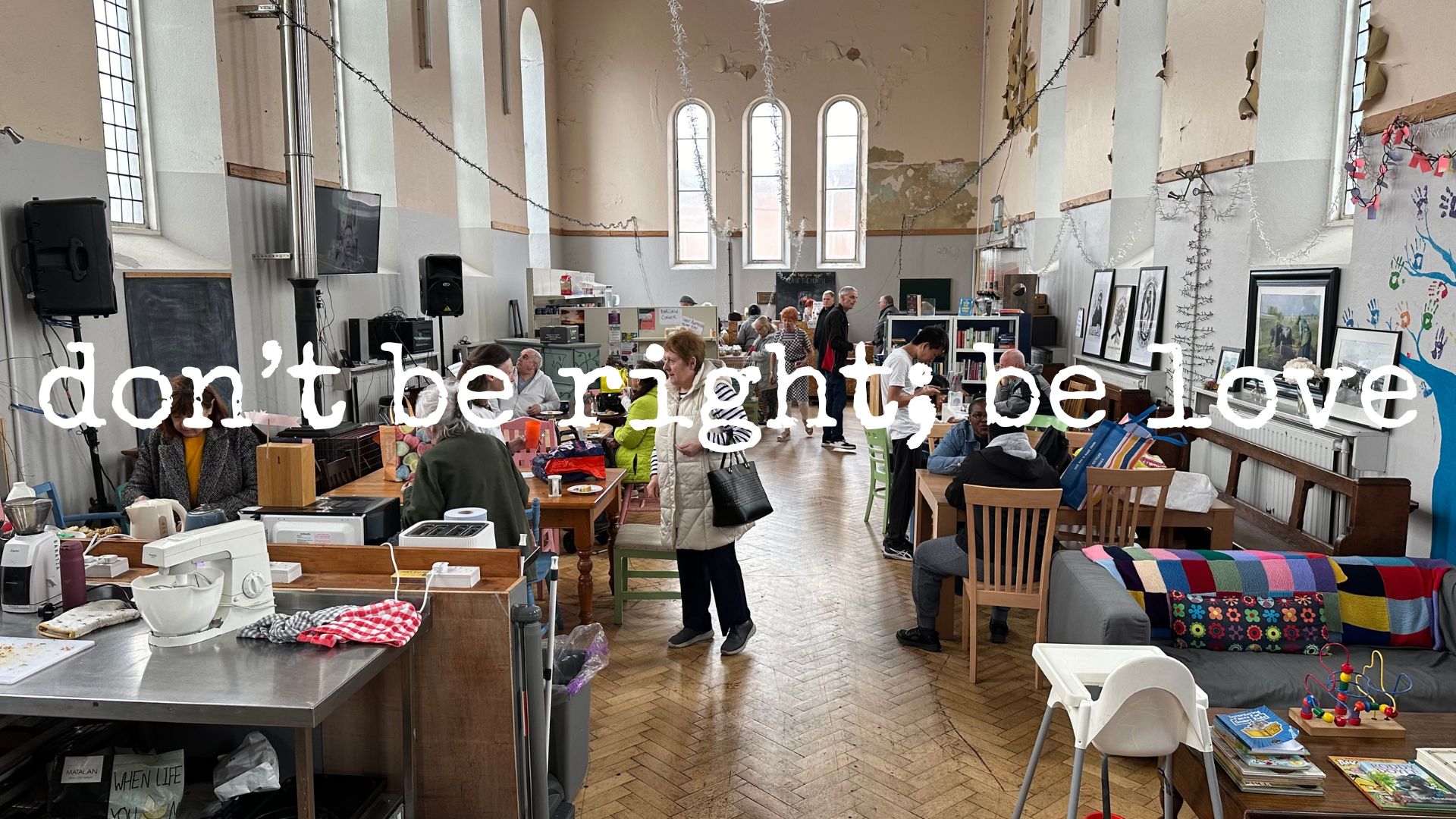
don’t be right; be love
Though the lectionary groups Jesus’ call to Matthew with a couple of healing stories, I stayed in the room with the tax collectors and sinners to see what I could find there. Here’s my sermon from this week.
___________________________
A few weeks back—I think it was the last time we had a full-blown lunch after church—Keith Amato came up to me in the Parish House and said, “I think eating together is one of the things we do best.”
I agreed. As I have noted several times, we stay longer at Coffee Hour than we do in worship; that’s not a critique, it’s a good thing. Sitting down with other people to share food is one of the best ways to break down walls and barriers and help us move to a relationship that sees more than differences. That happens because while we are eating together we tell stories and we ask questions, we listen to each other, and we become more fully human.
Our table is set here this morning for us to share the meal that is at the heart of our faith, and when we come to eat together we don’t put any barriers on who can join us. When theologian Frederick Buechner talked about Communion, he focused on the way eating together creates intimacy and vulnerability. He said,
To eat any meal together is to meet at the level of our most basic need. It is hard to preserve your dignity with butter on your chin, or to keep your distance when asking for the tomato ketchup.
One of the things that Jesus did with regularity was to eat with people. All kinds of people. For him, sharing food was an act of solidarity, a way of helping whoever was at the table to feel like they belonged there without having to earn their way in.
A meal sits at the center of our passage this morning. Jesus was walking through town and saw Matthew sitting at a tax booth. Tax collectors were not popular in first century Palestine, not only because they collected taxes for the oppressive Roman occupation, but also because the way they made a living was to overcharge and then skim the extra off the top. I’m sure Matthew had to deal with a fair amount of people who walked by his booth and let him know he was not someone they welcomed or liked.
Jesus saw him and said, “Follow me,” which Jesus did with the other disciples as well, but then Jesus didn’t lead Matthew on some journey to a new place. He went to Matthew’s house for dinner in much the same was as he called out to Zacchaeus (also a tax collector) to come down from his perch in a tree so they could go eat at Zacchaeus’ house. And they were not alone. Matthew records that the house was full of “tax collectors and sinners,” which one commentator was a sort of catch phrase used to stand for anyone consider to be someone who was excluded for whatever reason, sort of like the way David Letterman used to call people “young, surly, ne’er do wells.”
However we read the words, the picture Matthew was painted shows us Jesus in a room filled with people no respectable person would want to be seen with. at least according to those who deemed themselves “respectable.” And he was there on purpose to eat with them.
Though they weren’t willing to eat, a few of the people in the room were Pharisees; they were religious figures who are not featured kindly in the gospels because they were sticklers about the religious law. What mattered most to them was that people adhered to the religious law and believed the right things. For them, to be holy was to be pure, which meant they spent most of their time deciding who didn’t deserve to belong, rather than opening the table up to whoever wanted to eat. The most important thing about their religion was to be right. They saw what was going on and said to Jesus’ followers, loudly enough so Jesus could hear, “Why does your teacher eat with tax collectors and sinners?”
The Pharisees are difficult to talk about in sermons because far too many times preachers who have done it have made it sound as though Jesus was against Judaism when he confronted them. So it is important to remember that Jesus was an active and devout Jew his entire life. He wasn’t trying to destroy the Jewish faith; he was on the inside, in the thick of it, joining in the discussions about what kind of faith it would be, much like we face a similar tension in American Christianity.
Biblical scholar Amy-Jill Levine says,
“Jesus is not critiquing Judaism; he is engaging in an argument Jews were already having with themselves. The Pharisees were not simply gatekeepers of exclusion — they were a renewal movement. The contrast Matthew draws is an internal debate, not a religion vs. religion contrast.”
Jesus heard them and said, “Healthy people don’t need a doctor, but sick people do. Go and learn what this means: I want mercy and not sacrifice.”
That last phrase is a quote from the book of Hosea, one of the Hebrew prophets. Jesus wasn’t trying to make himself look good at the expense of the Pharisees with his response, he was hitting at the heart of something we say around here quite often, and that is relationship is more important than doctrine. First, he met them on their own terms, in a way. They looked at those around the table with Jesus and saw sick people, so Jesus said, “When you see sick people, you get them a doctor.” He wasn’t agreeing with their assumption; he was calling them to live up to their own logic.
Then he repeated a verse from the book of Hosea—from the scriptures they said they so devoutly revered. He said, “Go and learn what this means: I want mercy and not sacrifice.”
When the prophet spoke those words to the Hebrew people, he was conveying God’s concern that they had missed the point of their faith. People were consumed with making sure they followed all the sacrificial laws, and God was saying, again, people matter more than rules. The word that is translated mercy is not just being kind. It is a word that means radical solidarity. It means doing what Jesus did: seeing those who have been told they don’t belong and saying, “Why don’t I come to your house for dinner?”
And that’s the thing I like best about what Jesus did was he didn’t say, “Come to my place.” He went to Matthew’s house and ate what Matthew served alongside the people that Matthew hung out with. That’s a radical kind of hospitality because Jesus didn’t make Matthew meet his terms.
For Jesus, the most important thing about faith was not to be right but to be love.
As a denomination, we say, “Whoever you are and wherever you are on life’s journey, you are welcome here,” much as we print in our order of service that everyone is welcome at the table as we share Communion. All of that is good and it means people have to come in here to feel welcome. Jesus’ kind of hospitality was to say, “I’ll show you how much I think you belong: I’ll come to your house and meet you on your terms.”
Let’s go back where we started. Keith is right: what we do best is eat together. So let’s take what we do best out of this place to find those who are being told by others that they don’t belong and figure out how to meet them on their own terms. We probably can’t follow everyone home for dinner, but we can have conversations and ask questions, we can listen and move beyond what we think we know about them from our first interactions, we can allow them to become more fully human, we can deepen our connections and our compassion.
May we be the kind of people who take every chance we get to eat with tax collectors and sinners. After all, they are God’s beloved—just like us; and what matters most is not to be right but to be love. Amen.
Peace, Milton






I eat ever nourishing insight from your body of stewardship!
I eat ever nourishing insight from your body of stewardship! Thank you for your wisdom served with Abundance and Extravagance, Milton!
I love you!
Kenny
I eat ever nourishing insight from your body of stewardship! Thank you for your wisdom served with Abundance and Extravagance, Milton!
I love you!
Kenny
Your words are so heartfelt and true, Milton.
I do wish I could be sitting in a pew and listening to you”up close and personal.”
Thank you for being such a good friend to my family.
You are loved and admired.
Hi, Milton!
You have a gift for loving people by welcoming them to your table, feeding them well, and making space for connection. And I love that Don’t Eat Alone is never really about eating. It’s about your conviction that shared meals create shared lives.
Reading Matthew’s account of Jesus dining with tax collectors and sinners, I was struck by how deeply your vision resonates with his. Jesus so often chose the table as the place where barriers dissolved, strangers became friends, and grace was made visible. It seems fitting that Don’t Eat Alone has become your refrain, because it expresses something that has always been true of the Gospel: love invites, love welcomes, and love always seems to make room for one more at the table.
Many thanks for your reflections- this one especially resonates with me.
Thanks, Kristie!