collaborative grief
On most any morning, my daily ritual is to get up, pour a cup of coffee, do Wordle and the crossword puzzle, journal, and read. On Sunday mornings, I read through my sermon on last time before I print it, then I journal and read, so it was after I had hit “print” that I read these words from music producer Rick Rubin:
Nothing starts with us. The more we pay attention, the more we being to realize that all the work we ever do is collaboration.”
And it struck me in a way it had not hit me all week: our story this morning is a collaboration story. Let me show you what I mean.
Sometimes, the way we understand a story has a lot to do with where the story begins, and also where it ends. That’s particularly true when it comes to reading the Bible because the chapter and verse divisions, which were all added a long time after the stories were written, make it seem like we can dive in most anywhere. Add to that the reality that there’s only so much scripture we can read at once in worship and we can miss some important connections, if we are not careful.
Our passage today is a good example.
The heart of the story, which is often labeled as “The Feeding of the Five Thousand,” is one of the most well-known stories in the gospels because it is a miracle that is kind of easy to picture. As Matthew lays out the details, we can imagine a hillside full of people and Jesus telling the disciples to feed them with the loaves and fish, even if we struggle to understand how they fed everyone.
But the story didn’t start on that Galilean hillside, and it didn’t end there, as we saw from where we read together this morning.
The first twelve verses of Chapter 14 give us the context that really begins this story. The short version is John the Baptist was murdered by Herod on a drunken whim. His disciples buried him and then came to tell Jesus. Once he heard the awful news, Jesus did all he could to get away from everyone and everything to grieve the loss of his cousin, colleague, and friend.
But he couldn’t get away.
The crowds of people hoping for healing were relentless in both their need and pursuit of him and they followed him out of town into the desert, as did the disciples whom, I imagine, were doing their best to deal with their grief over John’s death as well as cope somehow with Jesus’ sorrow, which was new to them as well.
When Jesus became aware of what was happening, he didn’t become angry because he couldn’t get any alone time. Matthew says, “. . . he was wrenched with compassion for them.” This is one of those places where talking about the Greek word helps us. The word that is translated as “wrenched with compassion” means to be viscerally affected, to feel it in your gut. In ancient Mediterranean cultures, you didn’t love with all of your heart, as we like to say, you loved with all of you guts. That may not sound as romantic, but the compassion is not romance, it is a gut feeling to change things, to do something.
I started by saying this is a grief story—and a story of collaboration. Even as he was grieving, Jesus felt the grief of those around him so much so that instead of continuing to try and get away he turned to the mass of people and began to listen to their grief stories, to share their loads, and to offer healing. That went on all day and into the evening.
The disciples seem to have been exhausted by all of it and come across a little less compassionate, though I think they thought they were trying to figure out how to help with the crowd. Maybe they were also trying to take care of Jesus. Whatever the reason, they focused on the reality at hand. “We’re out here in the desert and it’s after supper time; don’t you think we should send them into the villages so they don’t starve?”
Jesus’ response was direct: “They don’t need to go away. You give them something to eat.”
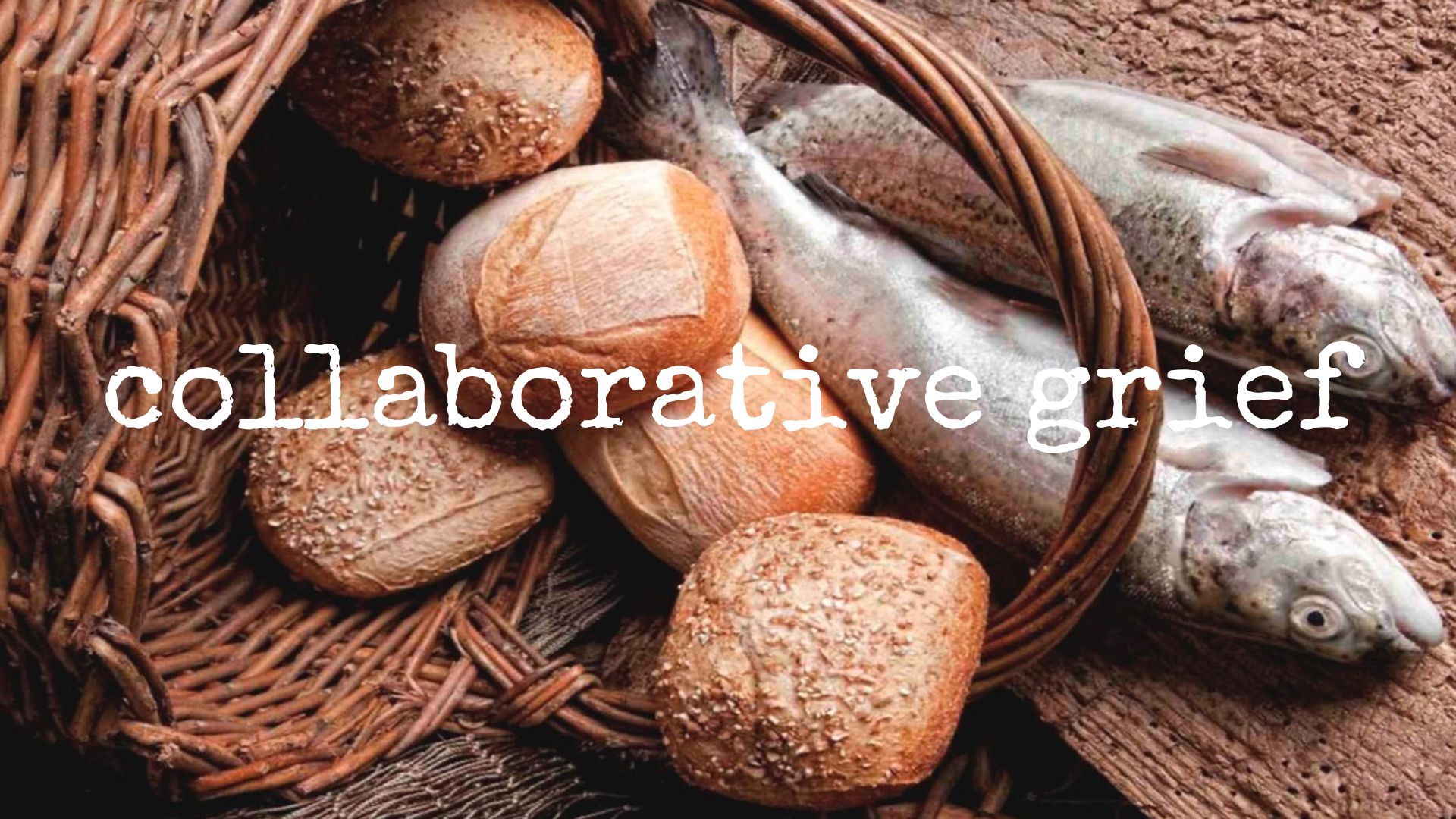
Their response was also straightforward. “We have nothing here but five loaves and two fishes.” In Matthew’s version, they didn’t even have a cute little kid who was offering his sack supper. They knew they didn’t have enough. The hunger of the crowd was not something they could solve. It didn’t matter what they did, they couldn’t fix the problem. Part of being a disciple, at times, meant living with the grief of inadequacy.
“Bring them here to me,” Jesus said. Then he turned to the crowd and asked them to sit down on the grass. He blessed the food and then gave it to the disciples to distribute. With several thousand people on a hillside, it is hard to grasp the logistics of it all, but the people seemed to know that dinner was being served. They sat down and began to pass the food as it came to them. And in the collaboration, everyone ate and there were leftovers.
I don’t think Jesus knew, necessarily, that it was all going to work out when he and the disciples started passing out bits of bread and fish. He just knew it was the right thing to do. If you have food and you see hungry people, you feed them. You offer what you have. And then see where it goes. Where it went was everyone ate and there were twelve baskets of leftovers at the end of a long, grief-filled day.
But that is not the end of the story, which is why I asked Eric to read the extra verses this morning. Matthew continues:
“Right then, Jesus made the disciples get into the boat and go ahead to the other side of the lake while he dismissed the crowds. When he sent them away, he went up onto a mountain by himself to pray. Evening came and he was alone.”
The day had begun for Jesus with an ambush of grief that had sent him searching for solitude. It ended with him returning to that quest and sending the disciples on across the lake so he could find some healing there as well.
When we read the whole story we can see one of the things it gives us is a good picture of life in that there are many times when the needs of the world around us crash in on what we need to take care of ourselves. One of the big challenges of life and faith is how to meet the needs in front of us and also take care of ourselves. If we aren’t doing what we need to do to foster our interior life, to deepen our sense of connection to God, to find ways to rest, then we won’t have the intestinal fortitude to love others with all of our guts.
Love is hard work and often costs us something, but real, enduring compassion doesn’t require us to sacrifice ourselves until we do damage. It calls us to collaboration. God is not calling us to sacrifice ourselves to the point that we destroy our health. We can take care of ourselves and others, too. The love God offers us and then calls us to share with one another is complicated in the sense that we most always have our own stuff going on when someone else needs help.
Hear Rick Rubin again:
“Nothing starts with us. The more we pay attention, the more we begin to realize that all the work we ever do is a collaboration.”
We are all telling grief stories most all of the time, in one sense or another, which means we are all trying to balance how to help and ask for help, how to interact and how to find time for ourselves, how to risk and how to work through our fear. At most any moment, we are those who need to be nourished, those who need to take care of our own stuff, and those trying to figure out how to best help the people around us.
Wherever we are in our stories, let us remember they started with love and they will end with love because of the God who called us into being and into relationship, into collaboration. Let us take care of ourselves, in every sense of that phrase. We don’t have to do this alone. God is with us and we are with each other. Amen.
Peace, Milton