Home Blog Page 55

lenten journal: we don’t need another hero

The subtitle to David Whyte’s book Consolations gives me a smile most every morning as I turn to my word for the day:

The Solace, Nourishment and Underlying Meaning of Everyday Words,

because the words are anything but everyday it seems to me.

(I have to say, parenthetically, that as great as his writing is, it bothers the hell out of me that he doesn’t use the Oxford Comma. But I digress . . .)

Today’s word was destiny. I don’t think of that as an everyday word; it’s a mythic word. And yet, when he defines (describes?) it, the word finds a quotidian home.

When we choose between these two poles, of mythic triumph or fated failure, we may miss the everyday conversational essence of destiny: our future influenced by the very way we hold the conversation of life itself, never mind any actions we might take or neglect to take. . . .

We are shaped by our shaping of the world and are shaped again in turn.

I can’t think of the word myth without thinking of Joseph Campbell and The Power of Myth. He changed the way I understood the word. Myth wasn’t make believe, it was archetypal story–the stuff civilizations are made of. One of the things he talked about was the monomyth of the hero’s journey, where the hero goes on an adventure, wins a victory in a decisive crisis, and then comes home changed or transformed. Jesus is one of the “heroes” he identifies.

I wonder about that.

Set your atonement theology aside for a minute and think about it. The crowd that waved palm branches was in full Bonnie Tyler mode, looking for a hero, as was Judas. And yes, Jesus did his share of healing, but after almost every instance he implored people not to go tell anyone. He kept saying things like, “The realm of God is among you, within you,” and. “You are the light of the world,” not, “Aren’t I the bomb?”

Heroes make for good fiction. I love Atticus Finch as much as the next person. But the truest way we can tell our story is to not make ourselves the hero. From a literary standpoint, the one who tells the story is the narrator, not the hero, nor the protagonist. One of the first things you learn when you study fiction is that first person narrators are notoriously unreliable, but when it comes to the stories of our lives, that’s all we have.

The Rumi couplet that hung with me from Melody Moezzi was

Your wounds may summon the light hereto
But this sacred light does not come for you

The best autobiographies are the ones who know the sacred light is not for them, primarily. They write about what they have learned, or the grace they have found, but not how they saved the world. Self-congratulation, whether fiction, biography, or real life–is not particularly helpful.

We often think we are looking for heroes, but we are really looking for each other. We don’t need to be saved as much as we need to belong, to be included. Rumi, again.

The faithful are mirrors for one another.

I’m not saying we shouldn’t have our moments in the sun, or that it isn’t fun or meaningful to be recognized for good work, or that we cannot bask in our accomplishments. I am saying those things are not the heart of the story. To be the hero is to separate ourselves. To be something other than fully human. The heroes ride off into the sunset; everyone else stays together and keeps on telling the story.

The word heroic gets thrown around a lot these days, often as a way to honor those in health care who risk their lives, which i most certainly want to do. But these folks aren’t riding off into the sunset. They keep showing up. They keep staying at the hospitals so their families are not endangered. They keep caring and doing and loving like human beings, not heroes. They are telling the story of who we are and who we are meant to be. Who we are made to be.

When the apostle Paul described Jesus, he said that Jesus “did not see equality with God as something to be grasped” and so he poured himself into his humanity, not to be a hero but to be one of us. He mirrors the best of who we were made to be. His light was to highlight how we are built to illuminate the world for one another. We are saved when we, like him, immerse ourselves in all the humanity we can find.

Tina Turner was right: we don’t need another hero. We need one another to show up and be us. We won’t ride off. We’ll just watch the sunset together.

Peace,
Milton

lenten journal: seasoned response

Spring never comes soon enough in New England or, perhaps I should say, it takes a long time to get here. It teases us in early April, as it did for the last two or three beautiful, crisp, sunlit days, but then come mornings like the one we woke up to that are cold and grey and rainy and make the budding trees look like guests dressed for a costume party only to find out they had been invited to a wake. It’s one thing to live through days like these in early April; it’s another thing to face them in early or even mid-May.

Spring never comes soon enough in New England.

Despair was the word David Whyte unpacked in my reading this morning, and he spoke of it as a season.

Despair is a difficult, beautiful necessary, a binding understanding between human beings caught in a fierce and difficult world where half of our experience is mediated by loss, but it is a season, a waveform passing through the body, not a prison surrounding us. A season left to itself will always move, however slowly, under its own patience, power, and volition.

To let the seasons turn, whether winter or despair, in their own “patience, power, and volition” is easier said than done. Covid-19 is an unexpected season in our lives, with less indication of when it will finally turn than our endless winter. When it comes to waiting on spring, at least I know I’ll get to plant vegetables by Memorial Day.

How, then, do we let this season pass under its own patience as we sit together all alone?

The other book I am reading is The Rumi Presciption: How an Ancient Mystic Poet Changed My Modern Manic Life by Melody Moezzi. Her word today was distraction. She started the chapter with a couplet from Ruminator:

love has not business with the five and six
only upon the Beloved are the true lover’s eyes fixed

She explained that “the five and six” was Rumi’s own shorthand for the distractions of the world: the five senses and the six directions (north, south, east, west, up, and down). Though she wrote the book long before we ever began to come to terms with the virus, she wrote something that has deep resonance for these days:

Never has it been so easy to forget what questions we were asking in the first place.

Distraction pulls us into an artificial world of incessant crisis and endless obligations. Whyte says despair can only stay “beyond its appointed time through the forced artificiality of created distance.” Perhaps created distance and physical distancing do not have to be synonymous. Perhaps, as many are beginning to note, we would do well to realize the goal does not need to be go back to life the way it was.

We can give ourselves room–space, distance, perspective–to remember the real questions we wanted to ask of life, or ourselves, of each other.

Since the forecast was for rain last night, I spent a couple of hours of my late afternoon in the garden, tilling beds, marking beds, and sifting compost. I may not be able to hasten the season, but I can prepare for it. Tom, my gardening buddy, was planting things that are undaunted by April in Connecticut: spinach, carrots, cabbage, kale, snap peas, parsnips. In the middle of Holy Week we were plotting a resurrection that will drag on all summer long.

When he and I met with four or five other folks who were interested in being a part of our gardening team earlier in the year, Tom offered four “Garden Goals.”

1. Pay attention.
2. Treat plants like people.
3. Don’t step on the beds.
4. Don’t forget Number 1.

I had finished writing last night when I got a text from a friend saying John Prine had died. I was on the phone with my friend Kenny with whom I have shared a love of music for thirty years. I finished talking to him and came down to tell Ginger. “Play something,” she said, so I got out my guitar and played “Angel from Montgomery,” which is my favorite song.

As I was reading about distraction and despair this morning, and thinking about how we stay attentive to the changing seasons, I could hear Prine songs in my head that all spoke to how we live through this season of despair and distance.

you know that old trees just grow stronger
and old rivers grow wider everyday
but old people just grow lonesome
waiting for someone to say
hello in there–hello

come on home, come on home
no you don’t have to be alone,
just come on home.

surround me with your boundless love
confound me with your boundless love
I was drowning in the sea, lost as I could be
when you found me with your boundless love
you dumbfound me with your boundless love
you surround me with your boundless love

Medieval poets, gone-too-soon folksingers, and brave new seedlings are all singing the same seasoned response. Let’s sing along.

Peace,
Milton

lenten journal: a bite-sized life

One of the most magnificent failures of my life was as a church planter in Boston.

Ginger and I moved to Charlestown, Massachusetts a few months after we married to try and start a church there. We worked hard at it and we had no idea what we were doing. Two or three years in, we had what is now the second worst winter on record in Boston (twelve blizzards!), and when it was over the Bible study group that held the promise of becoming a church was nonexistent.

I got a job as a substitute teacher at Charlestown High School because I needed to do something to make money and teaching seemed like worthy work. Ginger was already holding down two jobs as part-time youth minister and the First Congregational Church of Winchester, Massachusetts and as a chaplain for the Visiting Nurse Association in Stoneham.

What started as a sub job turned into something more permanent. About two weeks into the school year, one of the English teachers went out on long-term disability and I ended up with his classes. The chance to teach set me on a path to get my certification, which meant I had to go back to school for a teaching certificate, first, and then a Masters in English. I kept teaching full time through all of it.

Each of the four semesters of my Masters, I took two seminars alongside of the five classes I was teaching. I left as soon as school was out, caught the 93 bus to Downtown Crossing, cut over to the Red Line at Park Street, rode out to the JFK/UMass stop, and then rode the shuttle to class at UMass/Boston. At night, I did what I had to get ready to teach. On the weekends, I read for my seminars. As each semester began, I would say to Ginger, “I can do anything for twelve weeks, right?”

Part of the reason I could live with the stress was that I could see when it would end. I knew why I was doing it and I knew it would be over. I wouldn’t have to live that way forever.

When my father died, I experienced a grief I had never known before. I also experienced a new reality in my life: my father was dead. I would live the rest of my life without him. That was not going to change. There was nothing to life through, only a grief to live with.

A friend who was farther down the road of grief than I was gave me a helpful word. “Chop up the day into bite-sized pieces. Pieces you can digest. If all you can take in is the next fifteen minutes, then just live through the next fifteen minutes, and then live through the fifteen minutes after that.”

Their words were life-giving

It seems to me that these days hold some of both scenarios. At some level, we know life will not always require of us to be physically distant and confined to our homes except for the necessities. We will not always have to fear being gathered too close or touching someone. At the same time, we don’t know when that ending will come. And, as each day passes, the pandemic gets more personal. I know people who have, or have had the virus. I have yet to experience the death of someone in my immediate circle, which means I am fortunate. Though life in the time of Corona will have some sort of ending, we have no idea when it is, and so the grief feels like a stretch of open road that we are required to travel.

Both scenarios call us to cut life into pieces we can digest. I get up in the morning to read and journal before I start work, which is also reading. Around 10:30 or 11, I take a walk. The next marker on my schedule is a phone meeting with my colleagues to check in around 1:30. Four o’clock has become nap time, then another walk, dinner, another walk with the pups, and then writing again before I go to bed. Like my days in graduate school, I chop the days into pieces small enough to see my way through; like the grief after my father died, I hope the days into pieces small enough to see my way through.

Hear me clearly: I am not saying I have a handle on this, by any means. I am chopping the day into bite-sized bits to try and create a reasonable social distance between me and my depression. I have days when, as I said to Ginger, I don’t feel like I am depressed; I am deteriorating. And then there are hours in the afternoon, like today, when I dug garden beds in the evening sunlight and felt, briefly, whole. Most days, I live with a persistent disquietude–something I can see on the faces of most everyone I meet, even from six feet away.

Life will go on beyond this crisis. What life will look like, I don’t know. When we get past this part of the pandemic, thousand of people will have died, millions of people will have lost their jobs, and the world, as we know it, will be different. We are not walking towards a happy ending. We don’t have a great deal we can be sure of, other than we can take care of each other. Whatever life looks like on the other side, it is worth it to keep going. Together. That we know things will not always be like this means we have reason to hope.

That’s all I’ve got.

Peace,
Milton

lenten journal: figs and feasts

We mark the days of Holy Week as though Jesus was on a schedule that culminated in his execution on Good Friday. We give ourselves one or two things to think about each day and then move on to the next.

John wrote that if he had written down everything that happened in Jesus’ life the world would not have been able to contain the books. Though John’s sense of the world was much smaller than ours, it still seems a rather outlandish statement about someone who was killed at thirty-three.

I was in Memphis in February with a group from our church on our annual Civil Rights History Tour. As we came out of the National Civil Rights Museum housed in what once was the Lorraine Motel, I remarked to Ginger that I wondered what our nation might have been like had King, Malcolm X, and Robert Kennedy all lived to be old men. King was already moving to an emphatic denouncement of the Vietnam War. Kennedy shared much of King’s vision for equality and inclusion. Malcolm was going through his own changes and had so much to say.

But all we have are what they did in their short lives and what they wrote and said.

The world loses when people’s lives are cut short. I can think of several friends who lost not just loved ones but those they loved the most. Their lives were drastically changed. Their story has never been the same. Part of the impact of the pandemic will be many of us will have to learn this truth over and over.

Jesus didn’t come to teach us how to burn out, or to see how quickly we could get ourselves killed. Sometimes the way we read the story of Jesus’ life makes it sound like he was the embodiment of Edna St. Vincent Milay’s poem “First Fig.”

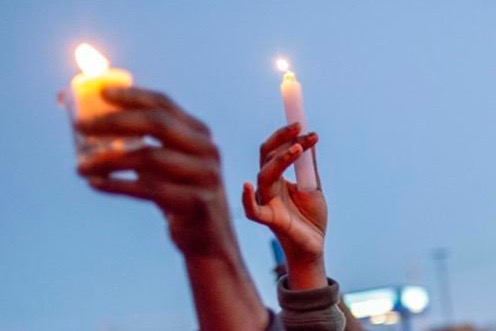
My candle burns at both ends
It will not last the night;
But ah, my foes, and oh, my friends –
It gives a lovely light.

What if Jesus had had a chance to grow old? What more would we have learned about what it means to be fully human?

It is hard to believe that the one who preached the Sermon on the Mount and healed people with a word or a touch had done and said everything he had to do or say in his early thirties. What sermons did we miss because the Romans wanted him dead?

I remember someone talking aboutDietrich Bonhoeffer and saying that people of varying theological perspectives ally with him because he died before he had a chance to say everything he had to say. I don’t know that any of us get to say everything, but I wonder if we couldn’t say the same thing about Jesus.

On this Holy Monday, as we call it liturgically, the story we tell about Jesus is that he cursed a fig tree for not bearing fruit. Some traditions read the story of Jesus “cleansing the Temple” (talk about your polite euphemisms) on this day as well. We might do better to lean into the blues and call it Stormy Monday, but we never really get to know what Jesus had on his mind.

What would we have learned about Jesus, and about ourselves, had he lived long enough to bury more friends than just Lazarus, to visit Jerusalem for more than a Passover or three, to share more experiences with his disciples than a handful of seasons on the Sea of Galilee?

Stanley Kunitz is a poet who lived a long time. Late in his life, he wrote a poem called “The Layers,” part of which says,

When I look behind,
as I am compelled to look
before I can gather strength
to proceed on my journey,
I see the milestones dwindling
toward the horizon
and the slow fires trailing
from the abandoned camp-sites,
over which scavenger angels
wheel on heavy wings.
Oh, I have made myself a tribe
out of my true affections,
and my tribe is scattered!
How shall the heart be reconciled
to its feast of losses?

As we work our way through our schedule to the Last Supper, I wonder what our lives and our faith would be like had we gotten to share in a larger feast of losses with Jesus.

Peace,
Milton

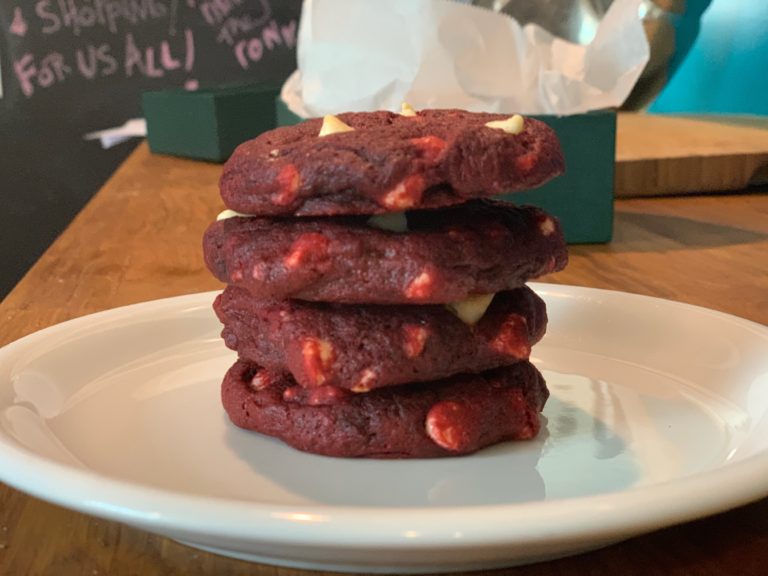
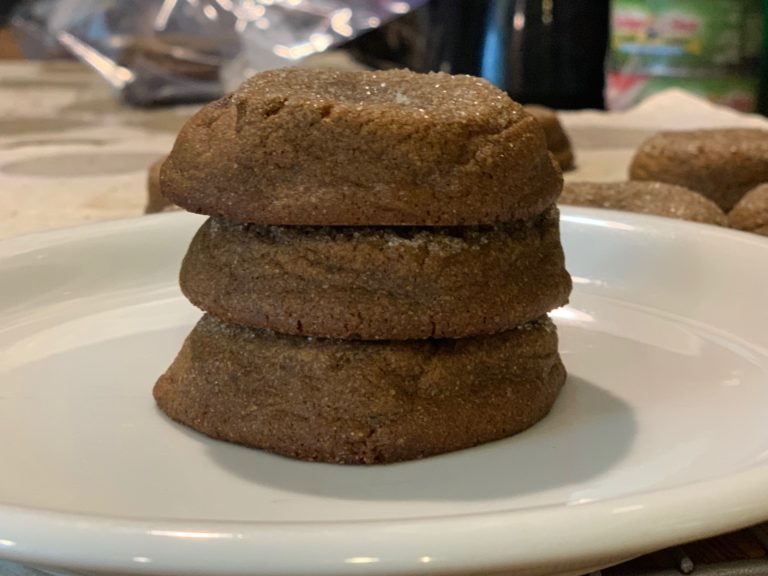
chocolate, olive oil, and sea salt cookies

Some of my cookies can be made on demand. These take some time.

These cookies came about as we began exploring new flavors to add to our repertoire. Early on in the Milton’s Famous days, we began to say we wanted our cookies to tell a story: there was a beginning taste, a middle, and an end. These cookies start strong, run deep, and tell a seriously rich chocolate story the whole way with a salty finish.

They are a close second to the Peanut Butter Sriracha Cookies as Ginger’s favorite.

chocolate, olive oil, and sea salt cookies

1 c olive oil
2 c brown sugar
4 eggs

1 1/2 c flour
1 1/2 c unsweetened cocoa powder
1 t sea salt
2 t baking soda dissolved in
2 T hot water
2 t vanilla

24 oz. semi-sweet chocolate chips
sea salt

Mix olive oil and brown sugar in a stand mixer. The oil will not emulsify with the sugar in the same way butter does. Scrape down the sides of the bowl and add the eggs. Beat the mixture until it looks creamy.

In a separate bowl, combine the flour, cocoa powder, and sea salt. Add it to the wet mixture to combine and then add the dissolved baking soda and the vanilla. The batter will be thick, but should be smooth. Add the chocolate chips and mix well. Chill the batter at least a couple of hours. I usually let it sit in the refrigerator overnight.

Preheat the oven to 350°.

Scoop the cookies on to a parchment lined baking sheet. The batter is sticky. I spray my scoop with Pam every two or three cookies. Generously sprinkle sea salt on the tops of the cookies. Cook for 12-14 minutes for 2 ounce cookies.

These take some time, and they are worth it.

Peace,
Milton

lenten journal: palmdemic sunday

Palm Sunday has come and gone without a parade.

Here in Guilford we have three churches on the Green: St. George Catholic, Christ Episcopal, and ours–First Church, since in 1643 you had to have a Congregational Church with a settled pastor to constitute as a town in New England.

For the Palm Sundays we have been in town, all three congregations gather on the Green together to bless the palms and then we recess to our respective houses of worship to continue. The only folks on the Green today were people walking themselves or their dogs. Ginger and Jake set out palm fronds and self-contained Communion cups in our Memorial Garden for people to pick up (coming to the garden alone, of course) and use as they watched out online worship. I noticed that St. George had some sort of drive through set up. Christ Church was live streaming.

Palmdemic Sunday is a new experience for all of us.

For me, Judas and Peter are the main characters in Holy Week, alongside of Jesus. Judas get the bad rap because of the way the gospels are written. None of the gospel writers can help themselves. From the start, any time Judas shows up they describe him as, “The one who betrayed Jesus.”

It seems to me that Judas’ image of what the Messiah would do was that of one who would bring the Roman house down. He was the New Testament version of Malcolm X, looking to Jesus to change things by any means necessary. He grew weary of waiting for Jesus to make his move, so he pressed the point. Perhaps the kiss in the Gethsemane was less a betrayal than a misguided challenge.

On the other hand, Peter flat out lied. Three times, as he stood in the courtyard outside the place where Jesus as being interrogated, he lied about being with Jesus. The last time, he swore violently as he lied. Then the rooster crowed and Peter burst into tears.

Judas didn’t lie, but when he realized what he had done he couldn’t bring himself to risk forgiveness. Peter lied, yet somehow managed to wait around long enough to be surprised by both forgiveness and breakfast on the beach.

But I am getting ahead of myself.

When I think about Jesus’ entry into Jerusalem on a borrowed donkey, it strikes me that the crowd seems to have made the same assumption Judas did. Some scholars imagine that across town the Romans were staging a military parade and Jesus’ entry was a paradoxical answer to it. I have no doubt that whatever Jesus did was more subversive than we understand, but I am not sure the people waving palms understood the implications of their–or Jesus’–actions. Like Judas, I think they thought he was coming into town to kick ass and take names. Things were going to change. The Romans was finally going to get what was coming to them.

Jesus, however, was riding into town to die. To be executed, in fact. To be publicly humiliated. Made an example of. Jesus rode into town to incarnate what he had been preaching all along. The crowd didn’t get it. By the end of the week, most of them were willing to settle for Barabbas. If Jesus wasn’t going to fix things, then let him die.

Even in a “normal” year, I am torn by Palm Sunday. I feel uncomfortable as we stand and wave our palms because I am not sure we understand who we are identifying with. To be Palm Sunday Christians, it seems to me, is to wave our branches and cry, “Save us, tell us it will be alright. Make things better.”

That is not how this is going to go down.

Neither the gospel not the story of our lives is a fairy tale. We are not headed to a happy ending. Easter does not take away the pain. This year on Palmdemic Sunday, in a way we have never been able to in our lives, we have a chance to grasp a hint of what the disciples felt as they self-isolated in the Upper Room: we don’t know what will happen.

Trump said one true thing this week: “There is going to be a lot of death.”

Easter Sunday was never the public event that Palm Sunday was. The big event played to a much smaller crowd. No palms. No parade. Just Mary in the garden, alone. Then some of the others. Even when the news had spread among those who knew Jesus, they still self-isolated in fear. No one was out in the street shouting, “Christ is risen.” Even after the Resurrection, it took some time to get over the fact that Jesus didn’t turn out to be who they hoped he would be. He was alive, yes, but the Romans were still stepping on their necks.

We will live through this week of death and Easter will come and usher in another week of death. Christ will be risen and people we know and do not know will die by the thousands, maybe even tens of thousands. The Resurrection doesn’t change that. Before we rush to say that everything is going to be better, let’s just stay here and tell the truth.

For a week, at least.

Peace,
Milton

lenten journal: empty chair

Over the past week or so, at a friend’s prompting, I have been posting the covers of books that have been significant in my life–just the covers, no explanation. I thought that tonight I would give a preview of tomorrow’s book (Anne Tyler’s Saint Maybe) and a little bit of explanation.

empty chair

what is
the difference
between
open space
and emptiness?
vacancy
and opportunity?
barrenness
and belief?

in one of
my favorite stories,
Ian had a chair
in the shape
of a hand
an open hand
a tender hand
God’s hand
to hold him

I drive by
furniture stores
yard sales
sometimes
hoping to see
any chair
that might
offer me
the same invitation

Rest well, my friends; remember we are not in free fall.

Peace,
Milton

lenten journal: who was that masked man?

One of the reasons I know that I am in the “high risk” age group is I am old enough to remember The Lone Ranger television show. Each week, he and Tonto saved somebody from something dangerous and then they would ride off into the sunset leaving someone to ask, “Who was that masked man?”

The other would reply, “I don’t know, but I wanted to thank him.”

Virus or no virus, I am the grocery shopper in our family, mostly because I am the cook. When I was growing up, my mother played the same roles. From time to time, she would need something from the store and be too busy to go and my father would volunteer. She would tell him to get two onions and some olive oil and he would come back with cookies and Fritos. When they would visit Ginger and me, my dad would take Ginger to the grocery store and they would come back as though they had been to an amusement park with a bag filled with their discoveries.

As I said, I am the grocery shopper in our family.

One of the most difficult and frightening things about Covid-19 is that we can be carriers without showing any symptoms. Though I will admit that the primary motivation behind my physical distancing is I don’t want to get sick, it matters that I learn to shift my thinking to realize I need to communicate that I am working hard not to be a contributor to the spread of the virus. I don’t imagine anyone I saw in the store this afternoon went in thinking they were contagious, but what the hell. They looked at me the same way I looked at them: we both saw each other as the threat. The recent call from the CDC that we wear masks when we go out adds a new wrinkle to life.

Since no one in our house knows anything about sewing, we are not going to make our own. A church member who is talented in those ways was kind enough to bring us three cloth masks, and another brought by some of the manufactured ones in an envelope carrying the inscription:

may the wind, the rain, the waves, and the roar of silence share their strength with you.

I felt goofy getting out of the car like I was an extra on M*A*S*H. In putting on the mask, I learned, once again, that hearing aids complicate everything, but I got the straps settled in and I went into the store. As I said, I quickly saw I was not the only one. The Fresh Market here in Guilford has done a good job taping arrows to the floor to make the aisles one-way streets to limit contact and marking off six-feet intervals at the butchery and bakery counters. I found the things I needed, with the exception of pinto beans, which are an item to hoard, evidently, paid for my groceries, and came home.

I know. Good story, bro.

Our words and actions all work on a metaphorical level alongside of our intention. We have heard so much about physical distancing that when someone steps off the sidewalk to create space between us I find myself saying, “Thank you,” because the distance has become a metaphor of solidarity and care. When the Lone Ranger wore his mask, the point was to hide his identity. It was some kind of chivalry for him to help people and not let them know who he was, and then he rode off as a hero without attachments.

Before Corona, I was an everyday grocery shopper. I like to buy fresh stuff. I like going to the store. The people at the Fresh Market and Bishop’s Orchards know me because I’m in there a lot. Several of the Fresh Market people make a point to learn the names of regulars, so some of them really do know who I am. One woman thinks my name is Marvin and greets me so enthusiastically that I don’t have the heart to correct her, so I just smile and return the greeting.

Part of what I have to get over with the mask is that it hides my face. People can’t see me smile. It makes me less visible. it is separating. It’s uncomfortable. And it is protection. It, too, is a metaphor of solidarity. To wear the mask is to say I am doing my best to not be a threat. And it gives me the chance to ask the person at the checkout, “Who was that masked man?”

I hope–just once–that one of them will answer, “I don’t know, but I wanted to thank him.”

lenten journal: how can I keep from singing

April 2

Today has been a day much like any other day. It’s a little hard to keep track. One of the things that makes Thursdays different around here is they are the new Sunday–at least, that is when we do the recording for Sunday’s service. Over the past couple of weeks, I have recorded some songs for worship services to be named later. Some of them are already on Facebook, but tonight I feel like singing. So I offer to you some of what I have sung in church, going back before the virus until now in hopes that the words and music may offer some comfort and companionship.

The first song is a Pierce Pettis cover, “Family.” I sang it in church about three years ago.

can you fix this its a broken heart
it was fine then it just fell apart
it was mine but now I give it to you
‘cause you can fix it you know what to do

let your love cover me
like a pair of angel wings
you are my family
you are my family

David Wilcox’s song “Show the Way” has been a personal anthem of mine for many years because of these words:

look–if someone wrote a play
to just to glorify what’s stronger than hate
would they not arrange the stage
to look as if the hero came too late?
he’s almost in defeat
it’s looking like the evil side will when
so on the edge of every seat
from the moment that the whole thing begins

it is love who mixed the mortar
and it’s love who stacked these stones
and it’s love who made the stage here
although it looks like we’re alone
in this scene, set in shadows,
like the night is here to stay
there is evil cast around us
but it’s love that wrote the play
for in this darkness love can show the way

One of my favorite songs is Stephen Foster’s “Hard Times Come Again No More.” One of the college students at church is a wonderful violinist, so we took our shot at it together.

let us pause in life’s pleasures and count its many tears
while we all sup sorrow with the poor
there’s a song that will linger forever in our ears
oh, hard times, come again no more

’tis the song, the sigh of the weary
hard times, hard times, come again no more
many days you have lingered all around my cabin door
oh, hard times, come again no more

What started out as a song for youth camp about thirty years ago has become a connection with all kinds of folks over the years. This is one I wrote with my friend, Billy Crockett. It is called “Traveling Mercies.”

and for the weary
and for the hopeless
and for the faithful
here is my prayer

go in peace
live in grace
trust in the arms that will hold you
go in peace
live in grace
trust God’s love

One night I was putting songs together for an open mic in Durham and realized REM’s “Everybody Hurts” fit with “Pass Me Not, O Gentle Savior.” Both songs have been hymns for me for a long time.

when your day is long
and the night is yours alone
when you’re sure you’ve had enough
Of this life
well hang on
don’t let yourself go
‘cause everybody cries
and everybody hurts sometimes

o, pass me not, o gentle savior
hear my humble cry
while on others thou art calling
do not pass me by

The last song for tonight is one that has moved my heart for many years. I love to sing this song.

why should I feel discouraged
why should the shadows come
why should my heart feel lonesome
and long for heaven and home
when Jesus is my portion
my constant friend is he
his eye is on the sparrow
and I know he watches me

I sing because I’m happy
I sing because I’m free
his eye is on the sparrow
and I know he watches me

My life goes on in endless song . . .

Peace,
Milton

lenten journal: the harvest of the present

As we flip to a new month, I don’t think I have ever been more aware of the arbitrary nature of the calendar. The date makes no difference. Hell, the day makes no difference. It’s tempting to say it’s like Groundhog Day, except we are not living the same day over and over. Things are changing, even as the days run one into the other. More death. More unknowing. More distance.

I grew up being told that heaven was our ultimate hope. Time was moving towards a final scene and then eternity . . . a wide open ellipsis. I feel like these days are teaching us the difference between eternal and unending. Eternity has no sense of time–another dimension, perhaps. Unending understands that he have to do this again tomorrow, for all we know: an infinity of finitude. To paraphrase C. S. Lewis, always Lent and never Easter.

Years ago, when I was a kid in Africa, I was in the car with my dad and we were listening to the radio. Zambia’s climate is divided into rainy seasons and dry seasons, rather than the seasons we name here. In the dry season, it is dry. In the rainy season, it rains nearly every day. It was the dry season. The voice on the radio said, “And now for today’s weather report.” What followed was about ten seconds of dead air where all we could hear were papers rustling. Finally, the voice said, “I cannot find today’s forecast. I will just read yesterday’s.”

The virus challenges any sense we have that time is linear, that it is going somewhere. In this world where time is no longer much of a marker, at least in the way we are used to defining it, how do we mark our days in ways that matter?

in the middle of all of this, I read David Whyte: “Beauty is the harvest of the present.”

Present: at this time, now.
Present: offer.
Present: gift.
Harvest: the gathering of the crops, of what we have grown.

Beauty is in what we have grown in these days.
Beauty is in what we have to offer one another.
Beauty is the gift of where we are right now.

About four o’clock I got a text from Tom, my gardening buddy, saying he was going to be out in our plot behind the barn. I went out to join him. The late afternoon sunlight fell across the garden in long, warm shafts like movie lighting. Gardening in New England right now mostly means getting ready. We are raking leaves, clearing and marking beds, and pulling up the skeletons of some of last year’s plants, as well as a few weeds. There is work to do and there is plenty of time to wax both philosophical and theological. Tom and I are pretty good at all of it.

The leaves that were cover for the winter will become the paths between the beds for the spring. The things we pulled out of the ground will go in the compost bins. The compost we have from all that rotted from last year will be food for what we grow in the days ahead. The things growing on their own–weeds and volunteer mustard greens–invite pollinators to get an early start. Our contribution, as humans, is our labor and attention. Everything is connected.

Beauty is the harvest of the present.

I was up just before the sun this morning to read and journal. Part of where the morning took me was reading through a list of names of people I love that I want to contact in the days ahead. As I read over the names, an old song came to mind in a sort of single-song playlist of the mind, so much that I wrote down the words.

love is but a song I sing
fear’s the way we die
you can make the mountains ring
or make the angels cry
though the bird is on the wing
we may not know why

come on people now
smile on each other (that’s my edit)
everybody get together
try to love one another right now

No matter what day it is, it’s always time for that.

Peace,
Milton