
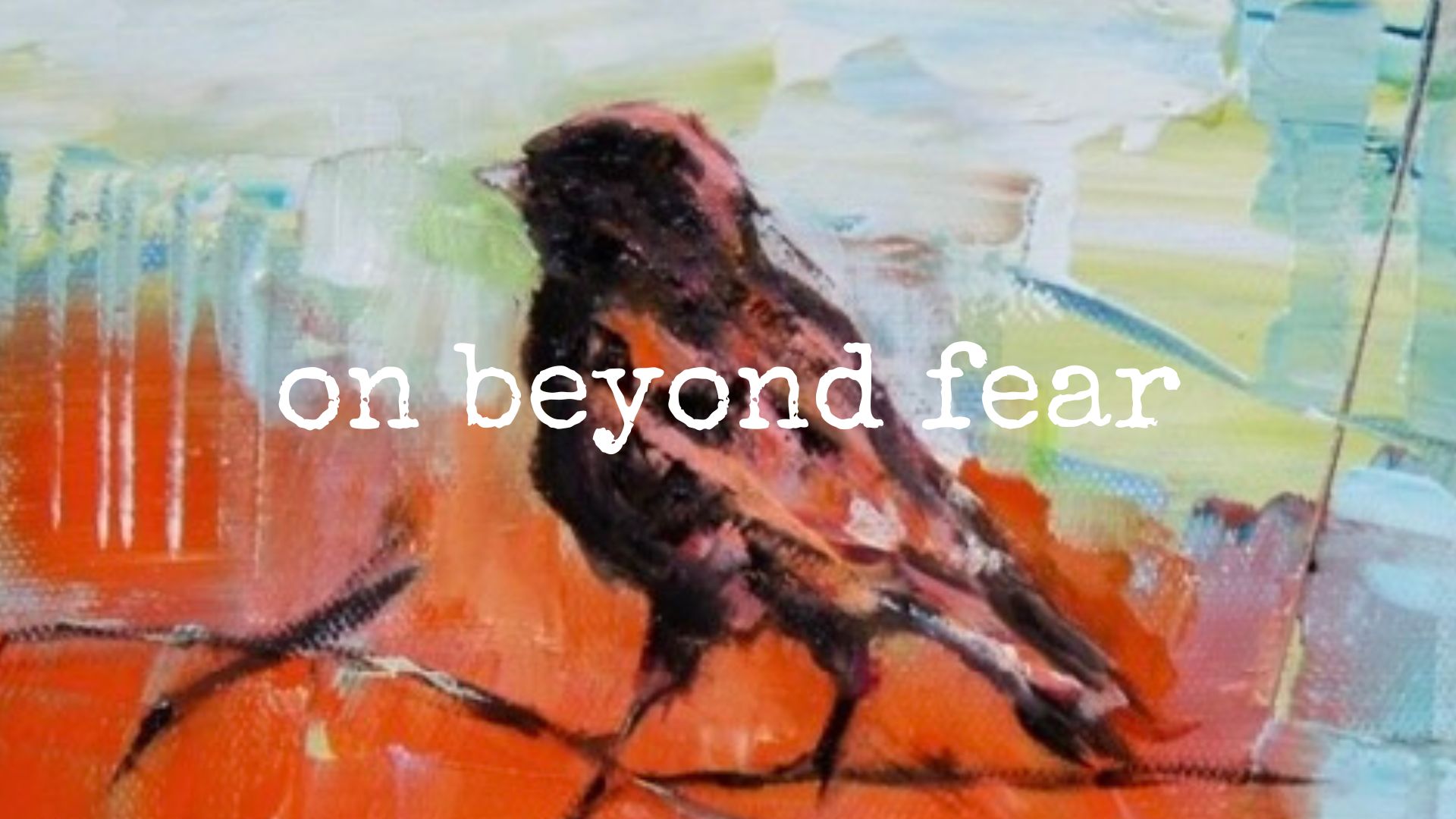
on beyond fear
In the midst of earthquakes and forest fires and wars and our continued national meltdown, I worked to come to terms with the continued admonition to not be afraid that shows up in the passage for last Sunday. Here’s how that worked out.
______________________________
Last weekend Ginger and I were in Durham, North Carolina for the memorial gathering for our friend Jenny who died in late February. Last Saturday would have been her forty-eighth birthday. Since we were going to be in Durham, we also took some vacation time on either side of the gathering, and we made it a point to put some distance between us and the news that we usually try to keep up with, so it was on the way home that word of the horrific earthquakes in Venezuela caught up with us.
I felt a tremor one time when I was a boy living in Zambia. It happened while we were at school, and it was not severe, so it was more of a curiosity than a catastrophe. I cannot begin to imagine what it feels like to literally have your world come crashing down on top of you.
We were catching up with my mother-in-law Rachel yesterday afternoon, and our conversation meandered until we ended up talking about what kind of natural disaster most frightened us and which was the easiest to live with. Earthquakes topped the list as most dangerous because there’s really nowhere safe to go when they hit. Tsunamis were a close second. I am fearful of tornadoes because they are so unpredictable in both their path and damage. Floods are right up there as well. The more we talked, we decided blizzards were the best kind of storm because the snow just stacked up and you could shovel it off after.
(And now you have a glimpse into life at our house, which may frighten all of you a bit.)
Fear is one thing when we are talking about hypotheticals—what if we would do if we were in an earthquake, for instance—and another thing when that which frightens us is real and present. Fear is also a word that shows up at several key points in Matthew’s gospel, usually in the context of one of God’s messengers saying, “Don’t be afraid because God is with us.”
I know it’s probably not a good practice to second guess an angel—or Jesus—but my experience is telling someone to not be afraid generally doesn’t do much to calm their fear. As we talk about what frightens us, or the daunting things Jesus mentions in our passage today, it’s not so much about not being afraid as it is about moving through and beyond our fear. Our trust in God reminds us that fear is not the last word. Love is.
Our passage picks up where we left off a couple of weeks ago. Jesus was sending out his followers on their own. When we looked at the first half of the chapter two weeks ago, we talked about the difference between a crowd (those who just gather) and a community (those we come together in intentional relationship). I said that Jesus didn’t send his followers out to do big dramatic things. He told them to go into people’s homes, to see what they needed, to love them in ways that met those needs.
We skipped a few verses in which Jesus told them it was going to be tough, but they already knew that. They lived in a place under the crushing rule of the Roman Empire, and they were hanging out with someone who kept talking about how to bring that empire to its knees, not with power but with kindness. Even so, Jesus turned to them and said, “Don’t be afraid of those people.” What follows those words is this long passage that moves back and forth between warning and comfort, between calling and compassion, all the time reminding his disciples of God’s abiding presence.
There are four particular images in Jesus’ words I want to touch on this morning. The first is one that has always intrigued me: the sparrows. Jesus said,
Aren’t two sparrows sold for a small coin? But not one of them will fall to the ground without God knowing about it already. As for you, even the hairs of your head are counted. Don’t be afraid. You are worth more than a whole flock of sparrows.
As far as the hair counting goes, I’m afraid that ship has sailed, but when it comes to the little birds, Jesus doesn’t say God catches them when they fall, only that God knows about their plight. God is with them, just as God is with us, as Matthew has underlined again and again. Our trust in God doesn’t mean we will be free from suffering. It does mean that we are not alone in it. And though these are words that have offered many individual comfort, remember Jesus was sending them out together to create community. God is with us and we are with each other.
We created that kind of community when our little group of family and close friends gathered at Motorco Music Hall in Durham last Saturday to remember Jenny and take care of each other. The venue is an independent concert venue where Jenny and Lee, her husband, had seen some of their favorite bands, and we talked and cried and laughed as we shared our memories and talked about the fingerprints she had left on our lives. The time did not make our grief disappear, nor did it bring Jenny back, but we listened to each other, we shared our suffering, which are some of the ways we move through our fear.
The language about not being afraid to leave your father and mother behind is the second image that catches my attention. Though the word family has remained across cultures and centuries, what the word means has changed. The family structure of first-century Palestine was quite different from what we think of in twenty-first century America. Still, what Jesus was saying was when it comes to the community of God, family is bigger than our biological relatives. And choosing a life of trust in God may lead us to make choices about who we include that cause rifts in our families of origin because we break traditions or make difficult choices.
These days, we sometimes talk about chosen family as those whom we have come to love in deep ways but are not relatives. That is also part of what Jesus was saying, along with the notion that if our families reject us for living truthfully, we are never outside of the family of God. God is with us and we are with each other.
The third image is about picking up our crosses.
When we hear those words, we think about Jesus’ death, but long before that happened, Rome crucified people for all kinds of things. Those who heard Jesus’ words would have been all too familiar with the gruesome death of the cross and the way Rome used it to make examples of people who didn’t fall in line with the Empire. Jesus then went on to say we have to lose our lives to find them, also familiar words to many, though not always easy to understand.
Maybe the last image will help.
After all of these big demanding images of the cost of discipleship, Jesus said,
“I assure you that whoever gives even a cup of cold water to these little ones, because they are my disciples, will certainly be rewarded.”
He ended his words where he began, talking about how we build community. And we do that—no, we do big things with small actions.
One more Durham story. Last week, Ginger and I were in a part of the city that runs into Raleigh, which is to the east of Durham. That part of town is filled with shopping centers on the one hand and the Research Triangle Park, which holds all kinds of pharma and tech corporations. Ginger had an earache and needed to get it checked at the Minute Clinic. We made the appointment and had an hour to kill, so I found a local coffee shop about three miles away. We drove away from the big stores down a wooded road to the NoRa Café. The small coffee shop was kind of hidden from the road. Inside we found a community gathering place, littered with books and games. The coffee was excellent and the pastries were homemade. We had a great time.
As we were leaving, I said to Ginger, “Here’s what I love about this place. The people who work here are doing great work. They love what they do. They are working hard. And, unless you happen to live in the neighborhood or know where Leesburg Church Road is, you would miss it. They aren’t vying for world domination. They just want to be good neighbors. That’s how you build a world.”
Though I’m not sure Jesus ever had a latte, I think that is what he was saying about the cup of cold water offered to the little ones, the forgotten ones, the ones around us. Don’t be immobilized by the fear of forces we can’t control. Move beyond your fear so you can see the faces around you waiting to become chosen family.
May we be those who pay attention to the news but do not succumb to the privilege of despair. May we be those who have a grasp of all that is wrong and damaging, but who also choose to trust that fear is not the last word. May we be those who share our suffering as a way to tighten the bonds between us, doing the small things well so that love can truly take hold. Amen.
Peace, Milton



Thank you, Milton! This is so helpful to remember. I zoom weekly with a group we call Looking for Hope. Some of us are near to despair. I will share your words with them next time we meet. They are very encouraging! Bless you!