an inefficient God
When it comes to the parables of Jesus, the various people who have translated the Gospels into English took upon themselves not only to translate the words but also to give us guidance with headings for significant stories. None of those is in the original manuscripts, which is also true of chapter and verse numbers. There is nothing wrong with the headings in and of themselves, and I am sure the translators all meant well and were expressing their understanding of the text, and there is often more than one way to understand the story—particularly with the parables.
Today’s parable is a good example. The Revised Standard Version, which is our pew Bible, titles it “The Parable of the Sower, leading us to believe it is mainly about the farmer who is out sowing their seed. J. B. Philips’ translation, which was done by a New Testament scholar in the 1950s, titles it “The Parable of the Seed,” which pulls our gaze away from the one sowing to what happens to the seed when it hits the ground. The Common English Bible, which is a 21st century translation, calls it “The Parable of the Soils,” calling us to look at the four types of ground as the heart of the story.
These various attempts at understanding the story help to remind us that a parables were not allegories where everything in the story had a direct connection to something in reality; they were a kind of teaching device, riddles of a sort intended to make people think, so it’s no surprise that our translators, as well as those who heard the parable when Jesus first told it, struggled to understand what the parable was about, or latched on to one idea and said, “This is it!” Jesus wanted people to wonder, to ask questions, to dig deeper into the meaning and see what they—what we—could discover.
This parable was the first in a whole string of stories Jesus told to illustrate how God moved and worked in the world. Throughout the gospels, Jesus told parables that started just like this one—the realm or economy of God is like . . .—and then Jesus would talk about farms, or pearls, or mustard seeds inviting his listeners to use their imagination when they thought about God because God is the ultimate parable of sorts, and by that I mean we can’t really explain God. We can trust and listen and follow, but God remains full of surprises. As one of my favorite hymns says,
for the wonders that confound us
for the truths that still confound us
thanks be to God.
In that spirit, my intent this morning is not to explain the parable. Deciding I have a clear indication of what it exactly means that I can pass directly isn’t much help. Instead, I want to offer some various viewpoints, bouncing off of the titles I mentioned, as a way of letting the parable open our hearts to a deeper conversation about who God is and the kind of relationship God invites to share.
So let’s start with the sower. The farmer.
Many of us are gardeners. If we get a pack of seeds, it often comes with instructions on how to plant it so that we have the best chance of getting vegetables. Some of those instructions include whether or not to plant it directly in the soil or to start it in a greenhouse or somewhere until they become seedlings. We worry about temperature and how wet the soil, not to mention what kind of soil we have to contend with—and not every plant likes the same thing. We plant seeds in order to harvest vegetables.
So when it comes to this parable about a farmer sowing seed and that seed falling on lots of different kinds of soil, the first question seems to be, why wasn’t the farmer more careful about how they sowed their seed? If the point of sowing is to reap a big harvest, wouldn’t the farmer be more efficient?
If we read the story as “The Parable of the Sower,” it becomes a parable about the character of God, about God’s economy, God’s community, and God’s extravagant generosity. We opened our service singing the hymn “Praise to the Living God.” We could go through our hymnal and find other songs written to highlight God’s attributes. I am willing to bet we won’t find a singing hymn extolling the efficiency of God.
That’s not how God works. God is extravagant, not efficient. Look at the wild flowers, at the fact that we are still discovering types of plants and insects that are new to us, that the universe expands beyond our imaginations, that there are about forty-seven shades of green in the forests that surround us. God is not efficient; God is extravagant. God knows there is more than enough love to go around.
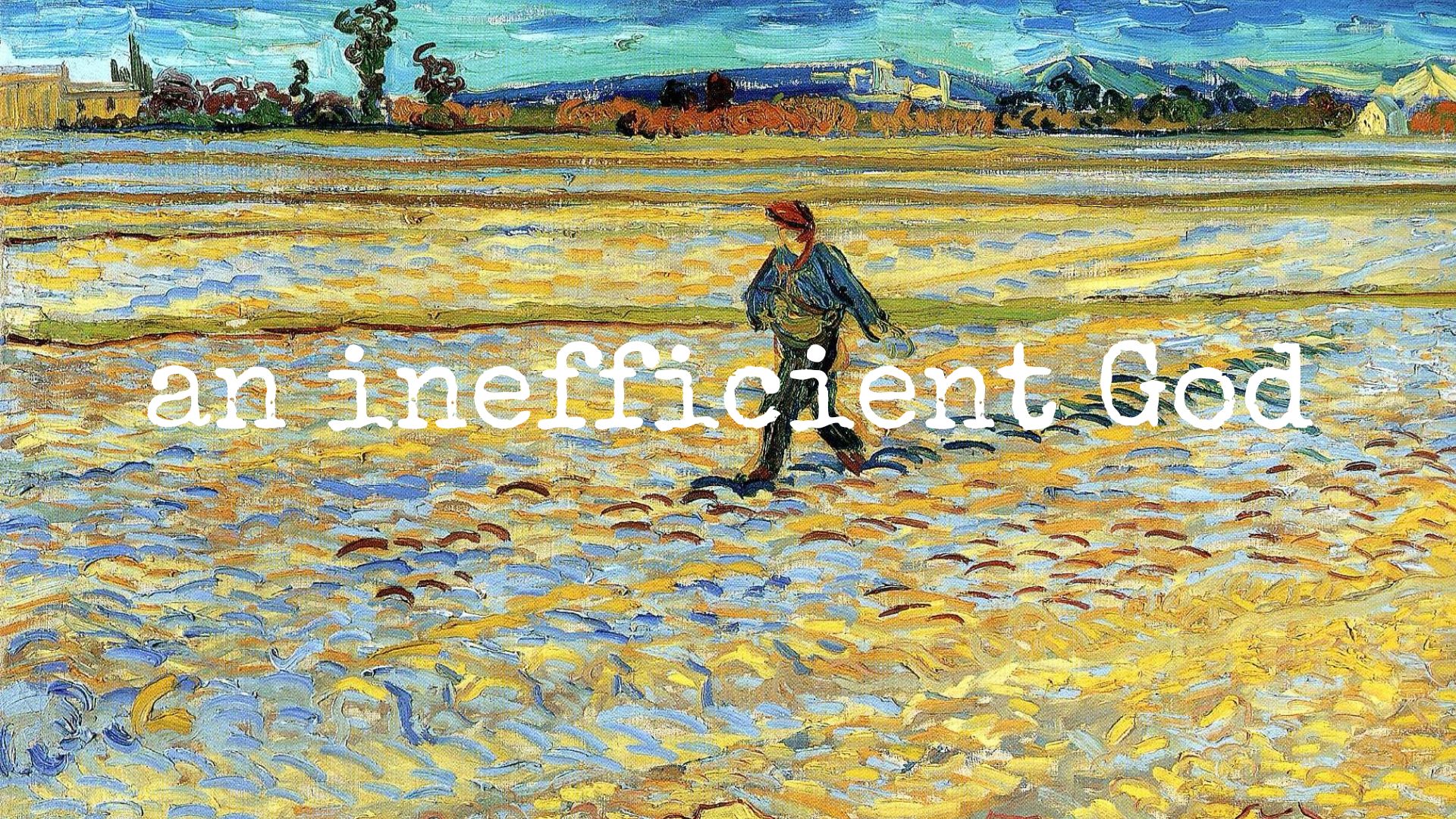
In our parable, the one who went out to sow seed is an odd farmer because the point or their sowing was not to maximize the harvest, but to sow as much as possible, sowing the seeds in every direction.
Which then begs the question, “What is the seed?”
All Jesus said in his breakdown of the parable is the seed is “the message (or the word) about the kingdom,” (the economy or community of God). It’s not just one word. We have to go back to all we have been reading in Matthew’s gospel: how Jesus continued to show how God is with us and we are with each other; how Jesus sent his followers out to feed people, to help those were sick, to break down barriers, to fight the oppression of the Empire with love passed hand to hand. The seed is not a speech or a formula; it is a way of being in the world that echoes the prophet Micah:
What does God require of us but to do justice, love kindness, and walk humbly with our God.
Justice, mercy, and humility are not in short supply in God’s economy. Love is a seed we never run out of. We can sow those seeds everywhere. Like the sower in the parable, we may have our hopes that the seed with take hold wherever it lands, the point is not the harvest, but the sowing. Kindness and justice are not investments intended to bring in a good return; they are how we spread the extravagant love of God.
And that brings us to the soils.
It is tempting to see the soils as categories of people and the way they respond to God. Of course, when we do that, we most likely imagine we are swinging examples of the good soil. I mean, look at us! It is also tempting to think that those labels are at least semi-permanent. Bad soil is bad soil.
Let’s not be tempted by either of those. Instead hear the words of Michael Marsh, an Episcopal priest who posted a sermon that was helpful to me.
“It’s easy and tempting to categorize ourselves and others as one of the four types of soil in today’s parable – hardened, rocky, thorny, and fertile. What if they aren’t categories of people but aspects and ways of being in each of our lives? What if we all have parts of ourselves that are hardened, rocky, thorny, and fertile? What if the four soils are descriptive of how we live and relate to God, others, and ourselves? Maybe the four soils aren’t judgments but diagnoses, information to be considered.”
His words give us other questions. What if we hold some of all those soils, the way our yards and gardens do? What if the soils are less about how we always are, but also good pictures of how we can be at different times in our lives, depending on our circumstances or emotional state?
Sometimes, when love comes to find us, are hearts are wide open and it can easily take root. Other times, if we are hurt or grieving or angry, we may choke it out or harden ourselves to its presence. As Marsh says, Jesus wasn’t issuing a judgment as much as offering a diagnosis: here’s how things go sometimes; God’s love shows up at moments when we are not ready or able to accept it, but that doesn’t mean the love quits coming. The sower keeps sowing, throwing out love in every which direction as though there is an inexhaustible supply (which there is) in hopes that it will take root in us so that we, too, can grow into extravagant lovers of our world.
I quoted my favorite hymn earlier:
for the wonders that astound us
for the truth that still confounds us
but I left out a line that is worth repeating here.
for the wonders that astound us
for the truth that still confounds us
most of all that love has found us
thanks be to God
It doesn’t really matter how we title the parable, or what most catches our eye—the sower, the seed, or the soils—the heart of the story stays the same: in the economy of God, there is an inexhaustible supply of love and our extravagant, wonderfully inefficient God keeps sowing those seeds of love in our lives no matter the circumstances in hopes that we, too, might grow into extravagant lovers of our world. Our extravagant, inefficient God is with us and we are with each other. Thanks be to God. Amen.
Peace, Milton