Home Blog Page 97

lenten journal: linger

When I sent out the call for words that might be a part of my Lenten Lexicon, my friend Beth sent the word “linger.” I love the word. The online dictionary gave three definitions:

stay in a place longer than necessary;
spend a long time over (something);

be slow to disappear or die.

Since last night I have stayed longer with and spent a long time over a song that found me many years ago. When I lived in Fort Worth I spent almost as much time perusing the record and CD bins at Sound Warehouse as I did at my own place. New music came out every Tuesday, so I usually dropped by on my way home from work to see what had arrived. On August 22, 1989 I found two records that have been a part of the soundtrack of my life ever since: Shawn Colvin’s Steady On and David Wilcox’s, which may be the best title for a first record ever.

The last track on the Wilcox record is a song called “The Kid.” From the first time I heard it I was captured by the longing, hope, adventure, and sadness in the song. There’s a burning inside when I listen to it, a sense that some ships have sailed and yet there are others still to come. I’m not done just yet.

I’m the kid who ran away with the circus
now I’m watering elephants
but I sometimes lie awake in the sawdust
dreaming I’m in a suit of light
late at night in the empty big top
I’m all alone on the high wire
look he’s working without a net this time
he’s a real death defy-er

I’m the kid who always looked out the window
failing tests in geography
but I’ve seen things far beyond just the schoolyard
distant shores of exotic lands
they’re the spires of the Turkish Empire’s
six months since we made landfall
riding low with the spice of India
through Gibraltar, we’re rich men all

I’m the kid who thought we’d someday be lovers
always held out that time would tell
time was talking, I guess I just wasn’t listening
no surprise, if you know me well
as we’re walking toward the train station
there’s a whispering rainfall
across the boulevard, you slip your hand in mine
in the distance the train calls

I’m the kid who has this habit of dreaming
sometimes gets me in trouble too
but the truth is, I could no more stop dreaming
than I could make them all come true

Who knows how many times I’ve listened to the song over the years and sung along, particularly when it comes to sailing around Gibraltar. I love the image of passing the rock with such a sense of triumph. And I love the whole idea of saying, “Remember the kid who sat staring out the window?— that’s me”—much like the kid in Guy Clark’s “The Cape” (which I have referenced more than once on this blog):

old and grey with a flour sack cape tied all around his head
still climbing up on the garage and will be till he’s dead
everyone around him said he’s acting like a kid
he did not know he could not fly and so he did

Sound Warehouse may not be here any more, but iTunes has a feature that says something like “customers who listened to this also bought . . .” that is as close to being a digital equivalent to digging through record store bins as they can get. One of the names that popped up under someone I was listening to was Buddy Mondlock, who happens to be the one who wrote “The Kid” all those many years ago. I found his version and was surprised to find a verse I had not heard before—and that doesn’t show up on anyone’s lyric sheet, including Buddy’s website. It came right after the verse about the circus.

I’m just the kid who fell asleep at the movies
snoring right through the final scene
that’s okay ‘cause I was right there with Bogey
side by side in the pouring rain
it’s our last chance to make a getaway
but it looks like I’m bleeding
take them with you I’ll hold them off
they won’t get by me while I’m breathing  . . .

I would love to know what made him quit singing it. He doesn’t say a word about it on his website, but he does mention that he co-wrote a song called “The Dark” with the aforementioned Guy Clark, and it’s another one I love, which turned my lingering into meandering.

in the dark you can sometimes hear your own heart beat
or the heart of the one next to you
the house settles down after holding itself up all day
shoulder slumps, gives a big sigh
you hear no one’s foot fall in the hall
that drip in the kitchen sink marking time
june bug on the window screen can’t get in but he keeps on trying
one way or another we’re all in the dark

fireflies, sparks, lightning, stars
campfires, the moon, headlights on cars
the northern lights and the milky way
you can’t see that stuff in the day
when the earth turns its back on the sun
the stars come out and the planets start to run around
now they call that day is done
but really it’s just getting started
some folks take comfort in that

and how dark is it
it’s too dark for goblins
and how dark is it
it’s so dark you can smell the moon
how dark is it
it’s so dark the wind gets lost
how dark is it
it’s so dark the sky’s on fire
how dark is it
it’s so dark you can see Fort Worth from here

Tonight, thanks to a song that has lingered in my life and found me again, I can see Fort Worth from here—all the way back to the record store and a CD I found ten days after Ginger and I became engaged. Now less than two months from our twenty-fifth anniversary I am grateful she has lingered with me and the dreams still keep coming.

Peace
Milton

lenten journal: blessing

I preached today at West Raleigh Presbyterian Church. My friend Lori Pistor is the Interim Pastor there. Those good people are reading my book for Lent and invited me to help kick things off. It was a wonderful day. Here’s what I had to say.

“Blessed From the Beginning”
A Sermon for West Raleigh Presbyterian Church
Mark 1:1-15
February 22, 2015

I’d like to start this morning with a question much like I asked the children earlier: what comes to mind when I say the word blessing? You don’t have to answer out loud; just hold the question for a moment . . . .

The dictionary says the word has to do with “God’s favor,” with “making something holy,” “to call on God to protect,” and, of course, “the prayer said before meals.” All of those are true and I think there is something missing in those definitions that is a vital part of the way we find our places in this world. Blessing someone is a way of saying, “you are good, “you are worthy,” “you are enough.” It’s a way of reminding one another we are wonderfully and uniquely created in the image of God and worthy to be loved.

We are all looking for a blessing.

As I started thinking about what it means to give and receive a blessing, my mind went first to the Seinfeld episode about Festivus, Kramer’s alternative to Christmas and Hanukkah. Some of you may remember. George’s father latched on to the holiday and everyone showed up for the celebratory feast. After dinner, Mr. Constanza said, “And now it’s time for the Airing of Grievances, which is when I go around the table and tell everyone of you how you have personally disappointed me this year.”

Blessing would be at the other end of the continuum, as in the words Jesus heard during his baptism: “This is my beloved child in whom I am well pleased.” Blessing.

Both our passages deal with water, wilderness, and blessing this morning. After forty days of rain, and then all the time it took for the water to recede, Noah and his family let the animals out of the arc and saw the rainbow—God’s sign of covenant and blessing.

Jesus came to the Jordan to find John, who was baptizing people as a ritual of forgiveness and reconciliation, preparing them for the coming Messiah. In the other gospel accounts, John was puzzled that Jesus came to be baptized. What Jesus came for was the blessing: you are my beloved child . . . .

Both blessings come in the midst of barrenness, of wilderness, and both are followed by times of trial and difficulty. Blessing is not simply a free pass or a sign of favoritism; it is a mark, a claim on our lives: you are mine and I love who you are. For Noah it was the beginning of building a new world. For Jesus, it was the beginning of his ministry. From the moment God imagined us into existence, we are loved. We begin with a blessing and, much like our stories today, it is followed by trial and difficulty.

Here is one of the ways in which Christian community is essential: we have the power to bless one another, to remind one another of forgotten blessings, or perhaps to offer the first blessing someone has ever really heard. Let me give you an example.

When I was in tenth grade, my family moved to Fort Worth, Texas. My parents were missionaries and we had lived in Africa. We were on a year’s leave and went back to Texas where our families were. I was fifteen, five-two, and I felt round and out of place. I can remember sitting on the edge of the bed in the room of the rent house and looking in the mirror and wishing I could be someone else—anyone else.

The youth minister at the church we attended was a man named Steve Cloud. He was everything I was not: tall, handsome, athletic. We had a Wednesday evening youth gathering at the church, so after school I would walk from the high school to the church and hang out until time for youth group. One afternoon he said, “Flash—which was his nickname for me—let’s go shoot some baskets.” We went out on the church parking lot where someone had nailed a backboard to one of the light poles. I shot and missed everything. The ball rolled across the parking lot away from us and I said, “You go get it” with a less than kind tone.

He chased down the ball and came walking back toward me. “Let’s go back inside,” he said. As we crossed the parking lot, he put his hand on my shoulder and said, “Flash, one day Trish and I are going to have kids, and when we do, I hope they turn out exactly like you.”

Blessing. I think I made it through high school on his words. And yet, if I could find Steve today my guess is he would not remember that story. He was not trying to create a life-changing moment; he was simply being attentive and being himself and working to find a way to let me know I was loved. It worked.

The opening line of Mark’s gospel reads, “The beginning of the gospel of Jesus Christ.” I had always thought it was simply the opening sentence: here’s the beginning and he went on to describe John’s arrival and Jesus’ baptism. One Sunday many years ago I heard a sermon by a colleague named Skip Waterbury who said that first line was not an opening sentence but a title: the entire account of Jesus’ life was the beginning of the gospel; we are the continuation of that story. As Jesus went through life looking for ways to offer healing words and touches, so are we to heal. As Jesus proclaimed the good news to those flung to the edges by the centrifugal force of life, so are we to tell the good news. As Jesus blessed those who had been told for far too long that they were not good enough, that they didn’t belong, that they were sinful because of who they were, so are we to bless. We—the Body of Christ—are the incarnation of God’s love in these days. The gospel story continues in what we do and say.

One of the people who keeps reminding me I am loved is my friend Burt Burleson. We have known each other since college days. Several years ago, when he was pastoring a church, he called one day and said, “I need a poem for Sunday about blessing,” and I wrote one and sent it to him based on an experience I had sitting in Boston traffic one afternoon. It’s called “Daily Work.”

The crush of afternoon traffic finds me
in an unending stream of souls staring
at the stoplight. From my seat I can see
the billboard: “Come visit the New Planetarium
You Tiny Insignificant Speck in the Universe.”

When the signal changes, I follow the flow
over river and railroad yard, coming
to rest in front of our row house, to be
welcomed by our schnauzers, the only
ones who appear to notice my return.

I have been hard at work in my stream
of consciousness, but the ripples of my life
have stopped no wars, have saved no lives —
and I forgot to pick up the dry cleaning;
I am a speck who has been found wanting.

I walk the dogs down to the river and wonder
how many times I have stood at the edge
hoping to hear, “You are My Beloved Child.”
Instead, I skip across life’s surface to find
I am not The One You Were Looking For.

I am standing in the river of humanity
between the banks of Blessing and Despair,
with the sinking feeling that messiahs
matter most: I am supposed to change
the world and I have not done my job.

Yet–if I stack up the stones of my life
like an altar, I can find myself in the legacy
of Love somewhere between star and sea:
I am a Speck of Some Significance.
So say the schnauzers every time I come home.

The story of creation begins with God saying, “That’s good.” The story continues in the life of Jesus with God saying, “You are mine and I am pleased.” Here today, the story continues calling us to find every way we can to let one another know we are loved, we are really, really loved. May we take every chance we get to bless one another. Amen.

Peace,
Milton

lenten journal: why

In my days years ago as a hospital chaplain, I spent a lot of time working around the word why. In the context of illness and terminal diagnoses, the word was neither helpful nor hopeful. Why did I get cancer? Why is my father dead? Any answer comes up lacking because it seems to fall toward either blame or platitude. I didn’t know what to do with the word why.

Somewhere along the way in my first year of Clinical Pastoral Education, one of my supervisors offered something that helped: instead of asking why, he said, we do better to ask, “What does this mean for my life?” Instead of dwelling on the cause, look to the consequence, or even the possibilities. As someone in my early twenties who was not particularly acquainted with grief, the idea gave me language that helped me connect with people in the midst of pain I didn’t understand. Down the years since, I have still found it helpful to ask, “What does this mean for me?”

During my first year at the hospital, I met a woman who was dealing with a recurrence of breast cancer. She was thirty-two. Over the next couple of years, she was in and out of the hospital. I was assigned to the oncology floor and so I got to know her and her husband; they told me stories of their two children who were five and seven. The treatments were not successful and she died at thirty-five. She made meaning to the very end. One Friday morning as I visited, she asked if I would come by at the end of the day, which I did. We both knew she was in her last days. She wanted to say goodbye and was intentional about asking several of the staff she knew well to come and see her. As we talked she said, “I found out I had cancer my sophomore year in college and I had to drop out for a year to go through treatment. It was during my last year at school I met my husband. I’d do it all again if it meant I got to be with him.” That’s what it meant to her. At the end of our time she said, “I may not be here when you come back on Monday. Thank you and goodbye.” Early Sunday evening her husband called to tell me she had died.

I don’t know why.

A few months ago, I first learned of a TED Talk given in 2009 by a man named Simon Sinek. He is a business person and thinker and pretty interesting person. The talk grabbed me because he did something different with the word why. He made it something worth asking. His thesis is our “why” is at the core of who we are: our passion, our story, our purpose or cause for doing what we do. From the why comes the how—how we do what we do, and then the what—what we do or what we make. If we want to connect with others, if we want others to share our passion, we must connect them with the why or else they won’t get it.

The word why is not the problem—it’s how we use the word that makes the difference. “Why am I here?” is another way of asking “What is my purpose? What moves me to act? How can I make a difference? What does it mean to be me?” When we share our whys—what we believe, who we feel called to be—we offer invitations to relationship, to connection, to community. Sinek pointed out that Martin Luther King Jr. didn’t have an “I Have a Plan” speech; he had an “I Have a Dream” speech. And people followed.
The word why takes me one other direction. I can’t hear it without thinking of Shawn Colvin’s song, “I Don’t Know Why.” The middle verses of the song say

I don’t know why
but somewhere dreams come true
and I don’t know where
but there will be a place for you
and every time you look that way
I would lay down my life for you
I don’t know why
I know these things, but I do

I don’t know why
but some are going to make you cry
and I don’t know how
but I will get you by, I will try
they’re not trying to cause you pain
they’re just afraid of loving you
I don’t know why
I know these things, but I do

Underneath her questions is a sense of solidarity, much like Sam Cooke singing, “Don’t know much about history . . . “—they both offer the hope of love in the midst of uncertainty.

but I do know that I love you
and I know that if you love me too
what a wonderful world it could be

The why we have to share with the world is we are here to love one another, every last one another, which means it could be a wonderful world.

Peace,
Milton

lenten journal: jazz

I can’t claim to know very much about jazz. I did see Miles Davis perform once—and he played the entire show without ever speaking to the audience. He did speak on other occasions and said things like this:

cook460Don’t play what’s there, play what’s not there.

Sometimes you have to play a long time to be able to play like yourself.

One night long ago I was with my friend Billy in Manhattan and we saw a flyer that said Toots Thielemans, McCoy Tyner, and Stanley Clarke were playing in a club called Fat Tuesdays; Billy said we had to go. It was years before I understood what I had been a part of that night. It was amazing.Over time I’ve learned a bit here and there. I love to hear Thelonious Monk play “Abide With Me” or Dave Brubeck “Take Five.” I have owned a few records by Charlie Parker, Duke Ellington, and Charles Mingus, but I don’t know the terrain as well as several of my friends.

What I does grab me is the spirit of jazz: the improvisation, the trust, the abandon. The parallel for me is improvisational comedy in the sense that both require a great deal of preparation for what they don’t expect. I saw Wayne Brady several years ago. His performance began with one of his staff coming out a few minutes before the show with a flip chart and a magic marker. He asked for forty words from the audience. As we shouted things out he wrote them down, one to a page. When he was finished, the drummer began playing a rap rhythm and Brady entered and began to freestyle as his staff member flipped the pages revealing the words we had written one by one. Brady never missed a beat. He had never seen the words before, but he had prepared. He knew how to trust himself, to step into the moment, to give it everything he had, so he made it look easy.

Anyone can make the simple complicated. Creativity is making the complicated simple — Charles Mingus

Good jazz musicians are so steeped in the basics that they are ready to not only respond to the unexpected, but to welcome it, in large part because they are good listeners. They are paying attention to what those around them are doing, listening to the invitations coming their way and responding with offerings of their own. Improv, at its best, is not about “It’s my turn” as much as “here’s what I can contribute.”

The most important thing I look for in a musician is whether he knows how to listen. — Duke Ellington

Jesus would have been a great jazz guy because improv was his lifestyle. I’ve been reading through the gospel of Mark and noticing once again how much of what Jesus does happens in the context of interruptions. He didn’t meet the disciples for breakfast to have them say, “So, at nine we need to be at the gate to heal the blind man, then there’s a leper at ten, you have a bit of free time until we feed the five thousand at noon, then we’ll scoot across the lake for your afternoon sermon, and then you’ll spot Zacchaeus in the tree and go to his house for dinner. Oh—and on the way a woman will touch your cloak and she’ll be healed.” Instead, he set out each morning listening to the day, to the disciples, to those he bumped into, to those who followed or gathered around, and then he responded to what he saw and heard. When their encounter was over, they were changed by the melody he offered them.

It’s the group sound that’s important, even when you’re playing a solo. You not only have to know your own instrument, you must know the others and how to back them up at all times. That’s jazz. — Oscar Peterson

That’s faith—life, too: “you must know the others and how to back them up at all times.” I think of the solo performances I saw today: the person who took my order at lunch, Ginger sitting next to me at the coffee shop as we worked on separate projects, my brother calling to catch up on life, the guy at the Costco pharmacy who somehow manages to remember my name—along with everyone else in line. How did I back them up? How did I honor their moment? I’m not speaking of some sort of grand gesture. Was I attentive? Was I present? Did they know I was listening?

Jesus leaned hard on the privileged people of his day to pay attention to the poor. When the woman broke the alabaster jar on poured perfume on Jesus’ feet, they went ballistic. Did he have any idea how much money was wasted? He just smiled and asked if they could hear the melody of her heart enough to back her up.

The memory of things gone is important to a jazz musician. Things like old folks singing in the moonlight in the back yard on a hot night or something said long ago. — Louis Armstrong

Our faith leans hard into the past. The writer of Hebrews said faith was “the evidence of things hoped for, the substance of things not seen,” but that future is tethered to the great cloud of witnesses who have already walked this planet and have stacked up stones to remind us to keep telling the stories. When we pass the bread and cup, we do so with all of those who have come before us. Just as we back one another up in this life, we must also keep reminding ourselves that the band, if you will, has been playing for far longer than our part of the song. To remember is to also embrace the grief over what and who have been lost. Those days are gone. Those people are gone. We are here. Together.

abide with me; fast falls the eventide;
the darkness deepens; Lord, with me abide;
when other helpers fail and comforts flee,
help of the helpless, oh, abide with me.

Peace,
Milton

lenten journal: belonging

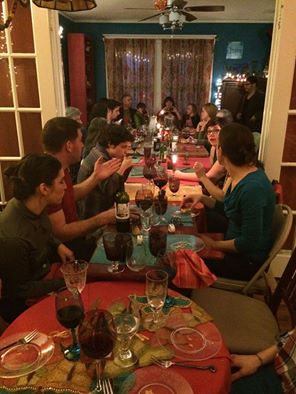
We gathered around our table tonight for another Thursday Night Dinner, which means we sat long after the food was finished to talk and tell stories. Somehow the conversation w10801861_10152557235479716_1499319343283768221_nound its way to one of the folks asking about those Christian sects that identified as “snake handlers.” His question and the answers that came from around the table reminded me of an experience I had as a boy.

We were on furlough from Africa and were in the mountains of North Carolina where Dad was to preach a revival for one of his seminary friends who was a missionary to the people back in the hills of Appalachia where he had grown up. The memories I have play like vignettes in my mind. I remember pulling up in front of old dilapidated houses and being told by my father’s friend to wait in the car as he went towards the door. On more than one occasion, the person inside came out with rifle drawn, wondering who the strangers were with very little intent to welcome anyone.

I also remember going to the service with Dad. Before the first one, Dad took my brother and I aside and said, “Boys, you’re going to see some things tonight that you’ve never seen before. Just stay together. Everything will be alright.”

When the time came for prayer in the service, all the men in the room—about thirty of them—came forward to the altar and grouped together. The pastor called on one man to lead them. No sooner had he said, “Dear God . . .” that all of the rest of the men began praying out loud, and loudly. I couldn’t understand much of what anyone was saying, but the room swirled with the emotion and spirit being generated by those praying. Some had catch phrases that seemed to circle around. I remember one man who said, “And the whole world” seven or eight times in a voice big enough for most of the world to hear. In my memory, the prayer went on for seven or eight minutes and then, by some unseen sign, they all got quiet except for the one who had started it all and he said, “In Jesus’ name, Amen” and they all went back to their seats.

When I finished the story, our guest said, “I didn’t grow up around organized religion and don’t really see the point of much of it. But I would kind of like to be a part of something like you described—that tribal sense of ritual and belonging. Too much of what passes for religion has a political agenda. That feels different.”

I have always been pulled by the verses in the Acts of the Apostles that talked about how those who were not a part of the burgeoning faith looked at those who were: “Look at how they love one another.” We don’t hear that much anymore. Paul admonished those to whom he wrote to “not forsake your gathering together.” Jesus’ last prayer was centered around one main idea: “make them one.” As I know I have said many times before, life and faith are team sports. At the heart of both life and faith is belonging. If we are not tightening the bonds and widening the circle, then we are missing the point.

I feel like I belong here in Durham because of the people around our table on Thursday night, because of someone calling my name walking down the street, because of conversations over coffee and beer, because of the shared experience of living these days together. I feel connected with friends down the years because we talk to each other in movie lines and song lyrics, because we have walked side by side through the valleys of grief and disappointment, because we have clung to the sustaining rituals of friendship. Lent, at its best, is not an institutional directive, but a relational connective: let us walk this road together towards the Resurrection. We are on pilgrimage—a modern day Canterbury tales—traveling side by side and telling stories to mark the time and tighten the bonds. When we get to the end, what will convince us most of all that Christ is risen will be our sense of belonging both to God and to one another.

Just stay together. Everything will be alright.

Peace
Milton

ash wednesday: dust

When I was in seminary, I pastored Pecan Grove Baptist Church, which was outside of Gatesville, Texas. To be more specific, the little white church sat next to a creek off of FM The word 'DUST' written on car rear windscreen following Saharan sand deposited in England by strong south easterly winds107 between Oglesby and Mound. Now you know right where it was, or is—it’s still there. When I went drove down from Fort Worth on the weekends, I stayed with Alene and J. T. Davidson. My brother was the music minister at Live Oak Baptist, which was further up FM 107 as it came into town. On the weekends he stayed with a man named Mike Poston. One Saturday afternoon I went up to visit my brother and Miller introduced me to Mike. When I asked him if he knew J. T. he said, “Know him! I help carry the dirt to make him.”

The story came to mind this evening as I read Ragan Courtney’s story about his experience as a young pastor on Ash Wednesday when he blurted out at the first one to come forward, “YOU CAME FROM DIRT AND YOU ARE GOING BACK TO DIRT.” I smiled along with him at the scene because it was not what he meant to say.
Dust, not dirt. We came from dust and to dust we shall return.

Dirt: any foul or filthy substance, as mud, grime, or excrement; earth or soil, especially when loose; something or someone vile, mean, or worthless; moral filth; vileness; corruption.

Dust: dry fine powdery material, such as particles of dirt, earth or pollen; a cloud of such fine particles; the powdery particles to which something is thought to be reduced by death, decay, or disintegration.

Though we may use variants of these words interchangeably, they are not theological synonyms. When we bow our heads and feel the thumb of the minister mark the sign of the cross in ash on our brows, the point of saying we are dust is to remind us of our impermanence, not our worthlessness. The dust, once infused with the imaginative love of God, sprang into being. We are born of love, and to love we shall return—that’s the larger story. Before there was any dust to form, there was Love. After all we know is gone and the universe has been swept clean, there will be Love. From Love we have come and to Love we shall return, dust and all.

Down the fifteen or sixteen millennia that Lent has been observed in one form or fashion, it has been accompanied by a lot of theology intended to remind us we are fundamentally flawed. We do not only sin, we are sinful. Damaged goods, almost from the start. Too easily, then, Lent becomes the season where we try to shed ourselves of what shackles us, hoping that our giving up will make us feel less like dirt. We are preparing for the Resurrection, for what can breathe new life into our tired bones and offer us hope beyond these dusty days. To focus on how we can shed ourselves on what shackles us is a good thing, but our worth as human beings is not at stake. We are wonderfully and uniquely created in the image of God and worthy to be loved. Period.

“To repent,” said Frederick Buechner, “is to come to your senses. It is not so much something you do as something that happens. True repentance spends less time looking at the past and saying, “I’m sorry,” than to the future and saying, ‘Wow!’”

We are dust, not dirt. We are temporary, more than tainted. We are beginning of focus not flagellation. Over these next few weeks, we are making room, creating space in our lives to acknowledge our griefs and losses alongside of our hopes and dreams. Life has not turned out as we expected, for most of us. Grief has become a primary color. We are in need of forgiveness for things we have done and left undone. And we walk these forty-odd days on our way to the Resurrection to allow the Spirit room to remind us we are more than dust: we are children of God.

I have always been drawn to John’s description of Jesus as he prepared to wash the feet of the disciples. He says, “Knowing he had come from God and was going to God, Jesus took a towel and washed the feet of his disciples.” I imagine that John knew Ecclesiastes 12:7—“and the dust returns to the earth as it was, and the breath returns to God who gave it—and I wonder if he was not illuminating a wider arc. Beyond the scope of dust to dust, there is God to God, Love to Love: the One who imagined us and breathed us into being is the One to whom we belong and shall return.

Dust, not dirt. Loved, not lost.

Peace,
Milton

ways of seeing

The weeks have slipped by since I last wrote. My silence has not been for lack of ideas. Sometimes, in the midst of the shouting from both screen and page over the various crises that have point of viewcome and gone, I have not felt the need to add my voice. The main reason, however, is my writing has been focused in other directions. I turned in the first draft of my next book (I love writing that sentence), which will be out in the fall. I have also been doing some work for my publisher that has afforded me different ways of seeing the words on the page as both a copyeditor and a curator of quotes for a devotional smart phone app.

As an author, I am creating something that wasn’t there before. I don’t know that I am saying anything that is completely new—in fact, I’m quite sure I’m not—but I am writing something that did not previously exist. The process is challenging, invigorating, frustrating, and despairing, depending on the hour. Regardless of the feeling in the moment, the overall arc—the point of view—is one of hope: I am working to contribute to the greater good, to foster community, to issue an invitation to connect. I want to write so that those who read can find resonance, to offer a way to look at the world that is filled with invitations.

As a copyeditor, the task is to correct, even to look for mistakes. I’m the one who checks for Oxford commas, who makes sure the writer knows the difference between that and which, who checks for spelling and punctuation. Though I manage to read the manuscript as I go, I am not looking to engage the author as much as I am just making sure he or she makes sense. My task is not relational. I don’t’ even deal directly with the writer. I like the work because it makes me learn the rules. I am a better writer from reading and righting what I find on the pages of others, and I’m glad it’s a side job because I weary of righting. I have to do it in short shifts because I get too focused on one or two errors and end up hunting for them. I remember the same dynamic from my days grading forty or fifty essays from my high school teaching days. To focus primarily on what is wrong for too long skews my vision. At the same time, my attention to their details offered them a chance to make things better. This time I didn’t have to grade them, just make corrections and comments.

The work on the devotional app has been like a treasure hunt. Once it’s up and running, a person can open the app on his or her phone and get a daily nugget of hope and encouragement. A sentence of support and solidarity. The publisher sent me a stack of books from their authors and invited me to go quote mining, which was a fun and fruitful exercise. Like the copyediting, I was not trying to take in the whole of what each one was saying, but this time I was looking for what they had done well. Instead of “look what you did wrong” it was “look what you said!” And I found much worth sharing.

To see the three points of view as metaphor continues to challenge me beyond the work itself. I am finding it helpful to pay attention to how I am looking at the world in a particular moment: am I creating resonance, correcting, or complimenting? Perhaps I need to notice if I only look at particular people or particular situations from one perspective. If someone feels the only way I look at them is as an editor, neither of us is getting a good look at the other. If someone feels I only pay attention long enough to get what I want from them, we are both losing out.

As Lent begins, and I begin my Lenten Journal for another year, I am mindful that paying attention to life means remembering to see in different ways on purpose. The Bible is filled with stories of people who were called to take a different look, to change their points of view. For that matter, so is most all of human history. To love, to grow, to forgive, to become all call us to new ways of seeing.

Open the eyes of my heart . . . .

Peace,
Milton

living invitations

“Living Invitations”
A Sermon for Pilgrim United Church of Christ, Durham NC
John 1:43-51
January 18, 2015

When I was a kid I thought Jesus was magic.

I’m not talking about the miracles. Somehow those made sense in their own way. The Messiah ought to be able to do miracles. I mean the super hero stuff in the scenes like the one in the account we read this morning where Jesus walked up and said, “Follow me,” and people just dropped what they were doing and walked off into the gospel. There’s another scene where, as he was preparing to enter Jerusalem, Jesus tells his disciples they would see a man with a donkey. He told them to say, “The Master has need of it,” and the guy would give them the animal. I was convinced it was some sort of messianic mind control. The disciples found the guy and said the words and then magically, robotically, the man went to the barn and got the beast, all the time muttering, “Master needs donkey, master needs donkey.”

I was talking to my dad about it one day, explaining my theory, and he said, “I always figured that Jesus just knew the people beforehand.”

Though he took away my magic messiah, what he offered in return proved far better for my burgeoning faith. Our conversation was the beginning of my seeing how few details there are in the gospel accounts and how much is left out: whole conversations happen in a sentence or two; sweeping changes come with the turn of a phrase. So it is with our story this morning. Even John, who can stretch out a story—half of his gospel takes place in the last week of Jesus’s life—moves quickly through Jesus’ calling of his disciples. Jesus finds Philip in Galilee and says, “Follow me,” and the next thing you know Philip is gathering up several others.

My favorite part of this account begins with Nathaniel’s skepticism. He asks, “Can anything good come out of Nazareth?” Philip echoes Jesus’s earlier words and says, “Come and see.” When Jesus sees Nathaniel, he says, “Here is truly an Israelite in whom there is no deceit!” and Nathaniel says, “Where did you get to know me?” as if to say, “Finally—somebody gets me!”

We come to this story in the middle of the short liturgical season of Epiphany. Unlike Advent, we don’t count these Sundays down to a big finish. We have no candles to light. Unlike Lent, we have no big theme or focus, no call to repentance or silence. Epiphany is the in-between time, the path of days from Advent and Lent, that mostly feels cold and ordinary. No magic. I’ve often wondered how the word itself became attached to the coming of the Magi, because I’ve never really understood what an epiphany—in the way I learned the word as a sort of “aha!” moment—had to do with a few people with odd gifts showing up late to the party. The church history answer is the coming of the Magi represented the “manifestation of Jesus to the Gentiles.”

One of the dictionary definitions for epiphany is “a sudden, intuitive perception of or insight into the reality or essential meaning of something, usually initiated by some simple, homely, or commonplace occurrence or experience.” The ordinary nature of Jesus’s interactions in our story this morning offers another answer. As Michael Rogness points out, “This text tells how it works: the Christian faith is passed from person to person. That’s how it started with Jesus, and that’s how it’s been for two thousand-plus years.” Our faith is shared most powerfully in the common occurrences of our daily interactions with one another.

I came across a cartoon last week titled, “Breakfast at Epiphany’s.” The line drawing showed people10420076_10205428715094455_1392760745701170587_n saying things like, “These eggs are amazing,” “It’s a caffeine miracle,” and “I finally understand hash browns!” A sudden perception of essential meaning from a common place experience. Dr. King talked people into walking and sitting down at lunch counters and boycotting buses to awaken us to the reality of racial injustice and to call us to come and see what we could do. Our world has been changed far less by grand gestures or sweeping decrees coming from the top down, and much more by one friend turing to another and saying, “Come and see what I have found;” by one person turning to another and saying, “Come and share what I have;” or “Come, let’s walk together.” As evidenced in the Incarnation, love is not an ideal or a proposition; Love has hands and feet. The revelation of Love is in the flesh. No magic. Just people—how did the dictionary say it?—simple, homely, or commonplace folks changing the world. Maybe homely goes a bit too far, but you get the idea. We find our way to Jesus—to love and to faith—through one another.

And it is through one another that we find our way to hope and joy as well. We live in days where we are offered examples of religious extremism and fundamentalism from those who attacked the cartoonists in Paris to those who reigned down on Duke this week for saying they would broadcast the Muslim call to prayer once a week. When all we are doing is shouting “No” in the name of whatever faith we profess, we are doing damage. Again, look at Dr. King and those with whom he worked. They were saying no to the injustice they saw, but that was not their primary source of hope. Martin found hope in saying yes to justice, yes to relationship, yes to love, yes to faith, even yes to joy. They marched on Washington singing, “Yes”—we shall overcome. Our call to follow Jesus is a call to be living invitations, whether marching for justice or walking down the halls here in our building.

As living invitations, may we be mindful we are not inviting people to be right or proper or correct. We are inviting people into relationship—with us, with Christ. We are inviting people to hope and faith and joy. We are inviting people to the messy work of community, to living out the commitment of life together on all the levels we can see. We are inviting one another to courage, to persistance, to compassion, to patience. We are inviting people to remember we are all wonderfully and uniquely created in the image of God and worthy to be loved. We are inviting people to the wonder of God that lives in the commonplace experiences of life together in Christ. May we be living invitations in all we do and say. Amen.

Peace,
Milton

wise and weary ones

photo by Leonard Beeghley http://leonardbeeghley.zenfolio.com
photo by Leonard Beeghley
http://leonardbeeghley.zenfolio.com

Christmas was gone
before they got to the manger,
camels and servants grumbling.

“We saw his star in the east,” they said.

Mary wondered why
a sign from God didn’t get
them there on time for the birth.

“You missed the angel choir,” she replied.

They knelt before the babe,
offering gifts and hopeful hearts:
“What matters is we made it.”

Peace,
Milton

christmastide: this day after

My friends, Burt and Julie, are celebrating the wedding of their son tomorrow. Several years ago, I wrote this poem remembering the birth of their daughter. Today seems a good day to look at it again.

this day after

Some time after seminary my
best friend, Burt, got married;
then a few more years and
they had a child. I remember
calling one day; he answered,
saying he was lying on the bed
looking at the baby. I asked,
“Do you ever look down and say,
‘You’re going to stay here?’”

Something about this day after,
this morning beyond the manger,
that reminds me God chose to
come into the world not fully
formed. Jesus looked up from
the straw much like Burt’s baby
from the bedspread, more
enchanted, perhaps, that he
could chew on his toes than

with what he would do later on.
I was two weeks old my first
Christmas; almost six decades of
Decembers have since passed
(twenty-five more birthdays than
Jesus had) and I couldn’t have
imagined that I would have to
span two centuries to get from
Corpus Christi to North Carolina.

Jesus considered lilies, cleansed
lepers, and chastised leaders who
thought they’d cornered the truth,
but not before he’d been a boy,
a teenager, a young adult; not before
he had increased in wisdom and
stature. And that first morning,
Mary might have looked and loved,
and said, smiling, “You’re staying.”

Peace,
Milton