I was driving to work yesterday and saw a sign in front of one of the storefront churches that inhabit our downtown neighborhood that said, “This is the year of great grace and great growth.” The rhythm of the words, when I said them out loud so I could remember them, pulled me towards writing a villanelle, which is a very specific form of rhymed poetry. (Think Dylan Thomas’ “Do Not Go Gently Into That Good Night” or Elizabeth Bishop’s “One Art.”) Here is what came from my encounter and effort.
Reminder
Caught by surprise by this statement of faith,
Drive-by wisdom from a church-front sign:
“This is the year of great growth and great grace” —
A slogan of hope I’m compelled to embrace,
As my grief-colored life undergoes redesign . . .
I’m caught by surprise by this statement of faith,
Black plastic letters, declarative case,
I hear more invitation than I do bottom line:
“This is the year of great growth and great grace.”
Though the scars left by sorrow are never erased,
My heart, ached with absence, can choose to incline
To be caught by surprise by this statement of faith,
Even as I keep driving, feeling lost and misplaced,
Somehow I am pulled by the simple punch line:
“This is the year of great growth and great grace,”
Which reminds me that grief is a gathering place,
Where we call one another to do more than resign
And be caught by surprise by this statement of faith:
“This is the year of great growth and great grace.”
has anybody seen my mouse? I opened his box for just a minute just to make sure he was really in it and while I was looking he jumped outside I tried to catch him, I tried, I tried . . .
I have spent the day
reciting the lines
of my life
moving from memory
hoping to find
something to ease
the empty space
the heavy space
the palpable absence
and all I can muster is
if I count my way around the room
we are twelve scattered across tables
and couches, close enough to talk
but all engaged by screens and books
silent disciples of different causes
I am facing one who looks troubled
though I cannot see what she sees
only what she shows in her eyes
the brick wall between us keeps me
from asking and her from telling
we have not even made eye contact
so I look around the room at one
who looks angry under his hat,
another pensive, finger tapping lip,
one dozing off, another honing in
all connected to somewhere else
I suppose I could wax critical about
our collective isolation — another time . . .
today I am grateful for an open-armed
room that can hold us all as we are
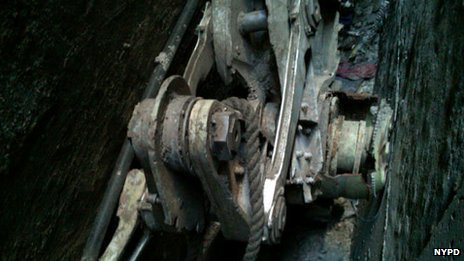
I realize I have been silent here for a couple of weeks. For a number of reasons, I have found it hard to get here. I could not let National Poetry Month pass without one more poem, however. I have been moved by this image and the story of the discovery of the landing gear from one of the planes that was crashed into the Twin Towers on September 11, 2001, which set me to thinking about the ways in which grief catches us off guard — and how deeply I miss Reuben and David, in particular.
landing gear
it’s been a long time
grief old enough to be
in middle school . . .
then one turn down
a trash-filled alley and
the feelings are fresh
the days give distance
but the pain doesn’t age
a fragment of memory
somehow tucked away
a shard of a song and
my heart breaks open
yes, life layers over losses
but you’re not lost —
you’re gone your’e gone
every time I want to talk
to tell you something
you’re still not here
so I will keep turning
down alleyways tearing
open old memories to
remember you were
here with me with me
that I’ll never forget
only steps away from the empty
tomb and already we’re walking back
to the cemetery alongside
a friend who must bury his father
most of our footsteps it seems are aimed
toward the grave rather than away
from it — lazarus could tell you that
we are like sheep headed for slaughter
we sat last night around the table
living out love as best we knew how
sharing cornbread chili chocolate
chip cookies on a cold april night
now is not the time for pat answers
that time never comes no never comes
no matter what life’s going to hurt
empty tombs are going to fill up
and we will keep living hand to mouth
heart to heart holding on for dear life
and trusting that the last word belongs
to love and light — even in the dark
One Sunday morning a couple of weeks ago, I posted a video on my Facebook page of a group called The Lone Bellow singing their cover of John Prine’s “Angel From Montgomery,” which is my favorite song. I captioned the post, “Here is our invocation for the morning.” A friend wrote back questioning the hope in the song, saying all he could hear was an old woman who had lost the love of her life and was now trapped in a mundane existence.
Tonight — this darkest of in between days — seems like a good time to explain what I hear in the song. My friend is listening well to Prine’s words. The woman is voicing her grief eloquently. What she had once is long gone, whether the old man is gone or they both have just grown weary of all of the losses that life inflicts. The first couple of verses give a quick topographical map of both her sadness and tenacity — and it’s right there I hear the first haunts of hope in the midst of all that feels so heavy. She has lost much and she is still here. The losses are not the last word, even if stammering out something of substance is hard to do. The chorus seems like something the disciples could have sung together as the cowered in the despair on this very night:
make me an angel that flies from montgomery make me a poster of an old rodeo just give me one thing that I can hold on to to believe in this living is just a hard way to go
The song is an invocation — a call to trust and live out loud — because I head a grit and determination in the darkness. She is joining the chorus of poets, prophets, and peasants all the way back to the psalmist:
For there they that carried us away captive required of us a song; and they that wasted us required of us mirth, saying, “Sing us one of the songs of Zion.” How shall we sing the Lord’s song in a strange land? (PS. 137:3-4)
In her own way, the old woman in the song is answering the psalmist’s question: you just sing, strange land or not. Sing as though the darkness will last only as long as the night, and grief for a season. Let’s keep singing as though we were going to live through this. “Faith is the substance of things hoped for, the evidence of things not seen,” said the writer of the Epistle to the Hebrews (11:1). Yes. Just give me one thing I can hold on to.
As I age, I appreciate what it takes to stay alive, to keep going. I joked with Ginger yesterday that as wearying as this Lenten season has been I imagined Mary getting to the tomb and finding Jesus only to have him say, “Could I have just one more day of rest? Come back in the morning and I’ll be ready.”
“Just give me one thing that I can hold on to,” Mary answered. And Jesus got up.
Perhaps what pulls me most in the song are the imploring requests of the chorus — make me, give me. It’s a prayer aimed in every direction — at God and anyone else who will listen, and as such is an invocation for us to do the same. God has given us to one another that we might lead each other through the darkness and doubt, through the grind and the grief, together.