
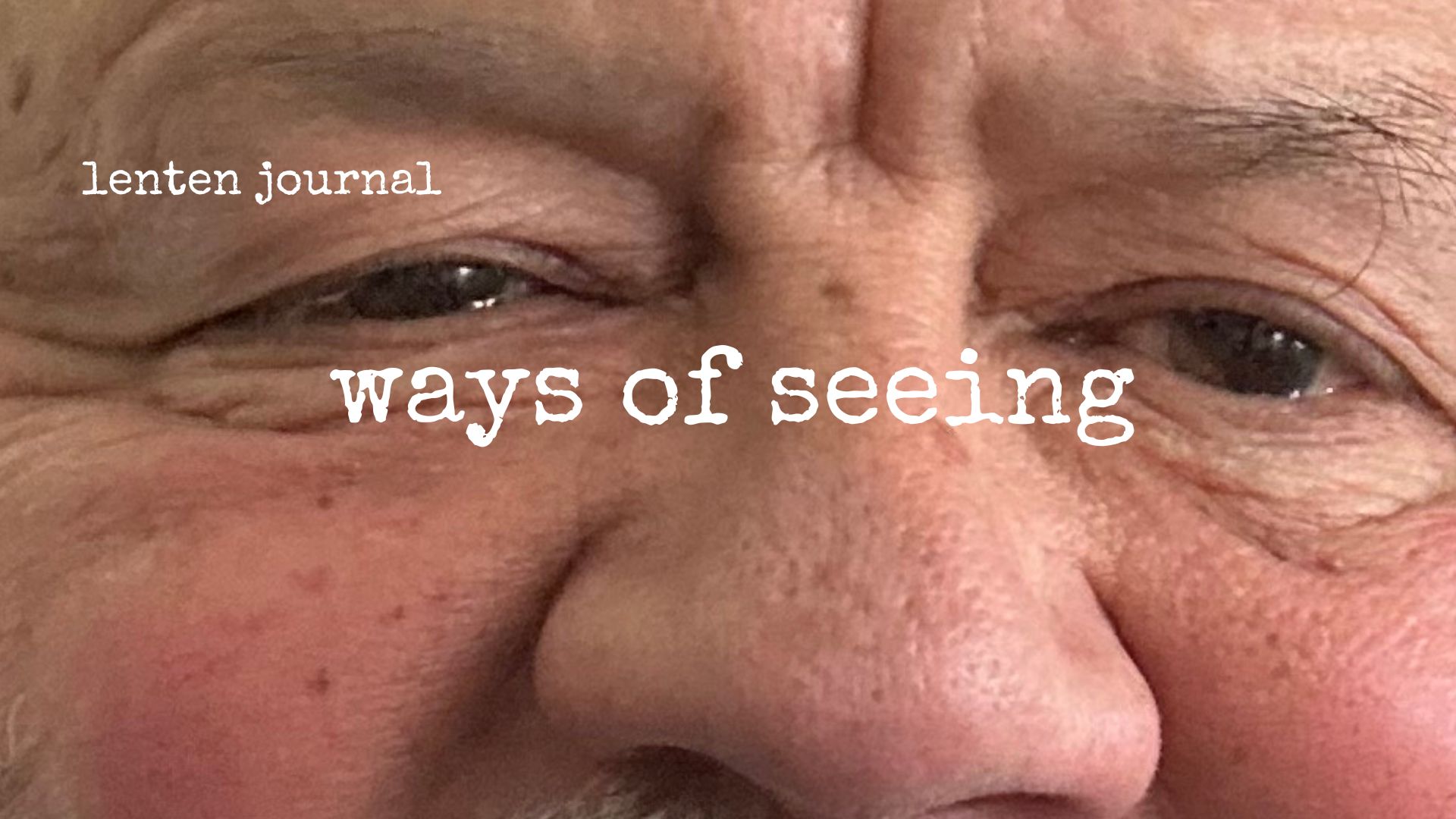
Jesus said, “The eye is the lamp of the body,” which set me thinking about the differences between looking and seeing and the meaning we make from both.
_________________________
All this week, as I have been contemplating our passage for today, I’ve been thinking about the differences between looking and seeing. Describing those differences is a bit of a challenge, because those two words can be interpreted in a number of ways. The way I want to talk about them this morning is to think of looking as a physical action, as in the way you might turn your head if I pointed and said, “Look over there,” and seeing as something that requires mental processing, as in my saying to you as you look where I pointed, “Tell me what you see.” That requires you to take in details.
Though Jesus didn’t talk about looking or seeing in our passage, in between saying our treasures should be in relationships rather than collections and saying we have to choose between serving God or property, he made these statements about the eye being the lamp of the body. If it is healthy, he said, the body is healthy. If our mind’s eye can’t take in light, then we live in the dark.
What’s the connection between our relationship to our possessions and our sight? I want to answer that question with another for us to ponder:
When we look at the world, what do we see, both literally and metaphorically?
(I want to take a moment here to notice the problem with using senses metaphorically. As one who lives with profound hearing loss, I can’t always hear. Sight is not available to everyone. Just a thought to keep in mind.)
Now, hold on to that question for a moment while I talk about Shakespeare.
On Friday, Ginger and drove up to Providence to see a production of Shakespeare’s play, “A Winter’s Tale.” The daughter of a longtime friend was the assistant director, and it gave us all an excuse to get together.
In the first act of the play, Polixenes, the King of Bohemia, was preparing to return home after being in Sicily for nine months visiting his dear friends, King Leontes and Queen Hermoine. Leontes tried desperately to get his friend to stay longer, but Polixenes wasn’t convinced until Hermoine convinced him to delay his departure. Oh—and Hermoine happened to be pregnant. As Leontes looked on, he convinced himself that what he saw was his wife and his best friend were having an affair—without any evidence other than that’s how he decided he saw things. Once he decided that was how he was going to view the world, he could not be dissuaded of his error and everyone’s life was damaged.
Had he been willing to entertain that there was another way of looking at things, it would have been a very different play.
When we look at the world, what do we see?
When Jesus said the eye was a lamp for the body, he was thinking about an oil lamp with a flame like a candle that would illuminate a small area. He had no concept of the kinds of bright lighting that we have, nor any sense of the ubiquity of light that we live with. He and people in his time, on the other hand, had experience with a kind of total darkness we rarely ever experience, one where they couldn’t see anything no matter how hard they looked.
One of the ways we use the word light, or the idea of light, is as understanding, as in “the light went on in my head,” or being “enlightened” when we learn something or come to a deeper understanding of something. However enlightened we might feel, it is helpful to keep the image of the limited light put off by those lamps in Jesus’ time as a reminder that we can’t see everything. There is, as one of our Congregational forebears said, “more light yet to break forth.”
No matter how much light we have, we can only see so far. Our limited light invites us to see that we have more to learn. We can look at that which is not yet in our field of vision as a mystery, even an invitation to grow and adapt. That said, another way of looking at the darkness that lies beyond the circle of light is to see it as dangerous because it is unknown or unpredictable. How we choose to look at it will have a huge impact on what we see.
Psychologist Abraham Maslow is attributed with the proverb, “When you have a hammer, everything looks like a nail,” which he used to say people have a tendency to over-rely on a familiar tool—a familiar way of seeing things—to solve every problem, even when it’s not suitable, as if there is a one-size-fits-all solution. That makes me think of the father in the movie My Big Fat Greek Wedding who thought the answer to everything was to spray Windex on it.
We can do that sometimes with the ways we look at particular groups of people, or maybe just people whom we perceive are not like us, by allowing ourselves to see everyone in that group as exactly the same, which often means we write them off. I’m not just talking about the “big” labels—political differences and so forth. When was the last time you dialed a customer service number and expected to have a good interaction? I’m afraid too often I dial the number with my hammer in hand.
I know I have used this example before, but it deserves repeating in this context. My friend Terry who lives in Durham decided to look at customer service calls differently. Rather than assuming it was going to be adversarial, he decided he would see the person on the other end of the phone as an ally. So when he calls, he says, “I have a problem. Are you the person who can help me, or do I need to talk to someone else?” He goes in looking for connection rather than conflict and invites the person on the other end of the line to do the same.
When we look at the world, what do we see?
As of this morning, the population of the world is just shy of 8.3 billion people. I have no idea how to look at that number in a way that makes sense. I don’t know how to quantify it, to picture how big that number really is when I look at it, other than I remember reading a book in high school called The Population Bomb that warned the earth could not sustain more than three billion people, which was the number we were approaching at that time. The population of the world has almost tripled since then.
We can look at those numbers and feel insignificant. Maybe I would do better to say how can we look at those numbers and not feel insignificant? I’m not sure we can, unless we look closer to home, close enough to see the faces around us, close enough to see that our eight billion co-inhabitants are gathered in small groups just like we are.
One of the guys that came to my regular Saturday morning coffee group yesterday used to be a regular but moved to North Adams, Massachusetts, up past Springfield. He is a social worker. He told me about three guys who live in Western Mass. who had their own coffee group and were looking at the lack of connection they saw around them. They decided to start what they called “The Dad’s Club” and put up notices that they were gathering in the park on a Saturday morning for a family-friendly gathering. They didn’t have a program planned. They just wanted to give people room to hang out. Twelve other people showed up. So they planned another get together and about thirty folks came. Now they are getting requests from across the country with people asking how they can do the same thing.
When they looked closely at what they had, they saw a way to make a difference.
When we look at our world, what do we see?
I want to be clear. I am not offering an invitation to see the world through rose-colored glasses. Life is hard. I don’t know that there is a way to look at the world that doesn’t hurt. We may not have control over much, but we can control what we do and say and feel, which is another way of saying we choose how we see—and be—the world.
If, like King Leontes, we choose to see—to believe—that people around us are trying to betray us, we can make them look like that. If we allow our anger colors our view, we might see everyone with targets on their back, waiting for us to strike. If we choose to see that everyone we encounter is fighting a great battle, we have the chance to see the connections between us. If we look at the world as a bunch of people who want what we have, we will live in fear. If we look at what we have as a resource for sharing, we will see people in need whom we can help.
When we look at our world, what do we see?
None of our lights are strong enough to see everything. Our perspective is limited. It grows when we put our lamps together, when we share what we see and choose to look beyond ourselves, to see beyond ourselves. May we be those who look for more than a reason to judge one another. May we be those who choose to see what we have as gifts to share. May we be those who trust that one of the ways more light will break forth will be by learning from those who we see as different. May we be those who look at the world as Jesus taught us and see a place where everyone belongs. Amen.
Peace,
Milton
Thanks Milton for the beautiful reflection and “insight” on looking and seeing who and what is in our line of vision with openness and compassion. So good to see you in Providence!