
As human beings, we spend a lot of time dealing with what we don’t know, whether we know it or not. Matthew 8:18-27 gives great examples of that, as well as Jesus’ call to relish our bewilderment.
_______________________
One of the jobs I have had along the way, as many of you know, was to work for Apple Retail as a Creative, which was the job title they gave to people who led training sessions for customers. I started working there about the time the iPhone 4 came out, which was significant because that was when smart phones moved from being a really cool thing only a few people had to something that began to feel like a necessity. A whole bunch of people who had never really dealt with computers now had one that fit in their hand.
Because of that, most of the workshops I taught were helping people move from a flip phone or a land line to learning how to use a touch screen and understand what an app was. Most all of them were bewildered. Maybe you remember what that felt like.
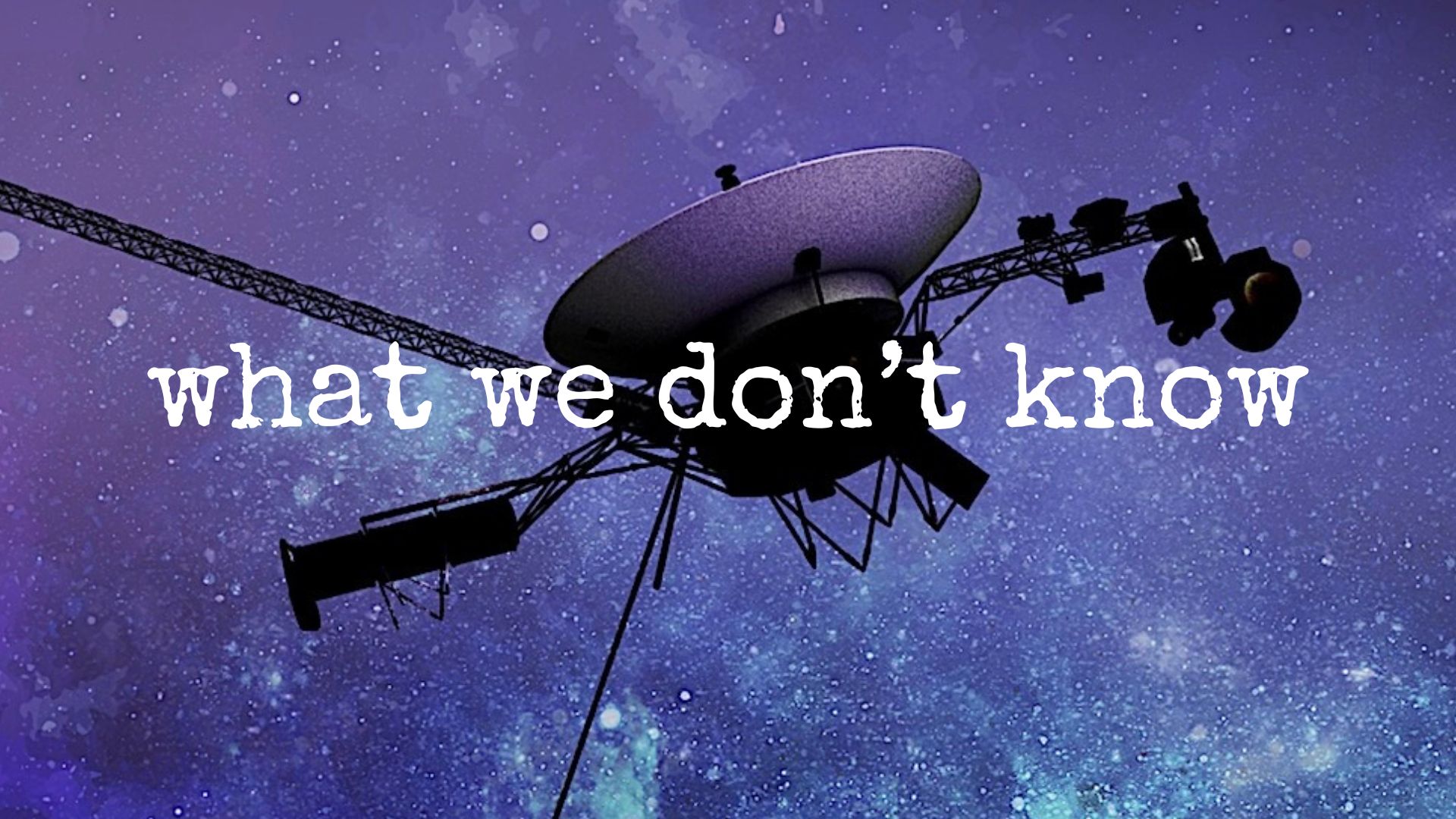
At the same time I began teaching workshops, I read a news story about the Voyager 1 space craft, which was launched in 1977, had reached the edge of the solar system and was the first human-created craft to reach interstellar space. I am not a scientist, but I am enchanted by certain aspects of it, and space is one of those. I was a junior in college when Voyager was launched, and part of what I loved about the mission was it was intended to fly by Saturn, but when they launched it they decided to let it keep going and see what else they could learn.
I made the connection between my students and the spaceship through an article that said the computer that was the core of the iPhone 4 was 250 times more powerful than the computer that launched Voyager 1. At the end of my workshops, I shared that fact and then said, “So quit playing Candy Crush and go change the world.”
Voyager 1 is still going, by the way. In November of 2027, the space craft will be fifty years old, and it will be one light day from earth. Think about that for a minute: It has taken fifty years for the spaceship to travel the distance light can travel in one day. There’s so much we don’t know or grasp about the universe. For that matter, there’s so much we don’t know about our smartphones.
One of the things that I learned at Apple was that it is often difficult to teach people a brand new thing, not because of what they don’t know—that’s why they are in the class, but because of what they don’t know that they don’t know.
We have to how be willing to learn to know what we don’t know.
Does that make sense? The statement kind of circles around on itself, but it strikes me that being willing to learn what I don’t know that I don’t know is a what trust is about. And it is at the heart of our scripture passage this morning: Life is a call to learn to how to live with what we don’t know we don’t know.
Matthew is in the middle of a bunch of miracles, as far as his gospel goes. Chapters 8 and 9 are almost one healing story after another. Then, in Chapter 10, Jesus sends out his followers on their own and Matthew moves to focus more on Jesus’ words than actions.
Matthew wanted us to grasp how bewildered people were by the way Jesus interacted with them. The verses we read give us an account of how a couple of people responded to what Jesus said and did. One was ready to go with him: “I’ll follow you wherever you go.” Jesus responded in a way that seemed to question whether the scholar knew what it was like to live on the road. He said, “Foxes have holes and birds have nests, but I don’t have a permanent address,” which sounds like Jesus assumed that was not the life of an academic.
Another was kind of ready, but didn’t want to move just yet, saying he would come after his father died. There’s not any indication that his father was gravely ill, so he didn’t know when that would happen.
Then Jesus got in a boat with some of his followers and they set out across the Sea of Galilee, which was not big, but can be stormy, and a storm blew up, a storm big enough to make them wonder how they would get across the lake. They didn’t know how they were going to survive. They woke Jesus up in a panic and he calmed the winds and the waves.
All three scenes have to do with not knowing what they don’t know and being called to trust God and to trust ourselves—and by that I mean one another, not just ourselves individually—such that we don’t live in fear of our circumstances but rest in the trust that however far we have ventured in this life and whatever it is we have learned, we have hardly traveled a light-day when it comes to the dimensions of God’s love and presence.
The biggest thing we don’t know is what is going to happen.
We can make plans, like the first person who said they were ready to go with Jesus. His response was to say, “Just remember you don’t know what it’s going to be like.” In more modern terms, we might say Jesus was saying following him was a journey and not a destination.
Maybe we find ourselves alongside the person who was hesitant to commit or at least wanted to do it at a later time when things were a little more wrapped up. We have probably all made plans in similar fashion: once this happens, we’ll do that. But we don’t know what’s going to happen. Things may not work out that way. The year that Voyager was launched and I was imaging my life ahead, never for a moment did I consider it would include being a pastor in Hamden, Connecticut.
Or maybe we find ourselves with the folks in the boat. We know from other gospel stories that many of Jesus’ followers fished for a living, so being in a boat on the Sea of Galilee would have been familiar to them, as would the knowledge that storms could come up quickly on the lake. But there’s a difference between knowing about storms, or the possibility of storms, and knowing what to do when we’re caught in the middle of one, whether we are talking actual storms or metaphorical ones.
All three situations describe people who didn’t know what they didn’t know. Jesus called them to trust. He didn’t answer their questions or explain things to them, in fact, depending on how we hear Jesus’ tone, his responses can be read as reprimands, but I hear his voice differently. He didn’t seem all warm and fuzzy in the way he said things, but I think he was being direct more than being directive. He wanted people to trust more deeply, and that meant helping them see what they had not seen.
Their response was a question: “What kind of person is this?”
We can hear in their question a bewilderment much like we might feel when we try to grasp that it has taken Voyager fifty years to travel the distance a particle of light can go in a day, and that at night we stand and look at stars millions, even billions of light years away, which means the light we are seeing has traveled that far and is that ancient. What kind of universe is this?
Long before Jesus walked the planet, the psalmist voiced of that bewilderment as a hymn of trust and wonder:
When I look up at your skies,
at what your fingers made—
the moon and the stars
that you set firmly in place—
what are human beings
that you think about them;
what are human beings
that you pay attention to them?
However large or small our presence is in the vast expanse of the universe, we are a part of it all, and we have been given the abilities to question and learn and trust and grow. We are never going to be able to see the whole picture. We will never know enough to be certain about what will happen next. But we are people, wonderfully and uniquely created in the image of God, who can change the world by trusting God and one another, by risking love when we know that opens us up to the unexpected.
So—put down your phones and go change the world.
Peace,
Milton