
“Where our treasure is, there will our heart be also” is among the Bible verses I first learned. This time around it hit me in new ways as I thought about how things connect us to one another and made some interesting connections of my own.
_______________________
Because all of us on our church staff are part-time, one of the things we have to do is get the order of service put together rather early. For example, Aren has already sent me the order for Palm Sunday to proofread. Not every church does it that way.
One of the good things about that is I have the scripture passage in my head well ahead of time, which helps me begin to formulate my sermon ideas and notice connections that might not have time to find me if the schedule were tighter. That also means sometimes those corrections are rather far afield from each other. This week, for instance, is a rather eclectic five-strand braid of things:
• the next segment of Jesus’ sermon on the mount;
• some words from Joy Harjo, a Native American poet and US Poet Laureate from 2019-2022;
• part of a skit from standup comedian George Carlin, who can be a pretty good theologian, even if unintentionally so;
• the book of Ecclesiastes, which we looked at in Bible Study yesterday; and
• the etymological root of the word enough.
I’m sure you can quickly see how all of those things go together, but let me make the connections anyway. Since we have already read the scripture passage, let’s start there and focus particularly on the second paragraph:
“Stop collecting treasures for your own benefit on earth, where moth and rust eat them and where thieves break in and steal them. Instead, collect treasures for yourselves in heaven, where moth and rust don’t eat them and where thieves don’t break in and steal them. Where your treasure is, there your heart will be also.”
When Jesus told parables, he could be pretty enigmatic. His stories were intentionally complex because he wanted people to do the work of unraveling them. His sermons, on the other hand, were pretty direct, as is the case in these verses: our hearts will be where our treasure is, where what matters to us is, which begs the question, what matters to us? Or maybe better, who matters to us? What or who are our treasure?
I would imagine most all of us have some keepsakes at home that hold deep sentimental value (Ginger might say, perhaps some of us have too many things); and maybe some things that have economic value as well. Jesus was challenging whether our stuff—our possessions and our property—matters more than the people around us. And that leads me to George Carlin who had a whole routine on “Stuff.” He said,
“That’s all you need in life, a little place for your stuff. That’s all your house is- a place to keep your stuff. If you didn’t have so much stuff, you wouldn’t need a house. You could just walk around all the time. A house is just a pile of stuff with a cover on it. You can see that when you’re taking off in an airplane. You look down, you see everybody’s got a little pile of stuff. All the little piles of stuff. And when you leave your house, you gotta lock it up. Wouldn’t want somebody to come by and take some of your stuff. They always take the good stuff. They never bother with that junk you’re saving. All they want is the shiny stuff. That’s what your house is, a place to keep your stuff while you go out and get…more stuff! Sometimes you gotta move, gotta get a bigger house. Why? No room for your stuff anymore.”
Where our treasure is, there will our heart be also. What does our stuff mean to us? What or who are our treasure?
Yesterday in our Lenten Bible Study we read and talked about Ecclesiastes 3, which begins with the verses most familiar—“for everything there is a season”—and then says,
What do workers gain from all their hard work? I have observed the task that God has given human beings. God has made everything fitting in its time, but has also placed eternity in their hearts, without enabling them to discover what God has done from beginning to end. I know that there’s nothing better for them but to enjoy themselves and do what’s good while they live.
Those words, which are over ten thousand years old reminded those of us around the table that the human condition has not changed in many ways. We are still trying to figure out what it means to be human and how to live with each other. One of the sections we talked about for a good while came at the end of the chapter.
I also thought, Where human beings are concerned, God tests them to show them that they are but animals because human beings and animals share the same fate. One dies just like the other—both have the same life-breath. Humans are no better off than animals because everything is pointless.
All go to the same place:
all are from the dust;
all return to the dust.
Who knows if a human being’s life-breath rises upward while an animal’s life-breath descends into the earth? So I perceived that there was nothing better for human beings but to enjoy what they do because that’s what they’re allotted in life. Who, really, is able to see what will happen in the future?
The connection to Jesus’ words, for me, is that our culture often equates importance with wealth and acquisition. Those who are the richest, those who have the stuff that costs the most, are the ones who have the power and influence (at least that’s what we’re told over and over), which can tempt us to wish we had the most stuff, or at least more expensive things.
Things don’t increase our importance regardless of what the ads tell us. We matter because we are wonderfully and uniquely created in the image of God, not because we are rich or powerful. God doesn’t play favorites. All of us matter and nobody matters more than anyone else.
The writer of Ecclesiastes pointed out that humans aren’t even the most important part of creation. We are a part, but not THE part. We are animals. We live and breathe and die just like all the others.
That’s why the writer said the best thing we can do as humans is enjoy what we do because life is short. He didn’t say anything about trying to see how much wealth we can acquire or how much stuff we can collect so we can be more significant. He said life is our treasure, in large part because it doesn’t last long. These are the days we have to share with the rest of creation and we should enjoy them, invest in them, live them.
Where our treasure is, there will our heart be also.
Joy Harjo points to ancient Indigenous wisdom that has a similar emphasis.
“We are in a crisis. These same false narratives have fostered a destruction of the natural environment in which we live, and grow children, grandchildren–in which we make a world to continue. What joins the original cultures of these lands is a shared belief system in which we are not separate from the land or from the consequences of the stewardship of these lands. We are the land. Together we move and move about with the knowledge that we are not at the top of a hierarchy; rather, we are part of an immersive field of knowledge and beingness, and human contribution, though crucial, is not the most important. All have a place.”
“The human contribution, though crucial, is not the most important.” I find myself wanting to repeat that sentence hoping it will embed itself in my heart as a continuing reminder that life is not a hierarchy but a web of relationships that runs from the smallest particle we can’t even see to beyond the farthest star we dare to imagine. There is an intrinsic generosity to life, a built-in community, a kind of sharing, that shows up in all kinds of ways from cosmic things to the ways we treat one another when we are at our best.
If what matters most to us—our treasure—is other people then our stuff becomes resources to share and help one another. And that leads me to the root word of enough, which I didn’t know until I looked it up. (Are you ready for a true Word Nerd moment?)
The Old English root word of enough is genog, which breaks into two parts. The first, ge-, means “together” or “with.” -nog means “to obtain.” Put those together and the root of the word enough, which we take to mean sufficient, means “to obtain together.”
Over and over in our study of Jesus’ sermon we have mentioned he spoke in the plural: happy are those who mourn, blessed are those who are exhausted, give us our daily bread. And here, at the heart of the word that invites to unclench our grip on our stuff is the same understanding that we are in this together, and that none of us is going to be here for long.
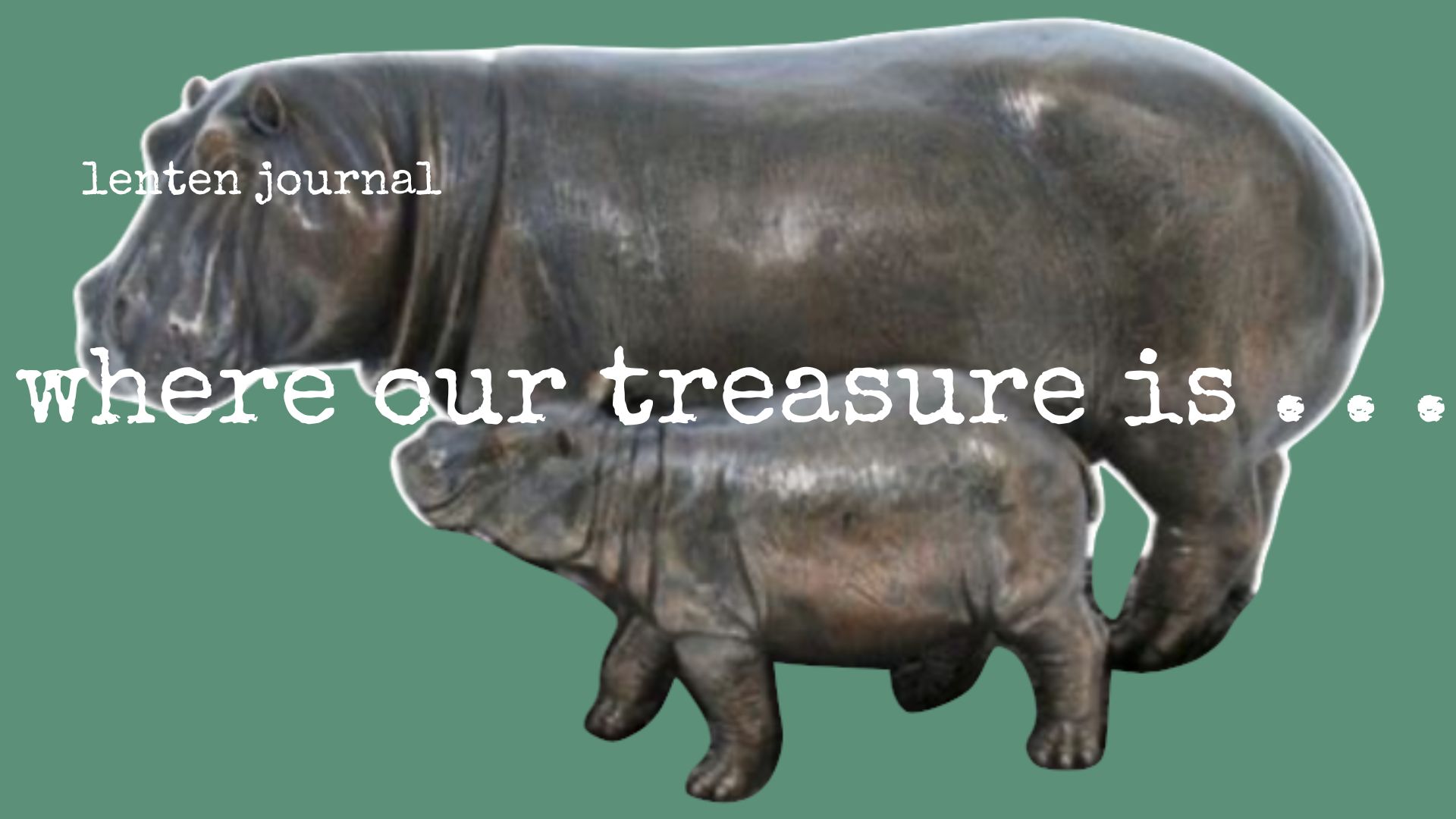
Where our treasure is, there will our heart be also. How then can we use our possessions to connect us to one another, to remind us of who we treasure? How do we keep our things from having a grip on us? Those questions make me think about the hippos in my office that you gave me at my installation. If you told me I had to go in my office and pick one thing before the building fell down, I would pick up those hippos and run because they are such a symbol of love to me.
A couple of weeks before my installation, I told a story in my sermon about some clay hippos we had in our flower bed that were given to me by a friend who had died and that Ginger had run over by accident. Then to mark my special day you gave me new hippos. You listened to my loss and responded in a way that connected us, in a way that showed your love for me. I truly treasure those hippos because showed me your heart and they make me feel like I belong here.
May we live in a way that the things that matter most are not things but people. Let us use our things to remoind us that people are our true treasure. Let us treasure one another because we are not here together for very long. Amen.
Peace,
Milton