Home Blog Page 30

the math of discipleship

I preached this morning at our church in Guilford, and it was another peach of a passage as far as the lectionary is concerned. I had to write the sermon in traffic, as I like to say, because it was a hectic week, but some of those things became part of what helped me to see the verses in a new light. Since my interim is over, this is my last scheduled sermon for a while. I hope you find something here that speaks to you.

________________________________

Last week, I started publishing an online newsletter called “mixing metaphors.” Actually, Ginger was the one who came up with the title because, she said, it’s what I do. I like to mash up ideas and images that offer the chance for imaginative conversation about what it means to be human.

As long as my mother was alive, she admonished me to be like Jesus. After dealing with today’s passage and the parables that surround it, I wish I could tell her I think I’m pretty close because in the eight verses we read Jesus gives us a festival of mixed metaphors.

First, he said, those who did not hate their families could not be disciples. Then he said those who did not carry their cross couldn’t either–and they knew nothing about his upcoming crucifixion, so what that metaphor meant to them is up in the air. Maybe it had more to do with the weight of empire, since Rome used crucifixion as punishment for crimes, than our image of great sacrifice. Then he switched to talk about counting the cost of building a tower and counting the cost of going to battle against a more formidable opponent, and then he said, “Therefore, none you can become my disciple if you do not give up all of your possessions”–and then, in the following verses that we did not read, he said we were like salt. He hit everything from siblings to seasonings as he talked about what it means to be human.

Look, Mom, I’m like Jesus . . . ?

At least, I hope so.
But I have to tell you, when I read phrases like “must hate your family” and “renounce all your possessions,” I wonder what to do with them even though Jesus said them.

I have watched, for example, as some maliciously use the two stories about counting the cost to castigate those who have had their student loan debt forgiven, and part of me wishes those words of Jesus weren’t even written down so they could not be weaponized.

Though the gospel writers rarely give us any indication of Jesus’ tone when he spoke, I have been turning these words over all week listening for something that offers more than Jesus telling everyone they were a huge disappointment to God.

Then I saw something I had not seen before. Listen again:

For which of you, intending to build a tower, does not first sit down and estimate the cost, to see whether they have enough to complete it? Otherwise, when they have laid a foundation and are not able to finish, all who see it will begin to ridicule them, saying, ‘This person began to build and was not able to finish.’

Jesus said the reason the person had for making sure they could finish the tower was so they would not be ridiculed for a half-built tower. And the second story:

Or what king, going out to wage war against another king, will not sit down first and consider whether he is able with ten thousand to oppose the one who comes against him with twenty thousand? If he cannot, then while the other is still far away, he sends a delegation and asks for the terms of peace.

The result of the king measuring his army against his opponent’s was to decide the battle wasn’t worth it and to send a peace delegation instead.

The characters in both stories are examples of vulnerability, not victory. The first had a big idea that got knocked down by things they didn’t see coming, and the second had delusions of grandeur that were cut down to size in a moment of reflection.

The way Jesus talked about the kind of commitment it took to be a disciple, he seemed to say that there is not a way to communicate just how much it costs.

We can give lip-service to putting our commitment to God above family and possessions, or anything else for that matter, but living that out is a different thing, as is figuring out what that looks like. The truth is our lives are littered with lots of half-built towers and battles we didn’t fight. And most all of us are attached to our stuff.

These verses read, it seems, as if hardly anyone measures up as a disciple. But these verses don’t stand alone.

Just before this mess of metaphors, Jesus told three parables about banquets. One is about someone who goes to a banquet and tries to switch place cards to worm their way up to the head table only to be moved to the back (and Jesus said don’t be like that); one is about someone who hosts a banquet and only invites people they think will invite them back only to learn that doesn’t pay off (and Jesus said don’t be like that); and one is about someone who sends out invitations to a banquet to people who were used to going to banquets, and everyone responds with silly excuses, so the host instructs their servants to go out and find anyone who is hungry enough to come and eat (and Jesus said be like that).

In the chapter that follows our verses, Jesus tells three parables of people who appear to not count costs: a shepherd who leaves his flock of ninety-nine sheep to go out in the night to find one that had gotten lost; a woman, who loses one of the ten coins she possessed, tears up her house looking for it, and then blows her whole budget throwing a party for the neighborhood to celebrate; and a father who pulls out all the stops when his son, who had disowned him, comes home after losing everything because he has nowhere else to go.

The traditional reading of these last parables is that God is the extravagant one—and that is true about God. But what if we put ourselves in the place of the shepherd or the woman or the father? What if we think of these parables in the light of Jesus’ call to give up our possessions?

Perhaps what is missing in our understanding of what Jesus was saying in these parables is that Jesus understood most of us spend their lives counting costs. We measure our steps and choose our words; we run scenarios in our minds and make forecasts and predictions. We want to make sure we are safe. We want what is coming to us. We don’t want to get taken advantage of. We want to share, but we don’t want to give up too much.

The truth is that kind of math doesn’t add up because we can’t see what’s coming. What we can see are the invitations life is offering us right now—invitations to incarnate the love of God to those around us in tangible ways.

Our friends Jena and Marc felt compelled to pay for a student from A Better Chance (ABC) to go to college. When Julie became our foster daughter, they also gave us one of their cars because they knew we were going to need a second vehicle. They had the means to do both—and they were willing to do them.

Sometimes, the call to respond is more celebratory. Our goddaughter Ally and her partner Pete opened a restaurant in Athens, Georgia this week. As you can imagine, the opening was the result of years of dreaming and planning. Thanks to Avelo Airlines, we were able to figure out how to get there—and it mattered to her that we did.

At the same time, Ginger’s cousin in Alabama is facing a housing crisis and has nowhere to go, so we are in the process of adjusting some of our plans to buy a small place so he will have somewhere to live.

As I was working on my newsletter and trying to figure out life after my editing job, a person who I know through my blog but have never seen face to face spent two or three evenings after work helping me sort through some technical stuff I did not know how to do just because I asked.

I wish we had time to let the people here tell stories because I am sure this room holds many tales of ways people have been extravagant to us and ways in which we have counted the cost of what it means to be family or friends and then paid the bill.

Take some time to think of those stories and tell them to one another. They are stories of discipleship, if you will.

Jesus told these parables in response to questions that came from those who were critical of him: Why did you heal that man on the Sabbath? Why do you hang out with tax collectors and sinners?

Jesus’ answer was basically to say, “Why not spend my life on them? What else is going to add up to a life worth living?”

As followers of Christ—disciples—we are called to pay the cost of noticing one another, of witnessing one another, and attending to one another, of loving one another. We are called to offer our half-built towers as shelter, to share our daily meals as if they were banquets, to find one another no matter why we got lost in the first place for no other reason than that’s what Jesus did. And, like my mother said, we ought to be like Jesus. Amen.

Peace,
Milton

My writing here and in my newsletter are offered for free, thanks to the help of my members who help to support me. You can subscribe to my weekly newsletter (which is also free) and become a member. Thanks for reading.

food for thought

Part of the reason pastors take vacation in August is because the lectionary passages are complicated when it comes to preaching. Or perhaps the Lectionary Committee thought, “Hey, let’s dump all of these in August when we know we are not going to be in the pulpit.” Either way, in the waning days of summer when we are all looking for a little relief, the passages like the one for today (Luke 14:7-14) make us think harder than we want to.

The good news for me is the two parables are about meals, and I am always happy to talk about cooking and eating, whether literally or metaphorically.

__________________________________

I think one of the reasons I like Jesus is because so much of what he did and said revolved around food. He fed people. He ate and drank with all kinds of people. He even cooked breakfast after his resurrection–on the beach, no less. And he used the idea of gathering around the table as one of his primary metaphors in his parables.

All of that speaks to me. Whether I am cooking or eating, hosting the dinner or being hosted, I like to be at the table with people.

You may have noticed that our passage started with, “When he noticed how the guests chose the places of honor, he told them a parable,” which is to say we are coming in during the middle of the story. Jesus was at a dinner at the home of some people of privilege who thought of themselves as The Ones Who Made Sure Everyone Kept The Rules.

I mean, Jesus would eat dinner with anybody!

A sick man came to Jesus to be healed, but it was the Sabbath and the Rule Enforcers frowned on Jesus “working.” Jesus stared them down and healed the man. And then he told these two parables.

The two stories are connected, but they go in different directions. The first is about people who get invited to a banquet and switch their place cards so they can be closer to the the head table. The second is about someone hosting a dinner for people they know will invite them in return.

Jesus said that neither approach was the way to live. Life is about relationships, not transactions.

A couple of years after I got out of college, a friend who graduated after I did called and said he was coming to town and wanted to know if he could take me to lunch. Of course, I said yes. We had a great meal and a good conversation. Towards the end of the meal he told me that he was working for a life insurance company and wanted to talk to me about my insurance needs. My insurance needs were taken care of at that point, but I thanked him for lunch and he went on his way.

About a year later, he called again, saying he was coming through town. We went to lunch again and he tried to sell me insurance again. And it happened a third time, some months after that. At the third meeting, I said, “I am glad to see you and to hear about your life, but I don’t want to buy insurance. If you’re coming to town and you want to eat because we are friends, that’s great. If you want to see me because you think I could be a customer, I’m not interested.”

He never called back.

I look back on him how and I can find grace that I did not find back then. He was just starting out in a career and he worked on commission and he needed customers, so he called people that he knew. And what soured me was he turned a relationship into a transaction.

If he could have said, “Hey, I am just getting started and I could use some help making connections with people; can I buy you lunch and talk it through with you?” the story would have been different. Or, if I could have said, “I know you’re under pressure to sell insurance, but let’s just have lunch and leave that for another time,” rather than being as blunt as I was, we might still be in touch.

I know another person whose parents told her that the proper response to a gift is to return the container full. I gave her some peppers I had canned and she returned the jar full of something. When I said she didn’t need to do that, she said her mother had told her that she had to do that to be polite. But now it leaves me wondering how that expectation leads her to feel about people, like me, who return her containers empty and just say, “Thank you.”

Hear me clearly: life is not as simple as this is the right way and this is the wrong way when it comes to how we relate to each other in most cases. The give and take of our daily lives requires of us to move back and forth between being givers and receivers, hosts and guests. Like is a series of exchanges, in a way–but here is where we have choices about what we make those interactions mean to us and to others.

At the heart of both stories is this: don’t keep score when it comes to giving and receiving.

If you go to a banquet and you are at the table against the back wall, take it as a chance to dance where no one can see you and have the time of your life. If you’re the one hosting dinner, invite the people who need to eat, not those who will make you look good. Either way, enjoy the meal for the sake of the meal. Make a memory, not an accomplishment.

Life is about relationships, not transactions. Amen.

Peace,
Milton

PS—my newsletter, mixing metaphors, starts Tuesday. You can subscribe here.

zucchini boats

My earliest memories of zucchini are not good.

First, a bit of backstory: When I was growing up the house rules were that we ate whatever my mother cooked. If it was on the plate, we were expected to eat it. It was not negotiable. If we chose not to eat what was served, the plate was covered and put in the refrigerator and presented again at the next meal. I can remember staring down a piece of cheese toast one night that showed up again at breakfast–I don’t remember why. I actually liked cheese toast.

Zucchini was another thing.

It is no secret that I loved my mom’s cooking. I am a cook because of her. She was amazing, But she did something to zucchini that neither my brother nor I were able to tolerate: a zucchini casserole.

We could smell her making it when we came into the house in the late afternoon after playing with the kids in the neighborhood. She didn’t make it all the time, but often enough for the stench to feel familiar. As I remember, it was sliced zucchini and onions and cheese–which should have been fine–but it was The Dish We Hated More Than Any Other. Period.

I wish I could point to the day that my relationship to the green summer squash changed. It was not while I lived in my parents’ house, I know that. It was some time in college, I think–a time when it was served in some other form that The Casserole of Death. It was not a momentous shift, but it was a shift nonetheless. I learned to not only eat zucchini but love it. Just not in that casserole.

(I would add here that at some point in all of this, my mother quit making that dish.)

In the years since I have become a gardener, I have learned that summer time means being creative with zucchini since it is ubiquitous. I’ve got recipes for zucchini fritters, zucchini bread, zucchini noodles, as I am sure many of you do as well. The joke around here is you don’t leave your car unlocked in the summer because people will fill it up with the surplus squash from their gardens.

As I began to think about what I was going to make for dinner tonight, I started with what to do with the eight zucchini sitting on the kitchen counter. I have already sautéed some this week and diced up some others; I wanted them to be more than a side dish.

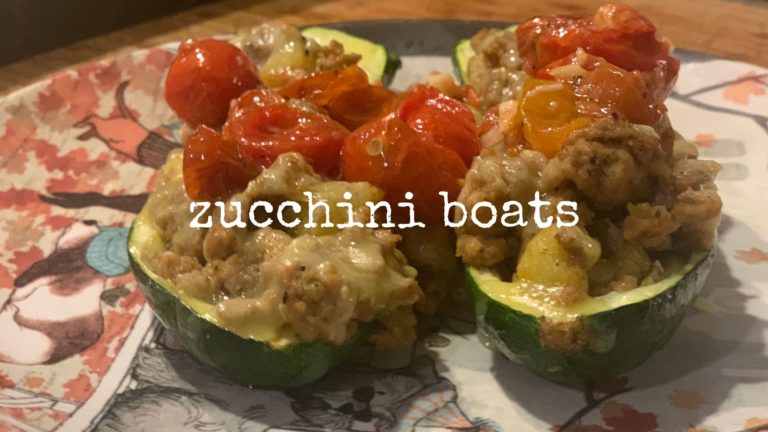
So I made zucchini boats as a way to offer a different culinary voyage. They aren’t fancy but they are simple, they look good, and they taste great, too.

I wish my mother had had this recipe. Growing up would have been easier for both of us.

zucchini boats

4 zucchini squash, halved longwise
1 lb ground turkey (ground beef or pork would also work)
2 cloves garlic, minced
(you could also add diced shallots or onions; I don’t because of Ginger’s allergy.)
taco seasoning
salt and pepper
1/2 cup cheddar cheese, grated

Preheat the oven to 400°.

Using a melon baller or a small spoon (the melon baller is easier), scoop out the center of the zucchini, leaving the sides intact. Save the squash you scoop out in a bowl.

Brush the inside of the zucchini with olive oil and place them on a baking sheet scooped side up. Roast in the oven for 20 minutes, until they are soft.

While the squash is cooking, combine the turkey, scooped out squash, garlic, and onions (if you are using them) in a bowl. Heat a skillet to medium heat and add a little olive oil and then cook the mixture until the meat is done and the squash is soft–about eight minutes. Set it aside to cool.

Take the zucchini out of the oven and then fill the boats with the turkey mixture. You may have some of the mixture left over, depending on how much you put in the boats or how big your squash are. Divide the cheese evenly over the tops of the eight boats. Return to the oven and cook until cheese is melted.

Remove from the oven and serve.

Like I said–not fancy, but really good.

Peace,
Milton

climate: change

climate: change

in the early days of language
we only had words for storms
weather meant trouble until
some began to realize that
a clear sky or a gentle breeze
meant something as well

but they talked about it the
way they talked about time
in Latin, Polish, Gaelic,
and Serbo-Croatian
weather and time
were the same word

In ancient Greek, kairos
meant the opportune
moment or the weather
I’m not sure I totally
understand the connection
except, perhaps, the sense

that time is more like
a breeze or a rain storm
than a ticking clock
we can no more save
or standard it than we
can guide a hurricane

the rain falls on the just
and the unjust or
maybe it just falls
time passes and heals
and makes us miss things
we are seasoned by both

even as we delude ourselves
into thinking we can control
either one; the best we can
do is cooperate, take our place
in the storm and the seconds

surrender our schedules
and forecasts, learn to ride
the wind rather than punch
the clock or set an alarm
and let our hearts dance
to the rhythm of the rain

we are not late or early
we are here, alive in this
time, in this weather
a climate of continual
change, a string of
moments that matter

Peace,
Milton


living a legacy

I am down to my next to last sermon at the church where I have been bridge pastor since the beginning of last December. They are moving into a promising new chapter as a new settled pastor joins them in early September and I am moving into Whatever Is Coming Next, a chapter that has yet to be fully defined.

My idea for my sermon came to me as Ginger and I sat in a pub on our last full day in Ireland; Guinness, it seems, is not only good for strength, but also for sermon ideas—in moderation, of course. The text is Isaiah 58:9-12. I’ll let my sermon tell the rest of the story.

_________________________________

When Ginger and I first moved to Boston in 1990, we couldn’t get over how old things were. The first house we owned in Charlestown was built around 1840. Having moved from Texas, where anything over fifty felt ancient, we felt like we were living in the middle of history. Then we had a chance to go to Paris. As we stood in Notre Dame cathedral, we could overhear a tour guide describing the two huge stained glass windows. One, he said, was a new window–a replacement after a fire–that had been put in place in the mid-1500s.

Our little row house in Boston suddenly felt new as well.

During our time in Ireland over the last couple of weeks, we saw lots of old things. We walked around the remnants of old castles, marveled at the miles and miles of stone walls that stood without mortar, and stayed in hotels housed in stone buildings dating back centuries. All of those were things I expected. But on our last full day in Ireland I was surprised by what we found.

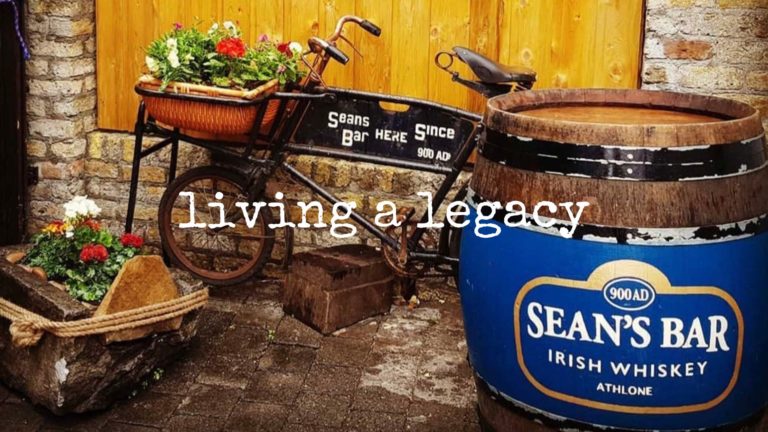
Our task that day was to drive from Galway to Dublin so we could fly back to Boston the next day. I looked at the map to find somewhere in between to stop for lunch and saw the name Athlone about halfway along the highway. When I searched to learn more about the city, I found out it was home to Sean’s Bar, which is certified by both the Guinness Book of World Records and the Irish National Museum as the oldest bar in Ireland–dating back to 900. That date means less time passed between Jesus being on earth and the opening of the bar than between the opening of the bar and today.

We knew we had to stop–and we did.

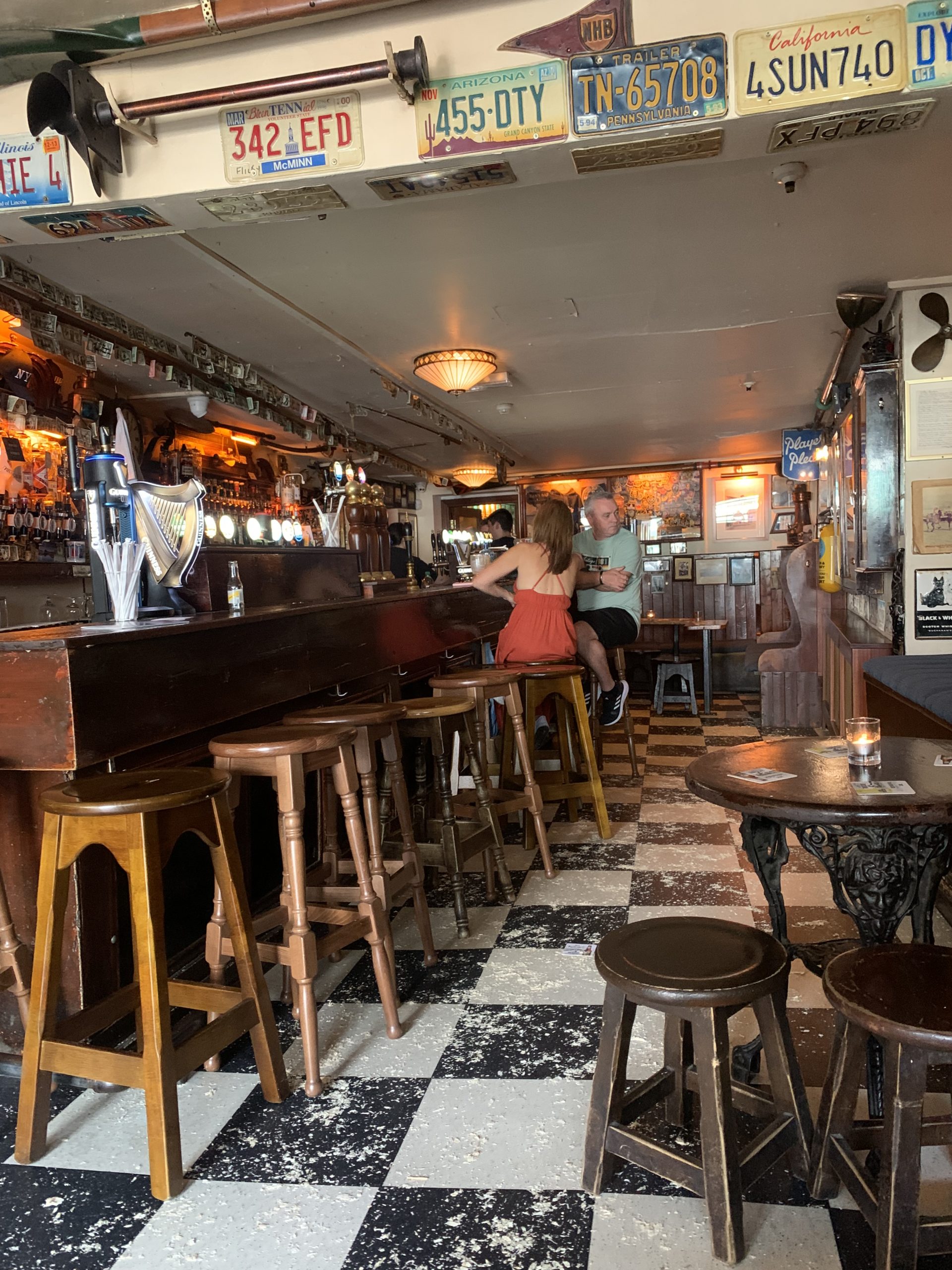
The building was unassuming. The pub was quiet and cozy and opened up on a patio that had been built more recently. On one wall was a shadow box that held a piece of an earlier building, which was basically a bunch of sticks held together by some sort of mud mixture. The room we were in wasn’t from 900, but the bar was part of a continuous lineage.

What I have since learned is Athlone is the English way of saying the Gaelic name, Atha Luain, which means “the ford of Luain.” Before bridges were built, this spot was where people could ford the River Shannon. Luain was the one who both provided a way across the river and a place for refreshment and rest, starting in 900. A town grew up around the inn, and then a castle was built in the twelfth century. Through all the changes, the pub has continued to take care of people.

As one of my friends noted when she saw our pictures, “Bars have been a necessity for a long time.” The idea that everyone wants to go to a place where everybody knows your name is much older than we think.

Soon after we got back, I read an article that said for the first time in American history people who go to church are in the minority. In 1990, seventy percent of Americans participated in worship; that has now fallen below fifty percent. Those of us who go to church live with the assumption that churches have been a necessity for a long time, too. Perhaps, what we miss is that it can’t stay the same if it is going to endure.

I wonder how many times over the years the patrons of Luain’s Inn or Sean’s Bar have lamented a change in location or decor or beverage options. My guess is at least every few years over the thirteen centuries, someone has said, “Well, it’s not what it used to be,” and yet, it’s still here.

We have lots of reminders around us that much of life works that way. We think of ourselves as being the same person our whole life, and yet our skin cells regenerate every two weeks, our stomach cells every couple of days, and our bones every ten years, to name a few. As we age, we don’t keep much original material and yet we are still ourselves. Our identity does not require us to stay the same; in fact, we have to change to stay alive.

One of the things I have enjoyed since I got back has been reading the email thread about the ways in which you as a congregation are preparing for a new year and for a new pastor. Those two things, along with what appears to be the first fall in a while not totally encumbered by the pandemic, have created space to dream and plan. It has also made room for trying to get back to the way things were. Those two impulses can pull against each other.

The words from Isaiah we read this morning were spoken to people who were working to rebuild what had been lost and trying to figure out how to keep going. Isaiah’s call was to do more than try to reinstate old patterns. Instead, he said, be healers. Repairers of the breach.

Be the ones who help others cross the river and provide refreshment and rest for them when they do.

We do not exist because of our institutions or for our institutions–that’s true about churches and governments and workplaces. We are made for one another. We are built to be healers, helpers, caregivers–and receivers: people who tend to one another.

One of the stops we made on our Peace Retreat was in a town called Rostrevor, which is in northern Ireland. As we were getting off the bus, Ginger and I saw a man walking two miniature Schnauzers, so we were quick to cross the street and talk to him. After we had met the dogs, we began to talk to him. His name was Paul. He asked what we were doing in Ireland and we said we were with a group hoping to learn more about how to be peacemakers by hearing the stories of those who are working for peace in Ireland.

“I was in prison in Manchester during the Troubles,” Paul said. He went on to tell us he had been sentenced to twenty-four years but got out after eleven years because of good behavior. “I was changed by my time in prison. I am a different person. I was a Republican (one of those fighting for a unified Ireland), but I’m not now. What matters most is that we learn how to be friends with one another.”

Across the street from Paul was a school that advertised itself as “integrated”–meaning Protestant and Catholic students attended together–and next to it was a church that had been converted into a restaurant and bar. As Ginger and I sat at one of the outside tables, we watched the church fill up with various groups of people sharing their lunches and lives together, and I wondered what the former congregation had missed that the restaurant seemed to be getting right when it came to making people feel like they belonged in that space.

Sean’s Bar has not survived because Luain had a plan for lasting a millennium. What he did was feed people and help them cross the river and those who followed him found their own version of hospitality to offer. Though they boast about being the oldest bar, that is far from the point. The point is that they tend to people day after day, and have done so month after month such that the years have stacked up into centuries.

Likewise, as you look to the days ahead and the hope of new life here in Westbrook, remember a couple of things. One, the point is not to last forever, but to meet the needs at hand. As Gareth Higgins, who led our retreat, says, look for ways to make the world less broken and more beautiful. Second, as you make room for and take care of one another, and of those who will come to join you, remember it ultimately doesn’t matter what order the hymns come in, or what prayer is said when, or whether you like every piece of music that is played.

What matters is you are here together and you want to widen the circle of belonging. You have a long history, but as you lean into that, remember the congregation that exists today is most likely quite different than the one that started here, and different from many of the versions of church that have inhabited this space since. Perhaps that is why Isaiah said we are called to be “repairers of the breach”–we are called to look for the little things (and some big things, too) that will make it easier for people to get across whatever boundary or difficulty that keeps them from feeling like they belong so they can find rest and refreshment.

God doesn’t expect us to last forever. God does call us to love one another with every moment we have. Amen.

Peace,
Milton

transported

I have been away from the blog because we have been traveling, finally getting to take a trip that was supposed to be a part of Ginger’s sabbatical in 2020. The focus of the trip is an eight day retreat with Gareth Higgins and Kathleen Norris in and around Belfast, learning about and meeting with peacemakers. Ginger and I came a few days early to see Dublin and will stay a few days after to visit Galway and the west coast.

Today is the first day I have had time or space to write. I am hopeful I will get back to a regular posting over the next few days. There is much to share. For now, here is a poem about those who have helped us get from place to place, offering directions for the journey.

transported

we have come to Ireland
both south and north
to rest to listen to learn
and think about what
it means to wage peace
some lessons
have come in transit

the person who first
greeted us when we left
the Dublin airport was
Declan, the cab driver who
snaked through the city
to get us to Temple Bar

all the while asking questions
and answering ours
affirming some of our plans
and altering others
with a gentle lilt
and a kind smile

Morgan carted us from
the Kilmainham Gaol
the thick stone walls
that hold so many wounds
to the invitation and
hope of EPIC the Irish
Emigration Museum

James took us back
to the airport so we
could move north into
a different story
that is the same story
and as James said
is more complicated
and he loved Belfast

the cabbie who drove us
from Belfast to Holywood
said she spent six and
a half months working her
way across America
we will be here fifteen days

and Julie our bus driver
for the week said
if you pass someone
in the street
of course you say hello
it might be the first time
someone has spoken
to them that day
it’s kind of important

Peace,
Milton

lemon basil ginger cookies

One of the sadnesses of my summer is that our basil has not done well in the garden. It is my favorite summer herb, particularly when the tomatoes are ripe and (since I live in New England) I can find good, fresh mozzarella cheese.

We are profligate in our planting of basil in the spring, planting both seedlings and seeds over a couple of weeks so that we have a contagion of bright green leaves all season, but not this year. Such is the way life goes. I am grateful, therefore, for the good people at Bishop’s Orchards who have had far better luck and share their wealth by providing full grown (and potted) basil plants–I’m talking eighteen inches high and bursting with leaves–for $7.99. Who knew summer could be saved so economically.

Basil also makes me pine for one of my favorite places in Durham, Fullsteam Brewery, and their seasonal Southern Basil Farmhouse Ale, which is a basil-infused beer that is exactly what summer tastes like. From the first time I tasted it, I started thinking about a cookie. When I started my cookie company, Milton’s Famous, I made them for as long as the basil lasted. Two of the farmers at the Durham Farmers’ Market, Helga and Tim, had the best basil and I swapped a big box of cookies for a bag of green goodness every Saturday.

When I try to describe my cookie recipes, I say I want the cookie to tell a story. I want there to be a beginning, a middle, and an end to the experience, not just a single scene. This is a sugar cookie at its core, with the earthiness of the basil, the tartness of the lemon, and the surprise of the crystallized ginger added in. As I said, I think it tastes like summer: sweet, rich, and zesty.

You’ve still got time to make them.

lemon basil ginger cookies

1 1/2 cups butter, room temperature
2 cups sugar
2 large egg
2 tablespoon lemon zest
2 ounces lemon extract

4 cups flour
1 teaspoon baking powder
1/2 teaspoon salt
1 cup fresh basil leaves, rough chopped
10 ounces crystallized ginger, rough chopped
sugar for garnishing

Preheat the oven to 350°.

Cream butter until fluffy; add sugar and let the mixer run for about five minutes. Add the eggs and beat until mixed well, and then add the lemon zest and lemon extract. Mix until everything is combined.

Mix the flour, baking powder, and salt in a bowl. Put about a third of the flour in the bowl of a food processor and then add the chopped basil. Process it until the basil is absorbed and the flour has a green tint. Add the chopped crystallized ginger and process until it is combined, but it can still be a little chunky. Whisk the flour from the food processor in with the rest of the flour and the other dry ingredients. Add to the butter mixture in the stand mixer and mix until well combined.

Using a one ounce cookie scoop, drop the cookies onto a parchment-lined baking sheet. Shape each ball into a disc and dip the top in sugar and place back on the baking sheet. Bake at 350 for twelve minutes. Makes about three dozen.

The most difficult part about writing this recipe was trying to quantify the amount of basil–first, because it is hard to measure and second, because I don’t actually measure it. I just use a whole bunch of it. A mess of it. A helluvalot of it. I am sure you can come up with your own measure.

Happy summer!

Peace,
Milton

bigger barns

My sermon for the church in Westbrook this week comes from the lectionary text, Luke 12:13-21, where Jesus tells a parable about a person who keeps building bigger barns so they can amass greater wealth. (Consider the previous sentence as a clear example of a way to get people to decide not to read further—but please keep reading.)

The story was a response to a request from someone for Jesus to arbitrate a dispute over an inheritance. He declined, and then told a story to say, “Your financial abundance is not the point of existence.” It strikes me as a good perspective for institutions as well as individuals.

___________________________

As best I can remember, it was a little over twenty years ago that Ginger and I were talking with my mother and she said, “‘Would you like an inheritance or would you and Ginger like to go to Africa?”

We were unflinching in our response. “Africa,” I said, “definitely Africa.”

As I have told you, I spent most of the first sixteen years of my life in Africa. We left the continent to move to Houston, Texas in 1972–on my sixteenth birthday. I had never had the chance to go back. I wasn’t going to miss the opportunity, even if it meant I didn’t get an inheritance.

it was a good choice, even though there are those who would point out that if I had invested the money spent on the trip it would have multiplied itself many times over in the last twenty-odd years. That’s true–and I would not have seen the herds of zebra and wildebeest, or listened to the hippo choir sing at night in the river below our camp, or listened to the young school children we met who were so proud to show us what they had learned, or had a chance to show Ginger the house where I lived in Nairobi, or gotten to take a hot air balloon ride over the Serengeti.

I am infinitely richer for those memories.

Maybe that is an odd way to start a sermon about what we do with our possessions, but that is the first thing that popped into my mind when I read Jesus’ admonition about storing up our treasures, I think because my father caught me by surprise. I didn’t expect him to value a memory with me over a savings account. My parents were savers and planners and they also knew they was not going to live forever, so they shared the wealth to deepen the bonds of family.

Though life doesn’t always play out as simple either-or decisions, we have many moments in our lives where we must choose between generosity and self-preservation, and those moments string themselves together into a way of living. Sometimes we become most possessive of the stuff we didn’t earn or collect but has been handed down; we act as if we deserve it.

That seemed to be the attitude of the man who came to Jesus and said, “Tell my brother to divide the family inheritance with me.” We don’t get any indication of the issues at stake. Perhaps the parents were dead and the other sibling was the executor. Who knows. Whatever was going on, Jesus had no desire to weigh in.

“Who set me as the arbitrator?” he asked, making it clear he had no intention of doing any such thing. He did, however, see it as an opportunity to speak to the larger issue, so he turned to those gathered and said something that jumped out at me: “One’s life does not consist in the abundance of possessions.”

That’s not one of the sayings of Jesus we quote with regularity.

I have a feeling, at this juncture in the sermon, that it probably feels like you know where this is going–that I am going to talk about how we have too much stuff and we need to learn to live on less and give away more—Marie Kondo style; that the point is not to see how much we can amass, but how much we can share.

Yes, to all of those things. But since that is the obvious sermon and you already saw it coming, I feel the tug to focus in a different direction and start with the sacred cow of many congregations: our endowments and our perceived need for bigger barns.

The word endow means “to provide an income for.” The basic idea is not a bad one. People leave an inheritance to provide some stability for congregations that meant a lot to them during their lives. Often, they leave quite specific instructions about how the money should be used, and often those instructions are trapped by history and, even though driven by passion, are short-sighted.

At the church in Guilford, there is a fund “to provide hats for the minister’s wife.” I don’t know who gave the money or when, but the designation is no longer useful or helpful–although I did make a case for using the money to buy me a new Red Sox cap every spring. Though the line item feels kind of silly, the problem is the designation makes it hard to spend the money because of all of the rules around endowments, which leads to a larger question: what are we saving for?

What I have seen more than once is churches saved the money, but then don’t spend it for fear they will use it up and then have none. Meanwhile, the day to day life of the church suffers because they don’t have the money they need to answer God’s call to ministry in their towns and neighborhoods.

Ginger served a church in Massachusetts that both had an endowment and struggled to raise the money to support the annual budget. One of the folks in the church came up with the idea of drawing “legacy pledges” from the endowment as a way to allow the church to thrive. “Those folks gave the money for the church to use, not to sit on,” he said. It was a life-giving suggestion to the congregation.

Maybe all of this is on my mind because you as a congregation are beginning a new chapter in a time when we are getting warnings about our economic situation. It also hits a recurring theme for me that the reason for a church’s existence runs deeper than self preservation. The reason we gather and minister as a congregation is not so the “church” will last forever, but so faith will endure through loving our neighbors as ourselves. We are called to meet the needs around us, to offer help and healing and hope. We are called to generosity and compassion, not frugality.

Theologian Carol Howard Merrit says,

Our future does not depend on our bank balance; it depends on whether we are making a difference in the world. Stewardship doesn’t mean we stockpile cash until we all die; it means that we look for ways to use our resources to feed the hungry, shelter the homeless, welcome the stranger, and tell the good news. Faithful ministry is not watching over the bank balance to make sure it doesn’t dip below a certain point. It’s about being faithful in our work and witness.

The reason the man in the parable built bigger barns was so he could feel like he had enough to relax and live his best life. That formula for life doesn’t work. There is never enough to allay our fear if our fear is about never having enough. Whatever security we think we have in our endowments is not a reliable sense of security. Congregations don’t thrive because they are sitting on tons of money. They thrive because they are sharing what they have and they are sharing themselves. They share what is in their barns.

We have congregations all over New England who have wealthy endowments but only a few people in the pews. Many are closing and the big question is what to do with the money they saved as security and never shared.

This congregation is far from closing its doors. In fact, you have a new pastor coming and you are sharing new ideas and dreams. You have good days ahead of you, even as I know you have big questions to face about how you will minister to people in Westbrook and the surrounding towns. Remember no one ever chose to be a part of a congregation based on how they handled their investment portfolio. Remember Jesus didn’t say, “I am with you as long as you have a healthy endowment.” He said, “I am with you till the end of the age.”

We are not called to last forever. We are not called to build bigger barns. We are called to love one another, to care for one another, to share with one another for as long as we can. The legacy of love that we create with our compassion and faithfulness is what will endure. Amen.

Peace,
Milton

lizzy!

lizzy!

she told us
she spells her name
with an exclamation point
by the way she dances
and flails her tail
any time we call her

she is an
off-the-chart extrovert
(I should know)
who wants to meet
everyone she sees except
the riddle of small children

most mornings
after breakfast and some after-
noons she takes time to sit
in the chair or on the back
patio in the summertime
and pay attention

she is not
bored or pining or asleep
she is attending to the world
a small schnoodle monk
soaking up the sounds and
sights for as long as it takes

an exclamation
point is used to show emphasis
she assumes the posture of
the punctation to soak up
the world not shout at it
then she goes back to dancing

Peace,
Milton

tomato time

Tomato season in New England runs a little later than other parts of the country. Ours are just beginning to come in–at least, the cherry tomatoes are starting to ripen–but most wait for August. The good news is we keep harvesting tomatoes well into the fall.

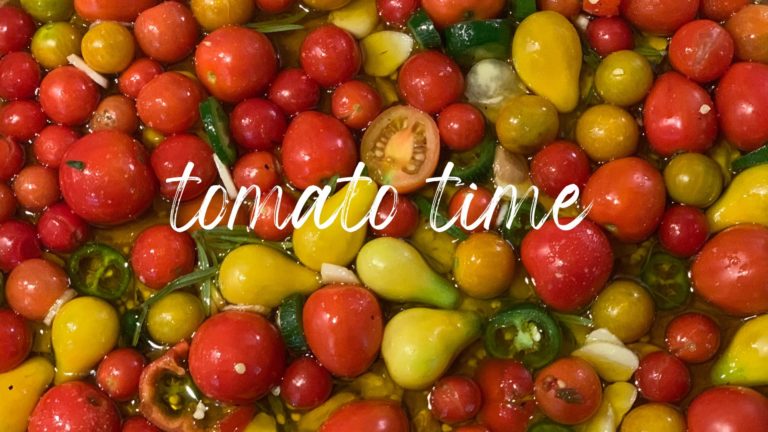
I would love to tell you we are going to have a bumper crop this year, but our tomatoes are having a hard time. They are still growing and there is fruit on the vine, but not in the quantities we had hoped, so the picture is from last year. Still, it’s a good time to talk about tomatoes.

A fair number of our cherry tomatoes get eaten as we pick them. They are like little pieces of candy on a hot summer afternoon, and then a good number of them get eaten fresh on, well, pretty much anything I can think to put them on. And still there are more. I have found two ways to cook them that make them last and taste even better; both of them take a little time, but not a lot of attention.

tomato confit

The traditional meaning of confit has to do with slow-roasting meat in its own fat (like duck confit), but the idea has expanded to include vegetables as well. As one article I read put it, confit is to deep frying what smoking is to grilling: low and slow versus fast and furious.

Here’s what you need:

enough cherry tomatoes to cover the bottom of a 9×13 baking dish
enough olive oil to come up about half way on the tomatoes
unpeeled cloves of garlic
fresh herbs (rosemary, thyme, basil)
salt and pepper

You can also add:

sliced jalapeños
peeled shallots cut in half longwise

Preheat the oven to 275°.

Cover the bottom of the dish with whole cherry tomatoes, then add the garlic, jalapeños, and shallots. Sprinkle with salt and pepper and lay the fresh herbs over the top. You don’t need to take anything off of their stems. Drizzle the olive oil over everything until it comes up a little over halfway on the tomatoes.

Roast for about 2 hours, until the tomatoes look wrinkled but are not bursting. Set the pan aside and let it cool. Squeeze the garlic out of its peel and put it back in the confit.

Put in top of everything from pasta to steaks to chicken to you name it.

I store mine in pint-sized mason jars and keep them in the fridge. Use the oil from the pan to cover them when you put them in jars.

Here’s the second variation.

oven-roasted tomatoes

The two biggest differences between this recipe and the one above are the temperature and the amount of oil you use. Oh–and you cut the tomatoes this time. My recipe is adapted from this one (and if you don’t know Smitten Kitchen, you need to.)

The ingredient list is similar to the recipe above.

enough cherry tomatoes to cover a baking sheet when halved
olive oil
fresh herbs (rosemary, thyme, basil)
salt and peper

Preheat the oven to 225°.

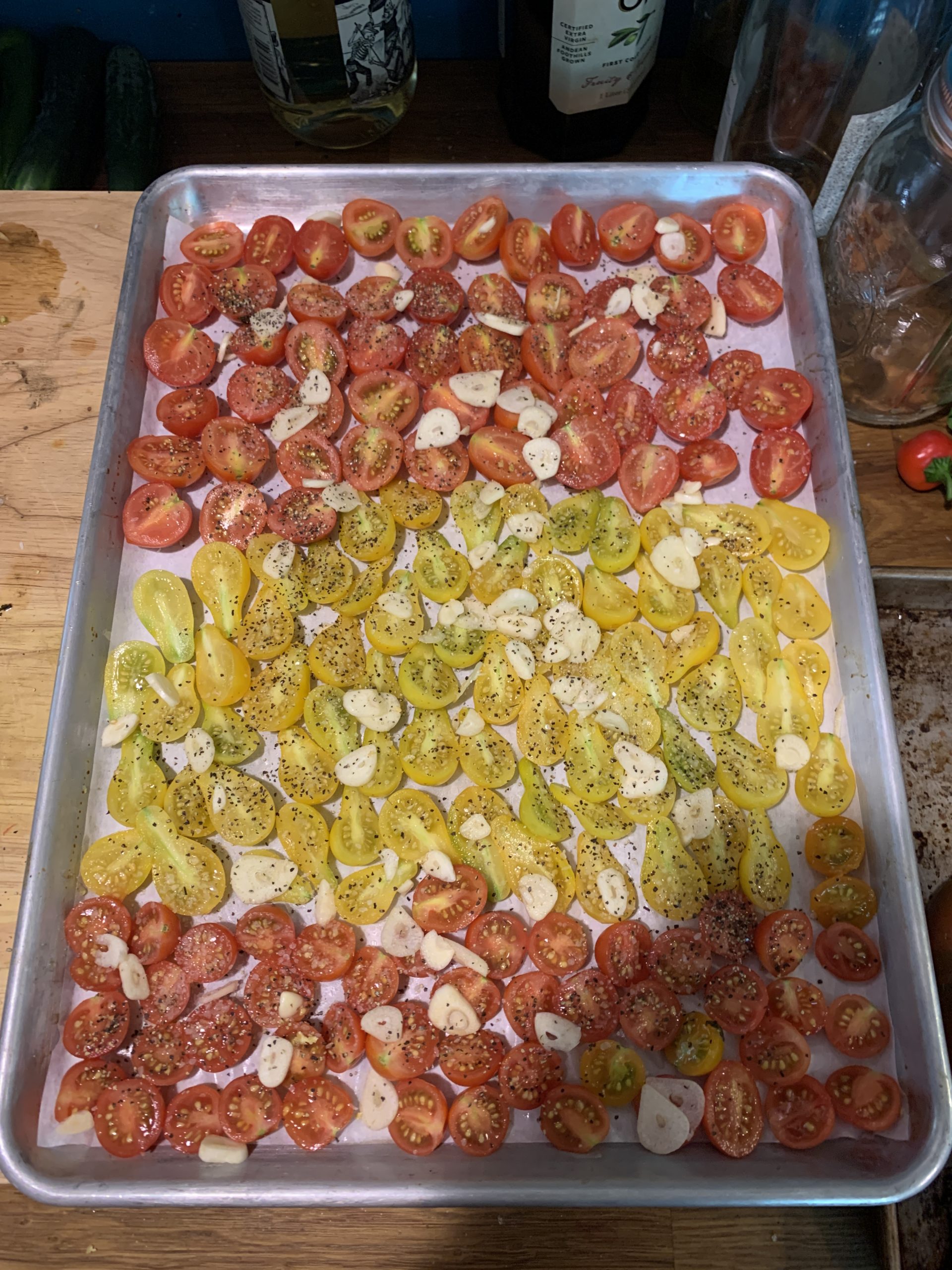
Line a baking sheet with parchment. Cut the tomatoes in half longwise (slice where then stem was) and arrange them on the baking sheet so they are close together. Get as many in there as you can. Drizzle with olive oil (you don’t want to drown these) and sprinkle with salt and pepper. If you want a little kick to them, add some crushed red pepper. Lay the herbs across the top. One again, you don’t need to pull them off of their stems.

Roast them in the oven for at least three hours. I use the cook timer on my stove, set if for three hours, and then forget about it so that they cool in the oven. They will resemble sun-dried tomatoes, but will have a little juice still left in them.

They make a great pizza topping, are wonderful on salads, and taste pretty damn good all on their own. You can also put these in pint-sized mason jars, or other airtight containers. If you do, cover the top with oil. You don’t want to drown them, but a little bit of oil will help them last. Refrigerate them once they cool, if you haven’t eaten them all.

Happy tomato days.

Peace,
Milton