Home Blog Page 99

advent journal: blue christmas

Last night before I went to bed, I pulled the box up out of the basement that holds our tree (both Ginger and I are allergic to the real ones) and we set it up in the living room. As we working, I said to Ginger, “I wonder if life was this hectic for Mary and Joseph.” We laughed. We wanted to get to it earlier. We were able to do it last night. So we cut ourselves some slack and enjoyed the lights on our tree (I wish you could see . . .). Tonight we went caroling with a group of our neighbors, which is an annual event in Old North Durham. I look forward to turning on our outside lights every night.

Still, I am finding it hard to feel in sync with the season. To feel the rhythm of the dance, if you will. When I get to Sunday mornings and am able to do my thing as the prophet, singing and reading the scripture, I feel connected to the story. Yet, somehow, I also feel a little bit like Cindy Lou Who: Where are you, Christmas?

This week our church will have our annual Blue Christmas service, which is designed to make room for the sadness and heaviness many of us carry through these days. It is one of my favorite services of the entire year, even if it’s far more quiet and meditative than is comfortable for an extrovert like me. I wish more people knew it was there. There’s enough sadness to fill the room. (Did I mention the service is 7 p.m. this Wednesday at Pilgrim UCC here in Durham?)

For all the tinsel and trappings that make up the season, the more I hear the story and work, as Meister Eckhart says, to give birth to Christ in my time and in my culture, the more I find the sadness inherent in life is intrinsic to the story. The darkness of these days is not simply something to endure to get to Christmas, these are the labor pains. The light shines in the darkness. One of the songs that always speaks to me during this season is Patty Griffin’s “Mary.” The song begins,

Mary
you’re covered in roses,
you’re covered in ashes
You’re covered in rain
you’re covered in babies,
you’re covered in slashes
You’re covered in wilderness,
you’re covered in stains
You cast aside the sheet,
you cast aside the shroud of another man
who served the world proud
you greet another son, you lose another one
on some sunny day and always stay
Mary

The angel said his name would be Emmanuel: God with us.

Who knows how many times I’ve written that sentence. It doesn’t get old to me. Here in the darkness, God with us. Even if we aren’t finished decorating.

Peace
Milton

advent journal: first lines

I was going back through some poems and found this one, so I spent a little time revising it and offer it anew tonight. Feel free to sing along.

first lines

I pulled into Nazareth was feeling ‘bout half past dead
I don’t want to hear a love song
doctor my eyes have seen the years and the slow parade of tears
headlights are flashing down the highway
I wonder if we’re gonna ever get home
a look at you all see the love there that’s sleeping
when you’re down and troubled and you need a helping hand
keep a fire burning in your eye pay attention to the open sky
you who are on the road must have a code that you can live by
you come a-walking with a scar on your soul
taking too much too lightly
you with the sad eyes don’t be discouraged

there’s a river of sorrow in my soul
there’s a river of love that flows through all times
don’t the hours grow shorter as the days go by
there are the ones you call friends
the mississippi delta’s shining like a national guitar
another turning point a fork stuck in the road
people get ready there’s a train a-comin’
you can play the game and act out the part
baby I’ve been searching like everybody else
in the middle of late last night I was sitting on a curb
where have all my friends gone? they’ve all disappeared
like a bird on a wire like a drunk in a midnight choir

I’ve been sleeping for some hours
just woke up and you were there
I will remember you will you remember me
when the road gets dark and you can no longer see
in every heart there is a room a sanctuary safe and strong
didn’t say we wouldn’t hurt anymore
people that are sad they wear a frown
it’s coming on Christmas and they’re cutting down trees
I heard was there was a secret chord
eight years old with a flour sack cape tied all around his neck
I’ve heard love songs make a Georgia man cry
am I young enough to believe in revolution

when it’s dark outside you’ve got to carry the light
the waltzing fool he’s got lights in his fingers
there ain’t nobody asked to be born
shut it down and call this road a day
we’re living in a time of inconvenience
you come home late and you come home early
we are swimming with the snakes at the bottom of the well
all the unsaid words that I might be thinking
the presence of your absence follows me
something in your eyes makes me want to lose myself
here we go again another round of blues
it was all I could do to keep from crying

oh play me a blues song and fade down the lights
so many years so many hardships
just when every ray of hope was gone
tell anybody that ain’t got nobody somebody’s coming
when I was a little boy my daddy told me mister
don’t ever try to climb too high ’cause it’s the fall that gets you
screen door slams Mary’s dress waves
we are swimming with the snakes at the bottom of the well
when you start if you exist God believes in you
I am an old woman named after my mother
I’ve been lately thinking about my lifetime
I can hear her heartbeat from a thousand miles

Peace,
Milton

advent journal: a (short) tale of two cities

I spent a huge chunk of the day working on my book. The time was one of my birthday gifts from Ginger. As I sat writing about home, I realized once again how much I have come to love Durham and the people who make it a wonderful city. Over the past few months as I have written about moving most all of my life and struggling to learn how to grow roots or feel as though I belong somewhere. In the process of writing the book, I have learned that home means different things at different times. I think more than one place in life can be home because it’s not a one time thing.

Seven years on here in Durham, after spending the day wandering around town on my fifty-eighth birthday, and still basking in the glow of a wonderful surprise Thursday Night Dinner last night, I feel at home here. I hold two cities close to my heart: Boston and Durham. I am fortunate to feel I belong to both of them.

And I had a great birthday. I feel celebrated, loved, and encouraged.

Peace
Milton

advent journal: caught by surprise

Last weekend I said something to Ginger about Thursday Night Dinner and she said, “We aren’t having dinner this week.” Knowing it was my birthday eve and knowing her penchant for birthday surprises, I took her statement at face value.

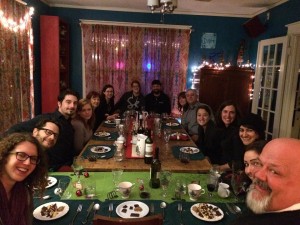
i spent the day writing and came home to find out we were going out. We went to Piedmont, a nearby restaurant, for appetizers and then Ginger said we had about twenty minutes to kill before the next event. We came back to the house to find a table filled with friends who had brought food of their own this time and we had a wonderful evening together.

I am writing tonight out of pure gratitude. I am ending my fifty-eighth year surrounded by friends and family. I do have to say it now: it’s been a good life all in all. It’s really fine to have the chance to hang around. On to the next chapter.

Peace,
Milton

advent journal: answer this question

As I was driving to and from work today I heard interviews on NPR related to what is being called “The Torture Report,” or the “Senate Select Committee on Intelligence Study of the Central Intelligence Agency’s Detention and Interrogation Program,” which looked at the secret prisons the CIA ran around the world after September 11, 2001. (And I read this summary.) They were justified as being what we needed to do to find Osama bin Laden and make the world safe again, or at least make us feel less scared.

When their practices first came to light, government officials came up with the euphemism “enhanced interrogation techniques” to avoid admitting that the people being held were being tortured. In the interviews today they were still holding that line of defense. When Robert Seigel asked rather pointedly if the ex-Congress member thought what was done was torture, Pete Hoekstra went into a song and dance about what was legal. Siegel asked if “in common language” what was done would be understood as torture. Hoekstra replied, “I can see how it could be considered torture.”

The questions I wanted someone to ask was, “If one of your family was in detention and these tactics were used on them, would you still say they were ‘enhanced techniques’?” and “When these kind of tactics have been used on our soldiers when they were prisoners of war, did we still see them as acceptable behavior?”

To justify what we have done and are doing by saying the terrorists are wicked people and we have to play their game to get them is not something I am willing to accept. It doesn’t make sense. I realize we live in a violent world. I realize there are people who want to do Americans harm. How does egregiously injuring some of them lessen the threat of their violence against us? How does imitating their inhumanity offer any chance of peace? In our fear and fury over the last decade and a half, we have spent lots of money, done lots of damage, and destabilized two countries. How has responding to violence with violence made things better?

It hasn’t.

Whatever defense is offered for our torturing uncharged detainees in secret prisons on foreign soil so they could sidestep American law cannot stand up to the question, “If these same actions were being done to someone you care about, would it still be OK with you?”

Then it shouldn’t be OK for anyone.

Peace,
Milton

advent journal: numbering the days . . .

m3

It was the summer of 1984, as I remember it.

I was twenty-seven, living in Dallas, Texas and working as a chaplain at Baylor Medical Center. My father was pastoring at Westbury Baptist Church in Houston. The ties between us were strained a bit, in large part because I was working hard to figure out who I was distinct from the man I was named for, much as he had had to do with Milton the First when he had been my age. Actually he had to figure it out earlier because his dad died before he was twenty-eight.

Some time that summer my father called and asked to come see me. He drove up from Houston and we went to dinner. He told me a story I knew already but I could tell somehow he needed to tell it again. My grandfather lived longer than any Cunningham male and he dropped dead of a heart attack (that was the phrase Dad always used) at fifty-seven. As we talked, I did the math in my head: my father was months away from his fifty-seventh birthday. He knew we were still figuring things out between us and he was on a sort of farewell tour, just in case fifty-seven was his number as well. We had a great evening together. As he left he told me he loved me and he was proud of me. And then he went on to live until a month before his eighty-fifth birthday.

This Friday, December 12, I will turn fifty-eight. Or, as my father always pointed out, I am finishing my fifty-eighth year.

Though the number didn’t scare me quite as much as it did my father, this is a moment worth marking: I am the second male in my family to live beyond fifty-seven. I am grateful for the life I have lived and hopeful for the days to come. I am planning to follow in my father’s footsteps and stretch this out for awhile longer. And tonight I am also grateful for both Miltons who preceded me, who begat me, who helped shape me.

Here’s to beginning number fifty-nine.

Peace,
Milton

advent journal: we did good

I was driving to work early this morning, as is my custom more days than not, and took my usual exit off of I-40 at Fayetteville Road. The ramp bends up and over the freeway to get to the mall and there’s a traffic signal just before the bridge. As I came up the hill I saw two cars in front of me, one in either lane and both with their flashers on. The car in my lane had seen better days. Through the back window I could see a woman sitting in the driver’s seat. A man had gotten out of the SUV in the other lane and was beginning to push the small car out of the way, though he was having some trouble because there was still a bit of an incline. I pulled my Jeep over to the side, jumped out of my car, and hit the back of the woman’s car running to give us a little momentum.

“Big Man!” exclaimed my pushing partner, and we both laughed as we got the car off to the shoulder as well. I reached to shake his hand, but he met me instead with a giant hug. “Thank you, Big Man,” he said. “We did good.” We were both smiling as we went back to our cars and on with our lives.

It was a good day.

Peace,
Milton

advent journal: it’s a privilege

On this second Sunday of the Advent season, I read the Hebrew scripture passage as if I were the prophet, which I have done for over twenty years in various congregations, and which has been preceded almost all of those years by my singing the chorus of “Prepare Ye the Way of the Lord” from Godspell. In this year’s lectionary cycle, today’s passage was taken from Isaiah 40 — the very verses that served as the basis for Stephen Schwartz’s lyric:

A voice cries out:
“In the wilderness prepare the way of the Lord,
make straight in the desert a highway for our God.
Every valley shall be lifted up,
and every mountain and hill be made low;
the uneven ground shall become level,
and the rough places a plain.
Then the glory of the Lord shall be revealed,
and all people shall see it together,
for the mouth of the Lord has spoken.” (NRSV)

Ginger began her sermon asking, “What does it mean to prepare the way of the Lord?” And then she invited us into the beginnings of a conversation about what happened in Durham over the weekend specifically alongside of a larger conversation about race in America. She quoted a blogger she had read somewhere in her preparation (and whom she was not able to identify at the time I wrote this) who defined privilege as being able to keep doing what we’re doing when bad things happen.

I am a straight, white, male. If I were only rich I would be four for four on the privilege scale. I have never had anyone follow me around in a store because they expected me to shoplift. I have never been stopped for driving white. I work hard to be inclusive and to be a part of working for a more just and compassionate world. And, for the most part, I get to keep doing what I’m doing. Her definition is powerful to me because she is not necessarily passing judgment. She is stating an important truth.

After my father died, I felt as though I needed to call all of my friends whose fathers had died before mine and say, “I’m sorry. I meant well, but I had no idea this is what it feels like.” One of the hardest things was being in a public space where people were going on with their lives as though nothing had happened. My father was dead. Yet, in their world, nothing had happened. They got to keep on doing what they were doing. While my father was alive, I lived in a state of privilege, if you will, even though I didn’t realize it.

As I listened to Ginger preach, I wrote down these words: “If we are to step out of our privilege we must embrace the grief of the world as our own. We must find a way let their grief enter our world.” My sentence didn’t answer Ginger’s question; it only added to it. How do we prepare the way of the Lord? How do we enter another’s grief?

I don’t think we can break through our privilege voluntarily, or by ourselves. I can’t just decide I’m going to be less privileged. I need something that disrupts my world view, that breaks into my life. I need a visceral experience of grief that breaks through and lets me connect to a wider world.

Though I have been a part of a number of protests, I would not call myself an activist. I am not well versed in the philosophy and logistics of how to pull off a demonstration, or why protesters do what they do sometimes. In many cities, people have blocked streets and highways, or impeded access to public venues, an approach I didn’t understand until this morning. Perhaps I should say I have come to an understanding of it. The road blockages cause the comings and goings of those on the highway to be disrupted. They can’t keep doing what they are doing. The disquietude in their day is an invitation to see beyond the inconvenience, to realize they can’t just keep on, that being human requires more of them than simply driving by.

I will admit I understand the metaphor better than I do the actual blocking of the highways. That said, I am grateful for those who risk going overboard to call me out into the grief of my world. One of the powerful implications of the Incarnation is that God did something God had never done before in experiencing what it felt like to be human, which meant leaving the privilege behind. Emmanuel: God with us.

And God was never the same after that.

Look back at the verses from Isaiah:

prepare the way of the Lord:
make the ground level
smooth out the rough spots
exalt the low places
knock down the high ones
and the glory of God will be revealed.

I’m pretty sure that means God expects more of us than a couple of carols and a pageant when it comes to living out the implications of the Incarnation in our lives, even more than a well-intentioned blog post, perhaps. Preparing the way — making the ground level — means knocking the pile of privilege on which I stand out from under myself, which I can’t do alone. Preparing the way means talking about this stuff out loud and on purpose and way beyond when it becomes uncomfortable.

But this post isn’t about trying to say I know what we need to do next. What I wanted to say was, “I’m sorry. I meant well, but I had no idea this is what it feels like.”

Peace,
Milton

advent journal: songs to sing together

The protests have been in my mind all day. Here are a few of the songs that have been the soundtrack in my mind. As we walk this Advent road, these are good tunes for the journey.

The first is a John Fogerty song covered by Mavis Staples and Jeff Tweedy called “Wrote a Song for Everyone.”

Met myself a coming county welfare line
I was feeling strung out, hung out on the line
Saw myself a going, down to war in June
All I want, all I want is to write myself a tune

Wrote a song for everyone
Wrote a song for truth
Wrote a song for everyone
When I couldn’t even talk to you

Got myself arrested, wound me up in jail
Richmond ’bout to blow up, communication failed
If you see the answer, now’s the time to say
All I want, all I want is to get you down to pray

Wrote a song for everyone
Wrote a song for truth
Wrote a song for everyone
When I couldn’t even talk to you

Saw the people standind thousand years in chains
Somebody said it’s different now, look, it’s just the same
Pharoahs spin the message, round and round the truth
They could have saved a million people, how can I tell you?

Wrote a song for everyone
Wrote a song for truth
Wrote a song for everyone
When I couldn’t even talk to you

Jackson Browne has been a part of the soundtrack of my life since high school. His latest recording holds this gem, “Standing in the Breach,” among others.

Although the Earth may tremble and our foundation crack,
We are all assembled and we will build them back.
And let’s just say the lives remain and held within our reach.
Try to put our world together, standing in the breach.

So many live in poverty while others live like Kings.
Though some may find peace and acceptance in all that living brings.
I will never understand, how ever they’ve prepared,
How one life is struck down and another life is spared.

Though the earth may tremble and cast our work aside,
Though their efforts resembled the fluctuations of time.
We rise and fall with the trust and belief and love redeems our seed.
And our backs and the hearts together, standing in the breech.

You don’t know why,
It’s such a far cry, in what this world could be.
You don’t know why,
But you still try for the world you wish to see.
You don’t know how, it will happen now after all that’s come undone.
But you know the change that the world needs now, is there in everyone.
The unpaid debts of history, the open wounds of time,
The laws of Human Nature always tugging from behind.
I want to think that the earth can heal and the people might still learn,
How to meet this world’s true challenges and if it costs their own can turn.

Though the earth may tremble and the ocean’s pitching arrives,
We are all assembled.And we will lift our eyes
To the tasks that we know lie before us and the power of our press besieged,
And lift our souls into the Heavens, standing in the breach.

You don’t know why,
It’s such a far cry from what this world can be.
You don’t know why,
But you still try for the world you wish to see.
You don’t know how,
It will happen now.
For all that’s come undone.
But you know the changes the world needs now is there in everyone.

Sarah Jarosz covered Bob Dylan’s “Ring Them Bells” and their effort will close out our song session.

Ring them bells, ye heathen
From the city that dreams
Ring them bells from the sanctuaries
’Cross the valleys and streams
For they’re deep and they’re wide
And the world’s on its side
And time is running backwards
And so is the bride

Ring them bells St. Peter
Where the four winds blow
Ring them bells with an iron hand
So the people will know
Oh it’s rush hour now
On the wheel and the plow
And the sun is going down
Upon the sacred cow

Ring them bells Sweet Martha
For the poor man’s son
Ring them bells so the world will know
That God is one
Oh the shepherd is asleep
Where the willows weep
And the mountains are filled
With lost sheep

Ring them bells for the blind and the deaf
Ring them bells for all of us who are left
Ring them bells for the chosen few
Who will judge the many when the game is through
Ring them bells, for the time that flies
For the child that cries
When innocence dies

Ring them bells St. Catherine
From the top of the room
Ring them from the fortress
For the lilies that bloom
Oh the lines are long
And the fighting is strong
And they’re breaking down the distance
Between right and wrong

May we keep marching and singing together.

Peace
Milton

advent journal: peace, officers

As soon as work was over this evening, I raced across Durham to meet Ginger at the Armory for the Durham Symphony Holiday Concert. Downtown was full of activity: something at the Durham Performing Arts Center (DPAC), a crowd around the downtown Christmas tree, and the usual folks finding their way to one of our many excellent eating and drinking establishments. As I passed the tree, I realized they were protestors joining those around the country trying to figure out how to respond the what has happened in Ferguson, Staten Island, and now Phoenix.

The concert was festive and charming. As we left, the conductor told the crowd that protestors had blocked the Durham Freeway and we might need to take an alternate route. “No alarm,” he said. “Just passing along information.” Since Ginger and I had not seen each other all day, we went into a restaurant and split the cheese plate so we could talk for a bit. As we were getting ready to leave, a group of about one hundred walked by chanting, “These are our streets.” We joined in and walked the three blocks past the Farmer’s Market and up Corporation Street. There were five or six cops on bikes who were pretty casual and considerate. One of the group threw a stone their direction and was quickly shouted down by those around him. Ginger even posted how proud she was of our police to Facebook as we walked.

At the intersection of Corporation and Rigsbee, the crowd turned left toward Motorco and Fullsteam and Ginger and I turned back to the right, to where our cars were parked and also where the police substation is. There were six or eight cars with their lights twirling and a line of cops blocking the street. As we got closer, we realized they were in full riot gear and carrying axe handle sized sticks. There were almost as many of them as there were protestors. About ten of us stood on the sidewalk and tried to tell them they were taking the wrong approach. There was no need for a power struggle. No need for a show of force. It was a protest, not combat. When the enemy didn’t show up, the makeshift army loaded onto a bus and went after them. Literally. They saw where the protestors were and blocked the street to create a confrontation. They arrested about forty people and then kept marching up the street even as the protestors went the other way. The only reason there was any sort of agitation was because the police made it happen.

Ginger called 911 three different times to report what was happening. The last time the operator asked if she would like to speak to an officer and one found her on the street. I walked up in the middle of their conversation. He said the protests had been going on for five hours and “you can’t let civil disobedience go on for five hours.” (Why not?) When she asked about the sticks, he said they were for pushing people back, not for hitting them. “They are better than guns,” he said.

“Those aren’t the only choices,” was my reply.

When I was teaching at Charlestown High School in Boston, one of the biggest lessons I had to learn was not to take personally the anger and rage some of my students. I was not the cause of their rage, though sometimes I became the target. When I could keep my senses and not get hooked into a power struggle, we could work things out. If I got hooked and we both got mad, the kid usually ended up getting suspended because I was the one with the power of the institution behind me. If I got hooked, it was because I let my fear get the best of me. Our police let their fear get the best of them this evening. How can a couple of hundred people marching and chanting be so intimidating and frightening to require our police to act as though they were in a war zone. There was no war. No battle. Just a protest: people walking down the street chanting and carrying signs.

We once referred to the police as peace officers: they kept the peace. Now they are law enforcement and some have even been given surplus weapons by the Pentagon. Rather than figure out how to foster a peaceful protest, they come to break it up, literally and figuratively, as though the creative expression of anger and frustration is dangerous in and of itself. The Durham Police had a chance to do something great tonight, to show America how a city can work together to work out its frustration and pain. And they blew it. Here’s hoping someone in blue will realize the error and do it differently the next time.

As we walked and the cops gathered, I thought of this old recording of Simon and Garfunkel singing “Silent Night” juxtaposed with the evening news. It seems like an appropriate carol to close.

Peace
Milton