Home Blog Page 6

foundation issues

I know I wasn’t the only one who struggled with what to say in my sermon today. I chose the passage a few weeks back—Luke 6:39-49—and it gave me a good jumping off place this morning. As I prepared the sermon, I kept thinking about words from King Lear I first learned reading Frederick Buechner: “The weight of these sad times we must obey, speak what we feel, not what we ought to say.”

___________________________

When I think back on Bible stories I remember as a child, one of the most enduring ones is the last parable in our reading this morning where Jesus compares building a house on the sand with building a house on a rock. Part of the reason is that it is a great image—you can picture it, even if you are not inclined toward housebuilding. And then there’s the fact that we learned a song to go with it, complete with hand motions (“The wise man built his house upon the rock . . .), which is probably the real reason it was cemented in my mind.

To live in Connecticut means to know what it means to build your house on a rock. The whole state is granite—sometimes so much so that foundations are hard to build.

Our coastlines might tell a different story. Last fall a video made the rounds of a house on the Outer Banks of North Carolina that collapsed into the sea because of beach erosion. Similar things have happened along the New England coast as well, thanks to the effects of climate change. You can bet I started singing the song as I watched the waves take the house apart (“The foolish man builds his house upon the sand . . .).

When we turn to Jesus’ use of the metaphor, which comes at the end of the sermon we have looked at for the last three Sundays, we need to look back to see what kind of foundation he called for us to build for our lives. He started off by saying that God’s Economy is built to make sure everyone gets what they need to thrive and that we all share what we have so everyone is covered, has their needs met, and is cared for. Aren reminded us that Jesus said not only should we love our enemies, but we should love one another in a way that does not demand reciprocity or repayment.

In today’s reading, Jesus challenges our arrogance with an image of trying to get a speck out of someone else’s eye when we have a small log in our own, and then switches to a say that fruit trees are known by the fruit they produce (people, too), and then he moves the person whose words and actions match each other in God’s Economy is like the one who builds a house with a solid foundation. It will withstand whatever storm is coming.

Our house in Guilford was built in 1795 as the schoolhouse for the town. It originally sat on the Town Green. Around 1830, it was moved from the Green and hauled by a team of oxen down the street to where it is now. They did not put it on a true foundation; they just stacked up some stones so it was secure and left it that way—much like the front steps of our sanctuary, which we repaired. Last year, Ginger’s church did what they could to fill in holes because of the number of critters who made their way in and out, but our foundation is not what we thought it was and that has had its consequences.

This past week, I spent the day at the Legacy Museum in Montgomery, Alabama, along with a group from Ginger’s church on a civil rights history tour. The museum is the best I have ever seen. The Equal Justice Initiative, its founding organization, presents an amazing amount of information in ways that speak to different kinds of learners without totally overwhelming them, and also offering difficult and tragic information in a way that offers people a chance to respond with something other than just outrage or guilt.

One of the things that struck me most profoundly—perhaps because I knew I was preaching about building on good foundations—was that the foundation on which we have built our country is not as solid as we want it to be. Slavery was a part of the mix—a crucial part of the mix—from the beginning. The first slave ship arrived in 1619, over a hundred and fifty years before we became an independent nation. In 1730, half of white New Yorkers personally enslaved Black people. By 1776, one in four households in Connecticut enslaved Black people. Many of the big insurance and finance companies who are at the center of our economy made their initial wealth funding and insuring the slave trade. Of our first twelve presidents, John Adams and John Quincy Adams were the only two who were never slaveowners.

I know these are hard things to hear but hang with me.

They call it the Legacy Museum because they want us to understand and come to terms with what it means that this is a part of our story as a country. It’s not the only part, and it is a significant part. The domestic slave trade permanently separated half of all Black families in the United States. Think about the implications of that for all the generations that have followed. The National Peace and Justice Memorial, which gives a visual of the thousands of Black people who were lynched, naming both the people and the towns and counties that killed them, marks the last lynching in 1957, the year after I was born, though I’m not sure those were actually the last incidents of racial terrorism.

This is not ancient history. We are still living the story. We are still building the house on a foundation that has some serious issues.

Jesus talked about how well the houses could survive a storm. (“The rains came down and the floods came up . . .) The one on the rock—the one grounded in God’s Economy of compassion and mutuality—survived. The one built on the sand—on the shifting ground of power and wealth—washed away.

You don’t need me to tell you that right now our nation—our world—is caught in the beginnings of a storm of strife and division and uncertainty. What is going on right now is not sustainable because it is not unifying. Two weeks ago, I said that the oldest meaning of the word economy is “household management,” which has less to do with supply and demand than it does with making sure everyone gets what they need. And I asked you to remember that Jesus talked about poverty, hunger, grief, and reputation, calling us to never lose sight of the fact that what we say and do and spend and eat and feel affects those around us.

How we understand our foundation—how we tell the story about how we became who we think we are, whether we are talking about our nation, our family of origin, our church, even our faith—also affects those around us. If who we think we are and who we actually are, based on what our words and actions show us to be, then our foundation will crumble and our house will not withstand the storm.

And as a country, we have not done a good job at coming to terms with the longstanding cracks in our foundation. We have to figure out how to do to our nation, our town, ourselves, what we did to our front steps when we realized they were not as strong as we thought they were. We tore them out and rebuilt them.

I realize that is a huge statement that is easier said than lived out. I also remember the sinking feeling I got when I saw the front of our church after the steps had been removed and realized how bad things actually were underneath. In the same way that we could not left the stairs without suffering a bad accident, we can’t leave things as they are and expect that things will just keep humming along.

The side of the Legacy Museum was emblazoned with a quote from Maya Angelou that read, “History, despite its wrenching pain, cannot be unlived, but if faced with courage, need not be lived again.”

The root of the word courage means heart. To be courageous is to live with our heart in it, to mean it, to do what matters most. Our courage begins in this room where we have to continue to learn to talk to each other across our differences—to speak heart to heart—and then our courage moves out in concentric circles. How can we widen the scope of our compassion? How can we engage people outside of our normal patterns? We can make a point to shop at places owned by people of color. We can learn Spanish on Duolingo. We can check in with our LGBTQ siblings to make sure they know we are there for them. We can stack the stones of a strong foundation of love and belonging to build a better foundation. Let us take courage. Amen.

Peace,
Milton

catch me

I’m working my way through Luke so I am a little off from the lectionary, but this turned out to be the right story for this past week and, perhaps, for the days to come.

_________________________

In my days as a high school English teacher, one of the books I loved to read with my students was Ernest Hemingway’s The Old Man and the Sea. I won’t say that all the ninth graders in my classes enjoyed reading the book, but I loved it because it presented such a simple and vivid picture of the old man—Santiago—chasing the big fish. Still they had a point: it’s not easy to describe that kind of struggle in a way that the reader can really get it, especially when none of us had been in Santiago’s situation.

A fair part of the story takes place after the fish is hooked and is dragging Santiago’s small boat while the old man hangs on waiting for the fish to exhaust itself. One day, a boy in one of the classes was vocal in his frustration with how long the whole thing was dragging out.

“He’s just sitting in the boat.”

The next day, I came with a big coil of rope and asked him to stand up. I secured one end of the rope to a pole in one corner of the room and then tied the other end around his waist and asked him to lean back so that the rope was taut, much the same as Santiago had to keep his line taut so the fish wouldn’t break it.

“The old man did that for a couple of days,” I said. “I want you to do it for forty minutes.” He was up for the challenge, but he couldn’t last. He still didn’t like the story that much, but he understood the old man better.

I tell you that story because I think we have to remind ourselves of how different life was in first century Galilee, compared to the world we know. That seems obvious, I know, but when we read the would-be disciples were out fishing all night, we have to work hard to picture the small, hand-carved wooden boats they sailed; or the rough ropes that made their nets; or even that they were not independent business people, but peasants who did grueling work but saw little of their profits.

We should also remember that the men in the boats were not strangers to Jesus. They were with him in Nazareth and his other stops across Galilee. In the verses between where we left off last week and today, Jesus went to Simon Peter’s house and even healed his grandmother. This is not a story about Jesus calling these people to something that hadn’t thought about.

Still, something changed in this story. They had continued to go to work, it seems, until now. Jesus got into the boat, first, to get a little distance from the crowd so he could preach to them. Simon and the others were cleaning up from having fished all night, which was the usual shift for fishers in the area. They had come back to port with empty nets, which was probably not that unusual because the pressure from the Romans for product meant that the lake was overfished.

Jesus finished his sermon and told them to sail out farther and dropped their nets. Simon must have rolled his eyes and responded with the Aramaic equivalent of, “You’ve got to be kidding me, Boss,” but he did as Jesus asked and dropped the nets. When they pulled them up, they were so full they were a problem. The nets were ripping and the boats were sinking. They barely made it back to shore with their record catch. And it frightened them. They didn’t know what to say or do.

Jesus said, “Don’t be afraid. From now on you’ll capture people.” It’s a word that means “to take them alive” and “to entrall,” the way we talk about being taken by a photograph or a dramatic performance. And Luke said they walked away, leaving their pile of fish with whoever was still on the docks, and went with Jesus. We could even say they were taken—captured—by what he said and did.

Luke makes it sound so simple—they just dropped everything and went with him—but they were allowing Jesus to change their whole view of the way the world worked.

They lived in a world of scarcity: there weren’t enough fish, there wasn’t enough money, they were oppressed by the Romans. They were accustomed to looking at the world and feeling trapped. Jesus said, “Try again. Throw the nets out one more time,” and with that came an image of abundance: more fish than they could reasonably harvest.

I wonder if it made any of them think of Jesus’ sermon in Nazareth when he quoted from Isaiah– The Spirit of God is upon me, because God has anointed me to preach good news to the poor, to proclaim release to the prisoners and recovery of sight to the blind, to liberate the oppressed, and to proclaim the year of God’s favor.—and then said, “Today you are seeing these words become flesh right before your eyes. Luke wants us to make the connection in the way he describes the turn of events.

Jesus was calling for spiritual, social, and even economic upheaval when he proclaimed the Jubilee, the Year of God’s Favor. Jesus still calls us to trust the extravagance of God, to trust that there is enough to share, that we are enough to take care of each other. And that is not a pipe dream. Even now, with eight billion people on the planet, we grow enough food in the world to feed everyone. The reasons people starve has to do with our broken systems that enforce a sense of scarcity and conflict. We have the ability to catch everyone, if we will unclench our fists and open our hearts.

Which takes me back to high school English—tenth grade this time–for Catcher in the Rye. In one of my favorite passages, Holden Caulfield asks his sister Phoebe, “You know that song ‘If a body catch a body comin’ through the rye’? I’d like—” and she interrupts to tell him he is remembering the line from a Robert Burns poem incorrectly: it was “if a body meet a body.” Then Holden says,

“I thought it was ‘If a body catch a body,’” I said. “Anyway, I keep picturing all these little kids playing some game in this big field of rye and all. Thousands of little kids, and nobody’s around–nobody big, I mean–except me. And I’m standing on the edge of some crazy cliff. What I have to do, I have to catch everybody if they start to go over the cliff–I mean if they’re running and they don’t look where they’re going I have to come out from somewhere and catch them. That’s all I’d do all day. I’d just be the catcher in the rye and all.”

Part of the reason the people in Jesus’ time were looking for the messiah was they were convinced that they were living in the last days and that things couldn’t get worse. Sound familiar? That perspective has been true for most every generation. We think we are last because we are the newest.

The eight billion people alive on our planet today represent a fraction of the 117 billion humans who have walked the earth. All of us have been in the same boat, wondering how we will make it through or who will save us from all of this. And God’s message to us remains constant: there is enough—enough food, enough room, enough love—if we will only catch each other. Amen.

Peace,
Milton

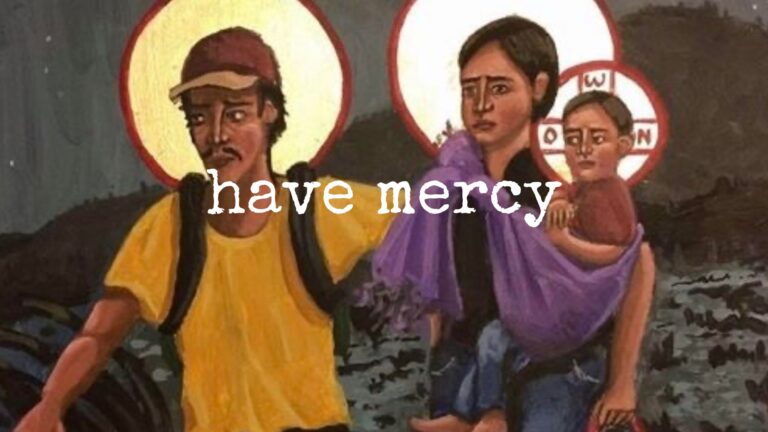
have mercy

Guy Clark has a song that says, “Some days you write the song. Some days the song writes you.” Some days that’s true with sermons as well.

_________________________

A crowd gathers for worship in a traditional setting. A preacher preaches a sermon, initially embraced by everyone. But then, at the end, the preacher reminds the crowd that the point of that “Good News” is mercy and compassion; not just for them, but also for foreigners. And suddenly the adoring crowd turns. The preacher gets death threats and flees.(from Eric Folkerth)

Some days, reading the from the gospels is like reading a newspaper.

The scene I just described may sound like Washington DC this week, but it is what happened in the passage we just read from Luke 4, which tells the story of Jesus’ return to Nazareth, his hometown. As we noted last Sunday, the scene is tied to both his baptism and his time in the wilderness where he was tempted. But this was not his first sermon. Luke notes that Jesus returned to the region of Galilee “empowered by the Spirit” and went from town to town preaching and healing and had created quite a following.

Then he came back to the town where he had been brought up, where he had been nurtured. Perhaps the synagogue where he spoke was the same one he had attended as a boy. One of those leading the service handed him the scroll from Isaiah. We don’t know if they had their own version of a lectionary or how the scripture was chosen, but Jesus turned to a particular passage and read:

The Spirit of God is upon me, because God has anointed me to preach good news to the poor, to proclaim release to the prisoners and recovery of sight to the blind, to liberate the oppressed, and to proclaim the year of God’s favor.

Then he sat down to talk to them about what he had read, and Luke says those in attendance were fixed on him. He had everyone’s attention. And he said, “Today, you have not only heard the scripture, you have also seen it embodied.”

People were raving about him and were so impressed by his words that they looked at each other and said, “Isn’t this the carpenter’s kid?”

But Jesus wasn’t through. He said, “I know you’re going to tell me to do here what I did in Capernaum, but a prophet is not welcome in their hometown.” And he went on to refer to two stories from the Hebrew Bible that they would have known well—one about Elijah and one about Elisha, both of which involved God’s grace and mercy expanding to include foreigners. The good news he brought was meant for more than the hometown crowd. God’s love knew no boundaries.

And they were enraged because he wasn’t who they expected him to be and they tried to kill him, but Jesus escaped.

If we look back what Luke has said so far, we should not be surprised at who Jesus turned out to be. When Mary was pregnant she sang a song when she visited her cousin Elizabeth, part of which said,

Holy is God’s name. God shows mercy to everyone, from one generation to the next. God has shown strength and has scattered those with arrogant thoughts and proud inclinations. God has pulled the powerful down from their thrones and lifted up the lowly. God has filled the hungry with good things and sent the rich away empty-handed.

When John began baptizing at the Jordan and people wondered if he was the messiah, he said,

“I baptize you with water, but the one who is more powerful than me is coming. I’m not worthy to loosen the strap of his sandals. He will baptize you with the Holy Spirit and fire. The shovel he uses to sift the wheat from the husks is in his hands. He will clean out his threshing area and bring the wheat into his barn. But he will burn the husks with a fire that can’t be put out.”

And then Jesus went from town to town saying he had come to offer mercy, sight, and freedom from oppression, and also to proclaim the year of God’s favor, which was another way of saying the year of Jubilee.

One of the traditions of Hebrew culture was that a Year of Jubilee was supposed to happen when all debts owed to other people were forgiven, all enslaved people were freed, and all land was returned to its original owners. It meant a fresh start for everyone.

Can you imagine what a year of jubilee would feel like? To have all of your debts forgiven? To be freed from exploitive contracts? To get back things that had been lost?

Or maybe we think about what such a year would cost us. Mercy doesn’t come cheap.

When Jesus started talking about extravagant mercy—choosing the disposition to be compassionate and to forgive—the crowd turned on him. To embody compassion in a way that made it available to everyone was too high a price to pay.

I hear the word mercy and I think of a song called “Mercy Now” by Mary Gauthier. The next to the last verse says,

my church and my country could use a little mercy now
as they sink into a poisoned pit it’s going to take forever to climb out
they carry the weight of the faithful who follow them down
I love my church and country, they could use some mercy now

Yes. We could use some mercy now. And as we read these words from Jesus’ first recorded sermon—that set the tone for his entire ministry—we hear again that we are called to be the ones offering mercy to everyone: the people we like and the ones we don’t, those who look like us and those who seem foreign, those we understand and those who confuse or even agitate us, those whom we think belong and those we wish we could exclude.

The word compassion means to suffer together, to carry each other’s pain. Let that definition sink in for a moment: to suffer together, to carry each other’s pain. Too often, our cultural message seems to be “I just want you to hurt like I do.” How then do we live so that we are sharing pain rather than causing it? How do we learn to see the pain around us and then find ways to share the load?

Jesus calls us to see the pain around us and to embody his words with what we say and do:

The Spirit of God is upon me, because God has anointed me to preach good news to the poor, to proclaim release to the prisoners and recovery of sight to the blind, to liberate the oppressed, and to proclaim the year of God’s favor.

As we contemplate what it means to be followers of Christ here in Hamden, here in America, I want to end my sermon by inviting us to read those words together as a pledge of our faith—an embodiment of our understanding of who Christ has called us to be in our time and in this place. The words are printed in your order of service. Let us read them together.

The Spirit of God is upon me, because God has anointed me to preach good news to the poor, to proclaim release to the prisoners and recovery of sight to the blind, to liberate the oppressed, and to proclaim the year of God’s favor.

Amen.

Peace,
Milton

triptych

I know the Revised Common Lectionary doesn’t point to the story of Jesus’ forty days in the wilderness until the first Sunday in Lent, but it seems to have more layers when it is taken in context between Jesus’ baptism and his sermon in Nazareth where they deemed him unrecognizable. I’ll find something else for Lent.

_____________________

The first time I heard the word “Trip Tik” was back in the days when you could go by AAA and they would help you plan your vacation. They printed out a booklet that had maps for the trip broken up in daily segments to make it more manageable.

It was years later before I realized someone at AAA must have been an art aficionado because the name of the guide was a pun on the word triptych— which isn’t spelled like it sounds. It is a word that came out of the eighteenth century to describe a painting on three connected tablets—a visual triology—and has also come to mean something composed or presented in three parts.

As we continue through Luke’s gospel, we are in the middle of a gospel triptych: the accounts of Jesus’ baptism, Jesus’ time in the wilderness where he was tempted, and Jesus’ return to Nazareth are three stories that are deeply connected.

Last week we saw that Jesus went out to be baptized to repent—to mark a change in his life. What happened in the river with John marked the beginning of Jesus’ ministry. Then, Luke says, “Jesus returned from the Jordan River full of the Holy Spirit, the life-breath of God, and was led into the wilderness. There he was tempted for forty days by the slanderer.”

It’s an odd sequence of events: Jesus walked the twenty-five miles back to town and then the Spirit led him into the wilderness—that is to say even deeper into the desert—to be tempted, which is a word, like repent, that meant something more layered to Luke (and to Jesus) than it often does to us. The word “tempted” can also be translated as “put to the test” or “put through a trial,” as if to say Jesus went out to wrestle with who he thought he was, rather than temptation being about (if I may use personal examples) how much I think about getting an ice cream cone whenever I shop at Bishop’s Orchards, or how I can hear the Salt and Vinegar potato chips calling me regardless of what food store I’m in.

Suffice it to say, Jesus had more at stake in this text than blowing his calories for the day.

Theologian Ched Myers points out that Jesus was retracing the steps of his ancestors who had wandered in that wilderness for forty years trying to figure out what it meant to be God’s people. Jesus, he says, was “driven by the Spirit deeper into the wilderness where he, like his ancestors [had to] discover what his vocation [meant].”

His baptism had culminated in God proclaiming, “You are my beloved child in whom I find delight.” Now he was alone in the wilderness where God had led him and he was hearing a voice that was not God’s and that began each challenge with, “If you are the Son of God . . . ,” a short phrase packed with self-doubt, calling Jesus to do something to prove himself.

If you are who God says you are . . .

Though Luke begins by saying Jesus was tempted for forty days, when the specific trails come it sounds as though they all happened at the very end of his sojourn. Jesus had fasted for forty days, Luke says, and he was starving. Then the challenge came: “If you are who God says you are, you don’t have to go hungry. You can make all the food you want if you just turn the stones into bread.”

Jesus answered by quoting from the Torah: People need more than bread to live.

The focus then moved to seeing things through the eyes of position and power. If you are who God says you are, pledge allegiance to those who say they have the power and you can have it, too. Worship the empire and you can share in the spoils. Take everything because you can.

Jesus went back to the Torah: We worship only God.

The last of the trials had to do with avoiding suffering by leaning on his position and privilege. If you are who God says you are, then jump off of the pinnacle of the Temple and make the angels catch you.

Jesus quoted one more verse from Deuteronomy: Don’t test God. Actually, it could be translated “don’t tempt God” because it is the same word that is used when the translation says Jesus was tempted.

There is an interesting similarity between the trials Jesus faced and the specific actions John the Baptist gave when people asked him what repentance looked like. John said, if you have two tunics, give one away to someone in need; if you are a tax collector, collect only the legal amount and don’t cheat others for your own gain; and to the soldiers he said, don’t use your power to extort others. They are not exact parallels, but we can here resonant themes of what it means to be a child of God. John was calling people to change their lives and to demonstrate that change in the way they incarnated the love of God in their words and actions. Even though we are in the crosshairs of a winter storm instead of a desert wind, we have to face similar questions:

If we are who God says we are . . .
. . . will we allow our need or our appetites to alter our integrity?
. . . will we give into the seduction of power and influence?
. . . will we take advantage of our position and privilege when it serves us?

The temptations didn’t offer Jesus a whole different life, or even a chance to run away from responsibility. They offered the choice to be content with a different version of himself—a lesser version. Instead of one who would use his miracles to heal and to teach, he could use them for personal gain. Instead of speaking truth to power, he could ally with those in charge to gain power for himself. Instead of facing suffering, he could use his privilege to avoid it and be on easy street.

And these trials were not a one-time occurrence. Jesus stared them down over and over throughout his ministry. The tests he faced in the wilderness were examples of what he faced almost every day: to use who he was and what he could do as a way to make his life more comfortable and powerful.

Over the past couple of years, a quote from a friend has attached itself to this story of Jesus’ time in the wilderness. I learned it when I was going through a time that tested my sense of myself and required me to make some difficult decisions. He quoted wisdom from another friend who said, “We either choose our losses or we lose our choices.”

Let me repeat that: we either choose our losses or we lose our choices.

When we are willing to risk beyond what feels safe or comfortable, we see things in ourselves and in our world that we did not see before. We create possibilities, as Jesus did coming out of the wilderness in this second part of our gospel triptych. From there, he went back to Nazareth, his hometown, which is the biblical story we will tell next week as we see the last panel of the triptych.

In the meantime, let us carry these questions into the days ahead:

If we are who God says we are . . .
. . . will we allow our need or our appetites to alter our integrity?
. . . will we give into the seduction of power and influence?
. . . will we take advantage of our position and privilege when it serves us?

We, like Jesus, choose how we live and relate to those around us. May we choose to live and speak and act as those who know they are beloved children of God created to love and serve one another as we travel this journey of life together. Amen.

Peace,
Milton

dropping our guard

I found some new things (well, new to me) as I read the story of Jesus’ baptism this year. Here’s what I said in my sermon.

___________________________

When it comes to Bible stories, particularly the ones we have heard during Advent and Christmas, and now going into the season after Epiphany, we often carry a sense of familiarity, as though we really understand the details of the story. We forget to remember that we don’t really have a grasp of what life was like in first century Palestine. We don’t often think about what people ate, or what their houses were like, what they did for work, or remember that they had to walk to get from place to place.

For the most part, the gospel accounts are not concerned with many of those details. As we have noticed before, they leave out a lot of stuff, from how much time has passed between events to the tone with which things were said.

Keep that in mind as we look at and listen to John the Baptist as he spoke to those who had come to be baptized. First of all, understand that he was at the Jordan River, which was close to the distance of a marathon from Jerusalem. Most everyone who came out to hear him had walked there and would have to walk home. There were no hotels along the river, nor were their restaurants. Yet, Luke says, crowds came. They wanted to hear what he had to say.

And John greeted them by saying, “You children of vipers!” (Probably not the welcome they had hoped for.) Then he told them they needed to repent—to change their hearts and minds—or they would be cut down like a dead tree and used for firewood. (Another comforting image.)

We might expect that they would have been at least taken aback, if not offended by his words; instead, they wanted to know more. (Which might have surprised John.)

They said, “Okay—so what should we do?” Don’t just yell at us–help us understand how to change.

That’s what the word repent meant in those days: to change your heart and mind. We are accustomed to thinking it means to be sorry for what we have done wrong, but it is larger than that, and more hopeful. John wasn’t calling them to simply be remorseful, he was calling them to pay attention to their lives and their relationships, to not allow themselves to simply go through the motions, to take an honest look at their lives and do things differently.

In response to their questions, he gave them practical things to do to help them understand what a changed life looked like: if you have more than you need, share it; don’t cheat others in your business for your own gain; and don’t use your power to your advantage.

All of those changes meant letting go of the way they were used to living, and to make changes that needed to happen; still, another word for change is loss. To change the way we live means to lose our comfort and the way we are used to being in the world.

Not too many chapters away from where we read this morning, Jesus said, “Lose your life to find it,” which is another way of calling us to change.

Now I get to tell you my favorite thing that I learned this week.

Our word lose comes from an old Norse word that meant “to disband an army.”
What it means to lose our lives is to disband our security forces, to let go of what we think we need to be safe so we can find out what it means to be faithful and compassionate.

We get lost in other ways as well. In our hymn “Love Divine, All Loves Excelling,” we sing of being “lost in wonder, love, and praise,” which means dropping our guard so that we can truly feel the presence of God. We can lose ourselves in a piece of music or a great story. When we are with the ones we love, we lose track of time.

As I offer those images, I don’t want to overly romanticize what it means to lose someone or something. My mother would have been 93 today. She died nine years ago this week. Since her death, my brother and I have both had to learn how to disband the armies we used to distance ourselves from each other and learn how to be family.

To disband our armies, for whatever reason, means to leave ourselves unprotected, which is risky and scary and hopeful all at once. And when we choose to feel vulnerable, love finds us.

The way the gospel writers tell it, Jesus didn’t make the trip out to the Jordan to see his cousin just to put on a show. He came to be baptized. He came to mark a change in his life, to repent. For thirty years he had lived in Nazareth. We don’t know what he was doing, though we could guess he might have worked with Joseph as a carpenter. And then he made a change—he repented—and that started with coming for baptism. He was not the same after that.

Luke doesn’t have all of the details included in the other gospels, but the image he paints is interesting. Look at the phrasing in the verse: “When everyone was being baptized and Jesus also was baptized and was praying, the heavens opened up.” Much like we said when we talked about the scene of Jesus’ birth and new understanding that the Greek word doesn’t mean inn, but means “a guest room,” which meant Jesus was born in the middle of a crowd, his baptism was in the context of a larger community as well.

There in the middle of the swirl of people and water, Jesus (and perhaps everyone else) felt the breath of God and heard a voice say, “You are the child I dearly love; I find delight in you.”

The story with John calling people baby snakes and ends with God saying, “It’s you! I ADORE you!” in response to Jesus’ commitment to change—his repentance—so he could grasp who he (and everyone else) were in God’s eyes.

Jesus walked back from the Jordan as a changed person, as we shall see in the weeks to come as we move through Luke’s gospel. He began to teach and preach and travel in ways he had not done before. When he finally got back to Nazareth, they hardly recognized him because of the strength of his compassion and focus.

As followers of Christ, we are called to repent. We are called to keep taking honest looks at ourselves, even when things seem to be going pretty well. We are called to see where we have become complacent or overly comfortable, where we have allowed our protective forces to camp for too long such that we have lost sight of who we are in God’s eyes. To fully grasp what it means to be wonderfully and uniquely created in the image of God and worthy of love (“It’s you! I ADORE you!”) means to risk that same kind of love in what we say and do.

With that in mind, I want to ask you a few questions. These are not things you have to answer out loud. Think of them more as a guided meditation. Make sure you are sitting comfortably. Close your eyes if you like. When you hear God’s call to repent, to change your heart and mind, what or who comes into your thoughts? What armies do you need to disband inside yourself so that you can lose yourself in loving God and others? Who do you know who needs to hear that they are wonderfully and uniquely created in the image of God and worthy to be loved? What practical things can you do to help them see that love?

As we ponder these things, may we remember that repentance is not a one and done kind of thing. It is a way of life. A way of being. A way of choosing to keep disbanding armies and opening our hearts every chance we get. Amen.

Peace,
Milton

star struck

The magi show up every January and those of us who step into pulpits are expected to talk about them. Here’s where their journey took me this year.

____________________________

The magi are among my favorite characters that show up in the story of Jesus’ birth because we don’t really know who they were. Some translators call them wise ones; others, scholars. The word magi is just a transliteration of a Greek word that can mean magician, sorcerer, astrologer, or a sage from another religion.

They didn’t make it to the manger. A close reading of Matthew’s account implies that Jesus, Mary, and Joseph stayed in Bethlehem for some time—maybe a couple of years.

The magi appear to be trusting souls. First, they followed a star because they trusted it would lead them to someone special. Second, they went to see King Herod because they were looking for a spiritual leader and they thought he would know about it since he was the actual king. Apparently Herod didn’t because he became agitated and angry, so much so that Matthew said everyone in Jerusalem felt the force of his wrath.

Herod pulled himself together and pulled the magi aside to try and get all the details and then asked them to promise to come back and report exactly where they had found the child. When the travelers became aware that the king was not someone who had anyone’s best interest at heart other than his own, they didn’t go back to the palace and home by another way so Herod could not find them.

Sometimes the magi are referred to as kings, but they don’t appear to be people with a lot of political power. They appear to have some financial means to travel across the desert, and the brought expensive gifts, but they didn’t make any claims for themselves other than to tell of the star that had led them.

Herod, on the other hand, guarded his power—except that he wasn’t the real power. He was called Herod the Great, yet he was on the throne in Palestine only because the Romans let him sit there. When he caught wind of the young messiah, he saw Jesus as a threat, not a source of hope and love. Where the magi searched out of wonder, Herod acted out of fear. The sages looked at the child and saw possibilities; Herod saw Jesus as a a problem to be dealt with.

Where our reading stopped this morning makes it seem as though this part of the story ends when the magi slip out of town without Herod knowing. I have heard and preached worthy sermons about the value of knowing when to go home by another way. That’s an important lesson.

But the story continues, and it troubles me a bit. Listen to the next few verses.

When Herod knew the magi had fooled him, he grew very angry. He sent soldiers to kill all the children in Bethlehem and in all the surrounding territory who were two years old and younger, according to the time that he had learned from the magi.

What I have been wrestling with is that these good-hearted, well-meaning sages who came looking for the messiah set terrible things in motion with their inquiry.

Hear me clearly: I am not saying the magi were responsible for the death of the children Herod killed. What I am saying is they did not have control over, nor could they foresee, the consequences of their words and actions. And I have spent a few days wrestling with what we can learn from them as we think about how we choose to live.

The fact is that Herod was a wicked, evil, mean, and nasty man and would have hurt anyone whom he thought threatened his hold on the throne. If the magi had gone back and told him what he wanted to know, he would have done the same thing and gone on a killing spree. They didn’t cause the massacre—and he appeared to have learned about Jesus’ birth from the travelers’ honest and trusting questions.

Let me circle back to where I began: I love the magi. I love their sense of hope and wonder. I love that they were willing to take off across the desert because they saw a star that intrigued them, that spoke to them, even though they had no idea where it was leading them.

What I want to hold in creative tension with that is that the world—then or now—is not that simple. They followed the star and didn’t look at much else. Herod was simplistic in his worldview as well, seeing his power as the only thing that mattered.

As we share in the wonder of the magi, we can also learn from them. When our lives become centered around only one thing, we can lose sight of our place in the world, our connectedness, and the impact and consequences of our choices. Jesus said life was about two things: to love God with all of our being, and to love our neighbors as ourselves, which, when you listen closely, means life is about a whole web of relationships. Time and time again, when people challenged Jesus about things he did because he was going against tradition or breaking a law, he responded by telling his accusers to look around and to look at more than the one drum they were beating.

When we are tempted to reduce what matters to one issue, we need to look around, to see beyond ourselves. And this is where we need each other to be God’s messengers. Much like the angel came and told the magi to go a different direction, we can help each other see the bigger picture, whether that is to look for guidance like the star, or to become aware of consequences we may not see. We need to help each other find other ways to go that remind is life is complicated and wonderful.

We are all inundated by voices claiming that their one issue or angle is the truth with a capital T, that what they have to say is all that matters. Sometimes we can fall into a similar kind of tunnel vision on issues both great and small and lose sight of the relationships that sustain us and the God who calls us to choose those relationships over any single issue. We can’t see everything that’s coming, but we can see how the call of Christ calls us beyond ourselves. Following that call will lead us to live lives of love. Amen.

Peace,
Milton

growing

This week sermon looked at two texts, one from Luke and one from Colossians. Alongside of the reality that we don’t know much about how Jesus grew up is the picture of who he grew up to be: who he became. How do we continue to become, to grow?

___________________

One of the realizations that repeats itself for me during Christmastide is that we only know a small slice of Jesus’ life. The gospels are not exhaustive biographies, running over into two or three volumes. They weren’t trying to tell us every detail. They were telling the heart of the story that mattered to them. Mark, for instance, starts with John the Baptist standing out in the desert. John spends half of his gospel telling the story of the last week of Jesus’ life. Matthew and Luke highlight different details about Jesus’ birth, as we have read over the past few weeks, but it takes one verse in Luke for Jesus to grow up, which Lynn just read. I will repeat it the way I learned it as a kid:

And Jesus grew in wisdom and stature and in favor with God and people.

Jesus didn’t come into the world fully formed, physically, emotionally, mentally, or physically. He had to grow and grow up, like every other human being. He had to become the person we see in the gospels, which meant he had to choose to grow and learn from the people around him and the things that happened to him.

I wish we had more stories about when he was a kid. Many years ago, a singer-songwriter named Rich Mullins wrote a song called “Boy Like Me/Man Like You” and he wondered,

well did you grow up hungry? did you grow up fast?
did the little girls giggle when you walked past?
did you wonder what it was that made them laugh?

did you ever get scared playing hide and seek?
did you try not to cry when you scraped your knee?
did you ever skip a rock across a quiet creek?

Jesus had experiences, encounters, and conversations that shaped him. Out of those things he chose to be the messiah he became, even as he came into the world as the incarnation of God. He experienced emotions, tragedies, accomplishments. He grew in wisdom and stature.

Maybe this is a funny thing to say about the Christ Child, but he had to learn that the world didn’t revolve around him.

What I mean by that is he had to learn how to live in community, how to be a We and not just an I, how to grow into the person who said that the two great commandments were to love God with all of your being and to love your neighbor as yourself.

In our second passage, which is part of Paul’s letter to the church in Colossae, which was a town in what we know as Greece, he was writing to people whose circumstances were quite different from the way Jesus grew up, even though they were not so far away geographically. Paul wrote, as he did in most all of his letters, to challenge and encourage people to grow in their faith. He knew, as we do, that we are all wonderfully and uniquely created in the image of God and worthy of being loved, and he knew that we have to choose to do something with that love if it is going to make a difference in our lives and in the lives of those around us.

And he used the metaphor of a wardrobe—of clothing—to talk about it:

Dress in the wardrobe God has picked out for you: compassion, kindness, humility, quiet strength, discipline. Be even-tempered, content with second place, quick to forgive an offense. Forgive as quickly and completely as the Master forgave you. And regardless of what else you put on, wear love. It’s your basic, all-purpose garment. Never be without it.

That is the translation from The Message, which works to say things in contemporary language, and sometimes gets a little too hip. That last sentence can also be translated, “And cover everything with love, which is the bond that leads to maturity.”

To mature is to grow. We, like Jesus, have to learn that the world doesn’t revolve around us. We, too, are shaped by our experiences and relationships. From those things and the way we choose to internalize those things, we become who we are—and that becoming continues until we die. We may stop growing in stature—in fact, we even start physically shrinking a bit as we age (in height, anyway)—but we do not have to stop growing in our capacity to incarnate God’s love among and between us. We can continue to mature, if we choose to continue to learn all that God’s love has to teach us.

Paul listed attitudes and actions as though they were garments: compassion, kindness, humility, grace, forgiveness, love. It strikes me that none of those things can be reduced to a single garment.

His metaphor of a wardrobe reminds us that we need to dress for the occasion, for the moment, much like we dress for the different seasons. What we wear in the summertime is not adequate for our winters. To put on our big coat in August makes no sense. Misty and foggy days like today, with temperatures that are not at an extreme make hard to know what to wear, so we dress in layers.

We clothe ourselves to match our circumstances. So it is with the way we respond to and live with one another. Compassion is not a one-size-fits-all proposition. Neither is kindness, or humility, or forgiveness. We try things on and sometimes they don’t fit. We wear the wrong thing and learn not to dress that way again. And, though the world does not need more fashion critics, we need to grow in trust so we can help each other by saying what looks good and what outfits might need to be retired.

That’s why clear and open lines of communication are important. That’s why we don’t give anonymous feedback. We speak the truth in love. And we have to learn how to do that and practice with each other.

We have to learn and grow and mature, just like Jesus did. As we mature, we create a greater capacity for us to grow together—and by that I mean both grow at the same time and grow closer to one another.

I will close with the words our scripture readers say at the end of each reading: May God grant us wisdom to learn from these words. Amen.

Peace,
Milton

advent journal: put the heart in

The last Sunday in Advent is always a hard one for me because it’s hard to find something fresh to say, which is why I bounced off of a passage from Philippians today. Here’s where it took me.

____________________

I’m going to take a risk with you this morning: I’m going to start two sermons in a row talking about Christmas movies.

Okay, so it’s not that big a risk.

One of the consistent things at our house during the holidays is we watch Hallmark movies. For the most part, the plot is the same and the actors change. Someone has to go back home because of a crisis of some sort, or because the big corporation they work for wants to buy the town, and they meet up again with an old love. Then they have to choose between corporate and community, between power and love.

And—SPOILER ALERT—love wins.

One of the reasons the movies continue to be popular is that’s a good story line. It feels good when love wins, particularly when it doesn’t always feel that way in real life.

Another tale that we tell every Christmas is the story of our faith, which is also a story about love and the promise that love is stronger than life or death or power or whatever else love encounters, but it is not a plot line that fits neatly into a formula or ties up all the loose ends. Life and love both have lots of loose ends. One of the difficult things about telling the story again is it can feel predictable—like a Hallmark movie.

What I mean is we can, perhaps too easily, allow ourselves to think, “I know this story,” without letting it settle into our hearts and the tangle of loose ends our lives hold on this particular Christmas, both personally and collectively.

Perhaps the many layers of loose ends we see in our systems and institutions emphasize the reality that we live in a nation—and perhaps a world—obsessed with power and money. The people who consistently get attention are those with both, and many of them spend a lot of energy clamoring for more. The people who are consistently not only left out but are often demonized are those who have very little.

Leading up to our most recent presidential election, the two candidates raised and spent almost four billion dollars. I don’t even know how to imagine how much money that is. I can put it in this context: The average SNAP benefit—what people get a month to help them buy food—is $187. A month. That four billion dollars would pay that bill for over twenty-one million people.

Instead, we got to see attack ads.

Paul wrote his letter to the Philippians understanding full well what brazen power can do. He had been in Roman prisons. He had seen how the empire destroyed families and even nations. He wasn’t writing a Christmas letter to the young church, but he was telling the same story of how love speaks truth to power—and he used it to call people to live out that love in the way they treated one another.

He said, “Adopt the attitude that was in Christ Jesus: Though he was in the form of God, he did not consider being equal with God something to exploit.”

Jesus wasn’t born to take control. We have heard and said it so many times that we can miss the shock of it—God entered the world as a baby, as a helpless human being born into a family without influence or privilege.

The incarnation of God is an act of love, not power. Jesus didn’t come to conquer or take over. He came to join with us as a human being, to show us how to live into our humanity, into our lives as those wonderfully and uniquely created in the image of God and worthy to be loved.

Paul said that is the foundation for how we treat each other:

“Therefore, if there is any encouragement in Christ, any comfort in love, any sharing in the Spirit, any sympathy, complete my joy by thinking the same way, having the same love, being united, and agreeing with each other. Don’t do anything for selfish purposes, but with humility think of others as better than yourselves. Instead of each person watching out for their own good, watch out for what is better for others.”

As we hear those words, let’s go back to Bethlehem.

When you imagine what Jesus’ birth was like, what do you picture? Is it a staid, even stark, scene like our little nativity here? At Ginger’s church, the littlest ones are the animals for their Christmas pageant and they are encouraged to dress as their favorite creature, so there are bears and lions and dinosaurs and Poohs and Eeyores all gathered to welcome the baby. I don’t know how the tradition started, but its good theology.

The word in Luke 2 that the King James Version translated as “inn” really means guest room. Some families had an extra room they rented out; that is to say they had two rooms. The manger was in the room—not in a barn—because the animals were brought inside for safekeeping at night, into the room that was also the kitchen and the bedroom and whatever else it needed to be. Jesus was born in the middle of it all, into the middle of a big welcoming mess.

With that image in mind, here these words again: “If there is any encouragement in Christ . . . .”

The root of the word courage means heart, so to encourage is “to put the heart in” whatever it is we do and say, to not just go through the motions out of habit or duty; to not let ourselves go along with things because that’s just the way things are; to choose not to take the easy road of cynicism but to choose the challenge of hope; to imitate Christ by not exploiting our advantages but seeing them as ways to, as Paul said, watch out for what is better for others.

I know. It’s the same old story. But it’s a great story. And this time around, we are the ones in the movie, if you will, we are the ones that have the chance to tell the story of how God’s love alive in us can change things when we encourage one another, when we put our hearts in it. Amen.

Peace,
Milton

advent journal: live and learn

live and learn

“the only way to learn is to live”

the words came from
a fictional librarian
who lives in a story
about consequences
an old word that means
what comes next after
whatever we said
or did or didn’t do
which we can’t see
until we live through it
and that makes me
want to flip the thing

the only way to live is to learn

to learn means to be
cultivated and to live
is to continue or remain
the way to continue
is to be cultivated
to fill the furrows of
our brows with what
has come next as we
plow our way through
one thing after another
so our days add up to a
story worth telling

living and learning
are chicken and egg
whether we’re talking
sequence or consequence
we must continue
to be cultivated and
remain attentive to
whatever is coming
remember the end of
the world is long overdue

Peace,
Milton

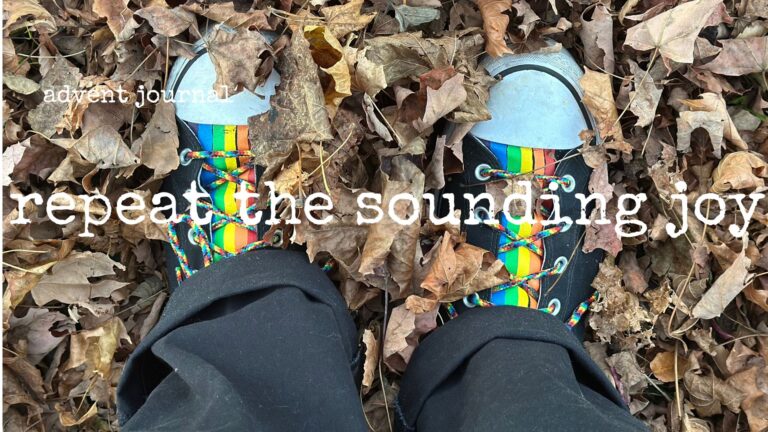
advent journal: repeat the sounding joy

One of our favorite Christmas traditions is watching—no, rewatching—movies. We have several that we need to see at some point during the holidays to make the season feel complete: “It’s a Wonderful Life,” of course; “Christmas in Connecticut” with Barbara Stanwyck; “The Preacher’s Wife” with Denzel Washington and Whitney Houston; Bill Murray’s take on “A Christmas Carol,” which is called “Scrooged;” Will Ferrell in “Elf;” and “The Family Stone,” which has a cast full of great actors in a story that is both heartfelt and hilarious about what it means to be family.

After a chaotic scene where a number of the story lines come tumbling in on each other in the big kitchen of the family home, one of the sons—Ben (played by Luke Wilson)—leans back on his pillow with his arms behind his head and in a voice that carries a tone of wonder and amazement says, “Repeat the sounding joy.”

He says it with such beautiful force that always gives me pause—and he says it before the big mess that has the family pulling in different directions has been sorted out.

I, like pretty much all of us, have sung that line every Christmas of my life in “Joy to the World,” but I had never really thought about what it meant until I saw “The Family Stone” and heard Ben speak the words: repeat the sounding joy.

Part of what Isaac Watts was communicating in his hymn was that to be joyful was to join the chorus of creation that is already making a joyful noise.

joy to the earth, the savior reigns
let all their songs employ,
while fields and floods, rocks, hills and plains,
repeat the sounding joy

We are not singing a new song; we are repeating the rhythm of all that is swirling around us. We are repeating what we hear—if we are listening, which is what it takes to make good music: first we listen, then we sing.

Poet David Whyte writes,

Joy may be made by a practiced, hard-won achievement as much as by an unlooked for, passing act of grace arriving out of nowhere; joy is a measure of our relationship not only to life but to death and our living with the constant companionship of our immanent disappearance, joy is the act of giving ourselves away before we need to or are asked to, joy is practiced generosity.

And then he says,

To feel a full and untrammelled joy is to have become fully generous; to have allowed ourselves to be joyful is to have walked through the doorway of fear: a disappearance, a giving away, overheard in the laughter of friendship, the vulnerability of happiness itself and the vulnerability of joy’s imminent loss, felt suddenly as a strength, a solace and a source, the claiming of our place in the living conversation, the sheer privilege of being in the presence of the ocean, the sky, of two people dancing at sunset—and from nowhere, a sudden surge from the unknown tide now filling our lives—I was here and you were here—and together we made a world.

I was here and you were here—and so were the rocks and trees and mountains and flowers and animals—and together we made a world.

When Paul wrote to the Philippians, he made it clear that joy was a choice:

Rejoice in God always! Again I say, rejoice! Let your joy show in your treatment of all people. God is near. God is here.

Let your joy show in the way you treat people. Another translation reads, “Make it as clear as you can to all you meet that you’re on their side, working with them and not against them.”

Repeat the sounding joy.

Now I am going to repeat some things you already know, but they are worth saying again.

Joy is not a feeling; it’s a choice. It is a choice to engage, to listen, to pay attention. David Whyte is right when he says that sometimes it catches us by surprise, but we still choose to be open and receptive, and we have to choose to repeat what is sounding around us. And that is true of all the things represented by our Advent candles: hope, peace, joy, and love.

All of them are choices. Acts of will. Things we have to decide to do. So are cynicism, conflict, self-centeredness, and apathy. Joy is not the only song being sung around us. If we choose, we can see the world as one where survival is what matters most, which means I have to get what’s mine because it’s everyone for themselves. Though we hear that song blasted at high volume all around us, it is not the song of creation. It is not the song we were made to sing. It is not the song carried by the magnificent moon that hung in the sky last night, or by the smiles we share with one another when we sit together in coffee hour.

To choose to repeat the sounding joy—or the sounding hope and peace and love—is not being naïve about the reality that life is painful. Being joyful does not mean to ignore our grief. To choose joy is to go beyond our fear, to dig deeper than our sorrows, and to trust that at the bottom of life the joy and hope and peace and love are still sounding.

It is also to choose to help others hear the song. As I said at the start, we are repeating what we hear all around us. When we see others—perhaps even those sitting on the pew with us—who can’t hear the song because it is being drowned out by other noise, we can choose to sit with them and sing until they can sing it too.

God is near. God is here. So are we. God is with us.

As Ginger likes to say, life is holy and life is quick. The days we have as part of the choir of creation don’t last long, but they are rich and crammed full of the presence of God—so say the rocks and the trees, the squirrels and the sunshine, the full moon and our broken hearts.

God is near. God is here. God is with us. Repeat the sounding joy. Amen.

Peace,
Milton