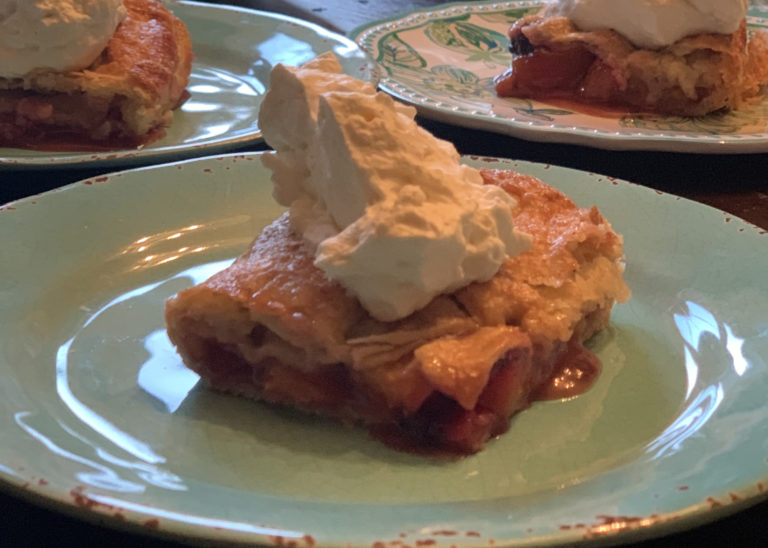
I have made this pie several times over the years, but when I made it most recently while we were in Durham, a friend asked for the recipe. I am slow in finally posting it, but here it is. The crust is versatile. You can use if for most any slab pie. And there are lots of different to fill slab pies. This just happens to be one of my favorites. You can also make an apple version of this by pretty much doing everything the same and just substituting apples for the fruit.
peach and blueberry slab pie
For the crust:
5 cups all purpose flour
1 tablespoon kosher salt
2 teaspoons sugar
1 pound (4 sticks) cold unsalted butter, cut into small cubes
12 to 16 tablespoons ice water
Process flour, salt, and sugar in a food processor until combined. Add butter. Process until mixture resembles coarse meal, about 10 seconds. With machine running, add ice water in a slow, steady stream just until dough comes together. (Do not process more than 30 seconds.)
Turn the dough out and divide it in two portions with one slightly larger than the other (this will be your bottom crust). Flatten both into rectangles about an inch thick and wrap with plastic. Refrigerate at least 1 hour (or overnight).
For the filling:
10 cups peaches, pealed and sliced
2 cups blackberries
1/2 cup brown sugar
1/2 sugar
1/4 cup corn starch
1 tablespoon lemon juice
1 teaspoon cinnamon
1/2 teaspoon nutmeg
1/2 teaspoon salt
Egg wash for brushing crust,
Cinnamon sugar for sprinkling on crust.
Place peaches in a bowl after cutting. Drizzle with 1 tablespoon lemon juice.
In another bowl mix both sugars, corn starch, 1 tablespoon of the lemon juice, cinnamon, nutmeg, and salt and whisk until well mixed. Pour the sugar mixture over the peaches and toss to coat. Set aside.
Preheat oven to 375 degrees F. Take the pie crusts out of the fridge.
Spray a 13 x 18 baking pan (I used a half sheet pan which is 13 x 18 inch).
Roll out the first pie dough on lightly floured surface until it hangs over the edge of the baking sheet by about an inch. Place it in the baking sheet. Use your fingers to push into the corners and up the sides of the pan.
Pour the peach mixture into the pan and spread it out so it is level.
Roll out the top crust so it just comes to the edges of the baking sheet. Lay it on top of the peaches and then fold the overhang of the bottom crust over the top to seal it. I don’t crimp the edges like I would for a round crust; I like it to look a bit more rustic.
Cut vents in the top of the crust. Brush with the egg wash and sprinkle with cinnamon sugar.
Place in you preheated oven and bake for about 45 minutes; go a little longer, depending on how dark you like your crust. Remove the pie from the oven and allow it to cool. Slice into squares once cooled. (I slice it into squares.)
I know I haven’t been here in a while. I’ll explain that another time. For now, I am preaching today at United Churches in Durham, Connecticut and I thought I might as well post my sermon since I have it written as a way to be back in touch. The passage is John 6:1-14: John’s version of Jesus feeding the multitude.
____________________________
One of the maxims in life that I think holds true is that our answers are often only as good as our questions. The best example I can give you comes from the old Pink Panther movie where Inspector Clousseau is checking into a hotel and sees a small dog sitting next to the desk.
“Does your dog bite?” he asks.
“No,” says the clerk. So, Clousseau reaches down to pet the dog who growls and bites him.
“I thought you said your dog did not bite,” Clousseau exclaims.
The clerk drolly replies, “It’s not my dog.”
Our answers are only as good as our questions.
Our story from John’s gospel swings on two pretty good questions.
In John’s version of what we have come to call the Feeding of the Five Thousand, an astoundingly large mass of folks has followed Jesus, hoping to hear him speak and see him heal people. They had not gathered for some planned event. As best we can tell, as we fill in the blanks with our sacred imagination, they had not come expecting to be fed. They wanted to hear Jesus. But as he looked out on the crowd it sparked a question that he aimed at Phillip.
“Where can we buy some bread for these people to eat?”
Another minister I know made an interesting observation that has stuck with me. She pointed out that Jesus was rarely the host when it came to hospitality. He hosted the meal on the night before his death and he cooked breakfast for Peter and the others the morning after his Resurrection. Other than that, his idea of hospitality was to go to others, to let them welcome him into their world. It is a powerful observation about how real inclusion involves figuring out how to meet the other person on their terms, not ours. And, after reading this story again this week, I think she missed one of the meals that Jesus hosted: the one right here. He wasn’t cooking, but the whole scene unfolds because Jesus asks where they can buy bread to feed everyone. The crowd had followed him quite a distance, but they had no expectation of being fed. They weren’t calling out for food. They wanted to hear him speak. They had heard about the healing he had done of both body and spirit. But Jesus knew a hungry crowd when he saw one, and so he asked Philip a question.
“Where can we buy some bread for these people to eat?”
John is quick to point out, as he retells the story decades later, that Jesus “knew what he was going to do” but asked to see how Phillip would respond. We have been conditioned to think that means that Jesus already knew he was going to do a miracle, which is one way to understand it, but what if Jesus’ question was more about trying to get them beyond the logistics of crowd control; what he was going to do next was teach them more about who he was.
Phillip answered quite concretely, “We don’t have enough money to give everyone a cracker, much less a meal.” He had no imagination beyond the futility of how much it would cost.
Even though Jesus was talking the Phillip, the conversation was in earshot of the other disciples. Andrew, who it seems had paid more attention to who was in the crowd, mentioned that he had seen a small boy with a lunch of five barley loaves and two fish, but then he added, “But what good is that for so many people?”
Our answers are only as good as our questions. Andrew asked a good question, though he had no idea what was coming next.
His question gave Jesus an opportunity to move beyond Phillip’s declaration of scarcity. What good is a little boy’s lunch in the middle of a hungry crowd? Jesus’ answer, by his actions, was that it was enough. Jesus knew they didn’t have money to buy bread for everyone, but the little boy who was willing to share what he had opened the door for a miracle.
The whole thing swung on the kid. John doesn’t describe the interaction with the boy, or tell us if he was with his family, or even how he and Andrew came to know each other. We can assume that Andrew didn’t just take the kid’s lunch like a playground bully. The boy must have offered it. He was willing to believe his little lunch could feed more than just himself.
Jesus took the lunch and blessed it, handed it to the disciples who began to distribute it, and everyone ate, and they ended up with leftovers, all because of the faith of a little child who trusted that there would be enough.
As one who used to work as a chef, I have to smile at how John makes the meal sound so easily done: they took the little lunch, passed it out to more than five thousand people, and everyone was happy. I worked for years as a professional chef and one of my jobs was running a wedding hall that held three hundred people. It took an incredible amount of planning and coordination to get dinner on the table. I don’t even know how to begin to think about over five thousand.
When any of the gospel writers often talk about “the crowd,” they do so as though it was some kind of cohesive unit, but let’s think about that for a minute. Over five thousand people had gathered on the hillside to listen to Jesus. As one who has a hearing disability, one of the first things I question is how the folks in the back even heard what he said without any amplification. If you think about when you have been in a large crowd, you know it does not move as a unit. Things start in one place and ripple out, like the wave in a packed stadium. When Jesus said, “Make the people sit down,” I picture the ones in front responding to the disciples’ request and the instructions rippling back until everyone was seated. If the disciples were the only ones serving the meal, it would have taken hours to distribute the food; the passage actually says that Jesus was the one who fed everybody and the disciples just collected the leftovers—which makes me think, perhaps, a big part of the miracle was in the way “the crowd” began to see one another as people: they had to share and cooperate so everyone could eat.
Remember Jesus’ question: Where can we buy bread for these people to eat?
Remember also that John said Jesus knew what he was going to do when he asked the question. Maybe so. Jesus knew he was going to feed everyone with what he had, and when Andrew pointed out the little boy with the loaves and fish, Jesus had all he needed: one person—one child–who was willing to share what they had.
Let me give you a personal example of why that matters.
I am going to have to have knee replacement surgery in the fall. I had my right knee done a little over two years ago; this is the second step on my way to becoming the Bionic Man. This week, I had conversations with two different people that centered around my surgery. Both were sympathetic. Both offered to help, but in different ways. One said, “After your surgery, if you need me to go to the grocery store or to pick food up for you somewhere, I would be happy to do it.” The other said, “Let me know how I can help.”
Both meant well, but it was the first one who made the difference for me because they were specific. They had taken time to think about me, about my surgery, about what they could offer and then they said, “Here’s what I have.” They knew I am the cook at home. They knew I am the one who does the shopping. They offered specifically to do what I will not be able to do, without making me come up with what I needed from them.
Trying to think of how we can save the world is a lot like Philip asking how they could afford to feed the crowd: it’s overwhelming and incapacitating. We can’t meet the needs of the world. But if we think about how we can share what we have with specific people, if we tune our hearts to see the needs in front of our faces, then we can make a difference in their lives and ours. We can all be fed, both literally and figuratively, because we have enough. We just have to be willing to share with one another. Amen.
it’s the periodic experience
of lostness in the supermarket
when I turn down the baking aisle
to find it is filled with crackers
my points of reference have been
relegated to the rubbish heap
if I want to find food I will have
to learn a list of new addresses
they do it on purpose, you know
because they know convenience
breeds complacency, familiarity
if it’s easy to find what I want
how will I ever imagine new needs
or what I might do with gochujang
I only have to make two turns to
get from my house to the store
the landmarks are not as easy
to move as the pasta and pet food
but I turn right instead of left
and then down a side street
without a street sign just to see
what has been there all along
one yard is decadent with daffodils
two houses host for sale signs
someone is changing aisles
I make a couple of turns and
come out in an unexpected place
surprised to find a new way home
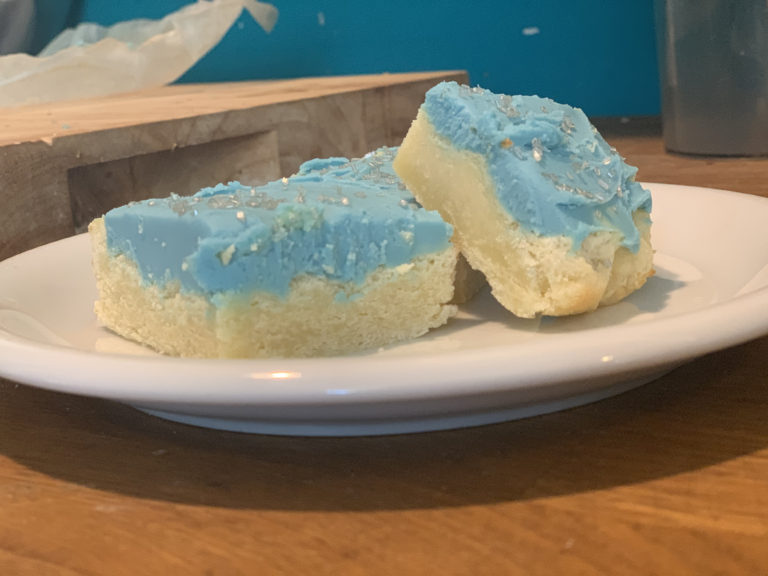
Ginger begins her sabbatical this week. She asked me to bake cookies for her staff meeting on Tuesday as a little going away present. This recipe had crossed my field of vision over the past couple of weeks, so her request gave me a chance to play with it a bit. Ginger loves a soft cookie, buttery icing, and pretty much anything lemon. When we lived in Durham, our friend Laura dubbed Ginger as “Sparkles,” which led to Ginger’s Instagram name, @sparklypastor, even though she is not on the app very much. A little blue food coloring to make a turquoise cookie (her signature color), some silver sparkles and I give you . . .
sparkly pastor bars
For the dough:
1 cup butter (2 sticks) at room temperature; plus 2 tablespoons for greasing the pan
2 3/4 cups (350 grams) all-purpose flour
1/2 teaspoon fine sea salt
8 ounces cream cheese, at room temperature
1 1/2 cups sugar
1 large egg
1 tablespoon lemon extract
For the frosting:
6 tablespoons (3/4 stick) at room temperature
2 cups confectioners’ sugar
1 tablespoon milk or heavy cream
1 teaspoon fresh lemon juice
1 teaspoon lemon extract
1/4 teaspoon salt
a drop or two of gel food coloring (optional)
sprinkles (optional)
Preheat oven to 350°.
Lightly butter a 9-by-13-inch baking dish. (Mine is Pyrex; you may also use a metal one. Line the dish with parchment paper so that it is taller than the short sides by about two inches. This will let you pull the bars out when they cool.
Whisk flour and salt together in a medium bowl; set aside. Beat butter and cream cheese in a stand mixer on medium speed with the paddle attachment until well blended–about one minute. Scrape down the sides with a rubber spatula and add the sugar; beat the mixture until smooth–another minute or so. Add the egg and lemon extract and beat on low speed until well combined–that’s right: about one minute. Scrape down the sides again. Gradually add the flour mixture, mixing on low speed just until blended–wait for it: about one minute.
Use the spatula to scrape the dough into the prepared baking dish and spread it into an even layer. I put a little butter or Pam on my hands and spread the dough out. Bake for 20-25 minutes, just until the edges are starting to turn light golden brown, and a toothpick inserted in the middle has moist crumbs. Let the toothpick be your guide more than the browned edges. This cookie should be soft and seem a little underbaked in the middle.
Take the dish out of the oven and set it on a wire rack. Let cool completely–probably an hour or so. When it is fully cooled, remove the bars from the pan using the overhanging parchment paper.
For the frosting, beat the butter in the bowl of a stand mixer on medium speed (using the paddle) until creamy–dare I say it: about one minute. Add one cup of the confectioners’ sugar, and beat on low speed until fully combined; add the second cup and repeat . Add the tablespoon of milk or heavy cream, the teaspoon of lemon juice, the lemon extract, salt, and food coloring and beat on medium speed until the frosting is light and fluffy, scraping down the sides halfway through–about four minutes. Add a little more milk or cream if you need to thin out the mixture.
Spread the frosting on top with a spatula (I use an offset) and decorate with sprinkles. Cut into bars and serve. (I cut six by four.)
My Sparkly Pastor said these are the best cookies I ever made.
If I had the chance to go back and rewrite Keeping the Feast: Metaphors for the Meal, I would do a better job of explaining why a chapter on baseball belongs in the book. For tonight–Maundy Thursday and Opening Day (even though it got rained out)–I pulled some of what I wrote in the chapter as food for the journey.
——————————-
I love sports as a fan, not an athlete, and I am a particular fan. I love baseball most of all because it is the sport most full of stories, the sport where the fans matter most, the sport that is about making errors and coming home. In a piece James Carroll wrote in the Boston Globe called “Baseball Communion,” he said:
The game means nothing, but while it’s on, the game means everything. The game belongs to the players on the field, but their performance is insignificant unless beheld. Thus watching becomes, intermittently, the most intense of human acts. Famously a mere pastime, what lifts baseball out of the realm of triviality is the meaning the fans attribute to it. A ballpark’s grandstands, therefore, matter as much as the lined field. The broadcast, too, becomes absolute, as entire populations pull up chairs.
I read his words and I think of the great cloud of witnesses in Hebrews 12:1. Baseball is a great metaphor for how God would organize the world because failure is essential to both.
I can better explain my attachment to failure, perhaps, by saying I am a lifelong fan of the Boston Red Sox. I was born in Texas, grew up in Africa, and have always pulled for the Sox, even when all I knew of them were the games we could get late at night on Armed Forces Radio. The Red Sox are my team. In 1967, I was in sixth grade and living in America for only the third year of my entire life. My parents were on leave from the mission field and we lived in Fort Worth where I walked each day to Hubbard Heights Elementary School, which was my first experience beyond kindergarten in an American school. Both my brother and I marveled at the kids in our class who had lived in the same house their entire lives. We were outsiders. As I tried to find my way into American life that fall, the Red Sox made an amazing late season run and won the pennant on the last day of the season. In those days when television didn’t control the sports schedule and there were afternoon games, even in the World Series. As I prepared to leave for school one morning, my dad said, “Would you like for me to write a note so you can come home and watch the Sox play this afternoon?” That moment defined my father in my mind. In later years, when I felt alienated from my family, his question reminded me I could not write him off. I don’t remember what I said other than yes. I do remember walking home right after lunch and sitting on the couch with him as the Sox came back from being down to force a seventh game and raise our hopes they would win their first championship in fifty years, only to lose the game, break my heart, and made me a fan forever.
Jesus spent a good deal of time talking about losing our lives, our pride, our place in line. He did little to climb the ladder to any sort of social or economic standing, choosing instead to surround himself with those who were accustomed with not being Number One. We share the Communion meal following his command to remember his death, which Frederick Buechner described as the “magnificent defeat,” or, in parlance of my high school students, “epic fail.” We come to the table to remember the failure, both his and ours, and to forgive and feed one another. This is how God organizes the world.
For ten of the years we were in New England, we lived in an 1850 row house in the downtown neighborhood of Charlestown. Both the house and the neighborhood had survived a myriad of changes, but since the house was built two things had remained the same: it was always located on a dead end, one way street and it faced a park, which was deeded as a “mother’s rest.” The house had neither a front yard nor air conditioning, which meant sitting at the open kitchen window was basically sitting on the sidewalk. One summer morning, I was sitting there drinking my coffee with my friend Billy when a boy about seven or eight entered the park carrying a baseball bat. He had the whole place to himself. After wandering around a bit, he did what countless other boys had done. He picked up the bat, stepped up to an imaginary plate in a crowded imaginary ball park (Fenway, I assumed), and prepared to face whomever was pitching that particular afternoon. I looked up from my place in the stands in time to hear him swing and say, “Strike one.” He stepped back, dusted off his tennis shoes, and stepped back into the batter’s box. Another swing. “Strike two.” This time we put down our coffee cups and became part of the scene, imagining it was the bottom of the ninth and everything was riding on the next pitch. We knew the script. He was going to hit it out of the park. We prepared to celebrate, even though he didn’t know we were watching. He leaned in and slowly tilted the end of the bat back and forth above his head. Then the pitch. “Strike three,” he said, and dropped the bat. His bat. His game. His pitcher. His imagination. And he struck out. Billy and I were both dumbfounded and, somehow, we understood. Failure is an organizing principle of our existence. . . .
Baseball marks time in ways other sports do not because it is fundamentally about two things: making errors and coming home. When we come to the Communion Table, we remember Jesus’ death, which Frederick Buechner called “the magnificent defeat,” and we offer one another fellowship and forgiveness. . . .
To know God knows what failure feels like strengthens my faith because I’m reminded that what lies beyond failure is love rather than success. We are always going to strike out more times than we hit it out of the yard, therefore we need each other to tell the stories and remember we are not alone. James Carroll says, “The game affirms the normalcy of physical communication with another — and with many others. That communion, we understand from an early age, is what we live for.” Therefore, we step up to the plate, if you will, to break the bread and share the cup remembering how God organizes the world: Jesus’ magnificent defeat, our own spectacular failures, and the grace that saves us all.
This post started because a friend posted a video with a song title I recognized, but it wasn’t the song I knew. It did however send me back to a song embedded deep in the soundtrack of my life that I needed to hear today on behalf of friends who are hurting deeply–and also for myself. Most of the songs tonight fall in that category. As we move into the heaviest days of Holy Week I offer these songs of lament and loss. You may have heard them if you’ve been around me much. Then again, a good song is worth listening to over and over.
The video for “Don’t Give Up” is as compelling as the song itself because Peter Gabriel and Kate Bush are in a constant embrace through the whole song.
in this proud land we grew up strong we were wanted all along I was taught to fight, taught to win I never thought I could fail
no fight left or so it seems I am a man whose dreams have all deserted I’ve changed my face, I’ve changed my name nut no-one wants you when you lose
don’t give up ’cause you have friends don’t give up you’re not beaten yet don’t give up I know you can make it good
I can remember the first time I heard Tracy Chapman. The song was “Fast Car.” I still love that record. The last track on her second album is the one I keep coming back to: “All That You Have is Your Soul.”
here I am, I’m waiting for a better day a second chance, a little luck to come my way a hope to dream, a hope that I can sleep again and wake in the world with a clear conscience and clean hands ‘cause all that you have is your soul
so don’t be tempted by the shiny apple don’t you eat of a bitter fruit hunger only for a taste of justice hunger only for a world of truth ‘cause all that you have is your soul
oh my mama told me ‘cause she say she learned the hard way she say she wanna spare the children she say don’t give or sell your soul away ‘cause all that you have is your soul
When John Mellencamp came out with Scarecrow it changed the way people thought about him. He was no longer Johnny Cougar. We can all sing “Pink Houses,” but one of the songs in the middle of the record is my favorite: “Between a Laugh and a Tear.”
when paradise is no longer fit for you to live in and your adolescent dreams are gone through the days you feel a little used up and you don’t know where your energy’s gone wrong
it’s just your soul feelin’ a little downhearted sometimes life is too ridiculous to live you count your friends all on one finger I know it sounds crazy just the way that we live
between a laugh and a tear smile in the mirror as you walk by between a laugh and a tear and that’s as good as it can get for us and there ain’t no reason to stop tryin’
When Jonatha Brooke wrote “Ten Cent Wings” that’s what chicken wings went for at Happy Hour, and where she got the inspiration for an amazing song.
I will love across the borders, I will wait until it’s dark I will fly and you’ll be with me, my wings, your heart then our memory may fail us, and our language will go too but the shooting stars will catch our celestial view
ten cent wings, I’ll take two pin them to my sweater and I’ll sail above the blue ten cent wings, tried and true orbiting like satellites I’ll sail away with you
Emmylou Harris is probably best known for “Boulder to Birmingham,” when it comes to grief songs, but “Bang the Drum Slowly” is the song she wrote after her father died. Her lament fits the losses we live with in these days.
I meant to ask you how when everything seemed lost and your fate was in a game of dice they tossed there was still that line that you would never cross at any cost
I meant to ask you how you lived what you believed with nothing but your heart up your sleeve and if you ever really were deceived by the likes of me
bang the drum slowly play the pipe lowly to dust be returning from dust we begin bang the drum slowly I’ll speak of things holy above and below me world without end
Patty Griffin’s record American Kid is the album she wrote after her father died, which happened around the same time my dad died. “Wild Old Dog” is one of the most visceral metaphors of what it feels like to find God in grief, or, perhaps, to understand how deeply God feels our grief. During Holy Week, I hear it as a crucifixion song.
God is a wild old dog someone left out on the highway I seen him running by me he don’t belong to no one now
it’s lonely on the highway sometimes a heart can turn to dust get whittled down to nothing broken down and crushed in with the bones of wild old dogs wild, old dogs
I bought Bookends when I was I school and the song “Old Friends” has haunted me ever since. I think I am finally starting to understand it.
old friends, old friends sat on their park bench like bookends a newspaper blown through the grass falls on the round toes of the high shoes of the old friends
old friends, winter companions, the old men lost in their overcoats, waiting for the sunset the sounds of the city sifting through trees settle like dust on the shoulders of the old friends
can you imagine us years from today sharing a park bench quietly? how terribly strange to be seventy
old friends, memory brushes the same years silently sharing the same fears
On the record, it was paired with “Bookends,” as it is in the video I found.
time it was, and what a time it was, it was a time of innocence, a time of confidences long ago, it must be, I have a photograph preserve your memories; they’re all that’s left you
One of the perennial favorites on my soundtrack is Pierce Pettis. I am going to let him close us out tonight, not with a song of resolution as much as a call to tenacity–to keeping on. This is “Hold on to That Heart.”
Molly works on the children’s ward the ones that aren’t gonna make it she holds those little hands and says a prayer sometimes she just can’t take it
I lay me down to sleep pray my soul to keep if I die before I wake slouching at the bar she says some people are hard they look at me like I’m crazy
I say hold on to that heart hold on to the love you know hold on to that heart Molly don’t let go
he picks up the telephone she says how you doing he says I’m alright no that’s wrong but I’m getting through it
said I used to have a wife used to have a life it wasn’t that long ago she says you’re going through hell I have been the myself but you can be strong I know
she says hold on to that heart hold on to the love you know hold on to that heart boy don’t let go
whatever is honest whatever is true whatever is loving and lives in you Think on these things and hold on . . .
I had a dream the other night about a huge reservoir. I was standing on the banks, taking it in. I didn’t go in the water and I don’t remember much else that happened, other than I was aware that the body of water that stretched out in front of me was my anger.
I woke up with the realization, or perhaps I should say finding words for the realization, that as I get older, I am getting angrier. I don’t mean the sort of grumpy-old-man-get-out-of-my-yard kind of mad. I mean I can feel that reservoir of anger growing in my soul, expanding its banks. I can feel the power there, the possibilities.
For someone who grew up in a family that prided itself on not getting mad, that growing lake feels like progress because there is much to be angry about.
My father grew up in a home where his father and stepmother yelled at each other. He was determined not to create that kind of home, so we weren’t allowed to yell. The lesson I internalized, which was not necessarily the one he was teaching, was I wasn’t allowed to get angry. As I learned that Jesus said, “Be angry and don’t sin,” it led me to think that perhaps anger was not the problem but a reality: we have a great deal to be angry about; we should be angry–and we should do the work to figure out what that anger can fuel or, if I stay with my reservoir metaphor, what the anger can water and feed, or even flood.
Anger is the deepest form of compassion, for another, for the world, for the self, for a life, for the body, for a family and for all our ideals, all vulnerable and all, possibly about to be hurt. Stripped of physical imprisonment and violent reaction, anger is the purest form of care, the internal living flame of anger always illuminates what we belong to, what we wish to protect and what we are willing to hazard ourselves for. What we usually call anger is only what is left of its essence when it reaches the lost surface of our mind or our body’s incapacity to hold it, or the limits of our understanding. What we name as anger is actually only the incoherent physical incapacity to sustain this deep form of care in our outer daily life; the unwillingness to be large enough and generous enough to hold what we love helplessly in our bodies or our mind with the clarity and breadth of our whole being.
I won’t quote the whole essay (though I’m tempted), but I will pick up at the end.
But anger truly felt at its center is the essential living flame of being fully alive and fully here, it is a quality to be followed to its source, to be prized, to be tended, and an invitation to finding a way to bring that source fully into the world through making the mind clearer and more generous, the heart more compassionate and the body larger and strong enough to hold it. What we call anger on the surface only serves to define its true underlying quality by being a complete and absolute mirror-opposite of its true internal essence.
When we think about anger, at least in its public expression, we think about rage–the way my dad thought about not yelling–so on this day in Holy Week when we have to come to terms with Jesus turning over the tables in the Temple we wonder why Jesus “lost his temper.” I’m not sure he lost anything. He wasn’t out of control. He wasn’t on a tirade. He was, to use Whyte’s words, full of compassion for those about to be hurt.
Maybe part of the reason anger grows with age is because pain and grief do as well. Sadnesses stack up over time. The aches and pains of living develop a constant level that offers a grinding reminder of our mortality every time we stand up. The fundamental loneliness of existence is more and more apparent, as does the superimposed inequity that divides us.
As I talked about this with my spiritual director last week, she led me to asking how anger could be a spiritual practice: how I could feed the reservoir, channel it?
Anger creates streams of compassion because it requires me to change in order to not be consumed. Letting the lake continue to rise breeds disaster. Flooding. Whole towns and villages washed away downstream. But a regulated river offers hydro-electric power. An irrigation ditch feeds a field. My stream of thought takes me to Norman Maclean:
Eventually, all things merge into one, and a river runs through it.
As I think of Jesus turning tables, I am mindful that he never got to feel what it is like to be old. He knew what it felt like to know death was inevitable, but he didn’t get to age. I am becoming increasingly aware as I age that I feel more isolated. A big part of that is my hearing loss: I am more isolated because I just can’t hear well. The pandemic has made apparent, or at least emphasized, that I live a long way from a lot of the people that I love most dearly and that is probably not going to change. Not being able to go see them has made the distance more visceral. As I said, grief increases with age.
Early on in coming to terms with my depression, one of the definitions offered that made sense was that depression was anger turned inward. The words don’t cover everything, but they hold a good bit of truth. This past year, I read Johan Hari’s amazing book Lost Connections where he posits that depression is profound grief. That sent resonating ripples across the reservoir of my soul. I am angry and grieving just like everyone else is one of the ways I hear Whyte’s words that anger is the “deepest form of compassion,” and it makes me think of one of my favorite passages in literature:
“Real isn’t how you are made,” said the Skin Horse. “It’s a thing that happens to you. When a child loves you for a long, long time, not just to play with, but REALLY loves you, then you become Real.”
“Does it hurt?” asked the Rabbit.
“Sometimes,” said the Skin Horse, for he was always truthful. “When you are Real you don’t mind being hurt.”
“Does it happen all at once, like being wound up,” he asked, “or bit by bit?”
“It doesn’t happen all at once,” said the Skin Horse. “You become. It takes a long time. That’s why it doesn’t happen often to people who break easily, or have sharp edges, or who have to be carefully kept. Generally, by the time you are Real, most of your hair has been loved off, and your eyes drop out and you get loose in the joints and very shabby. But these things don’t matter at all, because once you are Real you can’t be ugly, except to people who don’t understand.”
To the sentence that ends, “. . . you get loose in the joints and very shabby,” I would like to add, “and you lose your hearing.” I am angry. I am grieving. I am not alone.
My continuing conversation with Rob Walker led me to these words today:
Next time you have dinner planned with someone you care about, arrive (or plant yourself nearby) early. And do nothing. Observe the world; think about the person you’re about to see; cleanse your mental palate of other obligations or distractions. A significant moment deserves a considered prelude. Be ready.
prelude
maybe that’s the way to think
about the days between now
and when we finally get to hug
and smile unemcumberedly
to shed tears that won’t
get caught in our masks
waiting expectantly is not the
same thing as passing the time
can we foster our exhaustion
water our lives from the
growing reservoir of anger
let despair become a doorstep
we know the day is coming
life will not always be this way
if a significant moment does
deserve a considered prelude
I have continued to meander through Rob Walker’s The Art of Noticing. A couple of days ago, as hew was talking about taking in the soundscapes around us, he quoted artist Marc Weidenbaum:
“The world is a museum. You are the docent.”
I decided to let those words guide my writing tonight, after a loving nudge from Ginger to re-engage the practice of my Lenten journal.
a short un-guided tour
first, let me say
the exhibit holds more
than you can possibly
take in on one visit
those who know it best
come back daily
to look at the same things
that are never the same things
and to notice what
is missing and what has
been added or found
stop look and listen feel
free to touch most anything
it is all breakable, irreplaceable
we have no permanent exhibits
things to notice today:
the screaming baby just hit
the same pitch as Paul in the
middle of the na na na nanana nas when
he screams, “Judy, Judy, Judy . . .”
the beam of light across the
steeple is the shade of orange
Van Gogh was looking for
and never could find
not really . . .
but that would be pretty cool
I will leave you to your senses
and let you find what you find
while I notice that today
two people asked me
how long it had been
since I talked to my brother
and then late this afternoon
I called him by mistake
and we both laughed
at the same time
I need to sit with that memory
before it fades away
you can show yourself out