Two years ago today, my good friend David Gentiles died. Losing someone that close brought new feelings for me. Yesterday marked nine weeks since we buried my father-in-law, who was the first of our parents to die. The grief of these days is new to me, but as I sat in church this morning, for reasons I don’t know, it struck me that what is new to me is not new.
What has been is what will be, and what has been done is what will be done, and there is nothing new under the sun. Is there a thing of which it is said, “See, this is new”? It has been already in the ages before us. (Ecclesiastes 1:9-10)
If we’re talking about grief, it shows up early on just east of Eden when Cain killed his brother Abel. Whatever else we might find in that story, grief is front and center. Death and loss show up in the first chapter and have kept repeating their performances. From the beginning, we have had to learn without all the pieces of our hearts intact. Grief entered the story early, along with jealousy and anger, but so did grace and hope and redemption. Even God’s love is not new. It is, in fact, the very raw material of all creation, the very stuff that brought the universe into existence, long before humans came on the scene convinced that we were the most essential element and nothing of great significance – or, certainly, more significance – than ourselves had ever happened.
One of my favorite readings of the Creation Story was new to me when I was in seminary, though it dated back to Irenaeus in the second century. He felt Adam and Eve were created as children and God’s admonition to stay away from the Tree was to give them time to grow up. Their sin in eating the fruit was in growing up too fast and thinking they knew better than God.
There is nothing new under the sun.
As I think about what is new to me, whatever the feeling or experience might be, I realize we go through life much like the explorers before us “discovering” things that were already there. The only people who thought Columbus discovered America were those back in Spain who thought they were the center of their very limited universe. To people already on the “undiscovered” land had known about it for centuries. As I discover new experiences, new ages, and new feelings I am stumbling on to well-trodden paths as though I am the first to walk there. What I am feeling is not new. I am, instead, connecting with a memory older than time itself, offering me the chance to feel humility, resonance, wonder, and hope alongside of my grief.
Yesterday I waited on a man at the computer store who had his daughter with him. He held her the whole time we were talking. She had jet black hair that framed her young face and black eyes that glistened they were so dark. She smiled every time I looked at her. “Your daughter is lovely,” I said. “How old is she?”
“She has a birthday tomorrow,” he replied. “She will be two.”
She was born the day David died. As one heart as big as the world left the planet, this young one found it all new. I wonder as I wander . . . .
This afternoon, I found myself singing Joni Mitchell’s “The Circle Game,”which describes a boy growing up from a child to adulthood. The chorus sings:
and the seasons they go round and round and the painted ponies go up and down we’re captive on the carousel of time we can’t return we can only look behind from where we came and go round and round and round in the circle game
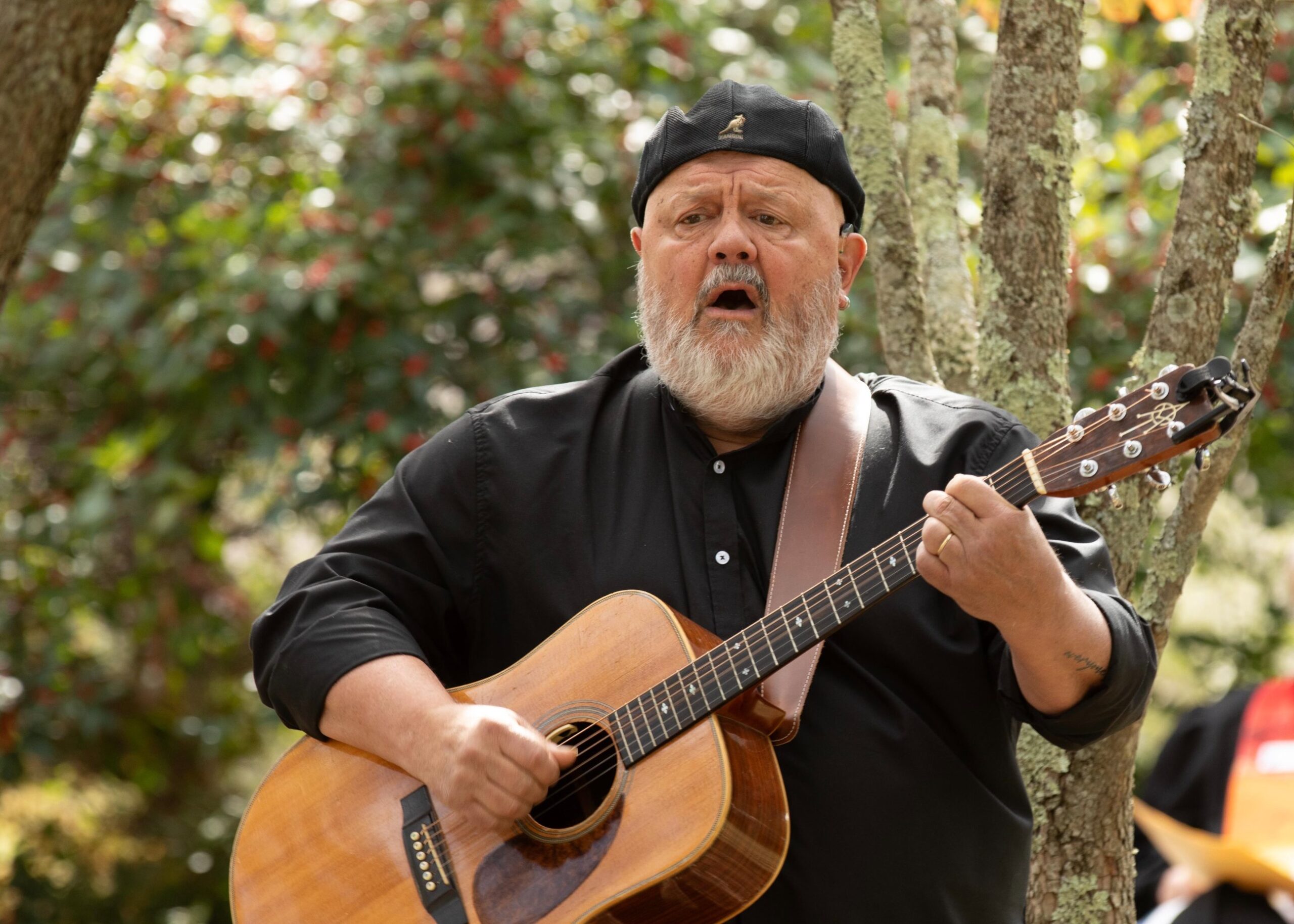
This morning, I finished my Advent stint as the prophet. After four seasons here in Durham, some of our children don’t know of Advent without me. As I turned to face them when I reached the back of the sanctuary as the congregation and I were finishing the song, I could see the three and four year olds singing, “Prepare ye the way of the Lord.” Circling round the seasons to do again what we have done before, to look for new eyes and new ears, to pray for Christ to be born again in our time and our culture is at the heart of what it means to be both hopeful and human. It’s not about looking for what is new but remembering what it true.
What is true is we were created with the capacity for wonder, with the ability to be caught by surprise by what has been there all along. We sat in the theater in High Point on Friday watching Scrooge be dragged about by the three ghosts until he came to the new realization that people mattered more than things. We all knew the old, old story, just as Dickens was writing down a tale that preceded him dressed in different clothes. And it was worth repeating.
I will keep repeating these days of loss and learn how much it matters to keep remembering and listening that I might discover more of who I am and who God is.
Here’s the good news : there is nothing new under the sun. Surprise!
I love to tell the story for those who know it best seem hungering and thirsting to hear it like the rest . . .
We took our high school kids on a field trip to High Point, North Carolina to see a production of “A Christmas Carol” today. The 10 a. m. performance played to a hall full of school kids of varying ages. The cast did a good job telling an incredibly familiar story. It’s not as though we were going to be surprised how Scrooge responded to the three ghosts who haunted him into embracing his humanity. As familiar as it is, it’s not a story that gets old for me. I love the idea that we can learn, that even the most jaded of us can find light again, that, as Huey Lewis sings, “You don’t need money, don’t need fame, don’t need no credit card to ride this train . . . .”
That’s the power of love.
Scrooge didn’t see anything new, he just saw it with new eyes – or a new heart – and it all looked different. He’s easy to judge. Seeing and hearing the story again and again, however, somehow makes him more understandable. I don’t mean that to justify him. I mean when life leaves us weary and burdened any of us can lose perspective. Today, as we watched, I was struck by how Scrooge moved from being motivated by guilt and shame with the first ghost to finding joy with the last one, once he realized he could make a positive difference with small gestures in the same way he had made life miserable for many with small gestures.
Driving back to school we passed a cemetery. On the side of the hill facing the road someone had taken long thin boards, painted them white, and laid them out to spell a message to passers by. One of the boys riding with me, who is autistic, read the words as he saw them, “GOO IS LOVE.”
I smiled. “I think it says, ‘GOD IS LOVE.’’
“That makes more sense,” he said.
God is Love. That’s the old, old story with an ending you can see coming for miles. It has been told over and over, and we are telling it again this year as we move with Mary and Joseph from Nazareth to Bethlehem, as we see shepherds running into town, Magi chasing stars, and Mary hiding things in her heart. Perhaps my eyes are so weary that I am looking at my reflection in the story, but they all seem tired to me. The shepherds were out sleeping in the field, the Magi had been on camels for more days than they could remember; Mary was on the verge of giving birth and rode a donkey across the country; Joseph was as perplexed as my student trying to figure out why GOO was love. All the tired travelers found their way to the manger, to the place where God poured God’s self into our exhausted existence to help us see something more.
I had not intended to publish a manifesto today, or any day for that matter, but this post at brainpickings.com set me to thinking what my manifesto would be at this juncture of my existence. Before I could begin to answer that question, however, I wanted to figure out exactly what a manifesto was. I was familiar with the word, but in a sort of cultural sense. I wanted more specificity. I found this from the Online Etymological Dictionary:
manifesto 1644, from It. manifesto “public declaration explaining past actions and announcing the motive for forthcoming ones,” originally “proof,” from L. manifestus (see manifest).
I then went in search of personal manifestos and found several here. I offer some of the highlights. Frank Lloyd Wright wrote a list of “fellowship assets” for his apprentices:
1. Reduce: The simplest way to achieve simplicity is through thoughtful reduction. 2. Organize: Organization makes a system of many appear fewer. 3. Time: Savings in time feel like simplicity. 4. Learn. Knowledge makes everything simpler. 5. Differences: Simplicity and complexity need each other. 6. Context: What lies in the periphery of simplicity is definitely not peripheral. 7. Emotion: More emotions are better than less. 8. Trust: In simplicity we trust. 9. Failure: Some things can never be made simple. 10. The One: Simplicity is about subtracting the obvious, and adding the meaningful.
Leo Tolstoy had some interesting ideas which included:
Have a goal for your whole life, a goal for one section of your life, a goal for a shorter period and a goal for the year; a goal for every month, a goal for every week, a goal for every day, a goal for every hour and for every minute, and sacrifice the lesser goal to the greater.
I have spent the last week working on what I am calling “The Double Nickel Manifesto.” I am happy to admit that every item represents something borrowed and learned from someone else. After all, originality, as one of my preaching professors used to say, is simply knowing how to hide your sources. The point of life is not to be self-sufficient. Thanks to everyone who has contributed. I also imagine this to be a work in progress. Maybe I’ll have a “Five and Dime Manifesto” when sixty rolls around.
The Double Nickel Manifesto.
Laugh a lot. Walk a lot. Look for every way you can to let people know you love them. Try new things.
Practice old things. Be honest and truthful. Don’t hang on to anger. Learn about the world and inform your compassion. Be kind because everyone is fighting a great battle. Don’t get too comfortable. Remember life and faith are both team sports. Make change normal. Fail gloriously and often. Don’t let fear get the last word. Talk about what hurts. Look for ways to connect. Live like there are no discards. Do justice, love mercy, walk humbly with God. Fall in love with a Schnauzer. Marry out of your league. Make music. Be a regular somewhere. Write it down. Be thankful. Make a memory out of every meal. Don’t eat alone.
I looked forward to being the prophet this morning at church.
The verses that were mine to inhabit as I put on my robe and walked down the aisle of the church are some of my favorites from Isaiah 61:
The Spirit of the Lord GOD is upon me, because the LORD has anointed me to bring good news to the poor; God has sent me to bind up the brokenhearted, to proclaim liberty to the captives, and the opening of the prison to those who are bound; to proclaim the year of the Lord’s favor, and the day of vengeance of our God; to comfort all who mourn;
I love the verses because of their beauty and power, because of the way Jesus appropriated them to say what he was about, and because of their compelling call to justice that has echoed down the centuries. But that was not what caught me this morning. As I practiced before church, I had an English teacher moment as I read: I was moved by a pronoun and its antecedent.
Verse three continues the sentence from above:
to grant to those who mourn in Zion— to give them a beautiful headdress instead of ashes, the oil of gladness instead of mourning, the garment of praise instead of a faint spirit; that they may be called oaks of righteousness, the planting of the Lord, that God may be glorified. They shall build up the ancient ruins; they shall raise up the former devastations; they shall repair the ruined cities, the devastations of many generations.
They – those who will be the carriers and perpetrators of love and redemption and justice are Those Who Mourn. Compassion and justice are born out of mourning, out of pain, out of woundedness. I was reminded of the definition of compassion I learned from reading Henri Nouwen many years ago: compassion is “voluntarily entering the pain of another.” And we can do that when we know what it is to hurt, to mourn, to miss.
Last night, our friend Diane took us to hear Amy Ray, one half of the Indigo Girls, who was playing a solo gig at Motorco Music Hall, a wonderful little venue here in our neighborhood. During the evening, Amy gave the mic to a woman who was calling us to action to help defeat the referendum in May that would restrict the definition of marriage in North Carolina. As she talked, she said, “Remember justice means we have to think about more than just us.” The word play hit home. I thought of Micah 6:8:
What does the LORD require of you but to do justice, and to love kindness, and to walk humbly with your God?
Every action he mentions calls us to notice more than just us, to open our hearts, and to share in the pain of those around us. God moved over time from the words of the prophets to the Word who became flesh: the Incarnation is a living, breathing call to compassion.
I gave into the temptation to read the article on the Huffington Post about Mitt Romney offering a $10,000 wager to Rick Perry over whatever as though $10,000 was chump change. Neither of them can count themselves among those who operate out of the their understanding of the pain people are carrying – or at least they don’t show that side in their public personas. When it comes to discussing politicians, they are far from alone. As Martin Luther King, Jr. spoke or led marches or did whatever he did, he was able to foment real change because he was living right out of Isaiah’s words. He knew mourning by name and he knew how to make meaning out of pain. Leadership in the truest sense is not about power or charisma or connections or money. It’s about compassion, about relationship. The angel’s only comfort for Joseph, whose future had been upended by the reality of a pregnant fiancée, was to say, “The child will be called Emmanuel, which means ‘God with us.’”
With. Us. Those words call me back to one of my old standards when it comes to poetry, “Wild Geese” by Mary Oliver.
You do not have to be good. You do not have to walk on your knees for a hundred miles through the desert repenting. You only have to let the soft animal of your body love what it loves.
Tell me about despair, yours, and I will tell you mine. Meanwhile the world goes on. Meanwhile the sun and the clear pebbles of the rain are moving across the landscapes, over the prairies and the deep trees, the mountains and the rivers. Meanwhile the wild geese, high in the clean blue air, are heading home again.
Whoever you are, no matter how lonely, the world offers itself to your imagination, calls to you like the wild geese, harsh and exciting – over and over announcing your place in the family of things.
The hope of the Incarnation comes alive for me in the prophecy – and reality – that the world will be changed by the brokenhearted. Come, all who mourn, all who grieve, all who ache for loves lost, all who are acquainted with failure, all who know all too well that they are not enough, for God is calling us to proclaim liberty for the captives, to set the prisoners free, to bring good news to the disenfranchised, to comfort others who mourn, to do justice, to love kindness, and to walk side by side with God.
Power didn’t come down at Christmas. Neither did orthodoxy.
Love came down at Christmas. Love is what matters most.