
My Pentecost sermon. Thanks for reading.
__________________________
One of the challenges of standing up here every week is trying to communicate clearly. Actually, that’s true even when I’m not standing in the pulpit. Almost any time we communicate with each other we run the risk of being misunderstood. Our words are an essential and valuable means of communication, and sometimes what we say and what others hear aren’t the same thing—and that’s true when we are all speaking the same language. The difficulty increases when we try to interact with those who speak another tongue or dialect.
Steve Martin used to do a routine about visiting France for the first time and he went through the names of a few things in French with great surprise, mostly mispronouncing them. And then he said, “It’s like the have a different word for everything.”
When we lived in Africa, often my father would preach with an interpreter. He would say a sentence in English and his companion would then say what he said, except they would say it in the African dialect spoken by the people in the room. It was a partnership that required a good deal of trust.
Our friend Jeanette Zaragosa de Leon wrote her doctoral dissertation on the role of the interpreters in the Amistad trial, which took place right here in New Haven. In 1839, (around the time our congregation moved into this building) a group of people from Sierra Leone who had been captured and enslaved revolted on the ship La Amistad and took control. The US Navy captured the ship and brought it into port here, where they charged and imprisoned the African people, not their Spanish enslavers, probably because the Spaniards could communicate more effectively.
The interpreters were key in the trial because they had to be able to understand the people from Sierra Leone (who spoke the Mende language), their Spanish captors, and the English-speaking lawyers—and also make sure everyone else understood each other. The literal freedom of the Africans depended on whether or not the interpreters did their job well. That there was someone in New Haven who spoke English, Spanish, and Mende in 1839 is astounding enough. How did they move between worlds and make sure everyone understood each other enough to feel a part of what was happening?
At Pentecost, the Spirit of God was the interpreter who broke the barriers and boundaries of language to create the possibility of beloved community.
Pentecost, as you may know, is not an inherently Christian observance, though we use the word like we made it up. People were in Jerusalem for the Festival of Weeks, an annual Jewish festival that took place on the fiftieth day of the Hebrew month of Omer. In Jesus’ time, Greek was the language of commerce and trade across the empire because Rome had decreed it. People’s native languages were not important to the empire. In Greek, Pentecost means “fiftieth day.” That’s where the name comes from.
Since it was a Jewish festival, most everyone who was in Jerusalem was Jewish, (including Jesus and his followers) even though they had come from many other places, some quite far away. Luke goes into specific detail about who all had gathered. (Verses I didn’t make Susan read this morning because the names can be quite challenging. I left that for me to try.) Listen to the incredible diversity of humanity that was all together.
Parthians, Medes, and Elamites; as well as residents of Mesopotamia, Judea, and Cappadocia, Pontus and Asia, Phrygia and Pamphylia, Egypt and the regions of Libya bordering Cyrene; and visitors from Rome (both Jews and converts to Judaism), Cretans and Arabs—we hear them declaring the mighty works of God in our own languages!” They were all surprised and bewildered. Some asked each other, “What does this mean?” Others jeered at them, saying, “They’re full of new wine!”
The root cause for so many Jews being scattered across the Roman world was the Roman occupation. As they conquered places they took slaves and servants with them, moving people against their will and then leaving them there. Some people were born in places where their parents or grandparents had been forced to live and they had stayed, much the same as the Indian people I encountered when I lived in Kenya. Their ancestors had been brought over by the British, moved from one colony to another, to build the railroad. By the time I lived there, some of those families had been in Kenya for five or six generations and felt both Indian and Kenyan.
Though they were mostly all Jewish, they were divided by geography; they didn’t speak each other’s language not only because of distance, but also because the oppressive empire diminished indigenous languages as much they could. That is why it is so astounding that when Peter and others stood up to speak, everyone understood what they were saying because everyone had been forced to learn the language of the empire, but because they heard him in their own language.
That detail is crucial: Peter and the others didn’t speak in different languages; everyone listening heard what was being said in their own tongue. That is not a small thing. In fact, it may be the essential element of the story of how the Holy Spirit inhabited the moment. New Testament professor Eric Barreto says,
“At Pentecost, God makes God’s choice clear. God joins us in the midst of the messiness and the difficulties of speaking different languages, eating different foods, and living in different cultures, and that is good news.”
His words reinforce what we have been hearing again and again as we have been reading our way through Matthew: God is with us and we are with each other. After Jesus left the earth, God’s incarnation of love went viral, to use a contemporary term, because in a crowd where everyone was defined by their differences the Spirit of God spoke a language of togetherness and connection. According to Acts, it spread like wild fire.
Theologian Willie Jennings, who teaches at Yale and lives right here in Hamden, says,
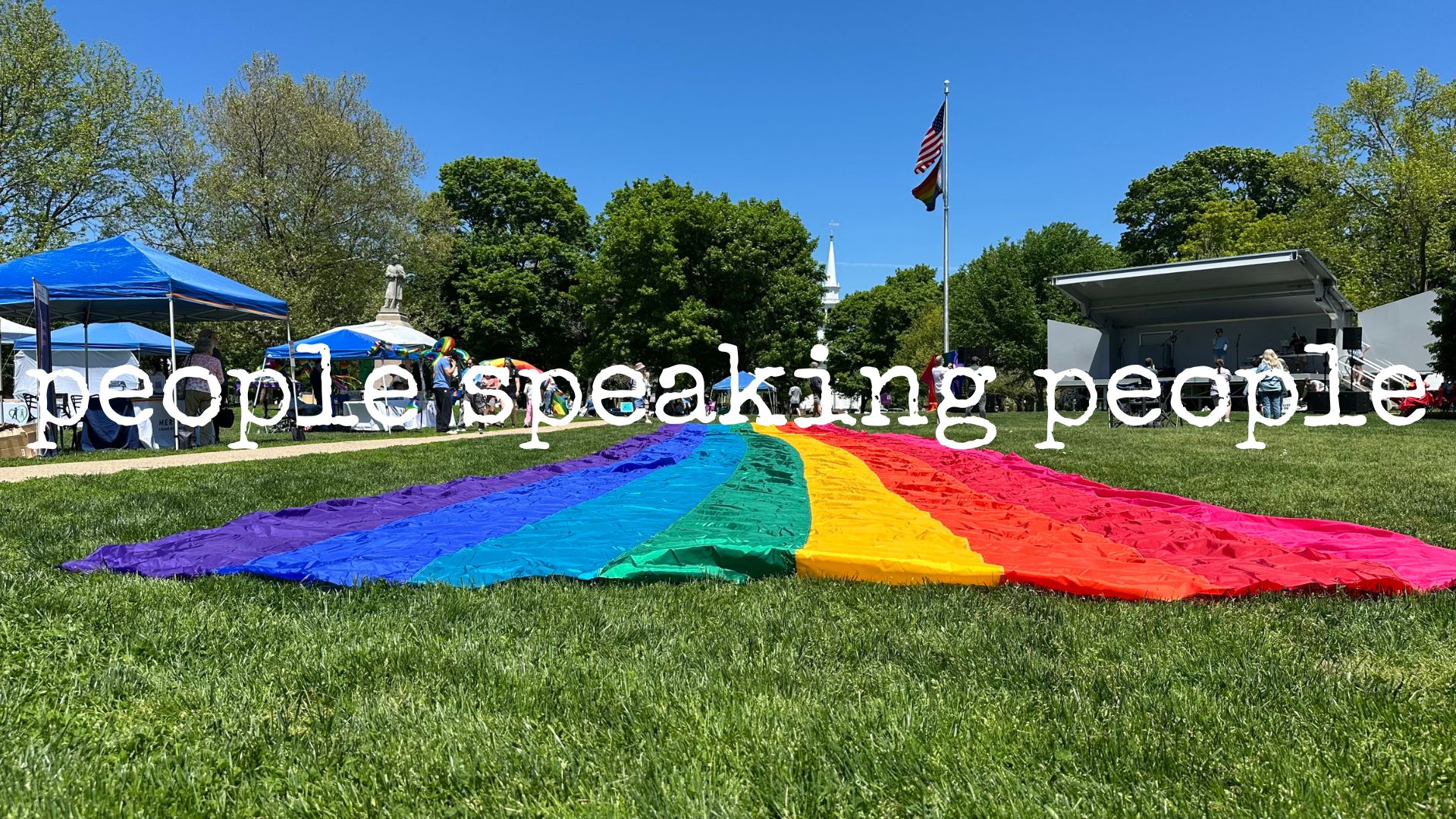
“Speak a language, speak a people. God speaks people, fluently. And God, with all the urgency that is with the Holy Spirit, wants the disciples of God’s only begotten Son to speak people fluently too.”
I want to read that again: “God speaks people, fluently. And God, with all the urgency that is with the Holy Spirit, wants the disciples of God’s only begotten Son to speak people fluently too.” I love those sentences, yet, even as I repeat them to you, I struggle how to communicate how rich it is with meaning. What happened that first Pentecost is so full of emotion and relational energy and I wrestled with how to talk about it in a way that doesn’t feel like an explanation, something that gets beyond intellect and into our hearts.
Part of the issue is it gets heady when we start to talk about the Trinity, because most any language we use to explain or describe God as Creator, Christ, and Spirit loses its emotion, sort of like trying to explain why a beautiful sunset makes us catch our breath.
That’s why Jennings words that “God speaks people” and wants us “to speak people too” grab me. When we speak people, we aren’t trying to make a point or win an argument, we are building relationships. Until the Spirit moved on that Pentecost day, the people gathered were defined by their differences—where they were from—as our scripture showed. When God spoke people through Peter and the others, they became connected by their common humanity. They heard because their hearts were opened by the Holy Spirit.
It wasn’t magic. It was the miracle of people speaking people, of people really listening to one another so that they could see how they were bonded together by the Spirit of God.
As we sit here this morning in the middle of a nation that defines itself mostly by differences and as we live with the constant bombardment of information and explanations that deepen the fractures. Even in this room, we don’t all speak the same theological or political language. How, then, do we open our hearts so that the Spirit of God can teach us to speak people? How do we hear the call of God in a language that calls us beyond the comfort of our certainty into risking relationships that can help create beloved community?
We start by seeing beyond the labels that divide us, whatever they are, and seeing the common humanity that connects us. God is with us and we are with each other. We were created in the image of God to love one another, to speak people: to be kind, to be compassionate, to love everyone because that are people just like us.
May we be those who live into our calling. Amen.
Peace,
Milton