Home Blog Page 86

advent journal: time and tide

One of the things I miss about living in Marshfield was learning to tell time by the tides. The tide came and went twice a day, but never in sync with the clock. The tides felt a rhythm rather than a ticking. They followed the moon, the earth’s turning, the breathing of the oceans. In Green Harbor, our neighborhood, the tide came in all the way to the sea wall. All of the sand was submerged. When the waves receded, they never left the beach in the same shape from one day to the next. We might walk down at low tide to find a blanket of tiny pebbles one day, a legion of throwing rocks the next, and then an afternoon of smooth sand.

When I was teaching last year, I watched a documentary about an artist, Andy Goldsworth, who built sculptures on the beach out of wood he found. He would begin work when the tide went out and kept at it until the tide returned — to destroy what he had done. He knew it was going to happen. He knew he was sculpting in a flood plain. Still, he built — and he even built the sculpture in a way that would allow the water to dismantle it with an artistic flair. Once finished, he would climb up to a dry viewing spot and watch the waves do their work.

The ocean is on my mind because I am aware the tide of darkness turns tomorrow. No. Not the Mayan thing. Tomorrow is the longest night of the year, the night when the darkness comes all the way to the wall, if you will; after that, the daylight begins to win again. I love the Solstice.

On this penultimate night, I was fortunate to be a part of a group of people who gathered under the Durham Farmers’ Market pavilion in the dark to stand vigil for those who were killed in Newtown, Connecticut. My connection to the group was through Ginger, who is a part of the Religious Coalition for a Nonviolent Durham — the sponsor of the gathering. But this was not a one time thing. Whenever there is a murder in our city, these folks go and hold vigil where the person was killed. Ginger has gone with the group on many a night to stand on a street corner where folks are not necessarily safe to stand and sing and pray, to hold silence and candles, to be a sea wall of hope against the tide of violence which floods so many lives.

Ginger asked me to go and sing “After the Last Tear Falls,” as I had done last night for our Blue Christmas service. As we gathered under the pavilion, the rabbi standing next to me said, “Do you know ‘If I Had a Hammer?’” My best guess is I haven’t played that song in a good thirty-five or forty years, but I knew the song by heart and I found chords to match and the candle-bearing crowd circled in as we sang:

I’d hammer out justice
I’d hammer out freedom
I’d hammer out the love between my brothers and my sisters
all over this land . . .

When it came my turn to sing, I noticed from almost the very first note that the rabbi was trying to sing along. He didn’t know the song, but he was listening hard and trying to connect. As I began the second verse, I could hear a quiet choir of hums and hopes following his lead. When I got to the end of the verse, which repeats

there is love, love, love, love
there is love

I invited them to join in. For the last half of the song, they hummed where they could and then joined in when they came to what they knew best: there is love.

We finished singing, passed the peace, and went out into the night, as the tide of darkness prepares to recede and the tide of violence is crashing in. I listened to a well-known denominational figure yesterday on NPR. Here is part of the interview:

COMMENTATOR: What’s the New Testament justification for owning firearms?
SPEAKER: Do unto others as you would have them do unto you. Love your neighbor as yourself. If you see your neighbor being attacked, if you see your neighbor in danger, you have an obligation and a responsibility to do what you can to protect them.

I thought about his rationale as we stood together tonight and returned again to the truth that responding to violence with violence is not a solution. It may get results, but it doesn’t turn back the tide of damage and despair. It matters more to sing together than it does to lock and load. When the soldiers showed up on the Mount of Olives, Jesus didn’t tell the disciples to go for their concealed weapons. He told Peter to drop his sword and he healed the soldier whom Peter had wounded. There is love.

Six months from now, the days will begin to grow shorter and the darkness will prevail, right in the middle of what we call ecclesiastically “Ordinary Time” — the days between Pentecost and Advent. The church calendar lays fallow, in a way: no major feasts or festivals; instead of telling the old stories, we work to grow new ones of our own. Then, just when it gets darkest, we begin to sing, again, “O come, O come, Emmanuel.”

God With Us.

In the darkness. In the violence. In the daylight. In the singing about the love between our brothers and our sisters. That same God, who showed imagination by coming into the world as a baby born to a poor family in a backwoods town, calls us to live with the same daring and determination. Violence has no imagination. Power knows nothing of whimsy and hope. But a bunch of people holding candles and singing in the dark?

There is love.

Peace,
Milton
advent journal: joy comes . . .

Throughout Advent, I have been collecting a soundtrack to get me deeper into the season. Tonight, I was greeted by two songs at our annual “Blue Christmas” service — one I sang and one I heard — that helped move me along towards the manger, sadness and all. Tonight, I thought I would share them with you as we approach the longest night of the year. First, is a song written by Melissa Manchester and Beth Nielsen Chapman had sung by the Indigo Girls: “There’s Still My Joy.”

I brought my tree down to the shore
the garland and the silver star
to find my peace, and grieve no more
to heal this place inside my heart

on every branch I laid some bread
and hungry birds filled up the sky
they rang like bells around my head
they sang my spirit back to life

one tiny child can change the world
one shining light can show the way
through all my tears for what I’ve lost
there’s still my joy
there’s still my joy for Christmas day

the snow comes down on empty sand
there’s tinsel moonlight on the waves
my soul was lost, but here I am
so this must be amazing grace

one tiny child can change the world
one shining light can show the way
through all my tears for what I’ve lost
there’s still my joy
there’s still my joy for Christmas day

The second is a song I learned from my brother many years ago and was written and recorded by Andrew Peterson: “After the Last Tear Falls.”

after the last tear falls
after the last secret’s told
after the last bullet tears through flesh and bone
after the last child starves
and the last girl walks the boulevard
after the last year that’s just too hard
there is love, love, love
there is love

after the last disgrace
after the last lie to save some face
after the last brutal jab from a poison tongue
after the last dirty politician
after the last meal down at the mission
after the last lonely night in prison
there is love, love, love
there is love

and in the end, the end is oceans and oceans of love and love again
we’ll see how the tears that have fallen
were caught in the palms of the giver of love and the lover of all
and we’ll look back on these tears as old tales

’cause after the last plan fails
after the last siren wails
after the last young soldier sails off to join the war
after the last “this marriage is over”
after the last young child’s innocence is stolen
after the last years of silence that won’t let a heart open
there is love, love, love
there is love

and in the end, the end is oceans and oceans of love and love again
we’ll see how the tears that have fallen
were caught in the palms of the giver of love and the lover of all
and we’ll look back on these tears as old tales

’cause after the last tear falls
there is love, love, love
there is love

The first prayer in the service was a responsive reading and closed with these lines:

All: We ask, “Will joy come in the morning?”
One: You answer, “Yes, joy will come in the morning.”

I was struck by the power of a good homonyms. As the service progressed and the two songs were sung, I felt what I had first heard in the prayer: yes, joy will come in the mourning. Amen.

Peace,
Milton

advent journal: acquainted with grief

Today has been a sad day.


My dear friend, David Gentiles, died three years ago today. Three years later, this day lies between the anniversary of the death of my father-in-law, Reuben, who died a year ago last October and January, which will mark the first anniversary of Lola, our Schnauzer who died after fighting to so hard to stay and take care of us. However we might measure our days, this has been a season of grief at our house. Yet, even as I write that sentence, I am aware that, though this kind of grief is new to me, it is not new. it feels different, I suppose, because I am now better informed.


One of the phrases from scripture that has intrigued me since I was a boy comes from Isaiah 53: “he was acquainted with grief.” The verb paints an unusual picture of one who  knows grief well, not as a friend, yet with some familiarity. As we read the prophecies into the story of Jesus, we see the Man of Sorrows, somehow full of grace and love and joy that ran deeper than any of the darkness. I’ve got twenty years on him, as far as being on the planet, and I am just getting acquainted it seems. As I learn more about what it means to live with vacancies the shape of loved ones, the loss of the little ones and their teachers in Newtown remind me that my grief is fundamentally not about me, but about what it means to be human, to be connected, to be loved.


This life we live is about losing as much as anything else, and about what we do with those losses. As we grieve collectively as a nation, we do well to remember our brothers and sisters in Africa and Syria, in Palestine and Pakistan who see their children die everyday, not because we must somehow we must compare our sorrows but because now we know more about what it means to be human. We are better acquainted with grief.


I have no big point to make here other than tonight I miss my friend. I am grateful for his life and sad it was not longer. And my mind turns to music, such as this favorite hymn:


come ye disconsolate where’re ye languish

come to the mercy seat fervently kneel

here bring your wounded hearts here tell your anguish

earth has no sorrow that heaven cannot heal


One of the things Dave and I shared was an unabashed love of John Denver’s songs. I keep coming back to this one:


friend, I will remember you

think of you pray for you

and when another day is through

I’ll still be friends with you


To all who are acquainted with grief, I hope you find rest and peace.

Peace,

Milton


advent journal: walking out

I love my wife for walking out of church this morning.

She began our worship, you see, by using a song they sang on the 2012 Freedom Ride to help us figure out a way to allow us room to deal with our grief over Sandy Hook in our service. So we sang,

I woke up this morning with my mind
stayed on children
Hallelu, hallelu, hallelujah

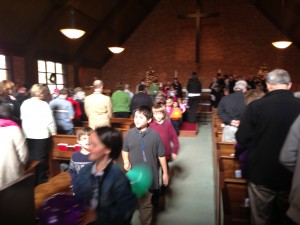
The moment was emotional and helpful. We moved on into the service and the children moved on to Sunday School at their appointed time. The service today was mostly music, culminating in our Pilgrim Choir’s offering of five or six pieces. The closing hymn of the morning was to be “Joy to the World.” About halfway through the next to last anthem, she walked out of the service. I could tell something was on her mind. As Eden, our music director offered some final words before our closing hymn, I heard a noise behind me. (I was sitting in the back today.) As Jeremy, our organist, began the introduction to “Joy to the World,” i turned to see all of the children coming through the door. They paraded down the aisle — with balloons — as we sang, “Joy to the World, the Lord has come . . . .”

When the carol finished, Ginger said, “This morning, our children are our benediction.” And then they came single file down the aisle again. leading us, first, to coffee hour and then on out into the world.

IMG_0582
She didn’t plan it; she felt it. She knew we all needed it, so she did it.

I do love that woman.

Peace,
Milton

advent journal: little words

One of the gifts I got for my birthday was time.

It’s something I always ask for and Ginger takes my request quite seriously. After a marvelous birthday breakfast together at Guglhuph, a wonderful German bakery and restaurant here in Durham, Ginger and Rachel, my mother-in-law, left me there with over three hours of time to read and write. I’ve been working on Victor Hugo’s masterpiece Les Miserables, hoping to get through all fifteen hundred pages before the movie comes out. I’m not sure I’m going to make it. Part of the reason is the beauty of his language, even in translation, preempts me from moving quickly through the book. Here’s an example of a paragraph that comes after a chapter that describes little more than a meal:

History ignores almost all these minutiae; it cannot do otherwise; it is under the dominion of infinity. Nonetheless, these details, which are incorrectly termed little — there are neither little facts in humanity not little leave in vegetation — are useful. It is the features of the years that make up the face of the century. (119)

I thought about his words Wednesday night when our friends circled around me and Kelly, a friend who was also born on December 12, in the dark under a strange giant spaceship-looking canopy and read twelve word poems (on 12/12/12) in our honor: birthday-ku, if you will.No little facts. No little leaves. No little words. No little loves.

I thought about it again today as I read some of the stories emerging from Sandy Hook: what the adults in the school did to protect the children, what the children did, and who those were who died. I also thought about the stabbing of the twenty children at the school in China that occurred on the same day and was barely mentioned on any American news outlet. No little lives.

The past two days at the computer store have been a parade of children either on their way to or from getting their picture made with Santa. The obvious bargain was they would get to play at the iPad table if they were good for the portrait. I kept thinking of President Obama’s words as he spoke of those who were killed:

The majority of those who died today were children — beautiful, little kids between the ages of 5 and 10 years old. They had their entire lives ahead of them — birthdays, graduations, weddings, kids of their own. And I have continued to wonder what features of these years — or perhaps I should say the years I have been alive — have done to shape the face of the century ahead. One feature strikes me as particularly difficult to own: since 1982 — thirty years — there have been at least 61 mass murders carried out with firearms in our country. We finish our national anthem singing about the land of the free and the home of the brave, yet we have let three decades go by and have done little or nothing to take a stand against the greed and fear that keeps killing us. We are not who we think we are.

How then, should we live so that we do not continue to kill one another?

When I was a youth minister in Fort Worth, Texas, I used to tell my kids that “I don’t have time” was a euphemism for “That is not important to me.” When something matters, we find time. We make time. When we don’t have time to do something, the reality is it has fallen from our priorities. Thirty years on, we have not had time (or in the parlance of our elected officials, the “the political will”) to come to terms with the roles violence and firearms play in our lives. Our politicians prioritize power and money over meaningful change that would create a safer society. They are more concerned with getting reelected and keeping their respective parties in control of the committee chairs than seeking effective governance.

I have to pause here because this is where my anger kicks in. I want to take time to mention a story I heard on NPR that came back to me as I began writing. Kiera Knightley was interviewed about her role in the new film adaptation of Anna Karenina. As she talked about how she came to acting, she spoke of the role her parents had played in helping her shape her craft — particularly her father. She talked about one of the most helpful notes her father had given her:

He said, “Beware of playing anger.” He said, “Anger isn’t very interesting. If you think you’re going to go there, really think about it because maybe there’s a more interesting route.”

I quote her that I might take the words to heart. I want to do something other than rant here. And so I will wonder aloud what might be the more interesting route through this tragedy. One of the scripture passages I saw quoted several times over the last couple of days is Jeremiah 31:15:

“A voice is heard in Ramah, lamentation and bitter weeping. Rachel is weeping for her children; she refuses to be comforted for her children, because they are no more.”

Though it was also one of the first to strike me, another verse out of the Hebrew scripture has kept coming to mind alongside of Rachel’s grief, one that goes back to the first act of human violence against another human. After Cain murdered his brother,

God said to Cain, “Where is Abel your brother?” He said, “I do not know; am I my brother’s keeper?” (Gen. 4:9)

The story keeps coming to mind, for me, because I think Cain’s question is emblematic of much of contemporary American society. We spend much of our time talking about what our rights are; we spend excessive amounts of energy protecting those rights, about what “I” deserve, what is “mine,” what belongs to “me.” We are a working paradox: a society that values the individual above all else. I think a modern American reading of Cain’s question sees it as rhetorical: of course we’re not our brother’s keeper, nor our sisters. We are a nation of self-made people, of boot strap puller-uppers, of accomplishers. The American Dream is about being anything I want to be, not about giving up my rights. We have chosen freedom over community and, in that choice, confused freedom and license. Being free does not mean being able to do whatever the hell I want to do. Freedom — true freedom — holds within itself a sense of consequence. There are things I can do, which I may even be allowed to do, but when I exercise those rights and do damage to those around me I am not free, nor am I promoting freedom. When I temper my choices by looking through the lenses of community and humanity and weigh the consequences of my actions, then I am free and I allow room for others to be free as well.

Jesus didn’t say, “Exercising your rights will make you free.” He said, “The truth will make you free.” And the truth is love is what frees us most of all. Freedom grows out of our lives together, not by our glorifying our individualism. We are most free when we commit our lives to the best for one another. All the one anothers. Together we must stare down the greed that keeps assault weapons in production and gun industry lobbyists paying off politicians. Together we must face the fear that keeps politicians from telling the truth and then living it out, that frightens people into thinking they must arm themselves to be safe, that fools us into believing that violence as a response to violence has ever solved anything. Together we must foster patience and determination that lasts longer than the twenty-four hour news cycle to figure out how to care for the mentally ill in our togetherness. Together, we must make time to do more than lament and blame.

Let us do more with the features of our years than trace the face of cowardice on our century.

Peace,
MIlton

advent journal: birthday eve prayer

beginningon the cusp of a new year
back edge of the old one
may I see life as frontier
‘stead of something that’s done

may I age with more grace
and far fewer demands
stare out into space
and work with my hands

make love the last word
and thank you the first
let my silence be heard
and in joy be immersed

look more at what’s starting
embrace all that ends
and let all of my charting
lead me home to my friends


Peace,

Milton

advent journal: how’s the weather?

It’s December in Durham, which means we have no idea what the weather is going to do from day to day. Right now, it might as well be May; tomorrow may feel like, well, December. Who knows. As I sat in our kitchen this morning, trying to decide whether or not to turn on the air conditioner, I saw a Facebook post from a friend showing that it was two degrees in Denver. Underneath, in smaller print, it said, “Feels like 18.” When I see a statement like that, I wonder who decided how eighteen degrees feel. Is it noticeably different from seventeen or nineteen?

Weather forecasting as always been an attractive career to me for one simple reason I remember my father articulating when I was in high school: “They get to be wrong everyday and they never get fired.” I am also old enough to remember George Carlin’s routine as Al Sleet, the “Hippy Dippy Weather Man.” At one point he says, “I imagine some of you were a little surprised at the weather over the weekend, especially if you watched my show Friday night, man. I’d like to apologize for the weather, especially to the residents of Rogers, Oklahoma; caught them napping.” And then there’s my favorite weather man, Phil Connor, who said, “You want a prediction about the weather, I’ll give you a winter prediction: it’s gonna be cold, it’s gonna be gray, and it’s gonna last you the rest of your life.”

I suppose the weather forecasters in Denver this morning are on to something larger than they realize with their postulations: there’s the way things are and then there’s the way things feel. Two measurements, sometimes both accurate, each in its own way and different for most every person. A life colored by grief feels the world differently than a life colored by achievement or surprise; a life colored by joy feels the world differently than one colored by depression or despair. For some, these days are Advent. For others, they are short, cold, and dark.

One of the things they taught us early on in Clinical Pastoral Education (CPE) was to understand that “perception is reality” when we were dealing with patients and families in trauma. What I had to learn (OK, one of the things I had to learn) was I couldn’t fix their perception. I couldn’t tell them what the temperature was and make them warm up or cool down with my explanation of reality. I had to listen. I had to listen to see how cold they were, or how hot they felt and then take their word for their weather in order to know how to help. I had to learn my readings of life weren’t the only accurate ones.

The birth of Jesus is the story of God entering our weather, putting on skin to see what it feels like to be one of us, stepping out into the cold rather than simply reading the thermometer and offers us a model to follow. Ginger and I talked about her trip on the 2012 Freedom Ride this afternoon and one of the biggest things I heard in what she learned is how hard it is for us to listen to someone else’s weather report rather than telling them the forecast. People need to be loved way more than they need to be fixed or advised.

Even though we have been in Durham five years, my blood has not thinned. From the inside of my skin, people think the winter is far colder than it actually is (that is, on the days when it is actually cold). I lived up North long enough that I no longer remember how to survive a Texas summer, and those folks just keep right on going as though it’s “not that hot.” Whether we call it the wind chill or the heat index, how it feels to step out into the weather of life is not so easily quantifiable. If wewant to know what it feels like, we have to ask.

And then we have to listen.

Peace,
Milton

advent journal: u2charist

I am a U2 fan because of James, John, and Todd — three guys in my youth group at University Baptist Church in Fort Worth back in the Eighties. Well, those guys and the fact that in those early days of MTV the band’s videos played relentlessly. One of my favorite memories at UBC was sending James’ mother to Sound Warehouse to pick up The Joshua Tree on release day because we were on a youth group ski trip. She met us with the CDs on our return. When the band came to town on the Rattle and Hum tour, we were all in the Tarrant County Convention Center for both nights. One of those concerts contained the performance of U2 and B. B. King singing “When Love Comes to Town” that ended up on the live record. James even managed to meet the band and they dedicated a song to him: “Bullet the Blue Sky,” as I remember.

My foot starts tapping just thinking about it.

The memories unearthed themselves this evening because I went to a “U2charist” at St. Philip’s Episcopal Church here in Durham. It’s just what it sounds like: a Eucharist with music by U2. The idea has been around about a decade, but I’ve never gotten to go to one. We met in the Parish Hall at the church. The music was provided by U2FX, a local U2 cover band, who did a good job offering the songs. The priests at the church led the worship. The offering went to support the work the church is doing with the Bromley Mission School in Liberia.

We sang a lot of songs. Here’s the list, in the order we sang them:

Pride (In the Name of Love)
Vertigo
Yahweh
Beautiful Day
Amazing Grace/Where the Streets Have No Name
Magnificent
Still Haven’t Found What I’m Looking For
Heaven on Earth/Walk On
One
40
Window in the Skies

Two of them were new to me: “Magnificent” (based on the Magnificat) and “Window in the Skies.” All of them added meaning and focus to the service. The lead singer of the band took time to talk about how the U2charist had come to be in the first place and how it had found a life in many adaptations. The point, for me, might be best described in one of my favorite Billy Joel lyrics: “I believe there comes a time for meditations in cathedrals of our own.” The centuries-old prayers backed by electric guitars made for good worship because it cast new light through the stained glass.

One of the quotes I come back to every Advent is one I found about the time I got The Joshua Tree, though the words are also centuries old, from the pen of Meister Eckhart:

“What good is it if Mary was full of grace unless I am full of grace? And what good is it if Christ was born 2000 years ago, if he is not born in me, in my time, and in my culture?”

I don’t think he was saying we have to contemporize everything to make it meaningful. I’m not saying that either. What I hear in his words is the call to keep the story fresh, to keep telling it in a way that compels our hearts to hunger for God. Tonight, hearing the U2 in the context of Communion made both the songs and the sacrament come alive in new ways. I ieft wondering how I might put together an Emmylou-charist — and how I can be the best midwife for Christ to be born here in Durham this year.

oh, can’t you see what love has done
what it’s doing to me?

Here’s the video for “Window in the Skies.”

Peace
Milton

advent journal: a picture of mary

Libby is one of the folks I work with at the computer store and she is a wonderful photographer. What I love about her work is the way she captures a moment more than she creates a pose. She works to tell a story in a snap shot. It’s art. And it almost always leads me back to Jackson Browne’s opening lines to “Fountain of Sorrow”

looking through some photographs I found inside a drawer
I was taken by a photograph of you
there were one or two I know you would have liked a little more
but they didn’t show your spirit quite as true . . .

When we start talking about old stories, we have ways of visualizing them. That’s why making movies out of great books is dangerous work. After seeing To Kill a Mockingbird on screen, I can’t help but hear Gregory Peck’s voice when Atticus speaks each time I reread it. The filmmakers did good work there. Some others have not fared so well in the translation: Demi Moore as Hester Prynne comes to mind. When we come to how we visualize the story of the birth of Jesus, we’ve seen too many Christmas cards and Hallmark specials to remember, as Rev. Barber said the other night, “Stop saying swaddling clothes; say nasty! The Christmas story is violent!.”

And then there’s Mary.

I had lived through who knows how many Christmases before I began to get a sense of who Jesus’ mother was. When you grow up hearing Mary speak in King James English and singing things like, “My soul doth magnify the Lord,” and you hear your share of cantatas and classical settings of “The Magnificat,” the picture of Mary too quickly becomes a rather well put together opera singer and poet. I mean she made that stuff up on the spot.

But no. She was young — just old enough to be given away (as property) in marriage and not very experienced or educated. Nazareth was a one donkey town. As far as her singing  goers, perhaps we would draw a better parallel to a teenager with her first guitar (or lyre, I suppose) than Kiri Te Kanawa. I also think she was strong. She seems like she was one tough cookie from the start.

Yet, just like Jesus, Mary didn’t arrive fully formed. But the time the gospels come to an end, Mary was one of the few left standing at the cross, even though it was her son who had been summarily executed. In between Bethlehem and Golgotha she had pointed people at the wedding to Jesus when they needed more wine. Later on she showed up with other family members to take Jesus home because they thought he had lost his mind. But where we meet her in the story she was a young girl surprised by the the Spirit and invited to a life she could not begin to comprehend, only trust, which she did.

One of the things I wish I had done while we lived in Africa was to climb Mt. Kilimanjaro. From what I understand, when you reach the last stretch ascending to the peak, they wake you up early in the morning — as in three in the morning — and you climb in the dark. They do it for two reasons: one, they want you too see the sunrise as you reach the summit and, two, they say you would climb it if you could see what’s in front of you. Sometimes it’s easier to look back where you have been than it is to come to terms with what lies ahead.

I wish there were interviews with Mary and Joseph where they spoke about what it was like to look back on where they had been as Jesus’ parents. I wonder how they would have told what happened on the road to Bethlehem, at their home in Nazareth, or any of the other stops along the way. I also wish there were pictures — captured moments like Libby’s photographs; I would love to see the young Hebrew girl we call Mary. I think it would change the story.

Peace,
Milton