Home Blog Page 85

lenten journal: where are we going?

“Where Are We Going”
Luke 4:1-13
A Sermon for Pilgrim United Church of Christ, Durham NC
February 17, 2013

In these weeks since Epiphany, we have journeyed through Jesus’ baptism, his first miracle, and his sermon in his hometown of Nazareth. This morning we come to the story of the Temptations.

(Jeremy, our accompanist, played the introduction to “My Girl” and I sang the first line)

Well — not those Temptations.

These are a little less rhythmic and a little more ominous. As Luke tells us, Jesus was led into the wilderness to fast for forty days. The Lectionary passages for this week makes the connection between Jesus’ time in the wilderness and the forty years of wandering by the Hebrew people after they came out of Egypt trying to come to terms with what it meant to be the people of God. His time in the desert also shapes our forty days of Lent: days intended to sharpen our focus, our faith, our faithfulness, and our direction as we move first to the Cross and then to the Resurrection.

As Luke tells the story, at the end of Jesus’ time of fasting, the devil showed up to tempt him. As we might imagine, Jesus was hungry, lonely, and tired. (I say the last one because I don’t imagine one sleeps well without food.) He was preparing to reenter the world and do what he came to do. The tempter even has Bible verses to shore up his argument and challenges Jesus to turn the stones into bread so he could satisfy his hunger immediately, to take power over the world by acquiescing to the world’s definition of power, and to jump off a tall building to prove the angels would catch him. After each offer, Jesus responded with a rather succinct and determined, “No.”

Reading through commentaries this week reminded me of how many people — from Dostoevsky’s Grand Inquisitor down to a college friend whose sermon I found online — have written trying to unpack the meaning of this story. Kyle Childress is my college and seminary friend. He wrote about an encounter with an old pastor who had preached at his ordination. After the service, Kyle walked him to the car. He writes:

He laid his Bible on the roof of the car as he opened the door and turned to me, “There are two more things you need to know about being a pastor. You’ll need to learn to say ‘No!’ and ‘Hell no!’” With that parting word he got in his car and drove away.

Kyle continues:

Luke tells us that immediately after his baptism Jesus goes into the wilderness and learns to say, “No!” He said “Yes” to God in baptism but in order to pursue his God-given vocation he had to struggle through what his vocation wasn’t. We will discover shortly what Jesus’ ministry will be when Jesus returns to Nazareth and preaches in his hometown synagogue, “The Spirit of the Lord is upon me …” Yet first, Luke shows us what Jesus will not do; who he will not be. And Luke tells that resistance is part of this vocation. Jesus learns, and so do we, that saying “No!” or resisting the devil, or Satan, whom Walter Wink calls the “spirit of the Domination System,” is a fundamental part of ministry.

Some years ago, Ginger and I made our one and what will surely be only trip to Las Vegas. The morning we were checking out of our hotel, I was walking out to the car following two men and one woman for whom it was still the night before. One of the men said, “I’ll tell you what. You’ve got know two things in life: where you’re at and where you’re going.”

“Well, hell,” said the woman. “I’ve always knowed where I was at, but I ain’t never knowed where I was going.”

The connection to the “Yes” of Jesus’ baptism is important because “No’s” cannot stand alone. We cannot define ourselves by who we will not be and survive any kind of identity crisis; that’s true of both individuals and organizations. We must know who we are, and we must know where we are going. The only “No’s” that stand are those rooted deeply in our affirmations of life and faith.

This story from the beginning days of Jesus ministry calls to mind perhaps my favorite description of Jesus that comes from John’s gospel near the end — on the night of the Last Supper. As Jesus prepared to wash his disciples’ feet, John says, “knowing . . . he had come from God and was going to God, got up from the table, took off his outer robe, and tied a towel around himself. (13:3) It strikes me Luke might have used the same phrasing for our story: Jesus withstood the temptations because he knew he had come from God and was going to God. The realization was not new to him that night in the Upper Room, but descriptive of his whole life.

When I first learned this story about Jesus as a child, I came away with the idea that the temptations happened once. Jesus was just getting things going and the devil tried to throw him off course; once Jesus stood up to him, it was over and done with. Somewhere along the way, I began to read the story differently. The temptations in this scene in the wilderness are archetypes for what Jesus had to stare down most everyday of his life. He could have used his powers to make himself safe, or comfortable, or powerful. He could have made things easier on himself, or played to the crowds to gain their popularity.  The “Yes” of his baptism and the “No” of his responses in the wilderness were not one time events; he repeated them everyday in each miracle, each parable, each encounter with those around him.

The trajectory of our lives is no different.

We, too, have come from God and are going to God. We, too, have said, “Yes” to God’s love in our lives, to being Christ followers — and we must repeat that yes, keep those promises everyday. We chose to be an Open and Affirming church more than a decade ago, and we must chose that again everyday. We have a history of being a church committed to missions and justice in our city and beyond; we have to keep making that choice in every board meeting, in every opportunity. We have chosen to travel this road of faith together as Pilgrim United Church of Christ, and connected to the larger Christian community; we must choose to say, “Yes” to what it takes to stay together and to love one another everyday.

We have come from God. We are going to God.
May the choices and commitments we make daily reflect the love of the One to whom we all belong. Amen.

Peace,
Milton
lenten journal: gardening notes

It was about this time three years ago when Ginger and I began making plans to move her parents here to Durham to live with us. Her father’s Alzheimer’s was progressing to the point that her mother couldn’t take care of him on her own and a nine hour drive was too far a distance for us to be of much help. We all became real estate moguls that spring, selling our house here and their house there and then buying one big enough for all of us. We found a wonderful old home just north of downtown. The house was built in 1926 and had been redone; the yard, however, had not.

We turned to our friends from Bountiful Backyards to help us turn the yard from garbage into garden. When they finished, we had three fig trees, two Asian pear trees, a peach tree, blueberry bushes, blackberry bushes, an elderberry bush, a pomegranate bush, and all kinds of other things that build a permaculture, along with two big beds for vegetables. And not a blade of grass in sight. Our little urban farm, if you will, has kept me on a learning curve of how to compost and fertilize and plant and harvest.

I’ve also had to learn how to prune — or, should I say, I’m learning.

My latest lesson came last week when Sarah and Kate came over to help give the garden its winter trim. I asked for help because my life was as overgrown as the backyard and I couldn’t catch up on my own. I also still cut back most anything with some trepidation because I’m not sure what goes and what stays. In my backyard, the wheat and the chaff are not so clearly labeled. We spent a couple of hours one crisp and sunny morning working our way around the yard.

They talked and pruned and I listened and asked questions. They were gentle and judicious in their cutting, paying attention to the shape of the tree, the direction of the growth, and the ability for all the branches to see the light. Each tree had its own pruning map, so to speak. The peach tree wants to take on a bowl shape, the branches growing out first and then up, like an open hand. The pear grows straight up, centered around one central branch that calls the others to follow. The fig tree grows every way it can, its size limited only by how much it’s cut back. The muscadine grape renders more fruit when cut back to one vine instead of many. As we worked, I took notes both mental and physical, and I couldn’t help but think in metaphor: I was being offered a visual picture of Lent. This is a pruning season.

At the risk of this post becoming “FIve Things I Learned in My Garden,” I want to mention a few things that I am taking as markers for these forty days, as guides for my thoughts and actions on the way to the Resurrection. I suppose the other risk is that I am stating the obvious. I’m willing to risk both as I begin my spiritual practice of writing everyday from now till Easter. The first is old growth has to be cut away for new growth to be possible. When they pruned the blackberry bushes, they told me the new growth that came from the cut would be what fruited. The old branches were spent. They weren’t making a statement of judgement; they were stating what they knew. What grew and fruited last year had to be cut away to make room for new growth.

I hear two things. One — some things in our lives need to be finished in order for new things to be able to begin. Attending to life in the same way Sarah and Kate attended to our garden means looking for what needs to go. Two — pruning is not clear cutting, or even random cutting. They were attentive. They discussed which branch had to be cut and where it had to be cut. Pruning in the wrong place would not produce new growth. How the new growth happens depends on where we cut.

The next thing is all growth is not necessarily good for the plant. Growth is not actually the point. Healthy fruiting is the point. Letting the plant grow into its fullness is the point of pruning. Therefore, good growth doesn’t always mean just getting bigger. Part of what Kate and Sarah took into account was how the different plants fit into the larger garden. Our biggest fig tree was significantly cut back because the peach tree close by needs the room and the sun.  The fig tree will grow and produce figs and will also stay smaller than it could because its best growth will be to let the peach tree come into its own.

One last lesson, at least for this time around: what grows now will need to be pruned in time. This year’s new growth will be old next winter and will need to provide nutrition for the new branches that will bear their fruit. As we grow and change, so do our roles in the world.

Wait. One last thing — how things grow is ultimately out of my control. I can only do what I can do. Last year I had trees full of peaches and pears and figs and the squirrels got every last piece. Until I saw the barren branches I didn’t realize the century-old pin oaks that line our alley were a squirrel highway and I had inadvertently built a Cracker Barrel. I pruned this year knowing that their traffic patterns haven’t changed. I’ve been told hanging empty aluminum pie pans from the trees will deter them. My neighbors have old CDs hanging in theirs. If the little bushy tailed varmints get all of the fruit this summer, we will prune and try again.

Peace,
Milton

P. S. — I know it’s Lent, but there’s a new recipe.

the next small thing

Last Saturday night, we went to dinner with friends. The dinner was good and the decor was cool enough, but it felt like the owners were working on a concept they hoped would become the next Cheesecake Factory. I don’t want sound as though all I’m doing is taking easy shots at an easy target. The food was good. The service was good. The place was really nice. They are trying hard. And it felt like a concept, not an offering. It felt like they hoped to have the same restaurant in Phoenix and Dallas and Any Mall, USA, which is fine.

Food, however, tastes better when it has roots.

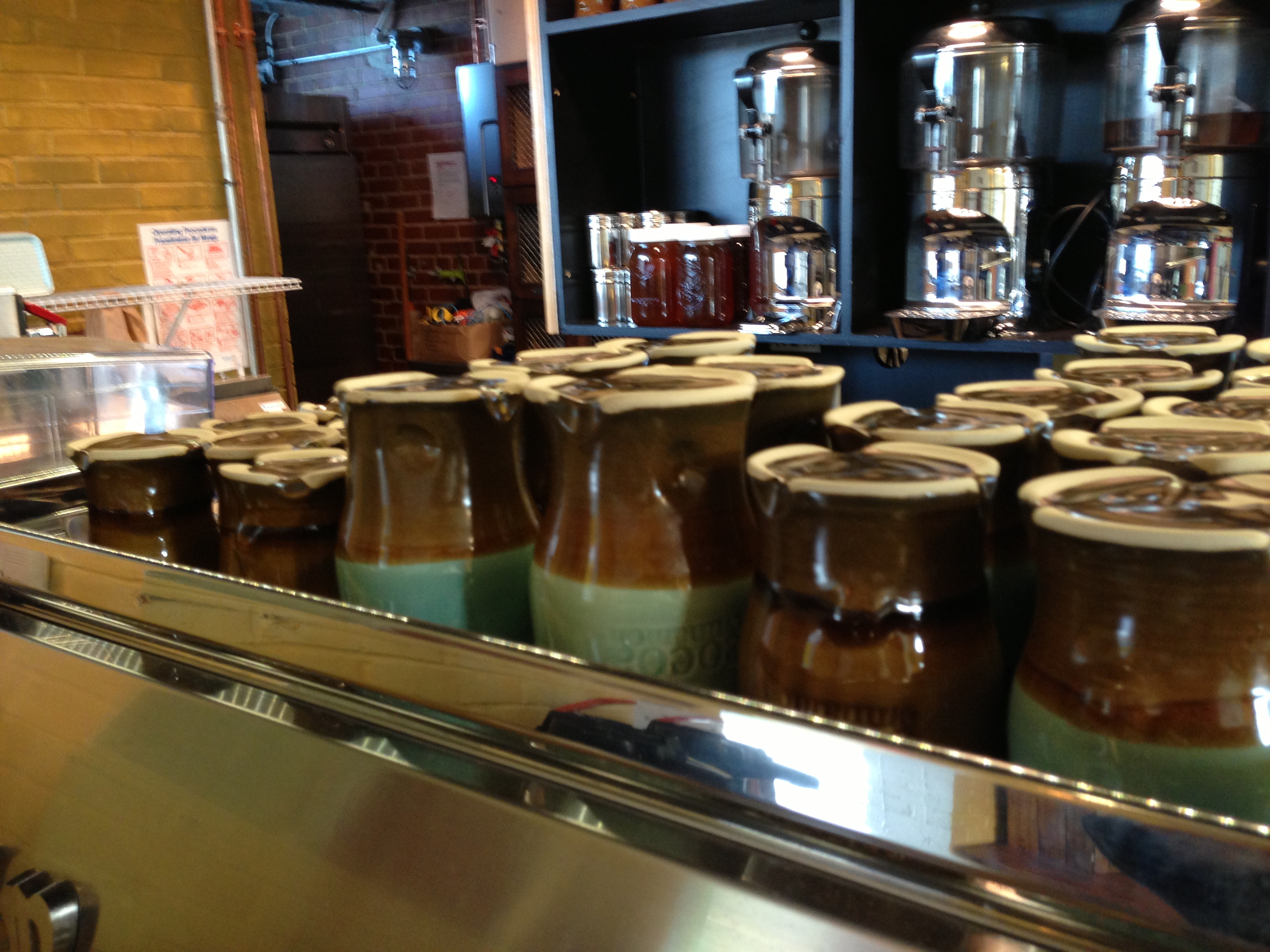
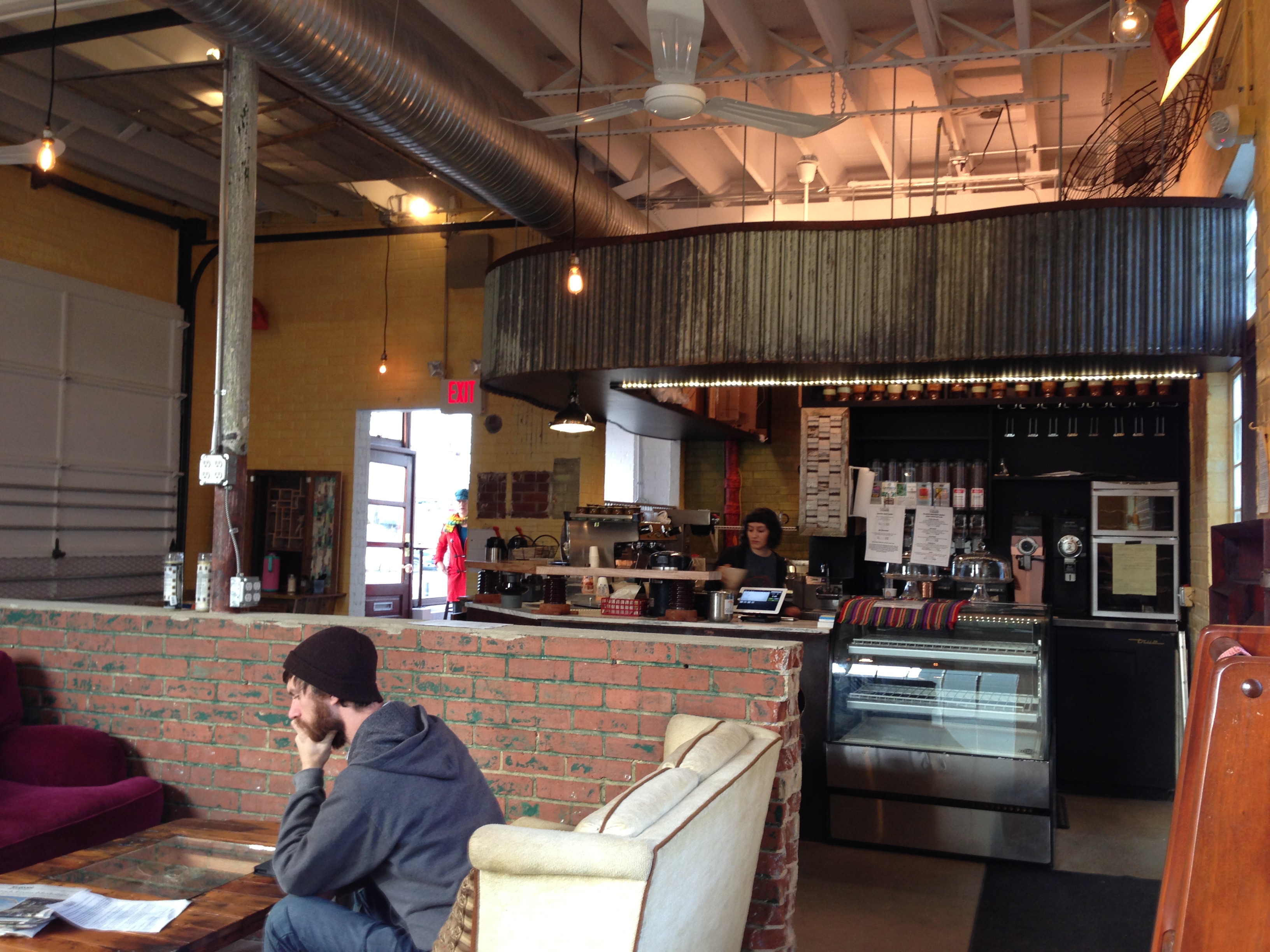
The restaurant came to mind today because I’m writing from Cocoa Cinnamon, the newest addition to our downtown neighborhood and the antithesis to last weekend’s dining experience. Areli and Leon, the owners and creators of this IMG_0984wonderful little shop, have turned an old gas station into a living art installation, inviting each of us who come in for coffee or Mexican sipping chocolate to find more here than the Next Big Thing; instead, it’s the Next Small Thing, which is even better news. As Win Bassett wrote one afternoon last week:

5:30 p.m. on Tuesday at Cocoa Cinnamon in Durham. Twenty people, not including baristas. Several just chatting, Jane Eyre, Virginia Woolf, 3 laptops, newspapers. African tribal music low in the background. Heaven.

Ginger and I got to know Areli and Leon when they first started out with Bike Coffee, which is exactly what it sounds like. Stopping by the bike for a coffee at the Saturday Farmers’ Market became our regular routine. As plans for the shop took shape, we hosted a coffee and chocolate tasting in our home. At every turn, I saw their artist’s-eye-view of things. Every cup of coffee had a story brewed in. As construction began and continued, we would stop by on our evening walks to see what was going IMG_0987 on. They collected pieces of conveyor belt salvaged from the now disappeared tobacco warehouses, along with pieces of flooring and shelving. They looked for leftover pieces of Durham wherever they could find them and gave them new life. And they invited both old and new friends to make their mark on the space. Here is an excerpt of a write up from a local media outlet:

Community support and involvement was a huge component in creating Cocoa Cinnamon. The couple used Kickstarter to help raise funds.

  “A lot of the community really chipped in,” Areli said.
Local artist David Solow basically curated the shop, which is located in a renovated gas station. The decor colors come from spices. The walls are a mustard seed yellow and the lights, which are holdovers from the gas station, are a paprika shade.IMG_1090
Local artists like Heather Gordon also chipped in.
Gordon is known for her works which convert original analog data to digital binary code. The floor she did for Cocoa Cinnamon contains elements of literary giant Walt Whitman and the brainwave recordings of Carl Sagan’s wife, Ann Druyan.
“We really wanted the front room to be geometrics,” Areli said. The design Gordon created is a bright collection of tiles in soaring patterns.
The drink condiment station is a converted cabinet with interesting trinkets inside the front panels.
Much of the decor is from re-purposed materials, Areli said.

Re-purposed. What a great word. I know I like because it resonates inside of me like a grand piano in an empty concert hall: I live a life that has been re-purposed more than once — and I am in the middle of doing it yet again. I fit into the decor of this room, even though yellow isn’t my best color. Along side of the belts and bits of shelving, the painted garage floors and the power-washed bricks, I, too, am trying to figure out how to write for a living. (Some days, I’m trying to figure out how to write and make a living.) There’s something about these walls, holding the shiny and the scars side by side, that invites me to be here: in the shop, in Durham, in me.IMG_1088

In these final days leading into Lent, re-purposing strikes me as a valuable and viable spiritual metaphor for the season: how do I reshape and restore and refocus this little life of mine? Needless to say, I will chase that rabbit and several others from my place in this little prayerbook of a coffee shop in the days to come.

Peace,
Milton

wintry mix

I love winter.

I love the cold and the snow and the bundling up. And I miss it. Durham does not know much of winter, other than the passing glances — wintry mixes — that leave us reeling from time to time because they are less than familiar. This weekend, however, I’m back in Boston for a friend’s wedding, back in the a place chiseled and shaped by the cold, a place where the rivers are supposed to freeze, where you keep an ice scraper close at hand, a place where the cold is a part of life and not something that brings things to a standstill, a place that holds strong memories of being out in the cold together.

This Saturday morning, I set out from our hotel to find a coffee shop where I could sit and write. The hotel is attached to a mall, which is not my most creative climate. I bundled up and wandered out to a nearby place I had found online, only to find it closed on the weekends. The next place was too packed. I ended up in a Dunkin’ Donuts, with a coffee that always reminds me of New England and free wifi.

Last Saturday I was in Texas, shopping in shirtsleeves with my friend, Gordon, and preparing for a dinner with friends — a dinner I was to “demonstrate.” The menu was improvised, but, like a good improviser, I had been thinking about it. Though I was looking for seasonal things, I had one thing on my list that was not indigenous to San Antonio: scallops. Earlier in the week, I had done a dessert party in Houston for my friend, Heather, and one of the items I made was a shortbread cookie with cheddar cheese and crystallized ginger. That recipe came out of my ongoing fascination with the ways in which sweet and savory go together. As I ate the cookie, I imagined what I planning as I stopped at the fresh seafood counter: a seared scallop sitting on top of a cheddar and ginger shortbread.

And it worked.

My new recipe, however, was a long time in the making. The ginger and cheddar combination goes back to one of my first cooking jobs at a small bake shop in Hingham, Massachusetts where we made a ginger and cheddar scone. We didn’t do it often because the owner thought the crystallized ginger was too expensive, but I what I carried away was how well the two went together. I learned how to sear scallops from Tim, my chef in Plymouth. And Robert, my first chef/teacher, taught me how to make a beurre blanc, which is a staple in good kitchens and was the sauce I made for the dinner last Saturday.

My familiarity with my surroundings and my memory file of flavors set me to stirring and searing, though I was in a kitchen I didn’t know with a collection of folks who were mostly knew to me. At dinner, Amy — who had loaned both her kitchen and her house for the event — shared that the entire evening had  been a rather unusual exploration for her. She, by her own admission, was a very plain eater, yet she had tried everything. She didn’t speak up until we were finished with our third course. “Tonight, I feel like a grown up,” she said, even as she displayed a childlike openness to our culinary adventure. She found courage in our common table, in the company of those she knew had nothing at stake in the meal other than to be there together.

Prior to our very first winter in Boston, Ginger and I went coat shopping. After watching her try on several things, the salesperson said to Ginger in an accent that revealed her familiarity with the frigid weather to come, “You don’t want cute; you want warm.” Her shared wisdom served us well. We certainly would have learned the lesson on our own, but she saved us both money and pain by speaking up. I learned to love winter because I learned how to stay warm. I could improvise on this icy morning because I have been prepared by the wintry mix of what I have been taught and told, what I have remembered, what I have shared.

Peace,
Milton

writing a new chapter

I know. It’s been days since I’ve written. Both my mind and my Moleskin are filled with fragments waiting to become poems and posts. Instead, my days and nights have been filled with food and friends, with laughter and tears, with new faces and familiar smiles.

Yesterday, I drove into Houston, where I graduated from high school. Houston was a hard town for me. My family arrived here in January of 1973 (I just realized that was forty years ago this past week) and I started attending Westbury High School at mid-semester of my eleventh grade year. I knew no one. Because of the way the schools were divided in those days, my brother attended ninth grade at Fondren Junior High, so we were not in the same building. The way I remember it, I went to school for two weeks before anyone talked to me. The worst part of the day was lunch time because I ate by myself. I’m sure that is, at least in part, how this blog got its name.

The story did not stay so bleak. Gordon Fort, whose parents were also missionaries in Africa and were on furlough, found out I was at WHS and found me at lunch one day. He introduced me to his youth group from Willow Meadows Baptist Church and my life was changed. I remembered who I was, I began to make friends, and I had a good senior year. Then, a year and a half after I had arrived , I left Houston and went to Baylor. My brother stayed all through high school; my parents stayed a lifetime. I left fairly unattached. Houston was, for me, not a place to go back to. And I haven’t been here in a long, long time.

When I drove in from Huntsville, I approached the city from a different perspective that I have in most of my travels. We lived on the Southwest side of town, so I always came from there. This time, I came from the north and could see how it sprawled out in front of me. I stayed last night with Heather, a high school friend, and her family, and I’ve done my best to sample as much of the good food here as I can.

As I have driven around, I have seen streets I remember — Bellaire Boulevard, Stella Link, Buffalo Speedway, Chimney Rock — but much of what was once there has changed. The same could be said of me. I am recognizable, but I am not the same person who learned to drive on these streets, and who worked so hard to get away from them. Though I still don’t want to spend the summer here, Houston’s wide open arms have caught me by surprise.

I am glad to be here.

Peace,
Milton

los tres reyes

I’ve loved the Magi since I was  a kid.

I don’t know if it was their exotic nature, or that they were chasing stars across the desert, or that they were a sort of odd addition to the whole manger scene, but they have continued to keep my attention. As I learned to love poetry, I found that they show up there quite a bit: Yeats and Eliot wrote two of my favorites; Ramon Guthrie wrote one that found a place in my novel in search of a publisher (though I couldn’t find it online). James Taylor wrote one of his best songs about the Wise Men, as did Bill Mallonee. I am in good company as Wise Men Watcher.

I knew about their story long before I knew about Epiphany. Growing up Baptist meant I came late to learning about the liturgical year, the Twelve Days of Christmas, and the place the Magi take in shaping how we mark our days faithfully. Now their journey is part of my journey, as Christ is reborn and I wrestle with how to follow suit in my own existence, and how to choose which star to follow.

Advent and Christmastide are filled with the telling and, perhaps more importantly, retelling the stories that have shaped us. One, which Ginger retold in her sermon this morning, happened her first Advent in Winchester, Massachusetts. The youth group were responsible for the Christmas pageant. One eighth grade girl, Chiara, saw it as her chance to stretch her theatrical wings and saw the role of Herod as her ticket to greatness. Nothing would do but she play the part of the King, and Ginger was happy to oblige. Chiara was determined and demonstrative in her portrayal, stomping about the stage after the Wise Men left saying, “This child could be my downfall.”

Then she stopped as she ran head on into an Epiphany of her own: “Wait a minute,” she said, “Herod is a bad guy.”

The dictionary defines epiphany as:

  • the manifestation of a supernatural or divine reality
  • any moment of great or sudden revelation

As Ginger told the story I knew well and the Magi marched across my mind as they have done for many, many years, I had a realization of my own. Those three kings had not one epiphany, but two: they awakened to who Jesus was and also to who Herod was. They had realized neither until they got to town. Their awakenings even come through in what has become their theme song, I suppose, “We Three Kings” — the verse is in a minor key and the chorus, a major one.

Both realizations are essential. Without the Child, realizing who Herod is leaves us despairing, if not cynical. Without understanding Herod, the scene under the Star is little more than the stuff Christmas cards are made of. When we are awake to both realities, any trip to the Manger carries with it a call to justice.

And a call to do more, to let God’s grace and love infect every aspect of our lives. The Magi were warned in a dream, Matthew says, that they should not go back to Herod and give him directions to Jesus, so they “went home by another way.” James Taylor borrows the phrase and sings, “Maybe me and you should be wise guys too and go home by another way.” They didn’t allow themselves to contribute to the damage Herod wanted to do. Good for them and, when Herod couldn’t find Jesus he killed every little Hebrew boy he could get his hands on.

“Forgive us,” says my favorite prayer from the Book of Common Prayer, “for the things we have done and the things we have left undone.”

Let me quit sticking it to the kings and talk about me. Ginger told us this morning that twenty-seven percent of the children in Durham  live in poverty. One in four. I cook dinner at the soup kitchen, I give food to the homeless people on the corner when I have it, I do blah blah blah, and (not but), AND there’s a school bus that drops off a whole load of kids every afternoon that live in the less than habitable apartments two blocks from my front door and I don’t know the name of even one of them. I go home right by their houses and it’s not hard to see that many of them are in that twenty-seven percent. All of a sudden, I’m in another Bible story asking a grown up Jesus, “Who is my neighbor?”

And Jesus answers me — in Spanish.

Peace,
Milton

there’s a word for that

One of the books I read and reread as a youth minister was David Elkind’s The Hurried Child, which was his take on adolescence in the 1980s. My guess is it still holds up pretty well. One of the things I took away from that book (or at least I remember it coming from that book — I didn’t check my sources tonight) had implications beyond dealing with teenagers. We have words, he said, for what is important to us. The converse, he pointed out, was also true: we don’t create vocabulary for what doesn’t matter. His example was middle school. We have elementary school and high school, but we don’t have a good word for what happens in between; we just call it middle school, a phrase teeming with un-imagination.

It’s not difficult to understand his point. If there is a hell, I’ll bet it’s a lot like seventh grade.

We also lack vocabulary for that with which we have yet to come to terms. I’m still looking for the word that describes those whom I have gotten to know through cyber-space and whose relationship I value, yet I have never seen (Simon Carey Holt and Bill Kinnon, to name two). Friend is not the right word, neither is acquaintance nor colleague. I want to do more than add an e or an i to make up the new word. My vocabulary has not caught up with my life.

Tonight over dinner, Ginger and I came up with another idea in search of a name. The conversation centered around a review of my book. It was written by Gio, a guy I met when we both volunteered for the inaugural Wild Goose Festival. I picked him up at the airport late one night. My list of people to collect didn’t distinguish between contributors and participants; all I knew was he was coming in from New York and needed a ride to Shakori Hills. Over our two summers at the festival, we chatted here and there, but never got to know each other much beyond our ride together late that spring night.

We are also both a part of Mike Morrell’s Speakeasy network, which offers bloggers the chance to review new books. The bloggers get the books for free; the authors get some grass roots publicity. I have been on both sides of the equation, and I find being the critic the more difficult because as soon as someone invites you to be a critic it’s hard not to hear that as an invitation to talk about what’s wrong with what you’re reading, rather than a chance to find solidarity.

One of the first paragraphs in his review says:

To be honest, I wanted to dislike this book from the first page of the preface! (the first paragraph is in dire need of a paragraph break). But the more I read, the more I warmed up to the author’s casual prose. He writes comfortably (albeit clumsily at times) as though we’re in the most natural of places for him – sitting about the dining room table.

And then, a few lines down he continues:

Indeed, perhaps his book would not have impacted me as it did if it were written any other way. Perhaps this, in itself, was what he might describe as an important slight difference. What seemed enormous to me in that first paragraph shrank in perspective, while Brasher-Cunningham’s stories – and the heart behind them – rose like dough from the page (what is this, like, the 5th food analogy? I’m writing a review on a book about food. Deal with it!).

I said to Ginger that I loved the shift in his writing. Somewhere in between those two paragraphs he moved from seeing my clumsiness to hearing the stories, from talking about me to reading along with me. And Ginger said, “We need a word that says when you quit being a critic and become a participant” — except participant wasn’t the word she wanted. We had a good time going back and forth about what the word we were looking for involved: compassion, alliance, listening, incarnation, connection. She even sent texts to our friend, Terry, whose pretty good at coming up with words.

We didn’t find it. I don’t think it’s there, though when Terry wrote back, “Quit being pond scum and become the water beetle making small ripples to keep the pond clean,” he was on to something. We still need the word.

We need the word because we need the attitude. We need the call to encourage and support, even in the moments when we feel compelled to say, “This is not your best work,” or “I didn’t get it.” We need the word because we are called most of all to find ways to connect, not to critique; to find ways to express solidarity rather than superiority. I could hear Gio’s point about my opening paragraph because I felt heard by the connections he made in other places. I felt heard not because he said nice things but because he was willing to draw connections to his own life, to do more than give it an American Bandstand rating (“I’ll give it a 75: has a good beat; you can dance to it”). He interacted, he engaged, he listened, and then he responded.

Compassion meets engagement meets incarnation: compasscarnagement?

We need to keep looking.

Peace,
Milton

advent journal: the prophet smiled

Our Christmas Eve service, like many around the country, is a service of Lessons and Carols. It is also a family service, so there is the rumble of restless little ones underneath all the singing and silence. It’s awesome. This year, Ginger made a point of asking a number of our children and young people to be the readers. The first one was a second grader named Matthew who is an awesome kid. He also helped me get ready for the all-church dinner before the service. He stepped up on the special stand that made him tall enough to see over the lectern and, dressed in suit and tie, he read from Isaiah 9 in tones of kindness and innocence:

The people who walked in darkness have seen a great light;
those who dwelt in a land of deep darkness, on them has light shone . . .
For to us a child is born, to us a son is given;
and the government shall be upon his shoulder,
and his name shall be called Wonderful Counselor,
Mighty God, Everlasting Father, Prince of Peace.
Of the increase of his government and of peace there will be no end,
on the throne of David and over his kingdom,
to establish it and to uphold it with justice and with righteousness
from this time forth and forevermore.
The zeal of the Lord of hosts will do this.

And then he looked up from the Bible and smiled. I mean teeth-showing-I-delivered-the-good-news smiled. I don’t even think I’ve thought about a prophet smiling. From now on, whenever I hear or read this passage, Isaiah’s going to be grinning through the whole thing. As he stepped down from the lectern, I turned to the person sitting next to me and said, “Now it’s Christmas.”

It is indeed. Merry Christmas.

photo(2)

Peace,
Milton

advent journal: a faraway christmas

The story below is one I wrote several years ago. I read it this morning at church. I offer it to you tonight.

A Faraway Christmas

by Milton Brasher-Cunningham


As we gather together on this Silent Night,

To sing ‘round the tree in the soft candlelight,


From a Faraway Christmas, from time that’s grown cold,

Comes a story, you see, that has seldom been told.


Of all of the legends, the best and the worst,

From Christmases all the way back to the first,


This little tale isn’t often remembered

From then until now, down through all those Decembers.


But I found an old copy tucked away on a shelf,

And I turned through the pages and I thought to myself,


Of all of the times between now and then

This is the Christmas to hear it again.


Once upon a time in a place we might know,

‘Cause their woods, like ours, often fill up with snow,


Was a small little hamlet — a Long Ago Town —

Of no great importance, or no real renown,


Filled with people who seemed fairly normal to me,

With names like Francesca, Francine, and McGee.


They had puppies and children, ate bread and ice cream,

They went shopping and swimming, they slept and they dreamed;


They laughed and did laundry, they danced and they dined,

And they strung Christmas lights on the big Scottish Pine


That grew in the square in the middle of town,

And when Christmas was over, they took the lights down.


They read the newspaper, they sometimes told jokes,

And some of the children put cards in the spokes


Of their bicycle tires, so they made quite a din

Till it came time for parents to call the kids in.


Yet for all of the things that kept people together,

The nice festive feeling, the Christmas Card weather,


For all of the happiness one was likely to hear,

This Faraway Christmas was marked, mostly, by fear.


Well, yes, they were frightened — but that’s still overstated;

What bothered folks most really could be debated.


Some were tired (exhausted), some were sad or depressed,

Some — the best way to say it — well, their lives were a mess.


Some felt pressure from not having paid all the bills,

Some were keeping dark secrets that were making them ill;


Some felt guilty and thought they were headed for hell,

But the town seemed so happy, who could they tell?


So everyone kept all their feelings inside,

And wished they had someone in whom to confide,


To say, “Life is lousy,” or “I’ve made a mistake,”

Or “Sometimes I’m so sad I don’t want to awake,”


Or “I miss my Grandma,” or “I loved my cat,”

Or “I never, no never get my turn at bat.”


Everyone kept it in, no one said a thing

Until once Christmas Eve, when the man they called Bing


Came to turn on the lights on the tree in the square

And nobody — not anyone — no one was there,


And he looked at the lights as he sat on the curb

And he said — to no one — “I feel quite disturbed;


“I know that it’s Christmas, when I should feel warm,

But I don’t think this year that I can conform.


It’s been hardly two months since my friend passed away;

How can I smile when he’s not here to say,


“’Merry Christmas’?” he asked and burst into tears,

And all of the sadness from all of the years


Came out of his eyes and ran down his cheeks,

And he thought he would sit there and blubber for weeks.


When Samantha showed up — she had not been expected —

And sat down beside him ‘cause he looked neglected.


He looked up through his tears, she said, “You look kinda bad.”

And he answered, “The truth is I feel quite sad.”


When she heard those words, tears jumped straight to her eyes,

“The truth is,” she said, “I tell too many lies.


I want people to like me, so I try to act cool,

But deep down inside I feel just like a fool.”


So they sat there and cried, like a sister and brother,

And were joined by one, and then by another,


With a story to tell and feelings to free,

And they wept and they hugged ‘neath the big Christmas Tree.


Can you imagine how many tears fell,

After all of the years that no one would tell


How much they were hurting, how broken or mad,

How long they had smiled when they really felt sad.


How long does it take to clean out your heart,

To get it all out, to make a new start?


That answer’s not easy to you and to me,

But they found out that night, those folks ‘round the tree.


They cried until daybreak, till the first rays of dawn

Broke over the tree tops and spread ‘cross the lawn,


In the new morning light Bing could see ‘cross square;

He also could see the whole town was out there.


They had come through the night, first one, then another

To sit down together like sister and brother


To pour out their hearts for the first time in years,

And let out their feelings, their sadness, their tears.


Samantha stood up and then turned back to Bing,

“You started us crying, now help us to sing.”


So he started a carol, the one he knew best,

About joy to the world, and it burst from his chest.


The others joined in, not because they weren’t sad,

But because they’d admitted the feelings they had,


Everyone sang along, both the sad and the scared,

Because true friends are found when true feelings are shared.


There’s more to the story, but our time is short,

Of how life was changed I cannot now report,


But instead I must ask why this story’s forgotten;

It’s not hopeless or humdrum, it’s not ugly or rotten.


Do you think it’s because people said how they felt,

And if we tell the story then our hearts, too, might melt?


What if we spoke the truth, what if we named our fears,

What if we loosed the sadness we’ve tied up for years?


Would we ever stop crying, would the dawn ever come?

And like those in the story, once the tears had begun


Would we sit on the curb, first one, then another,

And talk about life like sister and brother.


Oh, that is exactly why I chose to tell

This lost little tale we know all too well.


Our world is no different; we’re frightened and sad,

We feel helpless and hopeless, and certainly mad,


But none of those words is the last on this Night

That we wait for the Child, that we pray for the Light,


That we sing of the good news the angels did bring,

And we wish for peace, more than any one thing.


Yes, this story that came from a Long Ago Town

Of no great importance, of no real renown,


Could be ours, if true feelings were what we would say;

And we’d find such a Christmas not so faraway.

Peace,
Milton

advent journal: such a time as this

Yesterday on my break at the computer store, I walked over to Barnes and Noble to get a cup of coffee, which might be described as my regular routine. The line was about five deep when I got there, which didn’t bode well for my fifteen minute recess, but I decided to chance it since everyone in front of me looked like they were in line by themselves, save the mother and daughter at the front of the line. And they took a long time. I was far enough back that I couldn’t hear what they were doing, but I will own up to becoming a little impatient. They seemed to finish ordering and the woman at the cash register stepped away to take something out of the oven. The mother called out to her. “One moment,” said the server. “I don’t want to burn this sandwich.”

When she returned to the register, the mother and daughter handed her something and talked for a moment and then went their way. The serves seemed nonplussed. We all moved up in line. The woman who was next ordered, got her drink, and held out her credit card. The server said, “Oh — the people in front of you paid for you. There’s no charge.” The customer stood stunned for a moment and then began looking around, as we all did. Though we had all been looking at them while they took their time — or our time, I guess I should say — none of us could recognize them. The next person stepped up to the same good news. Evidently, the two had left a fair amount of money. When I got my coffee, the server said, “I’ve heard about this happening; it’s just never happened to me.”

I walked back to work thinking about the mother and daughter: how they had waited patiently to implement their plan, how they had walked away without waiting to be noticed, how they had built a memory, how they had been willing to let a little thing be enough.

One of the Bible stories etched indelibly in my mind is that of Esther. My father loved to tell the story because of the punchline when Mordecai compels Esther to stand up for her people:

“For if you keep silent at this time, relief and deliverance will rise for the Jews from another place, but you and your father’s house will perish. And who knows whether you have not come to the kingdom for such a time as this?” (4:14)

Most any telling I have heard of that story swings on our being aware of our moment to be a world changer. I love the story and it has always left me feeling some pressure. If I am supposed to change the world, I’m behind schedule. There is, however, a creative tension in what Mordecai is saying. He starts by telling her deliverance is coming, then he points out the part she can play. Still some pressure, I suppose, and he’s also calling her to do what she can do. In her case, admittedly, the stakes were pretty high. Still, as I played the bookstore scene back in my mind, Esther wandered on to the set and I heard Mordecai’s words in a different light. Who knows that the mother and daughter are in this world for such a time as yesterday. We all would have gotten our coffees without them, and that was their moment to offer what they had, not in a cosmic sense but, somehow, in an eternal one. Who knows whether we have not come into this world for moments such as this?

Peace,
Milton