the certainty of cynicism
has no room for gratitude
power never says thank you
we are a culture short on
courage and long on loud
to choose to be thankful
requires the tenacity of a heart
broken open and willing to sit
silently on a starlight night or in
the shadow of a bee’s wing
where we can be reminded
of our appropriate insignificance
and the sparkles of uncertainty
that fill our lives with hope
the opposite of fear is thank you
life is a road
but not the interstate
think two-lane blacktop
that hits all the lights
intentional inconvenience
that makes you stop
in soul food cafés
filling stations of the heart
hurry is not on the menu
the details of our days
are not detours
traveling together
takes time . . .
whatever sorrow lies
around the bend
is how we’ll get home
that’s all I can see from here
we have several mangers on our mantle
nativities from around the world
as though everyone showed up at once
the Magi made the effort to bring
incense and offerings; the shepherds
came crashing in with stories of angels,
but no one brought anything to eat
(and that’s what manger means in French)
on his way out, Jesus gathered his friends
for a meal so they could remember:
every time you eat, he said, you put us
back together—but for all the angels
and alleluias, all the stars and promises,
how can it be that no one in the stable
thought Mary and Joseph might be hungry?
Since I had a December birthday, my mother worked hard to make sure it didn’t get lost in our Christmas celebration. She didn’t put up any decorations until December 13, the day after I was born. My father had some unexplained need for all of the decorations to come down on December 26, so Christmas didn’t last long at our house.
In my twenties I began to learn about Advent and the liturgical calendar, which changed the way I celebrated the season and how I thought about my birthday in the middle of it. That my birthday falls in the middle of this season of anticipation doesn’t make it feel lost to me. As I wait to give birth to Christ in our time each year, I have a chance to reflect on what it means that I am still walking the planet.
One question that comes to mind as I stack up the years is I wonder what Jesus would have learned about being human had he had the chance to grow old. Can you imagine if he had been able to be around for three or four decades beyond his baptism? Beyond the questions about his ministry, my aging body makes me wonder how he would have navigated the aches and changes that come with age.
I am also wondering how I am going to navigate them. Specifically, my hearing is continuing to deteriorate and I am not sure what that is going to mean. As an extrovert, I draw energy from connecting with people. More and more, if there are more than two or three folks, I struggle to hear what anyone is saying. It is not just an inconvenience. It is changing who I am and how I see myself in the world. I have spent a lifetime working with young people. I am not a mentor for our confirmation class this year because I can’t hear to understand a roomful of teenagers. How am I supposed to be Milton if I’m not hanging out with kids?
My audiologists and the woman from the hearing aid company are working hard to figure out what else they can do. We have reset settings, changed earpieces, and tried everything they can think of. I still spend most conversations saying, “Say that again,” over and over. I feel like I am listening to the world through blown speakers.
My point here is not to elicit sympathy. I go back to my original question: what would Jesus have learned about being human had he been able to age? What if he had been around long enough for the disciples to have to tap him on the shoulder and say, “That woman in the crowd is calling your name and asking to be healed.”
Maybe I wonder these things because I am learning more about what it means to be human as I am challenged to redefine myself as some of the things I thought defined me are no longer things I can do. I am still Milton and I am learning how to be Milton in my sixties. I am Milton learning how to be me, even if I can no longer hear well. Milton, who loves to sing and listen to music. Milton, who loves to be in a crowd. Milton, who has still spent more summers at Youth Camp than not.
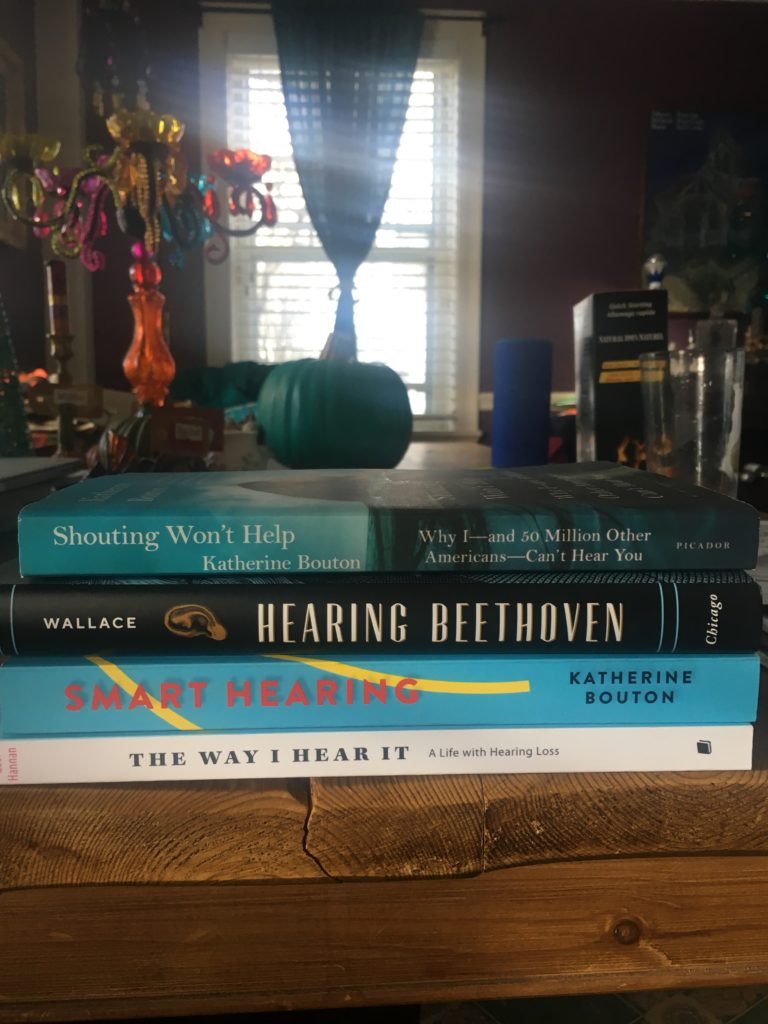
I am not the first to grow old, nor am I the first to lose my hearing. In fact, one of the books I picked up today—yes, reading is a coping mechanism—is Hearing Beethoven: A Story of Musical Loss and Discovery. Beethoven wrote symphonies after he went deaf. I figure he has something to teach me. Ginger even wondered if this meant I was going to write a symphony.
When I was in college, I had a hard time imagining myself old. As I have aged, I have enjoyed it. I like the ways in which life has called me to learn how to be less of an expert and more of a fellow traveler. I like letting go of the pressure to change the world, even as I like learning that I am changing the world in small motions. I love pouring my life into my marriage.
Now I have a hard time imagining how to live without being able to hear well. I am planning to be around awhile. My ears are not going to last as long as the rest of me. Again—I am not the first one to walk this road. I read a quote from Hellen Keller this week. She was responding to questions about whether the loss of sight or hearing was more profound. “Blindness cuts us off from things, but deafness cuts us off from people,” she said. I’m not deaf, but my hearing is getting worse quickly. I do feel cut off, often. And I feel incredibly supported and loved.
Life is a chronic condition. That’s another one of those things I am not the first to learn. As my friend, David Finnegan-Hosey likes to say, grace is a preexisting condition. Regardless of what happens to my ears, or any of the rest of me, I will be able to feel the rhythm of God pulsating in my bones and hear the melody of grace one way or another. And I’ll keep wondering what Jesus might have been like if he had had the chance to be sixty-two, or seventy.
You’re right. “Blessed are the cheesemakers” is way too easy of a punchline to end on.
When I was a boy living in Lusaka, Zambia, one of our neighbors was an American woman who had a large German Shepherd named Tammy. The dog was trained to sit in the middle of the front yard and look and sound menacing, since the woman was frightened of people who didn’t look like her. Tammy was most inclined to bark at those who didn’t look like her, as well.
The dog scared me. When we did go to her house, I was hesitant to approach her at all. One day, the dog did something she wasn’t supposed to do and the woman turned on the dog and yelled, “Tammy—shame!” The ferocious animal crumbled. She didn’t move. I felt incredibly sad for her.
Ginger worked late last night, trying to wrangle her sermon into its final form. The story for today is about Elizabeth and Zechariah learning that they would have a child who would grow up to be John the Baptist. The story became more complicated for her when she read one commentator who pointed to the line about the “disgrace” or “shame” Elizabeth felt for being childless. Luke notes that she remained secluded for five months after she found out she was pregnant and would say, “How good the Lord is to me,” she would say, “now that he has taken away the shame that I have suffered.” (1:25, Phillips) The commentator pointed out that for those who have struggled to have children, or who have not been able to do so, this is a difficult story, and that difficulty is lost on those who don’t walk the same road.
I love to tell the story, for those who know it best seem hungering and thirsting to hear it like the rest
says one of my favorite old hymns, but when the way we tell the old, old story does damage, we need to look at how we tell it. The fact that Elizabeth and Zechariah could not have children was not their fault, yet they felt shame—the same life-crushing force that broke that German Shepherd into pieces in front of me. Too many times, we hear that the old, old story is one of God yelling, “What the hell is wrong with you?” rather than saying, “I am with you.”
Most every time an angel shows up in the story, they start by saying, “Do not be afraid.” I understand how that can be read simply as a response to the fact that an angel was suddenly in the room, but what if, as we tell the old, old story, we were to take it in a larger sense: the presence of God is not something to be afraid of. God is not mad. God is not our for revenge. The point of the Incarnation is not payback. God is not trying to get even.
The same Gabriel who talked to Zechariah told Joseph it was all in the name of his son: Emmanuel—God With Us.
Shame does not give birth to life. Only love creates life. Only love breaks through the barriers we build between ourselves. We are created in the image of God. We were not created to be controlled by shame.
Last week, we went to see Boy Erased. The movie is based on a true story about a young man who is the son of an evangelical preacher. The boy comes out to his parents and his dad sends him to conversion therapy. The boy goes willingly at first, until he begins to realize what is being done to him and the others there, which is they are reminded over and over that God hates who they are. The one running the camp might as well have been yelling, “Shame!” over and over and over. When we left the movie, I could not get away from the thought that if our theology does damage, then something is wrong with our theology. If we are not building relationships, building up one another, binding ourselves to one another, then we are not telling the old, old story as it was first told to us.
The best thing we could do this Advent is to tell the old, old story with clarity and simplicity, beginning with, “Do not be afraid.” Gabriel told Zechariah to not be afraid because God had heard their prayers. A few verses later, Gabriel appeared to Mary and said, “Do not be afraid. God loves you dearly.”
Let’s tell that story. Please.
We are not sinners at the hands of an angry God. Jesus did not have to die as some sort of cosmic payment for our sins. Jesus was killed because the religious leaders of his day thought they could be more successful if they aligned with the fear-based oppression of the ruling government. Sound familiar?
Yes, we have sinned. And we keep sinning. But that is not who we are. We are the beloved of God. We are created in God’s image and worthy to be loved. That is the oldest story of all. And the best one.
Advent began here with a dark and rainy day. Even with full sunshine, these short winter days mean we only get about nine hours of daylight. We have had to have the lights on all day. In the early verses of John’s gospel he says, “The light still shines in the darkness and the darkness has never put it out.” (1:5, Phillips)
In these dark days, those words are both hopeful and fantastic. Can the light really outlast these days when we see some much hate running unleashed, so much intentional divisiveness, so much that pushes to define people by what they have done wrong or how they don’t measure up?
The old, old story reads like contemporary news, as the Romans sought ways to control and crush the people of Palestine, whom they considered to be less than human. They had set up an economic system that played to the rich at the expense of the poor. And still, Christ was born.
The sermon is short because it was a New Member Sunday and we had twenty-two people join. Here’s what I said.
_______________________________
There is a tradition in poetry of the “found poem,” which is a type of poetry created by taking words, phrases, and sometimes whole passages from other sources and reframing them as a poem—the literary equivalent of a collage. My message this morning is sort of a found sermon, if you will, pulling together a story, a poem, and a song—all borrowed—that say best what I is on my heart today.
When Ginger asked me to preach as we mark both Thanksgiving Sunday and Membership Sunday, I started thinking about the relationship between gratitude and belonging. What does it mean to be thankful? In our passage for today, Paul said, “Give thanks in all circumstances.” But for what? And how?
The story. Many years ago, my brother lived in Akron, Ohio. His barber was a Lebanese man who had fled Lebanon with his family when it was what Syria is today. They literally fled in the middle of the night with the clothes on their backs. In Lebanon, he had been a doctor. In Akron, he was a barber. My brother said when you walked in the shop and said, “How are you?” the man always answered, “Grateful.”
His gratitude had to do with more than things going well. He had learned that sorrow and joy are not opposites. Grief and gladness are not two sides of a coin. Its all mixed together, woven, one thread over, around, and through the other. We’re not waiting for things to get better so we can say thank you. We trust that God wants to do more than rescue us. We are here to make meaning of our lives, and we do that in deliberate community. We gather together to remember that love is stronger than death, than difficulty, than oppression, even stronger than evil. We give thanks because we are not hopeless. And we are not alone.
Now, the poem–written by W. S. Merwin. It’s called “Thanks.”
Listen with the night falling we are saying thank you we are stopping on the bridges to bow from the railings we are running out of the glass rooms with our mouths full of food to look at the sky and say thank you we are standing by the water thanking it standing by the windows looking out in our directions
back from a series of hospitals back from a mugging after funerals we are saying thank you after the news of the dead whether or not we knew them we are saying thank you
over telephones we are saying thank you in doorways and in the backs of cars and in elevators remembering wars and the police at the door and the beatings on stairs we are saying thank you in the banks we are saying thank you in the faces of the officials and the rich and of all who will never change we go on saying thank you thank you
with the animals dying around us taking our feelings we are saying thank you with the forests falling faster than the minutes of our lives we are saying thank you with the words going out like cells of a brain with the cities growing over us we are saying thank you faster and faster with nobody listening we are saying thank you thank you we are saying and waving dark though it is
There’s one line in that poem I want to talk back to.
Near the end he says, “With nobody listening we are saying thank you.” I want to talk back because of you. Because of us. Our faith in Christ and our commitment to one another means we trust someone is listening. That is why we are here today. That’s why we are welcoming folks into our belonging. That is why we are filling out our pledge cards—just one of the ways we make our belonging tangible.
when we help each other fight the fear be present with one another we will find that’s where the life of God is lived to give courage, to hear it now we are beloved this is holy ground I need you you need me this is why we gather this is why we gather to remember why we matter this is why we gather
One of the sentences that jumped out at me in our scripture reading said, “Be at peace among yourselves. And we urge you, beloved, to admonish the idlers, encourage the fainthearted, help the weak, be patient with all of them.” Be patient with all of them. I feel like I need to repeat that last phrase over and over until I get it. Be patient with all of them. With all of one another.
My church family, this is why we gather—why we join, why we read historic covenants, why we go to coffee hour, why we sit on committees, why we pledge, why we sing and pray and worship. This is why we gather: to remember why we matter.
I want to say something before the votes are counted. I want to say out loud that my hope is not defined by those who make the most noise or create the most confusion. I want to share the words of those who are speaking to my despair, who feed my hope, who remind me that “us” includes everyone.
Everyone.
I read a meme yesterday with a quote from Cornell West that read, “I am not an optimist. I am a prisoner of hope.” I found out the words were taken from his 1993 commencement address at Wesleyan University right up the road from me in Middletown, Connecticut. Twenty-five years later, the words feel even more powerful:
Last, but not least, there is a need for audacious hope. And it’s not optimism. I’m in no way an optimist. I’ve been black in America for 39 years. No ground for optimism here, given the progress and regress and three steps forward and four steps backward. Optimism is a notion that there’s sufficient evidence that would allow us to infer that if we keep doing what we’re doing, things will get better. I don’t believe that. I’m a prisoner of hope, that’s something else. Cutting against the grain, against the evidence. William James said it so well in that grand and masterful essay of his of 1879 called “The Sentiment of Rationality,” where he talked about faith being the courage to act when doubt is warranted. And that’s what I’m talking about.
You don’t have to be oppressed or come from a history of oppression to stand with the oppressed; you just have to have a definition of “we” that includes people of various points of origin and language and religious belief and sexual orientation and gender identity.
If we pause long enough and consider where we stand in relationship to the centuries-long quest to create a truly equitable democracy, we may be able to see that the revolutionary river that brought us this far just might be the only thing that could possibly carry us to a place where we all belong.
Every leap forward for American democracy–from slavery’s abolition to women’s suffrage to minimum-wage laws to the Civil Rights Acts to gay marriage–has been traceable to the revolutionary river, not the resistance. In fact, the whole of American history can be described as a struggle between those who truly embraced the revolutionary idea of freedom, equality and justice for all and those who resisted.
Last night, I got to hear my friend Christopher Williams sing. His song “Gather” hits some of the same notes.
to be known, to feel safe to be honest and unafraid to leave the past, run into hope to find together we are not alone I need you you need me this is why we gather to remember why we matter this is why we gather
Go vote. Please go vote. And then, whatever the outcome, don’t believe for a minute that the divisive drivel that passes for much of our public discourse is normal. Don’t believe that there’s not enough to go around. Don’t believe that fear is the strongest force. As my friend Hugh Hollowell says, love will win in the end; if love is not winning, it’s not the end.
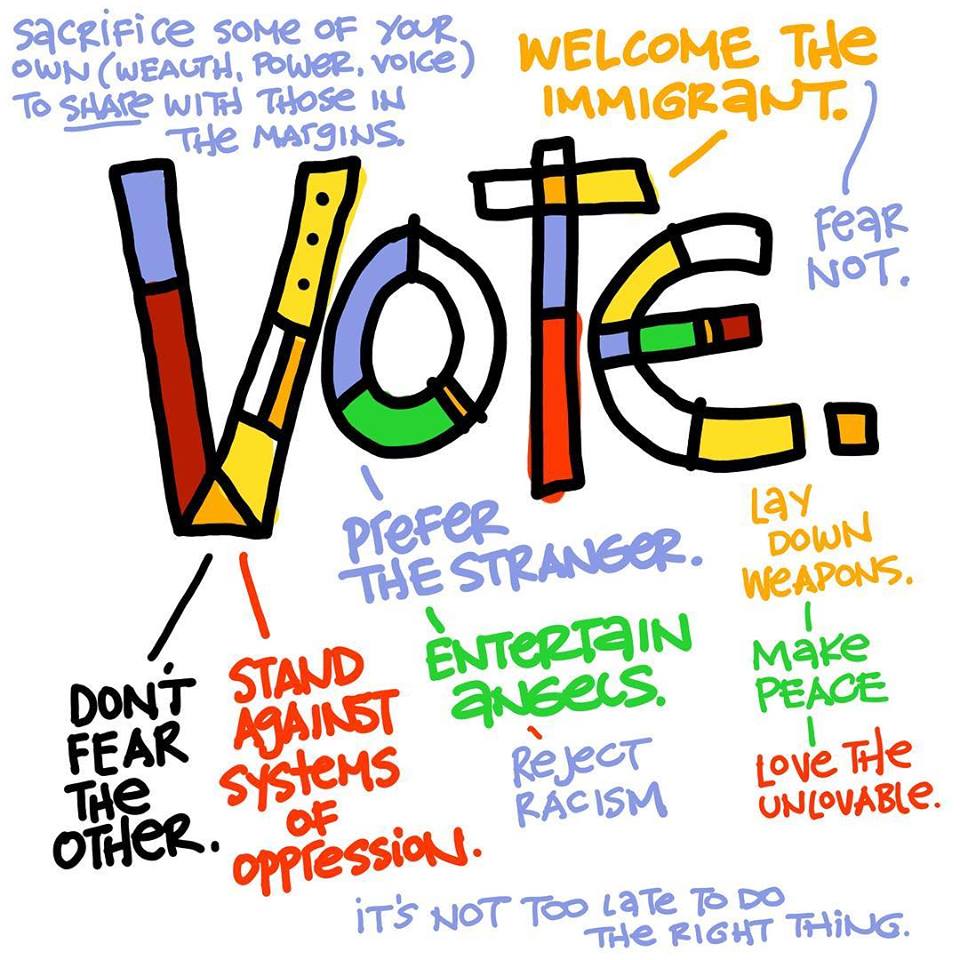
My friend Paul Soupiset, who is an amazing artist, put his thoughts into this image, which I hope you will carry with you to the polls tomorrow.
If I had a chance to get all of the people I have mentioned in this article to sit down at the same table, we wouldn’t agree on everything. To be together doesn’t mean to be in lock step. It does mean that my first move is to listen, rather that to demand to be heard. It does mean I trust that both life and faith are team sports and not individual events. There is no “them.” There is only US. That will still be true on Wednesday, regardless of the vote counts. We were built for each other. At the end of wedding ceremonies, I say, “What God has joined together, let no one tear apart.”
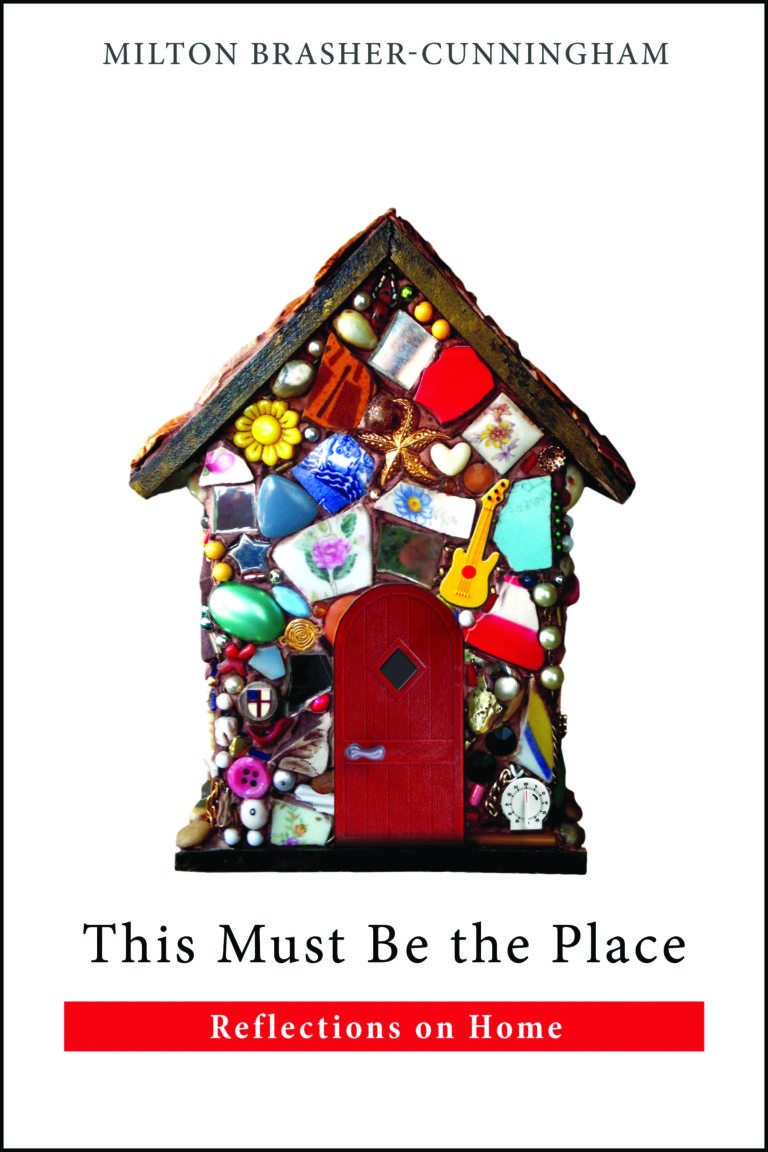
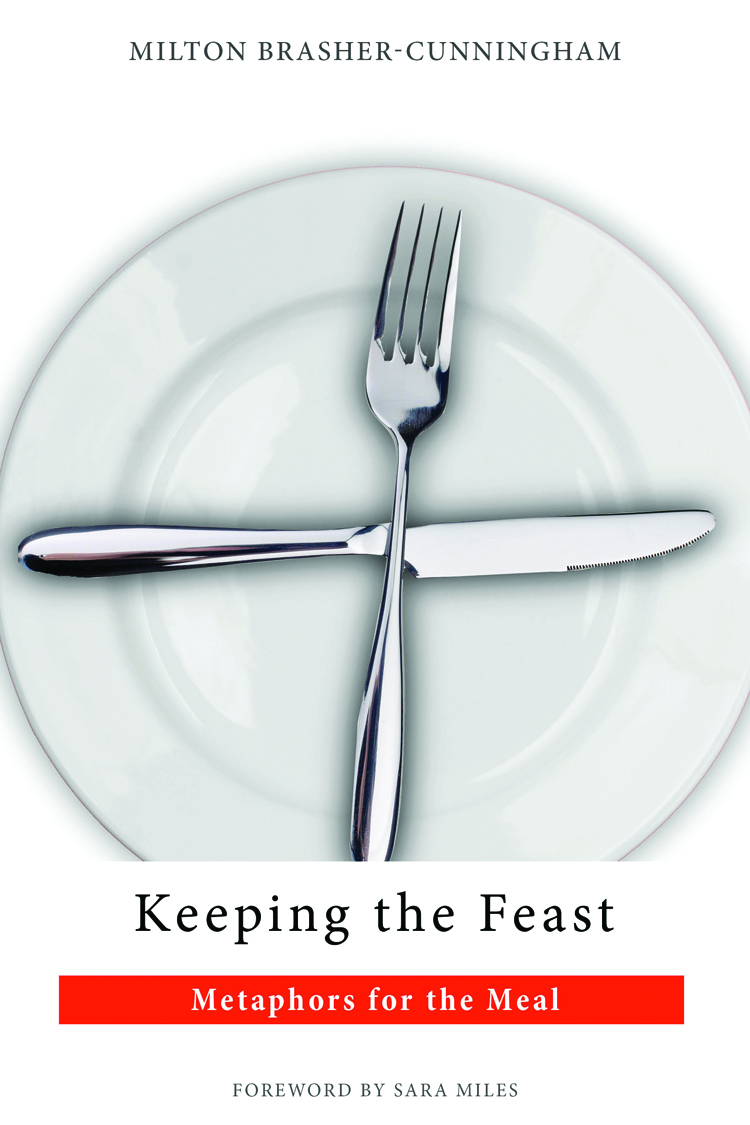
Just in time for the holiday season, my publisher has given me the chance to buy my books at a deep discount for the next couple of weeks. So I am offering them here for $7 each at my Facebook Shop. I am happy to sign them before I mail them out. You just have to order before November 16.
I preached again this week at North Madison Congregational Church. The lectionary passages— Mark 9:33-37 and James 3:13-18—hit particularly close to home this week. Here is what I had to say.
__________________________
As you may have gleaned from the personal information I have shared over our time together, though I have been ordained a long time, I have had a number of other jobs other than pastor. One of them was high school English teacher. I taught for seven years at Charlestown High School in Boston and then for three at the high school in Winchester, just north of Boston. I loved reading books with students and talking about the importance of language. I loved watching them grow in their confidence of expression. I hated grading, however—which is one of the main reasons I didn’t stay in the classroom.
During the years I was teaching, there was a professional discussion that centered around whether the point of English class was to make sure students had read certain books or whether they learned how to read well, or, even better, learned to love reading. The first angle saw knowledge as sort of finite: here are the books that contain what you need to know. The second saw that learning was not something a person could complete. We had to learn how to be lifelong learners.
Maybe that’s one of the ideas behind the Revised Common Lectionary, which is what we follow more Sundays than not to give us our Bible passages for the day. It is on a three-cycle, which means if you come back to church on the third Sunday of September in 2021, we will be reading these verses again.
An important aside here: please come back to church before then.
Even in the repetition, however, the words never sound exactly the same. How we understand these verses is colored by our context—by what is happening in our lives and what is happening around us. Three or six or nine years ago, the world did not feel like it feels today, therefore, how God speaks to us today will not feel the same either. At least that is what I have experienced as I read through the passages in the middle of all that has happened in our country recently and realized I had more to learn.
I am a straight, white, cisgender male, which means I am a part of those who hold most of the power in our country, and in our world, without having to do anything other than be a straight, white, cisgender male. If I were rich I could check off all of the boxes of privilege.
Perhaps you are wondering what any of that has to do with our scripture passages. Jesus wasn’t white and neither were the disciples. White people didn’t even exist in Jesus’ day. Europeans created the idea of whiteness as a way to justify their colonization of the world. (I realize that is a lot to say in one sentence. If you want to read more about the construct of race, Yale Div professor Dr. Willie Jennings’ book The Christian Imagination: Theology and the Origins of Race is a great place to start.)
But Jesus understood power. He was killed because he spoke truth to power. And he understood that power was not the way to peace and love. So when he heard his followers arguing about who was the greatest, he gathered them around him, and told them—again—that the one who would be first would be the one who put themselves last. Then he called over a child who was playing nearby and said, “If you welcome this child, you welcome me.”
Remember, the verses we are reading follow closely behind those we read last week where Jesus called his followers to take up their crosses—to use the greatest pain in our lives as a path to resonance with others. Now he was talking about welcoming children: listening to them, receiving them with kindness, treating them as valuable and important human beings. But this wasn’t a children’s moment before his real sermon. Children in Jesus’ day were of no consequence. I’m sure their parents loved them, but they had no rights and no influence. They were completely vulnerable and dependable and powerless.
Jesus scooped up a child and said, “When you treat her like she matters, you treat me like I matter. That’s what it means to be great.” Jesus wasn’t being cute. He was being political. He was being intrusive. He wanted the disciples to feel disquieted. Uncomfortable. “Quit talking about your greatness and attend to those who have no voice. Treat them as if they were important.”
Let us consider some of the context in which we hear those words this morning.
Our government has lowered the number of refugees it will allow into our country each year to the historic low of thirty thousand people. Let me put that number in perspective. In 1980, we welcomed 200,000 refugees. Not immigrants. Refugees. People who have been forced to flee. That number has declined ever since. Today, 68.5 million people have been displaced across the globe. No, we can’t take all of them. But our actions demonstrate that we are choosing to not listen to those who are most vulnerable in our world. Jesus said when we make room for them, we make room for him.
Botham Jean, a twenty-six year old black man was shot and killed in his apartment in Dallas by a police officer who said she mistakenly thought he was in her apartment. I know there are many layers to a story like that, and lots of emotions as well, and black men between the ages of 15-34 are nine times more likely to be killed by police than other people. Too many times the explanations we give for statistics like that sound like justifications, as though things would be different if the young black men would do things differently, but “being shot accidentally,” or being restrained more severely than others because of the color of their skin is not their fault. Jesus said when we value black lives, we value him.
This week as Christine Blasey Ford came forward to say that Brett Kavanaugh, who is up for confirmation to the Supreme Court, sexually assaulted her in high school. I realize my saying that out loud this morning may make some people nervous. The dynamics of what has followed should concern us all. What I find most disturbing is the ways in which some of the rich, white, straight, cisgendered males have banded together to protect their own and make it as difficult as possible for her to be heard. She does not have the power to demand a hearing. She does not have the power to demand an investigation. She does not have the power to delay the vote. She has her story. She has made herself vulnerable to death threats and character assassination. They have questioned why she took so long or why she can’t remember all the details. Her story has sparked the #whyIdidnttell and #whyididntreport hashtags on social media, where women have poured out stories of why they remained silent about abuse and rape. Jesus said when we take those stories seriously, we take him seriously.
One of my favorite songwriters is Jason Isbell. In his song, “White Man’s World,” he sings,
“There’s no such thing as someone else’s war
Your creature comforts aren’t the only things worth fighting for
You’re still breathing, it’s not too late
We’re all carrying one big burden, sharing one fate . . .”
As members of the United Church of Christ, we have a rich history. Our forebearers ordained the first African-American man to pastor a white congregation before the Civil War. They began ordaining women sixty years before they could vote. They ordained the first openly gay man in the early 70s—when the American Psychiatric Association still considered homosexuality to be a mental illness. We have a rich heritage, but just to wear that history like a medal and not respond to those who are silenced today is like claiming to be well-read just because we finished all the books we were assigned in high school. There is, as we often say, more light still to break forth.
That following Jesus was not for the faint of heart was a lesson the disciples spent their lives learning, and we are called to the same lifelong education. It is difficult, disquieting work. And it is what breeds hope and love and beloved community.
I heard part of a speech given by the actor Anne Hathaway this week. I will confess, I don’t usually think of her as a theological source for a sermon, but what she said was is what we have to continue to learn: that gay and lesbian people don’t revolve around straight people, people of color don’t revolve around white people, trans people don’t revolve around cisgender folks, women don’t revolve around men.
Jesus calls us to live into the truth that everyone else is as important as we are—important to God, important to the world, important to us. That means we must do more than share our leftovers. That means we must do something other than the comfortable thing. When he told the disciples to welcome the child, he meant to treat the little one as though they mattered as much as an adult male, not as a gesture of condescending generosity but as a recognition of God’s reality that we are al wonderfully and uniquely created in the image of God and worthy to be loved.
What if Jesus is right? What if we decided that greatness wasn’t about power or wealth or education or privilege, and we committed ourselves to seeing how much we share with others, how much we listen others, how much we love others, how much we serve others as a measure of a great life. What kind of world would we live in?
We go out from here into a world where everyone we meet is fighting a great battle. We go out into a world where people are taught to live in fear rather than hope. We go out into a world where those in power are concerned, mostly, with staying in power. We go out into a world where, no matter how bad it looks, God’s love will be the last word. Let us go out determined to keep learning how to share that love and welcome one another. Amen.
Peace,
Milton
And here is the Jason Isbell song in its entirety.
I preached at North Madison Congregational Church again last Sunday. The text was Mark 8:27-38, a passage that offers new things any time I read it. Here is my sermon.
__________________________
When the gospel writers began to put the stories down on parchment, many years after Jesus had ascended, they seem to have organized them so that one thing sort of leads to another—or at least that is how it appears as I read. We know the stories are not told in the exact order in which Jesus and his followers lived them because they are not in the same order from book to book. How we remember what happened matters as much as what actually happened, so there is something for us to learn from the context of our story this morning, even as we seek to learn from the account itself.
In the verses before Jesus started asking questions of his followers, Mark records this interaction:
They came to Bethsaida. Some people brought a blind man to him and begged him to touch him. He took the blind man by the hand and led him out of the village; and when he had put saliva on his eyes and laid his hands on him, he asked him, “Can you see anything?” And the man looked up and said, “I can see people, but they look like trees, walking.” Then Jesus laid his hands on his eyes again; and he looked intently and his sight was restored, and he saw everything clearly. Then he sent him away to his home, saying, “Do not even go into the village.”
Mark says Jesus and the disciples hit the road after the encounter and headed for Caesarea Philippi. The talk as they walked along the road is a rollercoaster of emotion. Jesus asks his disciples who people think he is. “They think you’re a prophet,” they said. That was pretty good news, I guess. It meant that folks were getting at least part of the message.
Then Jesus asked a more daring question: “Who do you think I am?”
Mark says that Peter was the one who answered. “You are the Christ. The Messiah.”
Jesus’ heart must have leapt just a little. Yes. Good answer. A+. We have a winner. High fives all around. Since they seemed to finally be getting the picture, Jesus decided he could go deeper. He began to tell them what it meant that he was the Messiah. He was going to suffer. He was a dangerous man to those in power and they were out to get him. They would get him. They would kill him. But that would not be the end of the story. That Jesus knew how to bring down a room.
Peter wasn’t having any of it. Mark says he “rebuked” Jesus. He reprimanded him. He was the Messiah—the Captain of the Winning Team. Things were about to change. Being the People of God meant they got to come out on top, right?
But Jesus turned and rebuked him right back. Peter might have been able to see he was the Christ, but he didn’t understand what that meant—much like the blind man Jesus had healed before they left town. So Jesus kept talking, working to help them see what it meant to follow him. The point of being the Messiah wasn’t to rise to power or to get revenge or to take control. God wasn’t trying to get things in order. The point of the Incarnation was to show the world what love looked like. Jesus came to love people and show them how to love one another. The point was to learn how to see a world where people take care of one another. Then he said, “Take up your cross and follow me.”
We hear those words and the metaphor seems clear: Jesus died on the Cross—we are called to live sacrificially, to offer our lives to God. But though his disciples knew about crosses, they did not know that was how Jesus was going to die. So what did the metaphor mean to them? And what did Jesus mean by his statement? It had to be more than, “When the Bible finally comes out, this verse will preach!”
What does it mean to take up our crosses and follow Jesus?
I will lean into the words of two friends for answers to that question. One lives in North Carolina and has spent his life working to help those who are homeless find housing. His name is Terry. He says he thinks our cross is the deepest pain in our lives. To take up our cross is to respond to that pain in the lives of those around us—to see it more clearly, if you will—rather than trying to get away from it.
This past September 13 marked what would have been my father’s ninetieth birthday. He died five years ago, a month short of eighty-five. After he died, I wanted to call all my friends whose fathers had died before mine and say, “I’m sorry. I meant well, but I had no idea how this felt.” The pain of my grief invited me to a resonance I had not known before.
Eric is a Methodist minister in Texas. He says when we talk about following our passion in life we miss our true calling and purpose. God calls us to follow our broken hearts. “Lose your life,” Jesus says, “and you will find it.” To follow our broken hearts is to live with compassion, voluntarily carrying each other’s pain, seeing all of those around us as those we are called to love.
I suppose the Apostle Paul might have heard the story about Jesus healing the blind man in stages, and the man thinking that people were trees. I hear echoes of it in Paul’s words at the end of 1 Corinthians 13—the Love Chapter. when he says, “For now we see in a mirror, dimly, but then we will see face to face. Now I know only in part; then I will know fully, even as I have been fully known.” But even through a cloudy mirror, Paul could see
Love is patient; love is kind; love is not envious or boastful or arrogant or rude. It does not insist on its own way; it is not irritable or resentful; it does not rejoice in wrongdoing, but rejoices in the truth. It bears all things, believes all things, hopes all things, endures all things. Love never ends.
Love never ends. Then again, neither does the need for it. Perhaps part of taking up our crosses is realizing the call to love those around in us is relentless, whether we are talking about the world at large or the pain and struggle that is a part of the lives in this room. It is easier to let ourselves see others as trees walking around rather than embracing them as one of us. To love one another—to share who we are and what we have—means to lose a lot. It means we have to give up our stuff, our privilege, our comfort, or our position so someone else can see a new life. Jesus was not being hyperbolic when he said love would cost us. If love never ends, neither does our calling to love those around us. To see people around us as they really are will break our hearts and help us truly see our place in this world. Power is not the point. We are called to love the world.
I closed my sermon by singing “In This Very Room, which you can hear here.
In this very room There’s quite enough love For one like me And in this very room There’s quite enough joy For one like me And there’s quite enough hope And quite enough power To chase away any gloom For Jesus Lord Jesus Is in this very room
In this very room There’s quite enough love For all of us And in this very room There’s quite enough joy For all of us And there’s quite enough hope And quite enough power To chase away any gloom For Jesus Lord Jesus Is in this very room
In this very room There’s quite enough love For all the world And in this very room There’s quite enough joy For all the world And there’s quite enough hope And quite enough power To chase away any gloom For Jesus Lord Jesus Is in this very room