Home Blog Page 62

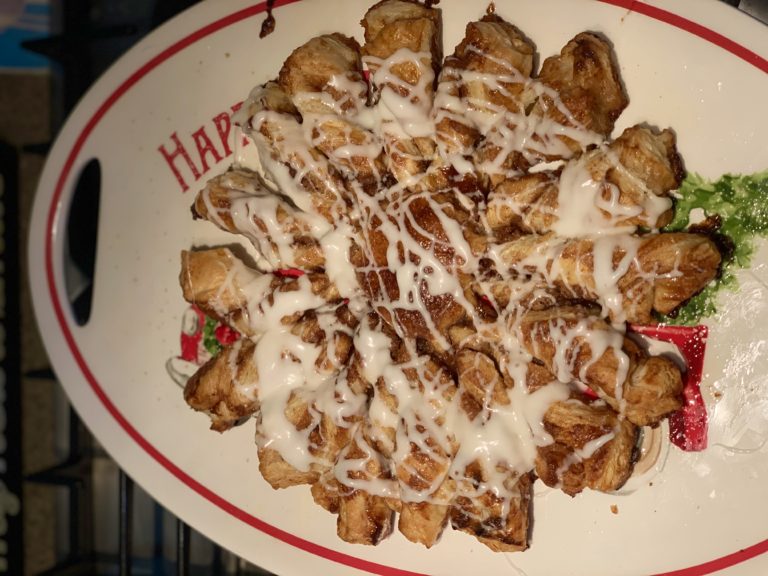
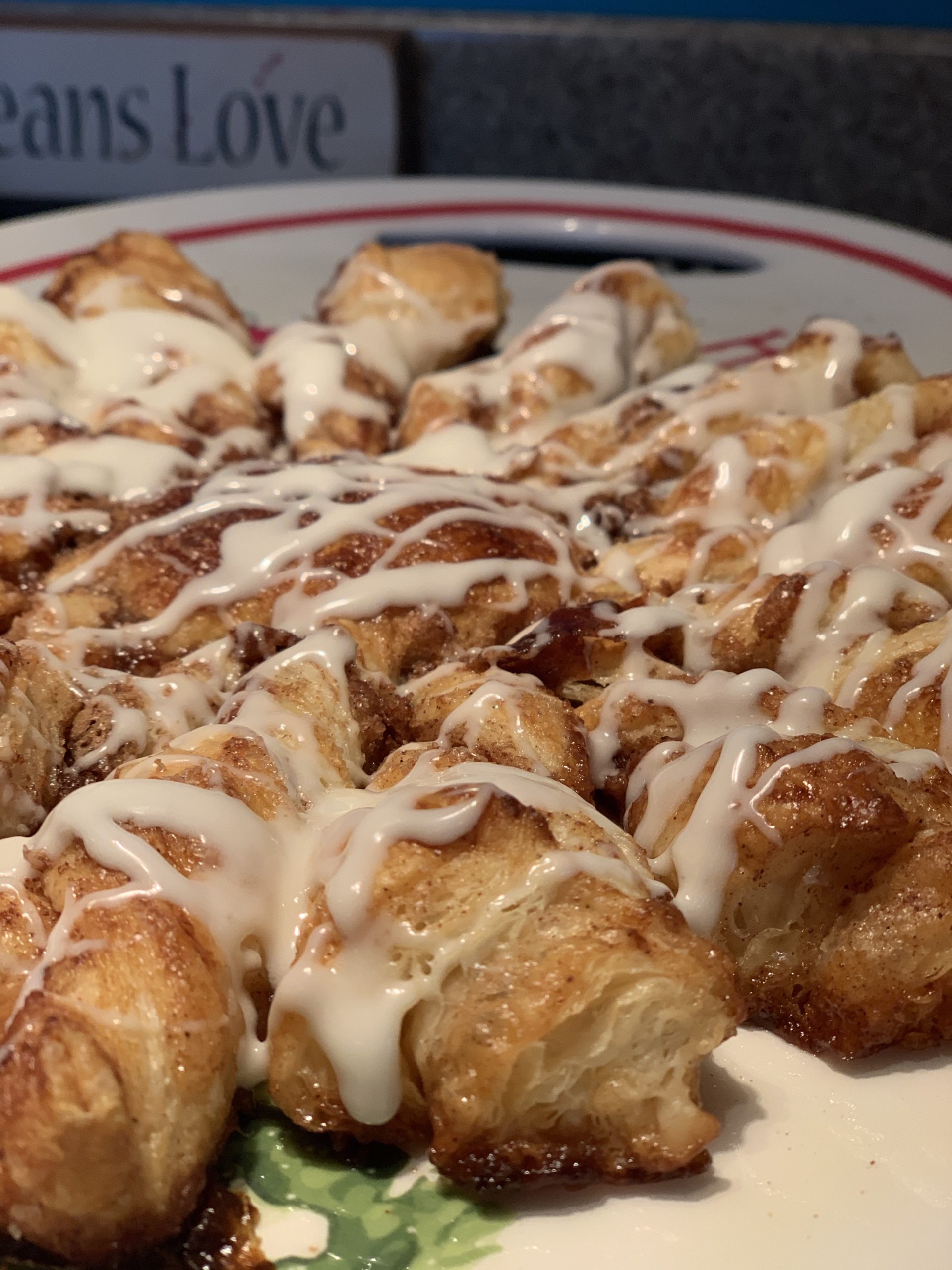
tarte soleil cannelle

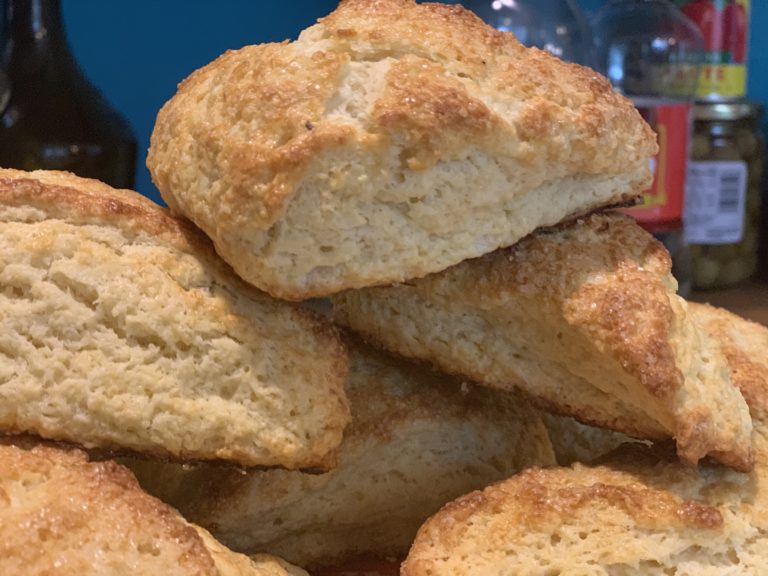
I wanted to make this tarte soleil–which means sun tart–as soon as I saw the picture at Smitten Kitchen. But I wanted to make if for breakfast. So, instead of her olive tapenade filling, I decided I could fill it as I do my cinnamon rolls and let the aroma wake everyone up. I also decided to post it this morning, just in case you need something for tomorrow or the day after.

Filling
4 teaspoons butter, room temperature
1/4 cup brown sugar
1 teaspoon cinnamon
pinch of kosher salt

Dough
2 packages puffed pastry (if it’s frozen, leave in fridge overnight to thaw; I found unfrozen puff pastry at our grocery store next to the tubes of biscuits)
1 egg yolk beaten with 1 teaspoon water (for egg wash)

Icing
powdered sugar
heavy cream

Leave the butter out overnight, or at least for a couple of hours.
Mix the brown sugar, cinnamon, and salt in a small bowl. Set aside.

Heat oven to 350 degrees.

To assemble the tart, roll out the first package puffed pastry flat on a large piece of parchment paper or reusable baking mat into a circle that will fit on a baking sheet. I used a medium sized plate, probably about eight inches in diameter to cut the circle. Repeat with second dough; put one in the fridge while you work with the other.

Spread two tablespoons of butter on the first round to all but a half an inch from the edge and then spread the cinnamon sugar mixture over the butter; dab the edge with water. Take the second round out of the fridge and spread the remaining butter on it. Place the second round on top and set a small glass upside down in the middle. With a sharp knife, and being careful not to cut through the parchment paper or baking mat, cut away from the edge of the glass in quarters (or at the 3-, 6-, 9- and 12 o’clock marks); cut each quarter in half, making eight strips, and then in half again, making sixteen strips.

Remove the glass. Place a finger the ray meets the center ( and where it is most likely to break off prematurely) and gently twist each strand a few times. Beat the egg yolk with a teaspoon of water and brush it over the pastry; you can also sprinkle the top with some cinnamon sugar.

Bake for 25-30 minutes, or until it golden brown all over.

Meanwhile, mix the powdered sugar and cream. I didn’t put amounts because this really is a you’ll-know-it-when-you-see-it kind of thing. Start with about a half a cup of powdered sugar and a tablespoon of cream. Stir it up. If it is too thick, add cream incrementally until it is how you like it.

Remove the tart from oven, let cool on baking sheet for ten minutes and then transfer it to a serving platter. Drizzle the icing over the top. Tear off rays of your cinnamon sun and enjoy.

Peace,
Milton

advent journal: solace

My friend Robert Dilday died in his sleep Saturday night.

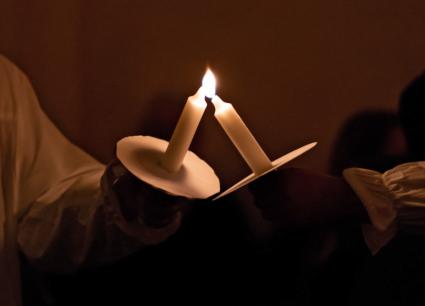
He was not old–by that I mean he was only a year older than me. He was ordained to the priesthood in the Episcopal Church on December 14. The picture above is him serving communion after his ordination. He had one Sunday at his new church and then he was gone. He had no medical issues of note. No apparent crisis. The announcement from his church said he died “of natural causes.” He went to sleep and didn’t wake up. I’m still trying to take it in.

The subtitle to David Whyte’s book Consolations is The Solace, Nourishment, and Underlying Meaning of Everyday Words. I was surprised to find that grief was not one of the words in the book, since it feels, more and more, like an everyday word to me and most of those around me. I began browsing through the index (I have not been reading sequentially) and there, between Silence and Touch was Solace–a word he also used in his subtitle.

Though I know the word solace–especially from hymns like “What a Friend We Have in Jesus” (“thou will find a solace there”)–I don’t know that I think of it as an everyday word like silence or touch. As I read what the word meant to him, I found these sentences:

Solace is the beautiful, imaginative home we make where disappointment can go to be rehabilitated. When life does not in any way add up, we must turn to the part of us that has never wanted a life of simple calculation.

We were in seminary together and then roommates in Dallas, along with Burt Burleson, for about a year and a half after we finished school. He moved to Washington DC to work for the Baptist Joint Committee on Public Affairs and I stayed in Dallas as a chaplain. I took a week of my vacation and went to DC. I wandered around the city while he was at work and then we wandered together at night, neither of us on the pastoral career path of most of our classmates. He continued in journalism and ended up as the editor of Baptist News Global. I wandered from chaplaincy to youth ministry to teaching to cooking to editing. From time to time, we checked in with each other, but life had flung us in different directions.

The rise of social media helped us find each other again. A little less than two years ago, Ginger led a group from our church on a Civil Rights History Tour to Richmond, where Robert lived. I knew he was active in working against climate change and fracking in Virginia, along with anti-poverty efforts. He spoke to our group one evening. Later that night, he, Ginger, and I talked late and told stories over drinks, which is when we found out he had decided to pursue ordination in the Episcopal Church, which meant there was a lengthy process. He had resigned from BNG and was preparing to go to Virginia Theological Seminary the following fall, which he did and, as I said, he was ordained a little over a week ago.

I think it is fair to say neither of us thought of life as simple calculation, other than knowing things mostly don’t seem to add up. Like someone dying a week after their ordination for no apparent reason other than life. I was telling someone who did not know Robert about what happened, along with a little of his story, and they responded by saying, “Well, at least he accomplished his goal.”

I could hear they were trying to offer comfort and they meant well. As I sit writing tonight, after reading Whyte, I can see that solace and comfort are not the same thing. The person I was talking to was not wrong; Robert really wanted to be a priest and he made it. But then we’re back to the thing about life not being simple calculation. I am not trying to balance the equation of my grief.

In her poem “Imaginary Conversation,” Linda Pastan writes,

You tell me to live each day
as if it were my last. This is in the kitchen
where before coffee I complain
of the day ahead—that obstacle race
of minutes and hours,
grocery stores and doctors.

But why the last? I ask. Why not
live each day as if it were the first—
all raw astonishment, Eve rubbing
her eyes awake that first morning,
the sun coming up
like an ingénue in the east?

You grind the coffee
with the small roar of a mind
trying to clear itself. I set
the table, glance out the window
where dew has baptized every
living surface.

Nothing we see or digest comes in its pure form–no ray of light, no bite of food, no sound or touch or feeling. All the colors of our lives seep into one another. And so, Whyte says,

Solace is not an evasion, not a cure for our suffering, nor a made up state of mind. Solace is a direct seeing and participation; a celebration of the beautiful coming and going, appearance and disappearance of which we have always been a part. Solace is not meant to be an answer, but an invitation, through the door of pain and difficulty, to the depth of suffering and simultaneous beauty in the world that the strategic mind by itself cannot grasp not make sense of.

I hear echoes of Ecclesiastes in his words:

Who knows if a human being’s life-breath rises upward while an animal’s life-breath descends into the earth? So I perceived that there was nothing better for human beings but to enjoy what they do because that’s what they’re allotted in life. Who, really, is able to see what will happen in the future?

Poet Ellen Bass responds to that unknowing with “If You Knew.”

What if you knew you’d be the last
to touch someone?
If you were taking tickets, for example,
at the theater, tearing them,
giving back the ragged stubs,
you might take care to touch that palm,
brush your fingertips
along the life line’s crease.

When a man pulls his wheeled suitcase
too slowly through the airport, when
the car in front of me doesn’t signal,
when the clerk at the pharmacy
won’t say Thank you, I don’t remember
they’re going to die.

A friend told me she’d been with her aunt.
They’d just had lunch and the waiter,
a young gay man with plum black eyes,
joked as he served the coffee, kissed
her aunt’s powdered cheek when they left.
Then they walked half a block and her aunt
dropped dead on the sidewalk.

How close does the dragon’s spume
have to come? How wide does the crack
in heaven have to split?
What would people look like
if we could see them as they are,
soaked in honey, stung and swollen,
reckless, pinned against time?

Robert’s death will not be that last one that surprises me. With that in mind, I have spent part of my day texting and calling seminary friends, in particular, to say thank you for their fingerprints on my life. It’s not a bad way to spend a day, maybe even a life. It has brought me solace, which, Whyte says, asks us

Firstly, how will you bear the inevitable that is coming to you? And above all, how will you shape a life equal to and as beautiful and as astonishing as a world that can birth you, bring you into the light and then just as you are beginning to understand it, take you away?

I know part of the answer is, not by myself.

Peace,
Milton

advent journal: o. christmas tree . . .

This morning I preached at our 8:30 service; our annual pageant took place at 10:00, so I didn’t have to do double duty. The passage for today was Matthew 1:18-25, which tells the story of Gabriel’s visit to Joseph. What follows is my manuscript, which is specifically aimed at our congregation, but it feels worth sharing. I titled it “O, Christmas Tree . . .”

__________________________

The first and only time I ever cut down a tree for Christmas, until I joined the committee four years ago, was when I was in college. I attended Baylor University in Waco, Texas. My parents lived in Houston, but also had a small cabin near Alvarado, Texas–about an hour from Waco–where we decided to meet as a family. I got there first because I was closest and I thought it would be cool to have a tree up when they arrived. I took my saw, found a tree, cut it down, and dragged it back to the house. It was then I realized that I had no sense of how big the tree was. So I cut off a good chunk of it and put it in the stand. I even decorated it and put lights on it.

When my family arrived, I told them the story. Then my mother, whose name was Barbara, asked–with a smile in her voice, “Why did you cut the top instead of the bottom?” We laughed hard and had a great Christmas.

This year, I went with the Committee went across a field off of Clapboard Hill Road and we cut down a tree too big for our sanctuary, so we had to cut about six feet off the bottom of it so it would fit in the church. The tree appears to have grown up without much instruction or attention. It never knew it was supposed to maintain a triangular symmetry as it matured. It had no idea it was being groomed to be the First Church Tree. It just grew. Some of its branches were over-achievers and reached out farther than their siblings. Some stayed close to the trunk, creating a rather artistic shape, you could say. I said it looked like a giant version of the Charlie Brown Christmas tree. Barbara Johnson, however, captured it perfectly when she stood up during joys and concerns and said, “My joy is this tree that reminds us that no matter who you are or where you are on life’s journey, you are welcome here.”

After church, Barbara Nichols and I were talking about the tree and she said something oddly familiar, “I know you had to cut off a lot to bring it in, but why did cut off the top instead of the bottom?”

This week, as I have driven and walked around town, I have intentionally looked at the “Christmas” trees that grow in yards and fields. Some seem to have the perfect shape, and then I would see a double trunk, or a big gap among the branches. Some seemed to bulge in places they shouldn’t–but I can understand that. When I just looked at the trees as part of the landscape around them, they fit in and seemed beautiful. But, like most of us, a closer scrutiny revealed flaws.

In our passage this morning, Gabriel visited Joseph after he had discovered that Mary was pregnant. They were not yet married. Whatever plans they had made for their life together were in a shambles. Joseph had not imagined he would end up being a part of bringing the Christ Child into the world. He just knew he had to figure out how to break off their engagement without disgracing Mary. Joseph was ready to cut the top off of everything, if you will, but Gabriel said, “Don’t be afraid. Take a step back. God is at work. So stay with Mary and, when the baby comes, name him Emmanuel–God with us.”

The angel’s words changed none of the circumstances, but they offered Joseph a new way to look at them. Yes, their lives were in chaos. Things were not as he thought they were going to be. Things he had hoped for had fizzled out, and a bunch of stuff had come out nowhere. He could respond in fear–fear of the unknown, fear of feeling out of control, fear of not keeping up appearances, fear of embarrassment or failure–or, if he listened to the angel, he could respond by naming God’s presence in his life. He could name his son Emmanuel–God with us.

Though there will be little angels singing glory to God in the pageant that will take place in about an hour, the real herald for me this season is our Christmas tree because, as Barbara Johnson noted, it does say we all belong.

Many years ago, my friend Billy Crockett and I wrote a song called “God is for Us.” The chorus says,

God is for us who can be against us
God is for us we are not alone
God is for us we are for each other
Alleluia, God is for us

Make sure you see the tree, if you haven’t had a chance. Better still, let’s make sure we really see each other as we wait for Christ to be born again in us this year. Amen.

Peace,
Milton

advent journal: the dark

I am affected by a lack of light.

Our electric bill goes up in the winter, I’m sure, because I keep the lights on all the time. I am also sure a big part of it is related to my depression. I walk around feeling like I have a visor on and the light can’t get to my eyes sometimes. I have learned to be outside as sundown approaches, especially if I am home by myself. If I am in the house when the sun goes down, I go down with it. These short days take their toll. I am grateful the Solstice is here and tomorrow will have just a little more daylight and I love the dark.

The dark is a place of rest and comfort, a place of unknowing and surprise, a place where romance unfolds, a place of solitude, a place of quiet. Whatever metaphors we have inherited that equate darkness with evil and harm, I am ready to set aside. I know there is evil in the world, I just want to find a different metaphor because the dark has too much to offer.

Read (and listen) to Guy Clark tell you about “The Dark.”

in the dark you can sometimes
hear your own heart beat
or the heart of the one next to you
the house settles down
after holding itself up all day
shoulder slumps, gives a big sigh
you hear no one’s foot fall in the hall
that drip in the kitchen sink marking time
june bug on the window screen
can’t get in but he keeps on trying
one way or another we’re all in the dark

fireflies, sparks, lightning, stars
camp fires, the moon, headlights on cars
the Northern Lights and The Milky Way
you can’t see that stuff in the day
when the earth turns its back on the sun
the stars come out and the planets
start to run around
now they call that day is done
but really it’s just getting started
Some folks take comfort in that

and how dark is it
it’s too dark for goblins
and how dark is it
it’s so dark you can smell the moon
how dark is it
it’s so dark the wind gets lost
how dark is it
it’s so dark the sky’s on fire
iow dark is it
it’s so dark you can see Fort Worth from here

Light and dark are not opposites as much as a continuum. Dawn and sundown hold their own beauty as we slide from one into the other. Yes, tonight is the longest night and tomorrow we will begin moving back towards the longest day, only to come back here again. We walk in and out of shadows all day and are touched by light of all kind in the dark. As Annie Dillard says, if we want to see stars, we have to go out in the dark.

How dark is it? So dark that I want to sleep.
How dark is it? So dark I can feel the weight.
How dark is it? So dark that I look for you.
How dark is it? So dark that I start to listen.
How dark is it? You tell me . . .

Peace,
Milton

advent journal: the longest night

We are one night away from the longest night of the year, which means the Fourth Sunday of Advent will bring just a little more light even as winter officially begins. The solstice set me to thinking about music again. I know I am only a couple of days away from having posted a bunch of songs, but that’s where I find myself as I prepare for the longest night. Here are some songs to learn and sing.

I’ll start with one from Mary Chapin Carpenter that is called “The Longest Night of the Year.”

we press our faces to the glass
and see our little lives go past
wave to shadows that we cast
on the longest night of the year

so keep me safe and hold me tight
let the candle burn all night
tomorrow welcome back the light
’twas the longest night of the year

Patty Griffin’s “Little Fire” is one I sang at our Blue Christmas service. It, too, is good for tonight.

my friend, you know me and my family
you’ve seen us wandering through these times
you’ve seen us in weakness and in power
you’ve seen us forgetful and unkind

all that I want is one who knows me
a kind hand on my face when I weep
and I’d give back these things I know are meaningless
for a little fire beside me when I sleep

The circumstances that swirl around us as the solstice approaches take me to “Christmas Time in Washington” by Steve Earle. Even though it was written in response to different crises, it still speaks to me.

so come back, Emma Goldman
rise up, old Joe Hill
the barracades are goin’ up
they cannot break our will
come back to us, Malcolm X
and Martin Luther King
we’re marching into Selma
as the bells of freedom ring

Long before Earle wrote his song, Simon and Garfunkel sang “Silent Night” as a protest song, with the 6 o’clock news playing at the same time.

I will close with Peter Mayer’s “The Longest Night.”

for deep in the stillness, deep in the cold
deep in the darkness, a miner knows
that there is a diamond in the soul
of the longest night of the year

a night that seems like a lifetime
if you’re waiting for the sun
so why not sing to the nighttime
and the burning stars up above?

maybe peace hides in a storm
maybe winter’s heart is warm
and maybe light itself is born
in the longest night

Sing to the night. We don’t sing alone.

Peace,
Milton

advent journal: regrets, I’ve had a few . . .

I got to reading Consolations by David Whyte this morning, and found this under the word regret:

Sincere regret may in fact be a faculty for paying attention to the future, for sensing a new tide where we missed a previous one, for experiencing timelessness with a grandchild where we neglected a boy of our own. To regret fully is to appreciate how high the stakes are in even the average human life. Fully experienced, regret turns our eyes, attentive and alert, to a future possibility lived better than our past.

The song that popped into my mind was “No Day But Today (Finale B)” from Rent.

there’s only us, there’s only this
forget regret, or life is your’s to miss
no other path, no other way
no day but today

I love that song and that musical. Ginger wants “Seasons of Love” sung at her funeral. It captures the “no regrets just lessons learned” approach that is popular these days. We don’t like to admit we screwed up, or that we hurt people, or that we missed something because fear or caution got the best of us. But regret is more profound than learning a lesson, more meaningful than saying, “I’ll never do that again.” Regret is a reminder that in our average human lives we are capable of great damage and doing it differently the next time is not the same as coming to terms with what cannot be repaired or redone.

As I sit here thinking about my regrets, they spread out across a continuum from things not done or passed by on the one end and hurtful things on the other. The things passed by feel like Sliding Doors moments. If you haven’t seen that movie, the plot revolves around how one woman’s life is changed by missing a commuter train. The story shows her life both ways. In many ways, I regret going to Southwestern Seminary. It’s the only place I applied because that’s what ministerial students graduating from Baylor did. And I can list a number of significant relationships in my life that grew out of my days at school in Fort Worth. I regret I never finished my doctorate. I stopped on purpose when I met Ginger. I wanted to fall in love with her more than I wanted to go to school. I have never regretted that choice. Our life together is my best life. And I regret I didn’t get to go back and finish it.

As I type that sentence, I realize how right Whyte is when we says that culturally we don’t know how to be honest about our regret. I feel as though I am supposed to follow my statement about my doctorate by saying it’s alright because I got a second Masters in English, or I learned how to be a chef. Both are true. Both have brought richness to my life. But neither is a PhD in New Testament.

When we move across the continuum of regret to the relational side, things get tougher because there’s more at stake than choices. Over the years, I’ve written a lot about my dad. Since he died, I have found great comfort in the fact that we found a way to connect with each other in the years before his death. And there are things I said and did to him, my mother, and my brother, that I can’t take back. In some cases, I sent other words and deeds after them to try and bring some healing, but those moments happened and I regret them.

One other group of regrets comes to mind for me: those places where I should have spoken up or stood up for someone and didn’t. Also those places where I dumped my anger on a server or customer service representative who was the one in front of me and not the one who caused my frustration. They were the victims of my willingness to take the easy way out with my anger.

The words in the Prayer of Confession that ask for forgiveness for “things we’ve done and things we’ve left undone” stand in stark contrast to the lyric, “There’s only us.” There’s never only us. Our words and actions have consequences. Someone is on the receiving end.

Whyte says, “To admit regret is to lose control not only of a difficult past but of the very story we tell about our present.” Sinatra swaggered when he sang,

regrets, I’ve had a few
but then again, too few to mention
I did what I had to do
and saw it through without exemption

His main point is he lived life on his terms. Here is a song that begins, “And now the end is near,” and the main message of the song is, “I didn’t learn a damn thing; I just did what I wanted to do.” In the video clip, he even begins the song by saying, “And now the national anthem.” He’s right about that. I read through a Facebook thread this week where several folks praised Trump’s foreign policy bravado and then criticized Obama for apologizing to other nations, as though real Americans don’t apologize. Imagine what would happen if we, as a nation, truly felt regret for our colonialism, our racism, and our history of genocide among Native Americans.

Regret breeds compassion. Regret reminds me that I am not the hero of this story, not the protagonist. Regret fosters humility. Regret is hard work. But what Whyte calls “the rich current of abiding regret” flows also too healing. We may not be able to make everything right, but we can learn to live differently. And to ask forgiveness.

Peace,
Milton

advent journal: we americans

I struggle with what it means to be an American. I am grateful for the opportunities I have been give because of my nationality, and I am troubled that much of my privilege has been on the backs of those who never had a chance to make the choices I have made. I can’t say I am proud to be an American because I had absolutely nothing to do with it. I was born into it. How can I be proud of something I didn’t do?

I digress. I sat down to write tonight, in the wake of impeachment, and all I could think about was songs. I have collected several songs that speak to and about America. The list is by no means exhaustive.

I’ll start with perhaps the oldest song on my list: Simon and Garfunkel’s “America.”

Cathy, I’m lost, I said though I knew she was sleeping
and I’m empty and aching and I don’t know why

In the mid-80s Jackson Browne released a song called “For America.”

I have prayed for America
I was made for America
I can’t let go till she comes around
until the land of the free
is awake and can see
and until her conscience has been found

Frank Turner is an English singer-songwriter whom I have pointed to before. Here is his song “Make America Great Again.”

let’s be a friend to our oldest friends
and call them out when they’re faltering
remind them of their best selves and then
we’ll make America great again

J. S. Ondara is a Kenyan immigrant to the US who came here because of his love for Bob Dylan. His song is “God Bless America.”

will you let me in, or are you at capacity
will you set me free, are you holding onto history
will you be sincere, are you averse to honesty
will you dare to hear those children matching on the street
for america

The Avett Brothers have a song called “We Americans.”

we are more than the sum of our parts
all these broken bones and broken hearts
God will you keep us wherever we go
can you forgive us for where we’ve been?

And I am going to finish up by circling back to Paul Simon and “American Tune,” which sounds like it was written yesterday.

I don’t know a soul who’s not been battered
I don’t have a friend who feels at ease
I don’t know a dream that’s not been shattered
or driven to its knees
but it’s all right, it’s all right
we’ve lived so well so long
still, when I think of the road we’re traveling on
I wonder what went wrong
I can’t help it, I wonder what went wrong

We are all in this together. We need each other.

Peace,
Milton

advent journal: incarnativity

I was inspired by Sarah Bessey’s wonderful post on how we tell the Nativity story and this is where her words took me.

incarnativity

when I turn in my dictionary
to define what pageant means
there’s nothing revolutionary:
a loosely connected set of scenes

our pageant is the Christmas Story
an acted-out Nativity
performed by all the little children–
incarnate creativity

the stage is filled with bathrobe shepherds
angels graced with cardboard wings
Mary, Joseph, and the baby
ensconced in a menagerie

the pageant scene is loud and crowded
a bit confused and filled with joy
a heavenly–well, we’ll just say a host
of hopeful hearts gathered ‘round the boy

we often have a different picture
of the couple traveling far
as though they walked along our highways
and underneath our sky and stars

we describe the sheep and cattle
crammed into a chilly barn
Jesus’ birth in bleak midwinter
woven into our cultural yarn

of a baby born in hardship
left to wander all alone
Horatio Alger as a Hebrew
who rose to make it on his own

our little children tell it better
that happy holy little herd
a crowd of people were with Jesus
with being the operative word

Christ was not born in a stable
but in a room a family shared
because the room for guests was taken
so they gave up what was theirs

so the child would not be born in
isolation, neither Mary all alone
others would have gathered ‘round them
to help them know that they belonged

from the start this was the message
name the boy Emmanuel
that very word means God With Us
now there’s a story we can tell

in our pageant of existence
our loosely connected set of scenes
our hopes and fears of all the years,
our weary roads and shattered dreams

gather shepherds, sheep, and angels,
bring your broken hearts and wings
we are all in this together
that is what Emmanuel means

On the eve of the impeachment vote, and thinking today of so many I know who are hurting and struggling, God with us and us with God is as good a word as I can think to say.

Peace,
Milton

advent journal: weather or not

something was in the air today
weather waiting to happen

more than once we asked each other
do you think it’s going to snow?

the forecasters on television
cover multiple micro-climates

so they say things like two to twelve
inches when it comes to snowfall

and we start postponing and
cancelling and hoping it happens

so we have a story to tell other
than the snow never came

it feels foolish to hunker down
for a storm that never shows

and it feels foolish to get caught
it the snow they said was coming

either way it’s going to feel foolish
so instead of buying bread and milk

let’s warm ourselves with wonder
and let the day go either way

we have more to talk about than
the weather and the coming storm

Peace,
Milton

advent journal: joy to the world

I started the day thinking about joy.

It is, after all, the Third Sunday in Advent, the Pink Candle Sunday, and that means the candle stands for joy. Sunday also means I start my day across the street for coffee at Blazing Fresh Donuts, which is one of the addresses joy inhabits, at least for me. I took David Whyte as my companion to hear what he had to say about joy.

Joy is a meeting place, of deep intentionality and of self-forgetting, the bodily alchemy of what lies inside us in communion with what formerly seemed outside, but is now neither, but become a living frontier, a voice speaking between us and the world.

I noticed first that the last phrase echoes the words that describe John the Baptist: a voice crying in the wilderness saying, “Prepare the way of the Lord.” He was, it seems to me, an incarnation of joy, a living frontier. I noticed second that Whyte’s definition says nothing about happiness, which is the reference points for most definitions of joy.

But joy is not overwhelming happiness any more than depression is overwhelming sadness. We are not talking a matter of degree, but a matter of substance. Happiness and sadness are circumstantial–responses to something that happens, or something someone does. The relationship is cause and effect. I was happy when I met Ginger; I was sad when my parents died. Joy is not only more than happiness, I think it is something else, something on beyond a response to circumstance. Listen to Whyte again.

Joy can be made by practiced, hard-won achievement as much as by an unlooked for, passing act of grace arrived out of nowhere; joy is a measure of our relationship to death and our living with death, joy is the act of giving ourselves away before we need to or are asked to, joy is practiced generosity.

Joy is practiced and received. It is more than a response, more than a transaction; it is a relational act. Joy is not earned, but it is cultivated. Worked for. Cultivation is a process: clearing, tilling, planting, weeding, tending, harvesting. Back-breaking work. Meaningful work. And still joy surprises, perhaps the way it feels to pick a summer tomato and eat it standing in the garden, or even pulling up what’s left of the garden in the late fall and filling the compost bin. Joy means coming to terms with all the light we cannot see.

It’s interesting to me that joy comes deep in Advent, but not so deep that the season is almost over. Two thirds of the way along this journey of waiting, we light the candle of joy. No angels have sung; all they have said is, “Fear not!” There is no messiah, just the hope of one. Also, we are not yet to the solstice. The nights are still getting longer. And we are talking about joy.

The way i look forward to Christmas Day changed four years ago because that is the day my brother called to say my mother was in the Emergency Room in Waco. She went home briefly after being bombarded with antibiotics, but I was on my way to Texas on January 1 and she was on her way to hospice; she died January 15. I thought about her because one of the examples of joy that Whyte gives is “the last breath of a dying patient as they create a rare, raw, beautiful frontier between loving presence and a new and blossoming absence.”

I don’t know if he had someone particular in mind, or he was imagining a scenario, but that example is flesh and blood to me. My mother was in hospice for fifteen days and over four hundred people came to see her. They told stories. Mom told stories. In the afternoons, she and I sang hymns together. She was sick and dying and filled with joy. Not denial. Not happiness. Joy: the culmination of her life of practiced generosity.

One afternoon, Ginger, my brother Miller, his wife Ginger, and me sat with Mom and read through a list of fifty names in the back of her Bible. When we said a name, she told us a story of someone she had met and found a way to insert herself into their lives, which was her particular talent, and then the lifelong friendship that followed. At her wake and funeral, I heard stories from people I knew and people I had never met who told me how she had planted herself in their lives. Most of the stories began with some sort of incidental contact that my mother turned into a connection.

I sat at a soup supper at church tonight with someone and they said they were learning that the opposite of addiction was connection. Perhaps we can say the same about fear. To allow ourselves to be joyful, Whyte says, “is to have walked through the doorway of fear, . . . the calming of our place in the living conversation . . . I was here and you were here and together we made a world.”

Early on in Advent we were reminded that the child would be named Emmanuel–God With Us. Jesus came that together we might make a world of practiced generosity, a meeting place, a belonging place, a loving presence.” Joy to the world is not a declaration, it is an invitation–with our names on it.

Peace (and Joy),
Milton