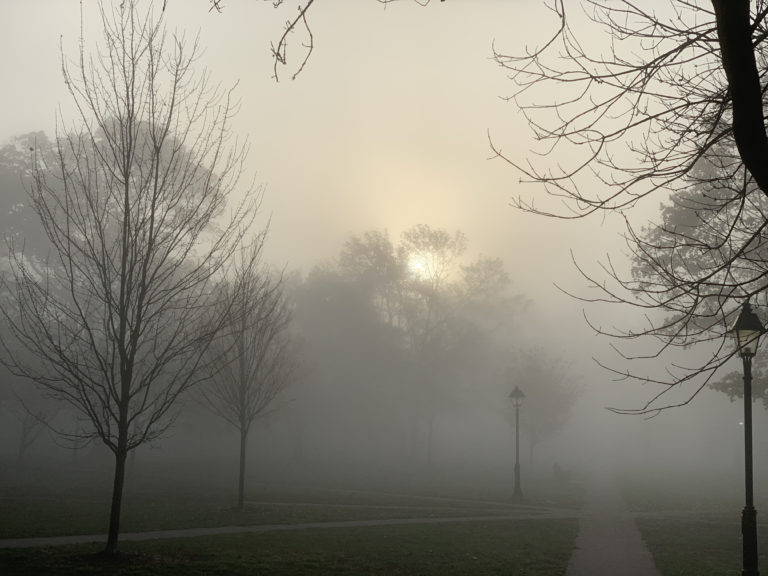
Almost every week since March, I get to Wednesday or Thursday and I think, “Where did the week go?” mostly because I haven’t been able to remember what day it was unless I have a meeting or a deadline. The present tense feels endless.
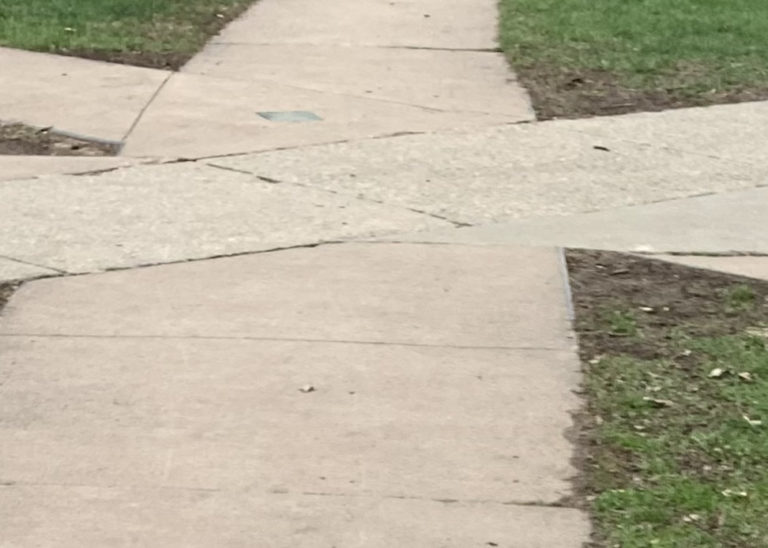
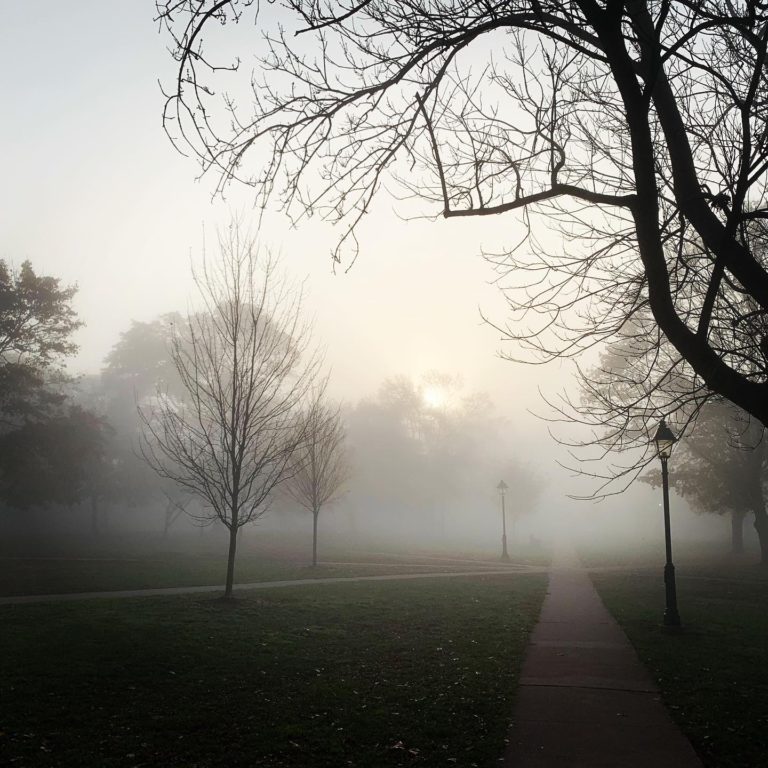
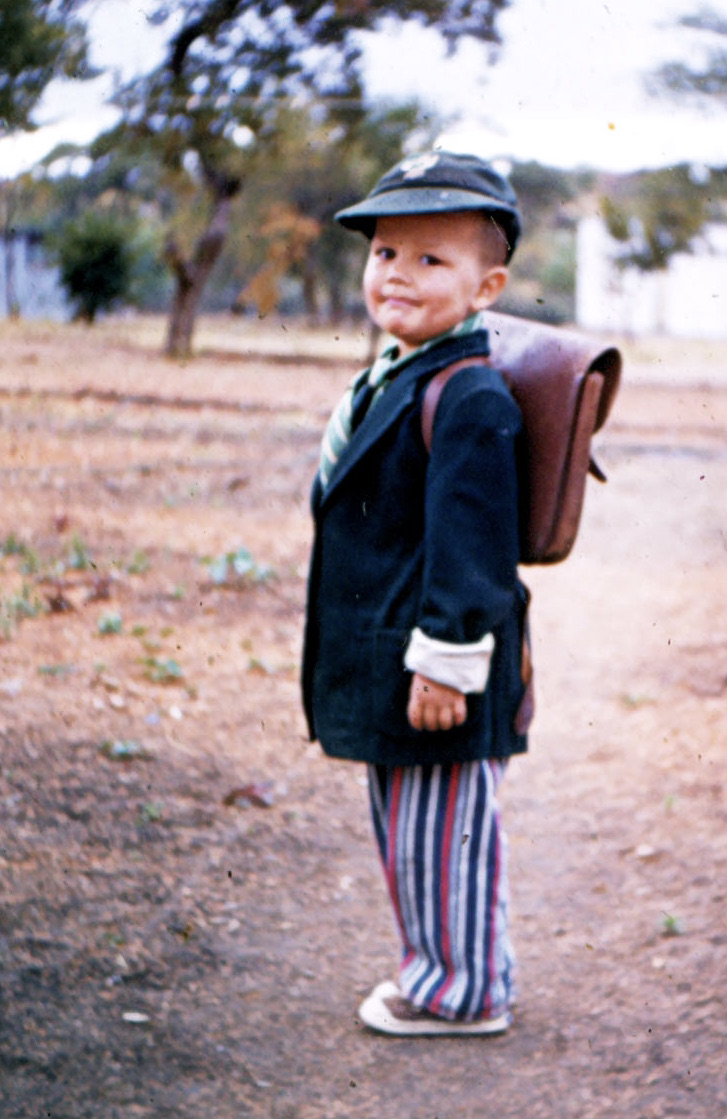
I’ve spent a good deal of my life learning how to live in the moment; like the song from RENT goes, “No day but today.” To live in the moment means the way the old gnarly tree seems to smile, or the stage lighting of the sunrise as it paints the church steeple a sacred orange as Lila and I take our morning walk. It means taking note of the way the crack in the sidewalk bends like a lifeline across the palm of a human hand, or the small girl whose stripes change direction on every layer of clothing as she dons her rainbow unicorn helmet and confidently scoots away.
But part of the reasons moments matter, I am learning, is because they move from one to the next. They come and they go. They are exquisite because they are not eternal. Or, perhaps better put, they are eternal–transcendent–but they are not unending.
What traps us in these days of isolation is an unending present that something other than a moment. It is inertia. Ennui. It’s not only that Tuesday afternoon won’t end, it’s that there is nothing to make it Tuesday. Today might as well be March 256th instead of December 15. Time is standing still and disappearing at the same time. That is not the stuff memories are made of.
We need endings. We need closing scenes that move us from one moment to the next, from before to after. We need episodes, even seasons. We need for the credits to roll. We need to know that Tuesday matters. We need to make memories and that requires more than an endless present.
I should clarify: I’m not talking about death. We have had too many of those endings because of this virus, and COVID has kept us from being able to mark those endings well because we cannot gather as we normally would. But we’ve got to do more than survive. We need to exist–“to have actual being.” Part of that, at least for me, is figuring out how to go out and end something, which is part of what it takes to create a memory.
I guess that also means going out to start something that is worth bringing to a close.
As I know I have said many times, one of the ways to think about the word remember is that it means to re-member, as in putting ourselves back together again. A moment has significance, even movement. Momentum comes from the same root. When we relish the moment and then let it be over, we do more than pass the time. We connect. We create. We come to life.
To live in the moment means to go out and end something. Let it be over, but only after you have created a memory, even it it’s just following the crack in the sidewalk.
After a long day, I have been staring at the screen and writing down dead end streets to the point that I have circled back to an old poem of mine that showed up in a memory today. I need to sleep, so I am going to lean into to your grace and offer words I said a few years back on this same night–updated where they needed to be.
far afield
I wonder what the shepherds did
the year after the angels came,
or how the Magi went about their
business when they got back home.
Do you think the innkeeper woke
in the night sometimes and opened
the door, hoping for strangers, or
sat out in the barn for no reason?
How did they keep the story fresh?
Or did they go back hoping for a
return engagement of wonder— gloria in excelcis ditto—
Did they hang that one special night
like an ornament in their hearts,
but lost its shine over the years?
Could they still hear the melody?
Steps away from my sixty-fifth
Christmas, and the field of my heart
feels far away from the manger.
though I’m out hoping to hear angels . . .
but tonight I have found these words:
Love will not wait till I’m ready;
grace comes, but does not evict grief;
hope runs like a hound for my heart;
peace disquiets as it comforts.
So I gather my sorrows like sheep,
stack these words like wood for a fire,
and strike the match of all that matters . . .
only to find I am not alone.
Can you hear the angels singing?
Do you know the way from here?
If not, we will follow the stars.
Since I preached about joy this week, I thought I might as well put together a hymnal to go with it. When I started looking for joy songs, I found, much as I did in my sermon, that joy doesn’t travel alone. Joy grows out of grief and pain. So that’s where the songs started.
Amos Lee’s “Cup of Sorrow” is an anthem of solidarity that builds on the understanding that shared sorrow breeds compassion.
I’ll send a prayer out across the ocean To a man been forced out of his home I’ll send a prayer out across the ocean So that he may not suffer there alone
I want to drink from your cup of sorrow I want to bathe in your holy blood I want to sleep with the promise of tomorrow Although tomorrow may never come
David Wimbish is a friend from Durham, North Carolina who is a part of an amazing band called The Collection. “Left of Your Joy” asks the kind of hard questions we only ask around those we trust who know our pain and still see the spark in us.
God’s been closing windows and slamming doors The rain keeps leaking in, what the hell was that house for? Love came at so high a cost that you could not afford So now you’re throwing up your hands and feet are kicking up a storm
But there’s still light in your eyes It’s small but it still shines
There is nothing in the past that you belong to And even if the memories come and find you Well, it is not the task to try to rescue what’s left What’s left of your joy
Anjte Dukevot’s “Hold On” is a song between friends–a melodic commitment to stay and to encourage.
When your heart is bent to weigh down a train Hold on When your soul is shipwrecked and you’re miles away Hold on
When your fortress is an eggshell Full of haunted cracks you cannot weld There’s no mercy sleep under stolen sheets In a stillborn dream when your tank is empty When your path is dark and your compass gone When your map is torn, torn
And all your life you never thought you’d end here Hold on And all the glass is in pieces and the maids are in tears Hold on
Bob Bennett is another friend, except he lives in California and we never get to see each other. His song “Joy as Deep as Sorrow” years for happiness and understands that joy is something else. Something as deep as our grief.
I want sweetness and light To keep me up all night Happy hours passing without sleep As sharp as a knife I want love in this life To cut me fast cut me deep
I’d like to see good fortune Paint a target on my back I want laughter to stage A surprise attack One fine day Maybe two or three in a row Blessings lined up Waiting to become the status quo I don’t want to be unfaithful But I really want to know Is there a joy deep as sorrow?
The War and Treaty are a band I learned about because they were supposed to open for Jason Isbell at a concert that I didn’t get to hear because of the pandemic. Their music is gospel and blues and Americana all wrapped up together and then some other stuff I haven’t found words for. “It’s Not Over Yet” is another song of solidarity.
is this message to hard to receive did that last blow steal all of your relief can I massage your doubt into belief I’ll give you back your joy if you give me your grief
well I see your pain you wear it on your sleeve mistake the rain for the tears you cry when sleep and I know it’s dark and the clouds all look like a pile of smoke from your heart
but it’s not over yet you got more to live for it’s not over yet happiness at your door it’s not over yet here’s your unclouded day it’s not over yet for you and me
I love Kris Kristofferson’s “Feeling Mortal” for several reasons, but mostly because he thanks God for being an artist and for the work of art that God did in making him. It makes me smile every time.
pretty speeches still unspoken perfect circles in the sand rules and promises I’ve broken that I still don’t understand soon or later I’ll be leaving I’m a winner either way for the laughter and the loving that I’m living with today
God Almighty here I am am I where I ought to be I’ve begun to soon descend like the sun into the sea and I thank my lucky stars from here to eternity for the artist that you are and the man you made of me
In “May I Suggest” Susan Werner makes a bold claim: this is the best part of our lives, if we are willing to have the eyes–and the heart–for it. I love this song for so many reasons, not the least of which is all the rhymes–the great rhymes–she finds for suggest.
may I suggest may I suggest to you may I suggest this is the best part of your life may I suggest this time is blessed for you this time is blessed and shining almost blinding bright just turn your head and you’ll begin to see the thousand reasons that were just beyond your sight the reasons why why I suggest to you why I suggest this is the best part of your life
Our closing hymn, “Dance in the Graveyards” by Delta Rae, will send us out dancing into the grief and struggle, drawing strength from those who have gone before us even as we face days we have yet to understand.
When I die, I don’t want to rest in peace
I want to dance in joy,
I want to dance in the graveyards, the graveyards
And while I’m alive,
I don’t want to be alone mourning the ones who came before
I want to dance with them some more,
Let’s dance in the graveyards
I’ve got the joy, joy, joy, joy down in my heart . . .
In an earlier chapter of my life, I was a high school English teacher at Charlestown High School in Boston. The student population was a broad mixture of ethnicities but, because of the nature of urban public education in America, what most all of the students shared in common was they were from poor families.
I had two classes of tenth graders–about seventy kids, fifteen going on sixteen. Over a third of the girls had children. I don’t mean they got pregnant their tenth-grade year; they had children to take care of, along with trying to get to school, and, for many of them, work to help support their families.
I think of them most every Advent when we tell Mary’s story because they give me a good incarnational image of what she might have been like: a poor, pregnant brown-skinned teenager.
I have to keep reminding myself of how young she was because of the profound nature of her words in what reads more like a song than a prayer. Over the centuries, what we have come to call the Magnificat has been set to music, primarily in classical settings. While this may be jarring to some who love classical music, I think it has more in common with a protest song–more Dylan than Mendelssohn, more Beyoncé than Bach. Her words call us to remember that there was more to Mary than a human vessel for the baby. In the middle of her life turned upside down and her country in the hands of an oppressive force, she sings like a prophet:
God’s loving-kindness is for those who fear God from generation to generation. God has shown the strength of God’s own arm; God has scattered the arrogant in the intent of their hearts. God has brought down the powerful from their thrones, and lifted up the lowly; God has filled the hungry with good things, and sent the rich away empty.
And she starts it all off by saying, “My spirit rejoices in God my Savior.”
Her words are in harmony with those of Isaiah who, as we have noted for a couple of weeks now, was speaking in the aftermath of captivity and despair. Nevertheless, he said,
God has sent me to preach good news to the poor, to bind up the brokenhearted, to proclaim liberation to the captives, and opening up, release, to the prisoners; to proclaim the year of the Holy One’s favor, and the day of vengeance of our God; to comfort all who grieve; to pay reparations those who grieve in Zion— to give to them a glorious garland instead of ashes, the oil of gladness instead of grieving, the mantle of praise instead of a diminished spirit.
Both are songs of protest, of resistance against oppression and despair, against the dehumanizing actions of those in power. And both are songs rooted in joy.
Theologian Willie Jennings, who teaches down the road at Yale Divinity School, says joy is an act of resistance against despair and death–and that it is hard work. He gets more specific:
Joy begins with renouncing despair by angling one’s body against it. It is always body work. And it is dangerous work because you are negotiating reality at the line of death and despair, twisting and turning between surviving and thriving.
It is fundamentally a decision of thought, act, gesture, and dress to do something different with the given of fear, oppression, or violence. It is a profound work of improvisation–and that is never just making things up. It is working with the given and drawing on those around you and who went before you. Joy formed under this pressure is always an oppositional joy that humanizes dehumanizing conditions. This is the art of making pain productive without ever trying to justify or glorify suffering.
After listening to Dr. Jennings, the grandson of sharecroppers who moved, as he put it, “from the Jim Crow South to the racist North,” I began to see that those of us accustomed to comfort and privilege don’t always know how to get to joy.
I don’t mean to assume that we all have it easy, but I am aware that most of the people of the world, at any given time in history, are more familiar with oppression than I am. Those of us who fit that definition of privilege have been given a gift this year by the isolation of the pandemic because we have a better first-hand feel for living under circumstances beyond our control–of having to respond to fear, death, and despair.
In no way do I mean to equate life in the pandemic with the legacy of slavery, or what Native Americans have lived through, or the Holocaust. I do mean to say ten months of isolation is taking its toll and we are left with the choice of whether we will make meaning of the pain or let ourselves be consumed by it.
Both Mary and Isaiah digested what they heard from God and then chose to respond to their circumstances rather than be defined by them. They listened to the call of the Spirit of God, and that call was outside of themselves so they could see the shared suffering as an opportunity for compassion, and thus for joy.
In his first public sermon, Jesus stood in the synagogue and read these very verses from Isaiah and then said, “That’s why I’m here: I want to heal broken hearts, break open what imprisons people, and set people free from what has captured them.” It’s not hard to imagine that he knew those verses because his instigator of a mother quoted them to him as a child. She didn’t just give birth to him; she helped him grow up into the man who was Love Incarnate. The birth of Jesus is the story of how God chose to respond to the pain of the world by becoming a human being. Jesus is Love with Skin On. Jesus was who he was, in good part, because of the prophet who parented him.
On Friday we received the news that one of the vaccines had been officially approved. We also watched this week as the daily death counts reached historic levels. It will be months before most of us are vaccinated. The pandemic is far from over. Neither are the deep divisions that are tearing at the fabric of our nation. Death and despair are here for the winter and the spring, which means we, like Mary and Isaiah have to choose to respond to our circumstances rather than be defined by them.
We have to choose to do the hard work of joy, to see our collective pain as an opportunity for compassion. Let me give you an example that hits close to home. Tuesday evening I was at the Christmas tree lot across from the Big Y in Guilford when I ran into people I know in town. Their teenage son died almost two years ago. Their grief is still raw. When they asked what I was doing, I told them about being the remote bridge pastor here at United Churches and also told them what Pastor Jeanette’s daughter was going through and the impact that has had on their family and this congregation. About an hour later, I got a message from the woman who asked, “Does that girl’s family need help? Do we need to help make sure they have Christmas?”
In these difficult days of grief and despair, how will we make sure we hope one another have Christmas? How will we offer a glorious garland instead of ashes? How will we do the hard and beautiful work of joy, resisting death and despair? How will we make meaning of our pain?
Let us go out into the days ahead to answer those questions with our words and actions.
A couple of Sundays ago, Ginger talked about numbers in her sermon, bouncing off of the scripture about God knowing the number of hairs on our collective heads. A couple of nights ago, I talked about the role the Beatles have played in the soundtrack of my life. Tonight, they both come to mind because I am a couple of hours away from closing out my sixty-fourth year. Cue the clarinets . . .
The story of the song is that is one of the first songs he ever wrote–at sixteen. The Beatles performed it in their early days in Liverpool and then it found its way on to the Sgt. Pepper’s record. It was recorded in early December fifty-four years ago.
I remember hearing the song as a teenager and thinking sixty-four seemed a long way off. Tonight, it doesn’t feel like it took that long to get here. In Ed Sheeran’s song “Thinking Out Loud” he proclaims, “I’ll be loving you when we’re seventy.” When I hear the song I want to tell him to raise his expectations.
As for numbers, in sixty-four years I’ve lived in thirteen cities in five countries and four states. I’ve been to fifteen schools. I’ve lived in forty-five different residences. We’ve had eight schnauzers. This will be my 2,044th blog post and they have garnered 7,542 comments. I’ve published four books (one was self-published), been to youth camp for twenty-two summers, owned two KitchenAid mixers, had the same guitar for thirty-eight years, and I have one love of my life.
But the numbers don’t tell the best story. On the last night of Year Sixty-Four and the eve of what will be, I’m sure, the least-peopled birthday I can remember, it is the very loved ones I can’t be with that are the best story, chapter after chapter of connection and challenge, of failure and friendship, of laughter and heartbreak and hope, and meals. Lots and lots of meals.
It feels good to get to tonight and think, no whens about it:
I was probably seven or eight when I started by records–forty-fives, singles. I’m talking 1963 or 1964. Every Sunday after church in Lusaka, we listened to Top of the Pops that was broadcast from the UK on Radio Zambia. I should say I listened. The rest of my family endured it. I couldn’t get enough.
To listen to the radio in those days meant to listen to the Beatles. I can remember the announcers teasing with the promise of a new single–a Beatles song we had never heard. “Nowhere Man.” “Paperback Writer.” “Help!” “We Can Work It Out.” “Hey, Jude.” Then I moved on to albums. Rubber Soul.
I still feel those songs in my bones.
We were back in the States my sixth grade year when Sgt. Pepper’s came out (I had the record the came with the paper cutouts) and then Magical Mystery Tour. Then the White Album. We were back in Kenya for Abbey Road and Let It Be. Once again, Top of the Pops played “Get Back” for the first time.
Then the Beatles broke up. And I blamed John (and Yoko) mostly because that is how the story was told. And my dad liked to bad talk John because he never forgave him for saying the Beatles were more popular than Jesus. But part of it was I connected more with Paul’s melodies.
I had to grow into John.
I was in seminary when he was killed. In the years that followed, I began to realize what we lost when he died: “Working Class Hero,” “Beautiful Boy,” “Instant Karma,” “Imagine,” “Give Peace a Chance (War is Over).” In the weeks following his death, I heard this song in a new way:
So this is Christmas And what have you done Another year over A new one just begun
And so this is Christmas I hope you have fun The near and the dear ones The old and the young
A very merry Christmas And a happy New Year Let’s hope it’s a good one Without any fears
It’s still one of the songs I listen for each December.
Marking the fortieth anniversary of his death in the same week that Bob Dylan sold the publishing rights to his entire catalog for $300 million makes me mindful of how much John’s music, with or without the Beatles, has been in my life. Tonight, that is all I wanted to say.
I am grateful for the songs we have and saddened for the ones we missed.
It’s late. It’s been a long day. I am looking for words to offer.
Part of my day was looking at the lectionary passages for this coming Sunday, since I am preaching. Maybe I am just tired enough for this to make sense, but I found myself paraphrasing 1 Thessalonians 5 as though it was written during a pandemic.
Here is how I imagine the letter.
And we urge you, beloved, to admonish the anti-maskers, encourage the exhausted, help the isolated, be patient with everyone. See that none of you repays anger with anger, but always seeks the common good for one another. For everyone! Rejoice always, pray continually, live gratefully, wear your mask, wash your hands, and keep your distance, for this is how God would have us live. Don’t quench the Spirit or skip the sanitizer.
One of the annual events Ginger and I have been a part of in Guilford is a service of remembrance for parents who have lost children. It is an astounding time of both grief and healing. Ginger usually speaks or prays and I sing. This year, the service was live streamed, but it was moving nonetheless. The song I was asked to sing was “I Wish You Peace” by the Eagles, which set me to thinking that on this Sunday when we light the peace candle perhaps some songs about peace might serve us well.
I wish you peace when times are hard the light to guide you through the dark and when storms are high and your, your dreams are low I wish you the strength to let love grow on I wish you the strength to let love flow
The next song that popped into my head is Paul Simon’s “Peace Like a River.” The title has always stuck with me because I knew it first as a youth group song. Now that I have let that ear worm loose, listen to Simon’s song about civil rights protest.
Peace like a river ran through the city long past the midnight curfew we sat starry-eyed oh, we were satisfied
and I remember misinformation followed us like a plague nobody knew from time to time if the plans where changed oh, if the plans were changed
you can beat us with wires you can beat us with chains you can run out your rules but you know you can’t outrun the history train I‘ve seen a glorious day
Another old favorite popped up in the jukebox of my heart: Nick Lowe’s “(What’s So Funny ‘Bout) Peace, Love, and Understanding?”
and as I walk on through troubled times my spirit gets so downhearted sometimes so where are the strong and who are the trusted? and where is the harmony, sweet harmony?
‘cause each time I feel it slippin’ away just makes me wanna cry what’s so funny ’bout peace, love and understanding? what’s so funny ’bout peace, love and understanding?
You might know the Elvis Costello version better, but Nick wrote the song, so I thought I would let him sing it–accompanied here by Los Straitjackets.
Kate Campbell is a roots singer-songwriter who has songs that reach deep in the heart. She also has a deep appreciation for the history of music, particularly in the roots and gospel traditions. “Peace, Precious Peace” is one she says she found on album by Stringbean–David Akeman–who I remember from Hee Haw. His words and music offer a carol of sorts.
there’s a wonderful feeling in the hearts and the minds in a world that is sick of blood and shame and the battle for glory and the peace we shall find when we lay down the sword and the flame
there’ll be shouting and singing there’ll be joy everywhere there’ll be banners from every land unfurled there’ll be jubilant ringing of the bells everywhere when there’s peace, precious peace in this world
Beth Neilsen Chapman’s “Peace” is a carol of yearning. I think we could sing it anytime of year. I couldn’t find her singing it, but I did find Michael McDonald’s cover.
Oh wondrous child of whom the angels sing know my joy feel my suffering shining star make this love you bring so bright that I may believe that my way will not be lost from now on, ’til that rivers crossed my soul renewed my spirit free in you I’ll find my peace
Though my opinion would quickly be contested at my house, I think John Denver and the Muppets: A Christmas Together is the definitive Christmas album. One of the songs it contains is The Peace Carol.
add all the grief that people may bear total the strife, the troubles and care put them in columns and leave them right there the peace of Christmas Day
Sam Baker’s story is as intriguing as his songwriting and performing. “Go in Peace” is one of my favorites. The melody plays off of “Come, Thou Fount;” the words are a simple and profound benediction.
go in peace go in kindness go in love go in faith leave the day the day behind us day is done go in grace let us go into the dark not afraid not alone let us hope by some good pleasure safely to arrive at home
We will let him close the set.
I hope you are finding the music of peace to carry you in these days.