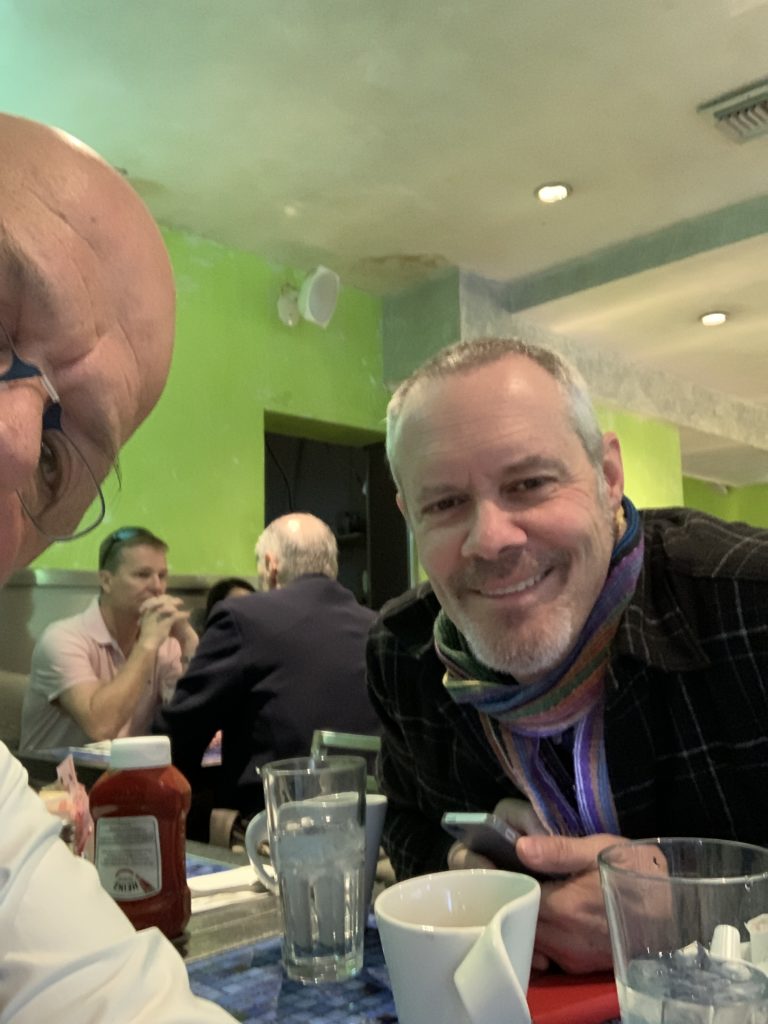
My first date with Ginger, who is now my wife, was a Lyle Lovett concert in a tiny club in Fort Worth, Texas. On our second date, I cooked dinner for her. It was a Saturday night and I put together a mixture of fettuccine alfredo and cajun-spiced chicken that she thoroughly enjoyed. We fell in love with one another rather quickly, so we ate together most every Saturday night that spring and she asked for a repeat performance of the dish so often that we named it “Saturday Night Chicken.” Though we do eat a variety of food, that is our signature dish: the one we most associate with us.
Over the years, I have changed a few things as our tastes have changed or as I learned new things, but it is still pretty much like I made it that first Saturday night.
1 pound boneless chicken breast cutlets, cut in small pieces
1 tablespoon olive oil
1 tablespoon butter
adobo seasoning (see note)
Tony Chachere’s Creole Seasoning
fettuccine pasta
1/2-1 cup Parmigiano Reggiano cheese, grated
2 tablespoons butter
1/4 cup heavy cream
pasta water, if needed
Put a big pot of water on the stove to boil for the pasta. If you are using dry pasta, it will take longer to cook than fresh. The trick is to time it so the pasta finishes with the chicken and the alfredo sauce.
Cut the chicken into bite-sized pieces–at least that is what we do. It also works to cut them in strips. Put them in a bowl and toss with the two seasonings. I use about a tablespoon of both because we like it spicy. Experiment to your own taste, or use other spice mixes. You can also add more as you are cooking.
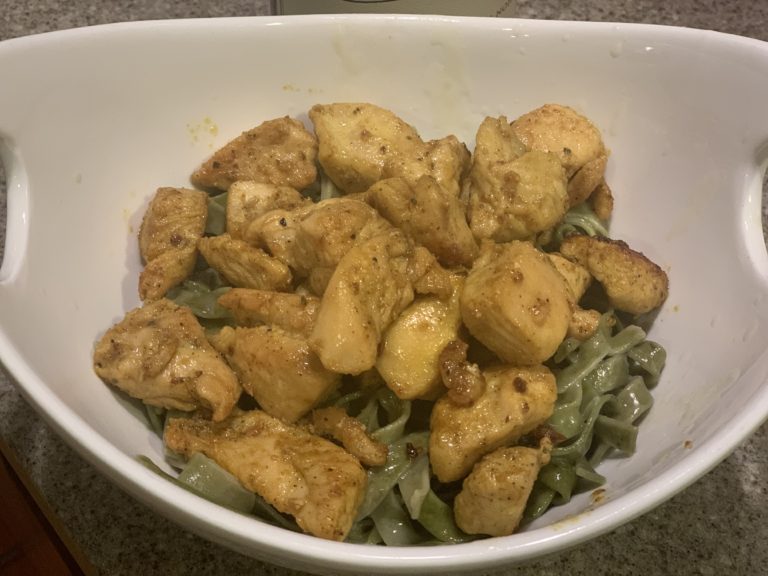
Get a sauté pan or a skillet good and hot and then add the butter and olive oil. When the fats are hot, but not smoking, add the chicken pieces and cook until they are cooked through and a little crispy. Don’t overload the skillet. Put in just enough to kind of cover the bottom of the pan. Do it in batches if you need to. Then set the chicken aside for a minute to make the sauce.
When you know the pasta is close to being done, start making your alfredo sauce. Take another sauté pan and melt about 2 tablespoons of butter over medium heat. Add the cream. Then stir in the cheese. If you are draining the pasta through a colander, save about a half a cup of the water. If you are using a pasta fork (I think that’s what it’s called), put the pasta in with the butter, cream, cheese and stir it all so the pasta is covered. Stir over medium low heat until the cheese melts and it thickens a bit. If you need more moisture, add a little of the patsa water. You can also turn the heat up under the chicken for a minute to let it warm up.
Divide the pasta between bowls and top with the chicken.
Open a nice bottle of wine and feel the love.
NOTE: I used to buy my adobo seasoning, but now I make my own, adapting this recipe.
3 tablespoons garlic powder
3 tablespoons salt
2 teaspoons ground black pepper
1 teaspoon dried oregano
1 teaspoon ground turmeric
You can pulse all of these in a coffee grinder, or just leave the spices as they are.
I’ve missed it. And I’m working to change that pattern for the days ahead. I’ll start with my sermon for today. I am preaching in two places this morning: remotely at United Churches of Durham CT and in person at First Congregational Church of Guilford, which was also recorded earlier in the week since not everyone can get into the sanctuary. Here is what I had to say.
“Small Mercies” Exodus 13:12-23
Back in the days of Blockbuster Video and VHS tapes, Ginger and our friend Cherry rented the movie Casino. It was so long that it took two tapes. They popped one in the VCR and were a little puzzled that the movie just started without any titles or credits, but they chalked it up to Martin Scorsese being a creative director. Still some things didn’t make sense. When they got to the end of the tape and the final credits began to roll, they realized they had started in the middle of the movie.
Our lectionary passage this morning is the beginning of the second tape, as far as the story of the Hebrew people goes. It will make more sense if we give it a larger context. The Book of Exodus is telling the story of how the Hebrews became a people, a nation, and a community of faith. It is also the story of their learning to live in relationship to God in new ways. It began with their Exodus from Egypt. Then the wandered in the wilderness of the Sinai Peninsula for forty years.
In one of the early chapters of this story, the people complained because they didn’t have enough to eat. No–they didn’t just complain. They whined. “Why did God bring us out here to die? We would be better off back in Egypt.”
In response, God rained bread every morning like dew–manna–which inspired our hymn for today: “Morning by morning, new mercies I see.” In the evening quail flew into the camp and just sat there. Though this part of the story is told only once, the food supply chain was never broken. I want you to remember that the meals didn’t stop for forty years. Hang on to that detail.
One more piece of this prelude: the chapter of the story we are reading today begins with Moses going up the mountain to get the Ten Commandments. He was gone so long that the people began to think he was never coming back and they got anxious. Their pleading makes me think of the line from the chorus of John Prine’s “Angel from Montgomery”—“. . . just give me one thing that I can hold on to.”
So they melted all their jewelry and built a Golden Calf to give them that one thing: something they could see and touch—a god they could grasp. Moses came down the mountain with the Tablets, saw the calf, got mad, threw down the tablets and broke them, and then burned the calf to ashes, mixed the ashes with water, and made the people swallow the consequences of their actions. Moses was mad, God was mad, and they people were distraught.
The Hebrew people, as I said, were in the process of becoming a people. They had spent generations in Egypt being defined by who they were not and as they physically wandered in the Sinai, they were spiritually wandering as well, trying to figure out who they were. To see themselves as God’s people meant they had to come to terms with God. For all the parted seas and giant gestures of deliverance, the Hebrews lived with a basic insecurity that God was not going to hang around. They wanted constant reassurance. They wanted a god they could touch, a god they could understand. Rabbi Jonathan Sacks says,
“We now understand the entire drama set in motion by the making of the Golden Calf. Moses pleaded with God to come closer to the people, so that they would encounter [God] not only at unrepeatable moments in the form of miracles but regularly, on a daily basis, and not only as a force that threatens to obliterate all it touches but as a Presence that can be sensed in the heart of the camp.”
In the aftermath of the Golden Calf, Moses pitched his tent outside the camp. Both he and God kept their distance from the people, who wanted presence most of all, but didn’t know how to ask for it. From the camp, they could see that God came to Moses in the form of a “pillar of cloud, and that Moses and God were in conversation in a way the people had not experienced: it gave the appearance of two old friends talking.
Moses was a man acquainted with powerful revelation. God first spoke to him through a burning bush that never burned up. When Moses raised his arms, the sea parted and the people escaped Egypt. The Torah records more than one conversation between God and Moses where Moses bargains with God. In this passage, Moses asks to see God face to face and God says,
See, there is a place by me where you shall stand on the rock; and while my glory passes by I will put you in a cleft of the rock, and I will cover you with my hand until I have passed by; then I will take away my hand, and you shall see my back; but my face shall not be seen.
I want to go back to the detail I asked you to hold on to earlier: the manna and quail had never stopped. Morning my morning, God had showed up and the new mercies had continued, but Moses and the Hebrew people had lost sight of them somehow.
The Hebrew people wandered for forty years across an area about the size of the state of Maine. When they left Egypt, they thought, I’m sure, that everything was going to be okay. They were freed from their enslavement. God was with them. But it was just the beginning. What they thought would end quickly dragged on for generations. They didn’t know when it was going to end. They didn’t know what to expect. They built the golden calf so they could have a deity they grasp. They wanted a quantifiable life and a quantifiable god. They wanted certainty. They wanted another grand gesture on God’s part to give them a sense of presence and what they got was breakfast every morning.
In one of my favorite movies, Miss Firecracker, Carnelle Scott is a woman who is well-acquainted with grief and tragedy, and who is also in the last year of her eligibility for the Miss Firecracker Contest in Yazoo City, Mississippi. Her cousin Elain had won it years before when Carnelle was a child, and Carnelle is sure she can do the same and that winning the title will change everything. She places fifth.
Later, she says to Mac Sam, the come-and-go love of her life, and also one of her biggest encouragers, “I just want to know what I can reasonably expect out of life.”
“Not much,” he answers, laughing and coughing at the same time.
“But something,” she persists.
“Eternal grace,” he says.
We are wandering into the eighth month of distance and isolation connected to COVID-19. In many ways, we are less sure about when this will be over than ever. We are a little over two weeks away from an election that will answer some questions but leave much of our cultural turmoil and division still in play. We are struggling to deepen and widen our understanding of what it means to be a people as we come try to come to terms with the structural racism and bigotry baked into our systems. We, too, want some certainty about what is coming next. We, too, pin our hopes too easily on grand gestures. We, too, want to know what we can reasonably expect out of life.
But, like, the Hebrew people, we will find our hope and our humanity in the small merices. We find our faith in the stories we tell that give us a sense of God’s presence, not in a full-on, in your face kind of way, but in how we remember what God has done in our midst. The cliché says that the devil is in the details. No. That’s where God is.
Micah 6:8 is a verse we quote often: “What does the Lord require of you but to do justice, love kindness, and walk humbly with God.” The oldest translations read “love mercy” instead of “love kindness.” The manna on the ground each day was an offering of God’s kindness. With that in mind, listen to Naomi Shihab Nye’s poem, “Kindness”
Before you know what kindness really is you must lose things, feel the future dissolve in a moment like salt in a weakened broth. What you held in your hand, what you counted and carefully saved, all this must go so you know how desolate the landscape can be between the regions of kindness. How you ride and ride thinking the bus will never stop, the passengers eating maize and chicken will stare out the window forever.
Before you learn the tender gravity of kindness you must travel where the Indian in a white poncho lies dead by the side of the road. You must see how this could be you, how he too was someone who journeyed through the night with plans and the simple breath that kept him alive.
Before you know kindness as the deepest thing inside, you must know sorrow as the other deepest thing. You must wake up with sorrow. You must speak to it till your voice catches the thread of all sorrows and you see the size of the cloth. Then it is only kindness that makes sense anymore, only kindness that ties your shoes and sends you out into the day to gaze at bread, only kindness that raises its head from the crowd of the world to say It is I you have been looking for, and then goes with you everywhere like a shadow or a friend.
In the musical Godspell, one of Jesus’ followers sings, “Day by day, day by day, O, dear Lord, three things I pray: to see thee more clearly, love thee more dearly, follow thee more nearly day by day.”
In the messy details of our lives, in our hunger for assurance, in our trust that we are held by eternal grace, and in all that is uncertain about what lies ahead, our daily kindnesses are our best reminder of God presence and our connectedness. Morning by morning. Evening by evening. Sorrow by sorrow. New mercies we see—day by day by day by day by day. Amen.
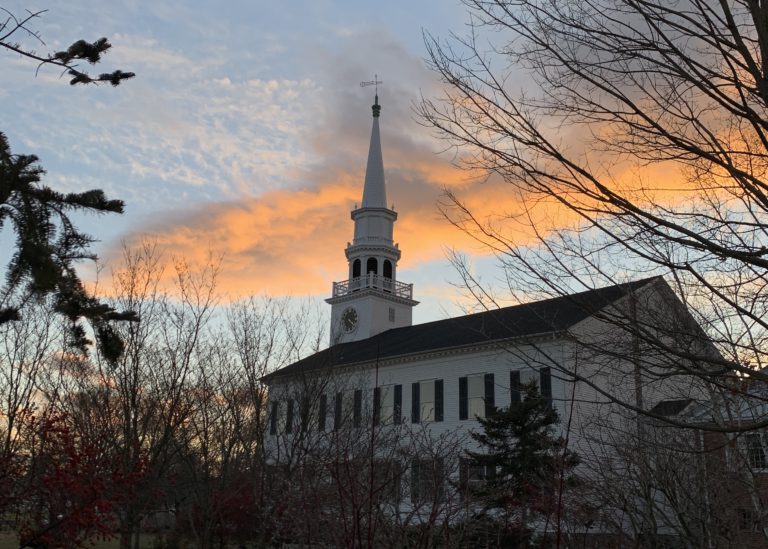
One of my Facebook friends here in Guilford posted this picture of the sunset blurred by the ash of the fires on the other side of the country.
scattered
the east coast sunset
looks like the west
african haze of the
harmattan but our
sun is not muted
by the desert dust
but by the ashes
of trees and homes
the remnants of
incinerated lives
carried cross country
ashes of remembrance
scattered shadows of
solidarity that say
we are connected
by wind and land
by fire and death
by loss and life
tell me why then
is it that I am
caught
by surprise
When I worked at the Roobar restaurant in Plymouth, Massachusetts, I learned how to make a marinara sauce from Tim Miller, the executive chef and one of the best people I ever worked for. I learned a lot of things from him.
One summer Saturday after we moved to Durham, North Carolina, I came home from the farmers market with both peaches and tomatoes. I’m not sure what got me to thinking about combinations, but I decided to play with what I had learned from Tim and use them both to make a sauce for a Thursday Night Dinner. As I remember, I poured it over eggplant parmigiana.
It worked.
A couple of weeks after I made up my signature cookies for Cocoa Cinnamon in Durham, I walked into the shop to see them labeled as “Milton’s Famous Cookies.” When I asked my friend and the co-owner about it, he said, “They are famous here.” My sauce has remained a little bit more of a secret, but it’s pretty damn good, so I will settle for
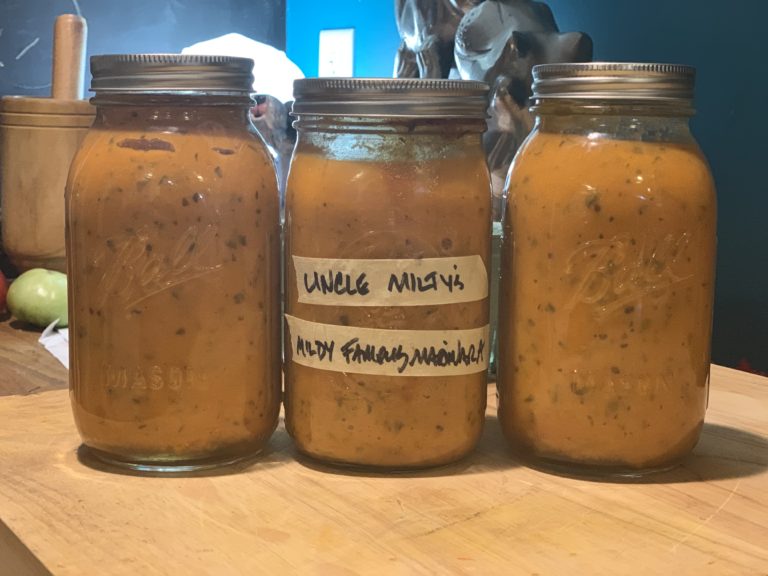
uncle milty’s mildly famous tomato-peach marinara
Like any good sauce, it’s all in how it tastes, so I am not giving specific amounts, other than to say use equal amounts of tomatoes (I prefer paste tomatoes–Romas, San Marzanos) and peaches. Even better if both are fresh, though canned tomatoes will work in a pinch. Don’t use canned peaches. Those are ready for pies. Frozen ones would work, however.
This recipe is designed to make a bunch of sauce, but you can make a small amount as well.
tomatoes, blanched and peeled
peaches, blanched and peeled
garlic
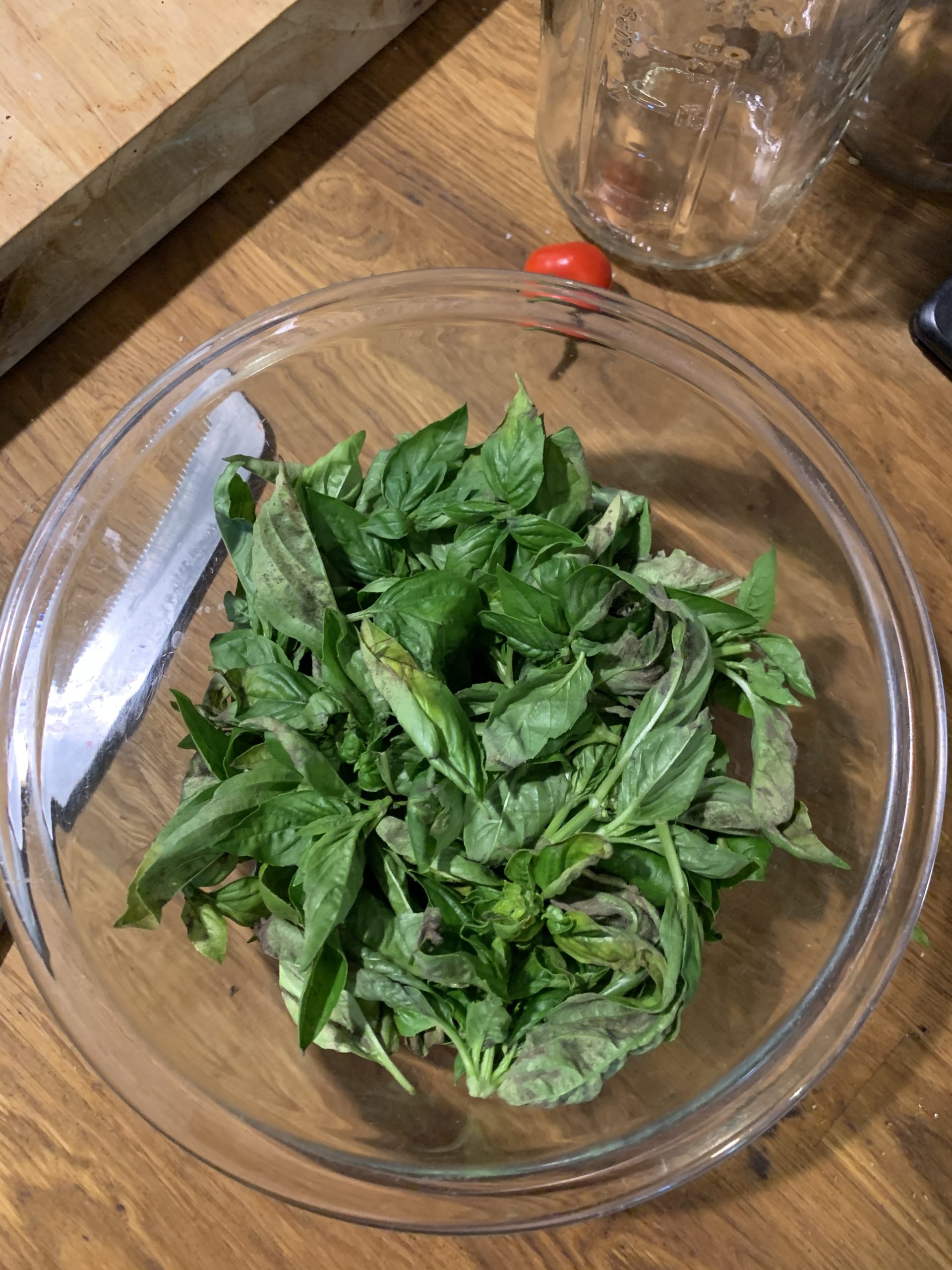
basil, chopped
olive oil
Bring a pot of water to boil. Score the tomatoes and the peaches across the bottom: make an “X” with a knife, that is. Drop the tomatoes in the boiling water for 1-2 minutes and then lift them out on to a sheet pan. Bring the water back to a boil and blanch the peaches for 3-4 minutes and lift them out.
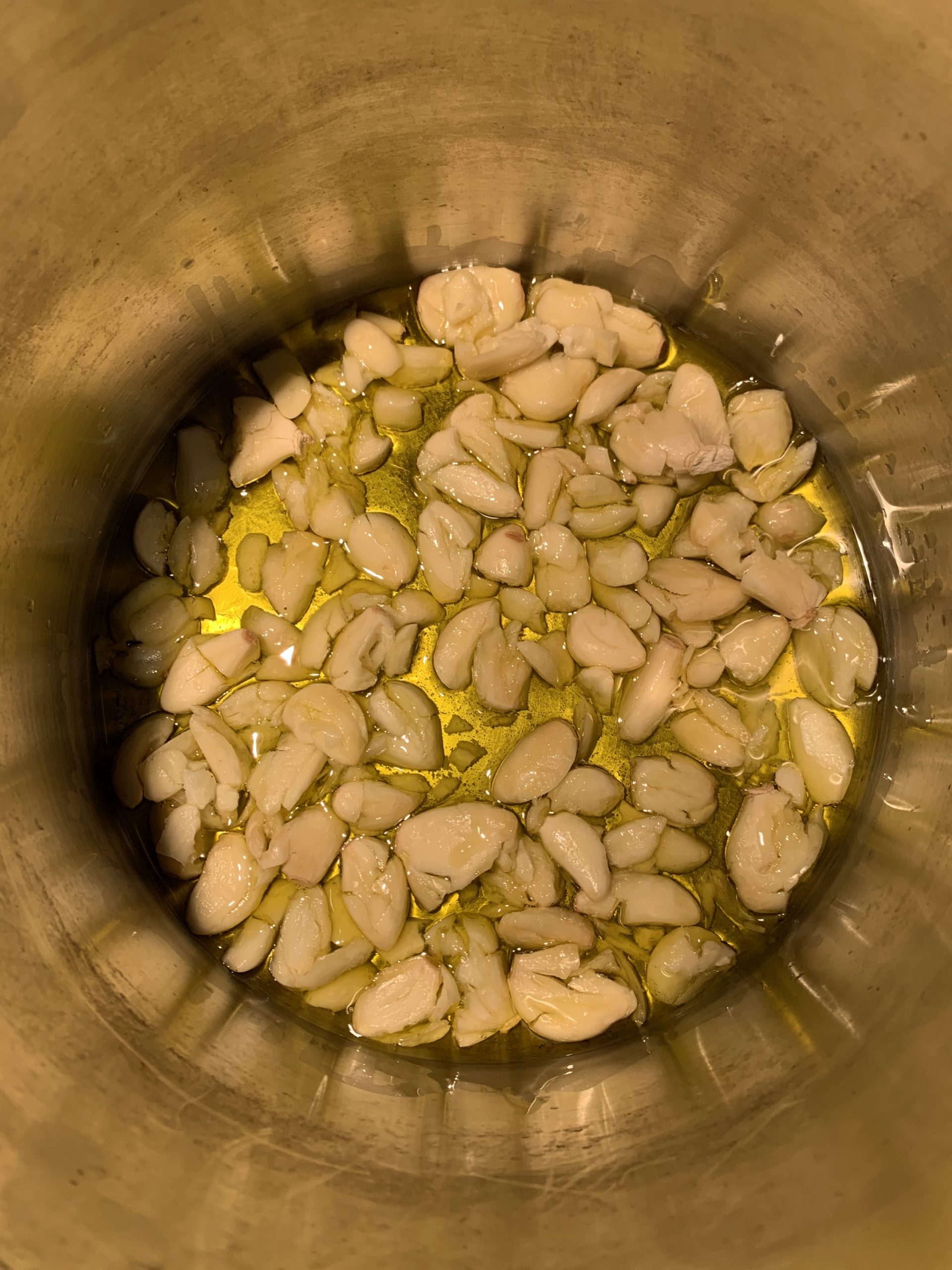
Empty the water out, wipe the pot dry, and return it to the stove. (Or use a different pot; I just like to have less cleanup.) While the tomatoes and peaches are cooling a bit, crush enough garlic to pretty much cover the bottom of the potand then pour enough olive oil over the garlic to cover the cloves about halfway. Put it over medium heat and put a lid on the pot. Stir it occasionally. Cook for 6-8 minutes, or until the garlic begins to brown a bit on the edges.
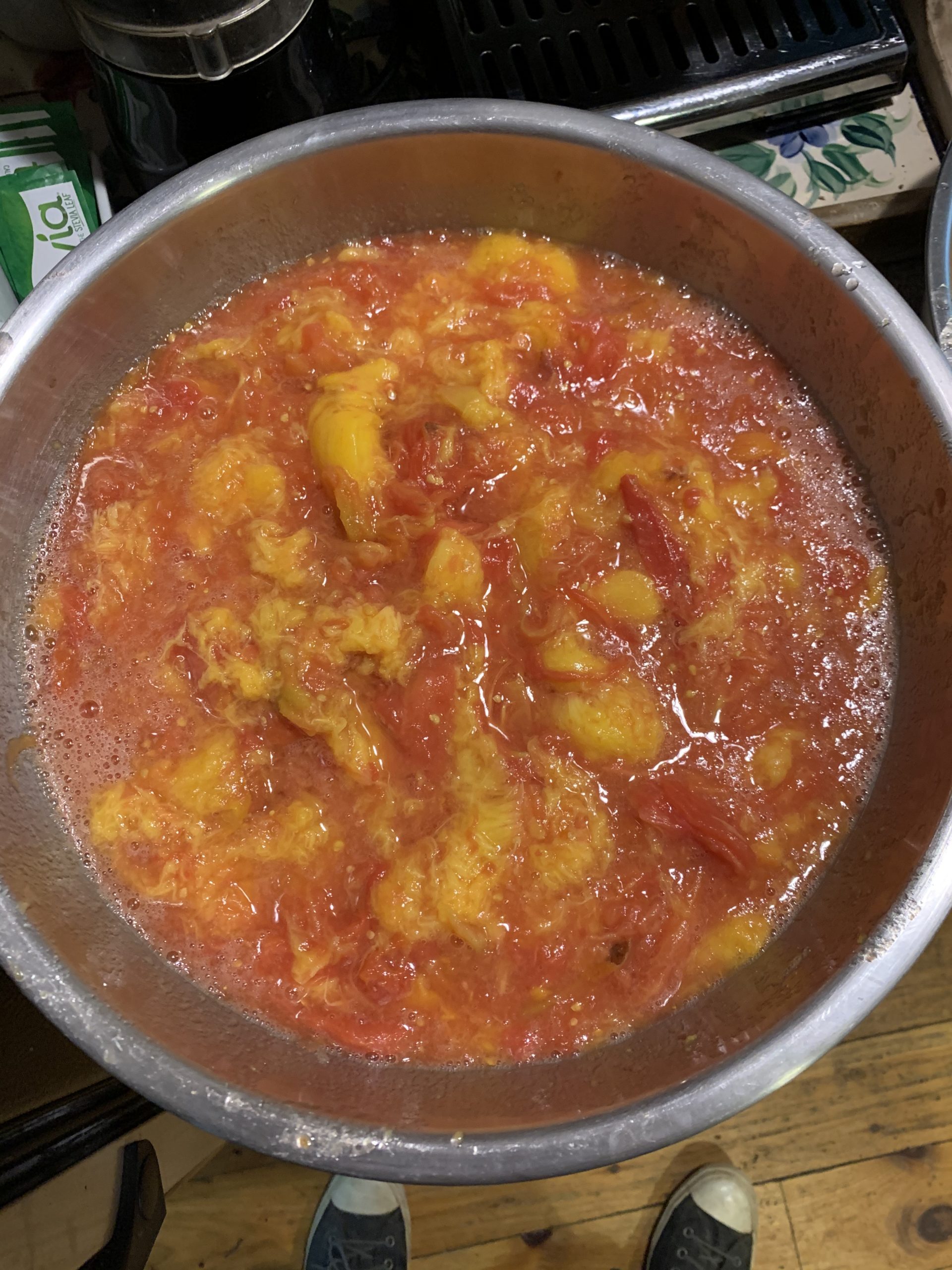
While the garlic is cooking, peel the tomatoes and peaches (the blanching makes it easy) and put them in a big bowl. Use your hands to crush everything together. Pour the mixture–carefully–into the pot with the garlic and oil and stir to mix well. Lower the heat a little and then let it come to a simmer. Don’t put a lid on it; you want it to reduce a bit. Cook for at least an hour–longer if can. Low and slow always makes a sauce taste better. Season the sauce–add salt and pepper, or maybe some crushed red pepper flakes–towards the end of the process.
Take the basil leaves off of the stem and chop them. When the sauce is nearly done, add the basil and stir. Then purée the sauce using an immersion blender until it’s smooth. Taste and season again.
If you want to can the sauce, add one tablespoon of lemon juice and 1 teaspoon of salt to the bottom of each pint jar (double for a quart jar), and then fill with sauce, seal, and process in a water bath (more boiling water) for 45 minutes (55 for quarts).
Yes, it’s pasta sauce, but it tastes so good you could eat it like soup.
the word distance
has its roots in discord
and disagreement
another way of
saying something has
come between us
we stand apart
before we masked
and measured ourselves
the strife simmered
under our skins
we want to blame
the virus but our
disease runs deeper
long ago we learned
to live at extremes
makes it easier to be
right even righteous
why give even an inch
to let them too close
is to risk infection
I learned a folk
song as a kid that
wondered where the
flowers had gone
a light apocalyptic
melody that carried
the question when
will they ever learn
when will we
My friend Nathan Brown is a poet. For a living. And he’s good.
At the beginning of the pandemic, he began something called the Fire Pit Sessions on his Facebook page, which grew out of his invitation for people to commission poems about life in these days. He then began to come on every night or two and read some of them and then sing a song—usually a cover, but often an original.
He did his forty-eighth Fire Pit Session last night and they just keep getting better. After he finished his poetry, he cited a few lines G. K. Chesterton’s “The Deluge” from memory
Though giant rains put out the sun, Here stand I for a sign. Though earth be filled with waters dark, My cup is filled with wine. Tell to the trembling priests that here Under the deluge rod, One nameless, tattered, broken man Stood up, and drank to God.
I wanna ask all the questions with answers we’ll never know I wanna find my faith in records from long ago I wanna set fear on fire and give dreaming a fair shot And never give up whether anybody cares or not
and I felt compelled to write a response to my friend, and so I sent him this.
August 3 marks seven years since my father died—on the same day that Gracie, our little goofy Schnauzer, died as well.
the third of august
the thing I never really liked
about august is the way the
heat and humidity ride under
my skin making it all but
impossible to be comfortable
I can move from sweaty to
surly because there is no relief
grief is an endless august in
the weather of the heart
an agitating absence a
hot breath of a breeze that
sends sadness seeping out of
every pore even the soft sun
of the morning is ready to burn
it has been seven augusts since
you died early that morning
and I sat in the parking lot
of the nursing home in Waco
my sweat as heavy as my tears
feeling like a fatherless child
a long long way from my home
one might think I would be used
to august by now but I am not
acceptance is not an arrival
I keep living through augusts
with you still under my skin
I will carry your name and your
memory yet another summer
I preached this week for our church. The passage was Matthew 14:13-24—the story of the Feeding of the Five Thousand—which is one of my favorites. Since our sanctuary is not air conditioned, we filmed in Ginger’s office.
One of the songs that was popular when I was in high school that has managed to stick around for almost half a century is a tune by the Scottish band Stealers Wheel called “Stuck in the Middle with You,” which includes the memorable lines
clowns to the left of me jokers to the right here I am stuck in the middle with you
A pandemic anthem well before its time, don’t you think?
I did too, as I worked on my sermon this week—only to be reminded that Ginger had referenced the song in her first virtual sermon back in March. But since March feels like it was years and not months ago, the song bears repeating because we are still stuck—or so it seems.
As August begins, we have gone almost five months since we last worshipped together in our meeting house or chatted at coffee hour. I am way behind on my NHQ–my Necessary Hug Quota. Because of my knee surgery in April of 2019, which sidelined me from cooking for most of the summer, our barn has gone almost a year without people gathered around our table for dinner. How I wish we could be together so we could share what we miss and the griefs—yes, plural—we are all holding. Whatever stories we are telling in these days of protest and pandemic, they are grief stories: stories of being stuck in the middle without resolution—and without each other.
I was grateful to find that the lectionary passage was the story we most commonly know as the Feeding of the Five Thousand, which you may not know is a grief story of its own. Our reading starts in the middle of things, as lectionary passages often do. The first sentence is the giveaway: “And hearing this, Jesus withdrew from there in a boat to a deserted place to be by himself.”
“And hearing this . . .” The English teacher in me wants to say, “Your antecedent is unclear. What did he hear?
The first twelve verses of Chapter 14 give us that context. The short version is John the Baptist was murdered by Herod on a drunken whim. His disciples buried him and then came to tell Jesus. And hearing this, Jesus did all he could to get away from everyone and everything to grieve the loss of his cousin, colleague, and friend. But he couldn’t get away. The crowds of people hoping for healing were relentless in both their need and pursuit of him and they followed him out of town into the desert, as did the disciples whom, I imagine, were doing their best to deal with their grief over John’s death as well as Jesus’ sorrow, which was new to them as well.
When Jesus became aware of what was happening, Matthew says, “. . . he was moved inwardly with compassion for them” and instead of continuing to run away Jesus turned back into the mass of people and began to listen to their grief stories, to share their loads, and to offer healing. This went on all day and into the evening. The disciples’ response was a little less compassionate, though I think they thought they were trying to help. “We’re out here in the desert and it’s after supper time; don’t you think we should send them into the villages so they don’t starve?” Part of being a disciple, it seems, meant living with the grief of inadequacy, which was wearisome, I’m sure.
Jesus’ response was direct: “They don’t need to go away. You give them something to eat.”
Their response was also straightforward. “We have nothing here but five loaves and two fishes.” In Matthew’s version, they didn’t even have a cute little kid who was offering his sack supper. They just knew they didn’t have enough. The hunger of the crowd was not something they could solve. It didn’t matter what they did, they couldn’t fix the problem.
“Bring them here to me,” Jesus said. Then he turned to the crowd and asked them to recline, as they would if they were going to eat. (For our purposes, let us imagine they were masked and appropriately distanced.) He blessed the food and then gave it to the disciples to distribute. With several thousand people on a hillside, it is hard to grasp the logistics of it all, but the people seemed to know that dinner was being served. They sat down and began to pass the food as it came to them. Everyone ate and there were leftovers.
The willing suspension of disbelief has always come fairly easily for me, so I have never had much of a problem with taking the miracle stories of Jesus at face value, or, as one of my seminary professors used to describe them, as parables in event, which is to say the miracle of this meal is pointing to something other than the amazing set of circumstances.
The state of my life often affects what I see in the story. These months we have spent in quarantine, as many have turned mask-wearing into a violation of their constitutional rights, have helped me to see that the miracle in this story is that a whole mountain of grieving people looking beyond themselves and feeding one another.
I don’t think Jesus knew, necessarily, that it was all going to work out when he started passing out bits of bread and fish. He just knew it was the right thing to do. If you have food and you see hungry people, you feed them. You offer what you have. And then see where it goes.
The lectionary passage stops with the count of how many were fed and, in doing so, leaves the story too quickly. But the next verse, verse 22, says, “Then he insisted that the disciples embark into the boat and precede him to the other side, until he should dismiss the crowds.”
The day had begun for Jesus with an ambush of grief that had sent him searching for self-isolation. It ended with him being not quite ready to leave when dinner was over: “You go on and I’ll catch up. I want to say goodbye to everyone”—and, yes, I realize that is an extrovert’s take on the story. Still, Jesus found some healing there as well. As the disciples walked down to the water, I imagine them hearing Jesus humming,
clowns to the left of me, jokers to my right . . .
And then they went on to the next day, which held new grief of its own, and some old stuff as well.
Jesus didn’t take care of people or tell the disciples to feed the crowd because it made everything better. Healing people didn’t bring John back to life. Handing out fish and bread didn’t eradicate the Roman occupation. But they were the right things to do. The hopeful things.
Vaclav Havel was a playwright who became the president of Czechoslovakia in the late 80s. He told of something that took place just a few weeks before he unexpectedly became a head of state. He was out in the countryside at a dinner party and fell down a sewer pipe. In his words, he almost drowned in that “fundamental mud” but someone had the wherewithal to get a long ladder and saved him. That he was in a sewer and that he became a state official were equally absurd circumstances. In that context, he wrote about hope.
Hope in this deep and powerful sense is not the same as joy when things are going well, or willingness to invest in enterprises that are obviously headed for early success, but rather an ability to work for something to succeed. Hope is definitely not the same thing as optimism. It’s not the conviction that something will turn out well, but the certainty that something makes sense, regardless of how it turns out. It is this hope, above all, that gives us strength to live and to continually try new things, even in conditions that seem as hopeless as ours do, here and now. In the face of this absurdity, life is too precious a thing to permit its devaluation by living pointlessly, emptily, without meaning, without love, and, finally, without hope.
We have more days coming that we can imagine when we are not going to know how long this is going to last, or what is going to happen next, or when life will feel recognizable again. The days ahead are also going to leave us feeling like the disciples, more often than not, when it comes to how what we think we have to offer stacks up against the needs around us. Whatever happens, even in life beyond the pandemic and quarantine, life is not going to feel like the life we think we remember. But Jesus, to use Havel’s words, didn’t do what he did because he knew it would all turn out okay, he did it because he was certain it made sense to share what food they had. And then he stayed to talk, and to listen.
One of the verses of our song for today goes
trying to make some sense of it all
and I can see it makes no sense at all
it is cool to go to sleep on the floor
‘cause I don’t think I can take anymore . . .
So much of life right now doesn’t make sense, from the virus to the vitriol of our national discourse. Truly, there are clowns to the left and jokers to the right. The world feels full of naysayers, nutjobs, and ne’er-do-wells in every direction. It doesn’t make sense to keep screaming at each other. It doesn’t make sense to just wish that life would go back to normal—whatever that was. It doesn’t make sense to just hunker down and take care of ourselves and let everyone else fend for themselves.
What does make sense is to do all we can to let those stuck in the middle with us know that we are all wonderfully and uniquely created in the image of God and worthy to be loved. What does make sense is to see these days as open space that offers us the chance to change, how we treat one another on both personal and societal levels. We are stuck in the middle together. What makes sense is to offer all that we have to a hungry world. To feed one another any way we can—even the clowns and the jokers. Amen.
Peace,
Milton
P.S.—Seems only fitting for this to be our postlude.
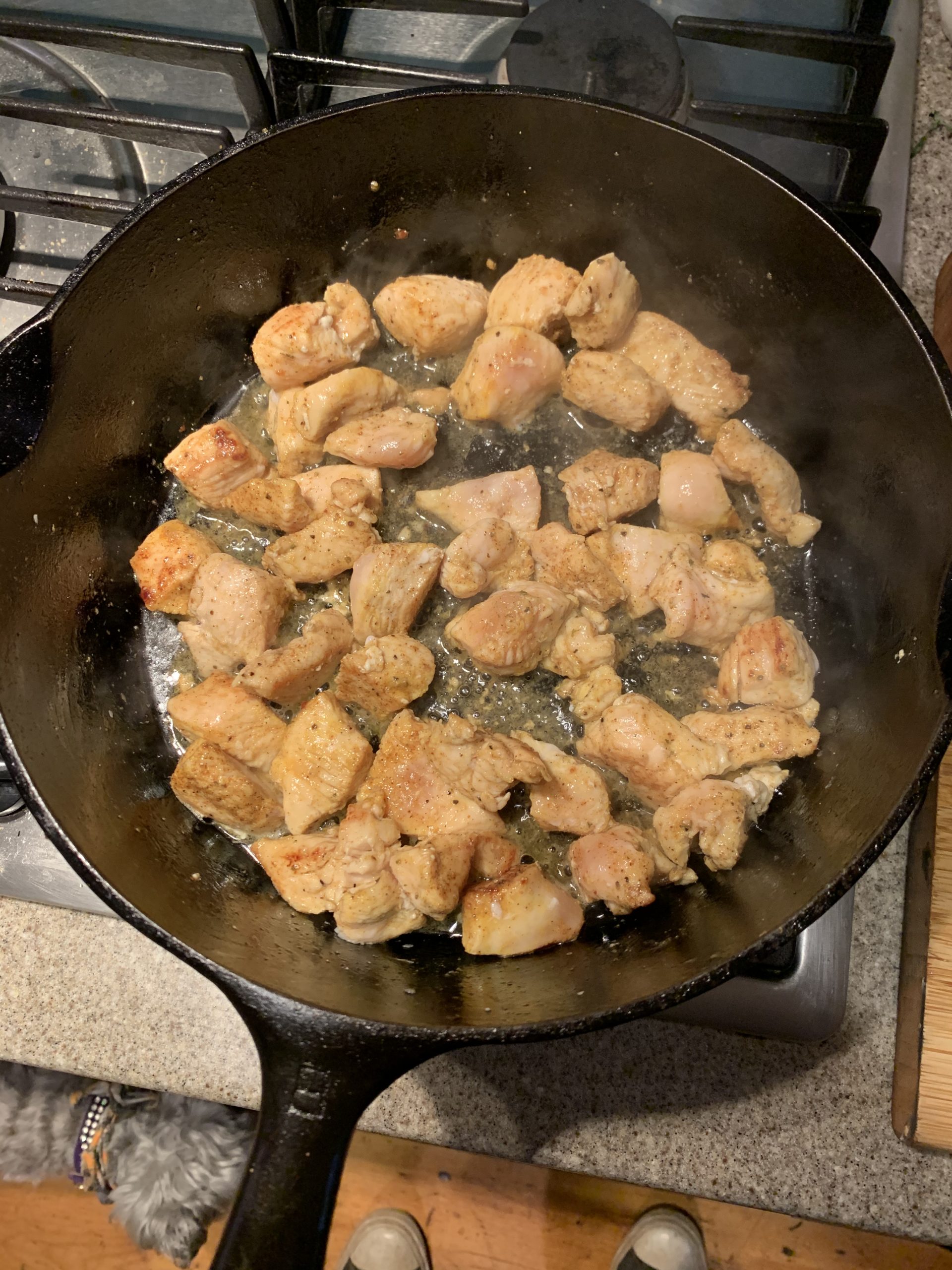 fats are hot, but not smoking, add the chicken pieces and cook until they are cooked through and a little crispy. Don’t overload the skillet. Put in just enough to kind of cover the bottom of the pan. Do it in batches if you need to. Then set the chicken aside for a minute to make the sauce.