Home Blog Page 17

lenten journal: wilderness

The origin story for Lent, one might say, is Jesus’ venture into the wilderness for forty days.

That image rolls off our tongues and out of our sermons as though we know what happened is described by only eleven verses in Matthew’s gospel and thirteen in Luke’s. The conversation between Jesus and the tempter can be read in a minute or so. I keep wandering what Jesus did for over a month and, actually, where he was while he was doing it.

The gospel writers, at least in our translations, say John was out in the desert baptizing people–including Jesus–in the Jordan River and that after that Jesus went out into the wilderness to fast and pray and be tempted. In Greek, the word we read as either desert or wilderness is the same. It is less a description of a particular type of terrain as much as an indication of a place that is not really a place in terms of human population or activity. John was outside of town doing his thing and Jesus just moved farther out.

As far as the forty days go, the number is a consistent symbol throughout both Hebrew and Christian scripture that intends to mark a significant period of time or a time when something significant happens. It makes me think of my youth ministry days and some of our long trips. When kids would ask how much farther we had to go, I always answered, “An hour and a half,” as if to say, “It will take as long as it takes.”

Journeys always take longer when don’t know how much farther you have to go.

However long he was gone, he wasn’t counting how many more Sundays until Holy Week began. We are also left to wonder (imagine?) if the temptations were the point of the pilgrimage or an intrusion. Either way, he had to negotiate the terrain around him, whether he stayed along the river or went out into the rockier arid land that rose around it. I wonder if he met people or was alone the whole time. What kind of animals did he encounter? Did he spend his days hiking or swimming or sleeping on the river bank?

Maybe I am taken by the wilderness and Jesus’ time there because landscape is a lively metaphor these days, thanks to some of my reading that talked about grief as terrain rather than process–not something we get through but something we live in and navigate. I am finding the image helpful as a metaphor for depression as well because it is the land I live in. I hesitate to say that because I feel like I have talked a lot about my depression lately, but it is the land in which I am living these days and I find the best way to remind myself that the terrain is not uninhabited is to speak up and hope for some response from others who live here as well.

Years ago, Ginger and I were driving from El Paso to Big Bend National Park in Southwest Texas. On that stretch of I-10 the exits are literally sixty miles apart. The landscape is a mixture of mountains and deserts and forests and wild life. As we passed one of the signs telling us we had an hour to go until the next exit, I said, “This is beautiful.” At the same time, Ginger said, “There is nothing out here.” Both things were true.

The landscape of life feels a lot like I-10 these days.

Perhaps that is why I am intrigued with how Jesus spent his time in the wilderness. He was out there long enough to come to a place where he had to stare down who he was for however long it took. And the questions he faced out there stayed with him the rest of his life. They weren’t one offs.

So I come back to my Lenten Journal–a day late–to see what I have to learn from the landscape this year. As I was preparing to write, I found this song by Bruce Cockburn that was new to me, “Forty Years in the Wilderness.” The chorus says,

take up your load
run south to the road
turn to the setting sun
sun going down
got to cover some ground
before everything comes undone
comes undone

A good word. It will take as long as it takes.

Peace,
Milton

what we can’t explain

Recent church tradition names this Sunday—the last Sunday of Epiphany before Lent begins—as Transfiguration Sunday, which means the Gospel reading for the day in most mainline churches is the story of Jesus transformation in front of Peter, James, and John, which we just read together. The story shows up In Matthew, Mark, and Luke, each offering a few different details, and all of them telling of events that are hard to fathom. Transfiguration is an old word, and not one we use much, which makes the account even stranger. Let’s look again at what happened.

Jesus took the three disciples to the top of a hill or a mountain and, while they were up there, Jesus’ appearance became excessively brilliant–almost overbearingly bright–and Peter, James, and John saw Moses and Elijah talking with Jesus in the midst of the brilliance.

Peter’s first response was to build shelters to capture the moment, or perhaps to stretch the moment into something longer; if the story were contemporary, Peter would have been posting to his Instagram account. But he was interrupted by a cloudy presence that overshadowed everyone and a voice said the same thing Jesus heard at his baptism: “This is my beloved son in whom I delight.”

Matthew says the disciples were frightened. Luke and Mark say the disciples were awe-struck; the Greek word can be translated either way. Jesus told them not to be afraid, and when they looked up, it was just the four of them again, on the top of a hill in Galilee.

As many times as I have read this story, I am never sure what to do with it. This past week, a question kept coming to mind: What do we do with things we can’t explain?

When it comes to comedy, we are told a joke isn’t funny if you have to explain it. Perhaps that is also true of experiences of awe and wonder.

Many years ago, I was listening to A Prairie Home Companion and Garrison Keillor told a joke that has remained one of my favorites.

Two penguins are standing on an iceberg.
One penguin says to the other, “You look like you’re wearing a tuxedo.”
The other penguin replies, “Who says I’m not?”

I can’t explain why it’s so funny to me, and, if it is not funny to you, my explanation wouldn’t help.

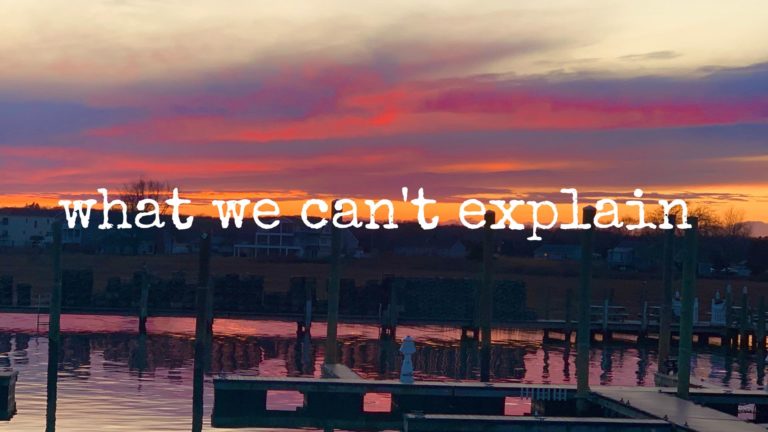
Late in the afternoon Monday I was running errands when I realized it was almost sunset. I called Ginger at home and told her to meet me in the driveway and we went down to the marina in Guilford in time to see the sky melt into pinks and purples and oranges as the sun dropped below the horizon. We did little else but sit there and talk to a couple of others who had stopped for the same reason.

Again, I can’t explain why we were moved by the way the fading light hit the clouds, and again, my explanation wouldn’t help convey how it felt to be there. Instead of breaking the sunset down into its component parts, the power of the moment was in the way our hearts expanded as the day drew to a close, and the sense of appropriate insignificance–the awe–we felt alongside of the shoreline and the sunset.

As people of faith, we are called again and again to trust what we can’t explain–that’s what faith is: trust, even when we don’t completely understand. That is not to say we are to accept things without question, or that the stories shouldn’t be examined. Sometimes we come to these stories from a more analytical perspective, just as a scientist might approach a sunset as a way of understanding the properties of light; those moments matter.

And sometimes we are given the gift of living with moments we can’t explain—the chance to engage life without the comfort of an explanation or a definition. The two are not mutually exclusive or necessarily opposites. They can both be avenues to deeper understanding. The latter, however, carries the reminder that life is not easily explained.

Our passage today begins with the words “six days later,” which lets us know we’re in the middle of the story. What happened earlier in the week was Jesus said, “All who want to come after me must say no to themselves, take up their cross, and follow me. All who want to save their lives will lose them. But all who lose their lives because of me will find them. Why would people gain the whole world but lose their lives? What will people give in exchange for their lives?”

After thinking about Jesus glowing on the mountain and the sunset on the marina, I heard something I had not before in his words, “All who lose their lives because of me will find them.” That reminded me to the closing line of one of my favorite hymns, “Love Divine, All Loves Excelling,” which says, “Lost in wonder, love, and praise.”

We often connect Jesus’ words about losing our lives to find them with ideas of calling and compassion–and those are good connections–and six days after he said that, he and three of his disciples were lost in a transcendent moment on a mountain. It was not an experience that reached a multitude like the feeding of the five thousand, or a healing that restored health to someone who was in despair over their physical condition. We don’t really know the point of the whole thing–why Moses and Elijah showed up, or why only Peter, James, and John were there–because, well, Jesus doesn’t explain it. All we hear is the voice from the cloud expressing love and delight.

We can’t explain what happened on that mountain with Jesus and the disciples. Peter, James, and John got to be there because they trusted Jesus and followed him up the hillside where they stumbled into a moment where they lost themselves in wonder, love, and praise. We may not see Moses or Elijah, but we live in a world–in a universe–that offers us opportunities to find ourselves by getting lost in wonder.

Dacher Keltner is a scientist who studies awe. In a recent interview, he talked about the role awe played in the grief that followed his brother’s death from colon cancer. He realized, he said, that he need more new in his life, more reminders of the transcendence and connection. He said,

For me, the awe practice in the grief was . . . to go out and do a walk and look for things that amazed [me], big and small. And you can do that. I gathered up a lot of sacred texts to stay close to. I went to “awe spots.” I don’t know much about music, but I intentionally went into music to find what is awe-inspiring about it. So, I made it a practice in life like a lot of people do, . . . like religion or spirituality. And it changed my life.

At the end of the Prairie Home Companion skit where Garrison Keillor told the penguin joke, he said, “Such a small joke, but a haiku is small, too. Or a piano etude. The Mona Lisa isn’t that big. There can be grandeur in a small thing. I myself am capable of grandeur. Who says I’m not?”

We may not end up on a mountain with Jesus, Moses, and Elijah, but we see wonders most every day that we cannot explain; we are offered the chance to be awed regularly. Perhaps Jesus’ words to us, rather than “do not be afraid” would be, “Pay attention—let the world surprise you.” It is in the songs we sing:

O Lord, my God, when I in awesome wonder
Consider all the worlds thy hands hath made
I see the stars I hear the rolling thunder
Thy power through out the universe displayed
Then sings my soul, my Savior God to thee,
How great thou art, how great thou art
Then sings my soul, my Savior God to thee
How great thou art, how great thou art

We are God’s beloved children in whom God delights; may we also be those who are open to being delighted by all we cannot explain. Amen.

Peace,
Milton

Thanks for reading. I write a free weekly newsletter, mixing metaphors that comes out every Tuesday. I would love for you to subscribe. If you would like to support my writing, you can become a sustaining member or buy me a cup of coffee.

divided attention

I waited until this morning to post my sermon in hopes that it would not get quite as buried under the Super Bowl hype. The text is 1 Corinthians 3:1-9, a passage that offers a less-than-flattering look at the people in the Corinthian church, but also offers a connection with them because they acted in ways we too often find familiar. Thanks, as always, for reading.

___________________________

Last year I was asked to conduct a memorial service for a man I didn’t know. He had connections to the church where I was serving as interim, and the family wanted the service there. I met with family members beforehand to learn a bit about him, and they told me a few family stories and talked about the company he had founded and built, but I was caught by surprise when I walked into the church and a red MAGA hat was in the middle of the spray of memorial flowers.

I could feel my guard go up, in part because I have encountered intense views from some wearing those hats. I realized as I sat in my place that the hat brought up stereotypes I learned from the way we talk about each other and the way we have been taught to define one another.

After several family members and friends had eulogized the man, I asked if anyone else wanted to comment. Four people got up from a pew in the back and came forward. They identified themselves as long-time employees of his company. There were two men and two women: one Black man, two Latinas, and one white man. They wept as they told stories of how he had created opportunity for them, loaned them money to get through crises, and helped take care of their families.

After the service, several people came up to say how meaningful the service was and to tell other stories. What I learned from listening is the man was more than his hat.

I thought a long time about using that story to open the sermon because just the mention of the MAGA hat would make some folks wary of the direction the sermon might take, or that others might decide they know where I stand politically and then make further assumptions. My choice to include it was bolstered by the words we read from Paul’s letter to the church in Corinth. They were a congregation that argued a lot, it seems, particularly around who they thought was the best teacher: Paul or Apollos, who was another missionary traveling between churches across the region.

The people in the church had taken to choosing sides rather than listening to each other–and that’s what took me back to the story. My impression of the man who died was changed by listening to those who knew him and loved him. A lot can change by listening.

I have a friend name Hugh who lives in Mississippi. He is a minister, a writer, and a community organizer. He wrote this week about sharing a meal with someone who shared very few of his political ideas and yet they found they had much in common. Hugh wrote:

We seem to have lost the capacity to listen. I’m not trying to sound nostalgic there as if I am mourning for an idealized past where everything was rainbows and kittens. Rather, it is harder to listen to other people now than it once was – largely because we have so many alternatives. Our hyper-connected world has made it easier and easier for us to find like-minded people, but also easier to shut out those who differ from us.

And because we do not listen to each other, we don’t truly know each other, and thus it is easier than ever for people in power to divide us. . . . Years of listening have taught me one critical thing: We are not nearly as divided as we think we are. Or, more accurately, we are not as divided as those who profit from our separation want us to believe we are.

We are divided, perhaps as much as we think we are; the issue is what we do with the divide. Hugh’s last sentence is powerful: We are not as divided as those who profit from our separation want us to believe—which is another way of saying it matters who we listen to.

If we listen to much of both public and social media, we are an irreconcilable nation, broken in two, divided into red and blue. Pick any issue, and we are poles apart. There is no nuance, no discussion of ideas, no sense of a continuum of thought. It’s either our side or their side, so we better take what is ours. The perspective prioritizes issues over relationships and individualizes systemic problems that we need to work on together. Over and over we are told we are not capable of learning how to live together–yet is what we are called to do.

Ginger, my wife, often speaks of the UCC as a place where we choose relationship over doctrine. I like that. But notice that it doesn’t say we choose not to talk about tough issues, just that when it comes down to it, we will choose each other over whatever the issue might be. In an interfaith workshop recently in Guilford to deal with increasing physical and verbal anti-Jewish violence, the trainers talked about choosing “counsel culture” over “cancel culture”—to find a way to move beyond just writing each other off.

Though it didn’t happen in church, the choice of relationship played out in public as LeBron James broke Kareem Abdul Jabbar’s all-time NBA scoring record–a record that had stood for thirty-eight years. There was a lot of talk about how Kareem would feel about LeBron’s achievement, and most of it assumed the record was what mattered most to Kareem. But he wrote an open letter to James on his blog to say he celebrated the achievement largely because the record didn’t define who he was–or who he had become as a person. Since he retired from the NBA, Jabbar has been an activist and writer–he has invested his life in relationships. He was happy to pass the torch without feeling as though his accomplishment had been negated.

As she reflected on Jabbar’s words, writer Rebecca Solnit said,

“Or maybe there’s one thing to say, about the capitalism of the heart, the belief that the essences of life too can be seized and hoarded, that you can corner the market on confidence, stage a hostile takeover of happiness. It’s based on scarcity economics, the notion or perhaps the feeling that there’s not enough to go around, and the belief that these intangible phenomena exist in a fixed quantity to be scrambled for, rather than that you can only increase them by giving them away.”

In other words, Kareem–or anyone else for that matter–could celebrate LeBron and still see Jabbar’s achievement as worthy of recognition. There is more to life than being in first place, or always being right, or making sure you are the one with the power because we have enough to go around if we are committed to choosing relationships over, well, pretty much anything.

In the last few minutes, we’ve gone from Paul’s letter to the Corinthians to a funeral to coffee in Mississippi to basketball to scarcity economics as a metaphor for how not to live. The thread I have been trying to follow–and I hope you have been able to see–is we have to keep reminding ourselves that what matters most is each other. Listening well is an act of love. Trusting one another is an act of love. Being trustworthy is an act of love. Being open to growing and changing is an act of love.

Rev. Susan did good work with us last week in her presentation after church, asking us to think about who our neighbors are. The implicit question was what kind of neighbor do we want to be? Our UCC motto says, “Whoever you are and wherever you are on life’s journey, you are welcome here,” but welcome just gets you in the door. Belonging takes work: attention, listening, vulnerability. It happens in small, significant gestures, not grand statements.

Let me give you a specific example. When Ginger and I decided to get married, it created big problems within my family. It’s too much to go into now, but the rifts and the fact that we moved to Boston four months after the wedding enabled the distance to grow. The divide seemed too expansive.

After a couple of years of living that way, Ginger said, “We are never going to get to have the conversation that clears the air, so maybe we should try another approach. Why don’t you pick a day of the week and call your parents and say these things: How are you? What did you do this week? Here’s what we did this week. I love you. And hang up.

I did just that, Saturday after Saturday. It became a part of our lives, and it grew in significance. After a time, I began to call on days other than Saturday, or my parents would call me. We still had serious disagreements about how we looked at life, but they died knowing I loved them, and I knew they loved me.

If we want to feel like we belong here and help others belong as well, we have to listen, to move beyond our assumptions, and trust that we have enough love to go around. May we be people who make those choices every day. Amen.

Peace,
Milton

blessed

I started a new interim today–actually a bridge interim, which means I am there to bridge between two stages of life for the congregation. The passage today was the Beatitudes. As I say in the sermon, a book, a conversation, and a movie gave me a new way to look at these familiar words.

_______________________________

I have been thinking this week about how to describe our passage for this morning and it strikes me that we might say it is “familiarly unfamiliar.” What I mean by that is we think we know what it means, but we would be hard pressed to actually describe it–sort of like the Second Law of Thermodynamics. I remember learning about it, so it is familiar, but ask me to nail it down and I couldn’t tell you if it is every reaction has an equal and opposite reaction, or things in motion stay in motion, or look both ways before you cross the street.

When we say we are going to talk about the Beatitudes from Jesus’ Sermon on the Mount, we could probably say that those are the verses that start with “blessed are,” and maybe even remember those who mourn, or the meek, or the peacemakers, but we might struggle after that. In addition, when we do read them, we let that word blessed go by like we understand it. Listen as we read them again this morning and see what you think that word means.

When Jesus saw the crowds, he went up the mountain, and after he sat down, his disciples came to him. And he began to speak and taught them, saying:

“Blessed are the poor in spirit, for theirs is the kingdom of heaven.
“Blessed are those who mourn, for they will be comforted.
“Blessed are the meek, for they will inherit the earth.
“Blessed are those who hunger and thirst for righteousness, for they will be filled.
“Blessed are the merciful, for they will receive mercy.
“Blessed are the pure in heart, for they will see God.
“Blessed are the peacemakers, for they will be called children of God.
“Blessed are those who are persecuted for the sake of righteousness, for theirs is the kingdom of heaven.

“Blessed are you when people revile you and persecute you and utter all kinds of evil against you falsely on my account. Rejoice and be glad, for your reward is great in heaven, for in the same way they persecuted the prophets who were before you.

“You are the salt of the earth, but if salt has lost its taste, how can its saltiness be restored? It is no longer good for anything but is thrown out and trampled under foot.
“You are the light of the world. A city built on a hill cannot be hid. People do not light a lamp and put it under the bushel basket; rather, they put it on the lamp stand, and it gives light to all in the house. In the same way, let your light shine before others, so that they may see your good works and give glory to God.” (Matthew 5:1-16 NRSVUE)

Blessed are the poor in spirit, those who are mourning, the meek, the merciful, the peacemakers; how can that word go in all those different directions and mean the same thing? What are we to make of what it means to be blessed?

Some translators use the word happy instead, but “happy are those who mourn” makes Jesus sound like he’s rattling off oxymorons–at least in the way we understand the word happy today. Some read the word blessing to mean a sign of God’s favor, sort of like the t-shirt I saw once that said, “Jesus loves you but I’m his favorite.” I’ve heard people talk about “the paradox of blessing,” meaning that being chosen by God is not always an easy thing. They use Mary, Jesus’ mother, as an example because she had the blessing of being his mother but that also meant she had to watch him be executed by the Romans.

But isn’t that the paradox of being human? Don’t most all of us lose those we love?

We have to be cautious as we talk about blessing because we bump up against the idea that suffering has a purpose, that we are supposed to learn something, which too easily becomes that God is trying to teach us something, and then we end up at everything happens for a reason, which means if we can’t figure out the reason then something is wrong with us.

To say those who mourn are blessed does not mean God won’t give us more than we can handle, or there is an explanation or a reason for our hardship. When we look back–when we remember what we have been through–we find meaning that might not have been apparent in the moment things were happening, but I’m not sure that is what Jesus was saying.

A book, a conversation and a movie helped me find a new understanding of our passage. The book is called Life is Hard by Kieran Setiya. It is full of good things, but I want to highlight one sentence and then ask you to keep it in your mind: ““Hardship is routinely hidden.”

Let me say it again. “Hardship is routinely hidden.”

In one of our conversations this week, Ginger, my wife, said she had finally realized I was always going to be depressed and she was able to stop feeling guilty about not being able to fix it.

I have lived with depression for most of my life, but I didn’t begin to figure that out until the fall of 2001 when a combination of choices and circumstance sent me into a free fall. I had no idea what was happening to me. I had never talked to anyone who had gone through what I was feeling. The way that Ginger loved me through those days is the main reason I am even standing here this morning. I didn’t expect her to fix it; I just needed her to be there.

As we were getting ready for church one Sunday–when things felt unbearably heavy to me–she said, “I have to ask you to do a hard thing this morning. I think you need to ask for prayer for yourself; I can’t do it for you.” When it came time for prayer requests, I stood up and said much what I just said to you and asked for prayers. At coffee hour, five people came up to me and said, “I had no idea we could talk about this out loud.” Hardship is routinely hidden.

Their words gave me a toehold: if I would tell people what was happening, I would be able to remember I was not alone.

And now–twenty-two years later–and we are still coming to new understandings of what my depression has meant in our lives. We have learned to love each other more deeply not because of the depression but because of our commitment to each other in the presence of my depression and all the rest that has made up our lives.

This weekend marks thirty-four years since the day we met. We went to the movie to celebrate–I mean, in the theater with popcorn and M&Ms. The movie we saw was A Man Called Otto. All I knew about it was Tom Hanks played what appeared to be a grumpy old man. What we learned early in the movie (without giving too much away) was part of his grumpiness came from grief: his wife, whom he loved dearly, had died six months earlier.

As the story unfolded, we got to know Otto and the folks who lived around him. In a way, they were a live action Beatitudes–they were mourners, meek ones, persecuted ones, people with pure hearts, peacemakers, merciful ones, along with a couple of other categories Jesus didn’t mention. And what they reminded each other was that the way we get through this life is to take care of each other.

Perhaps, then, one way we can read Jesus’ words is that he is saying,

This is how life is:
you are going to live with a wounded spirit;
you are going to mourn;
you are going to be humbled;
you are going to yearn for justice when it isn’t there;
you are going to be kind;
you are going to feel a singleness of purpose;
you are going to make peace around you;
you are going to be ridiculed for taking a stand.
And so is everyone else.
When you do these things together–when you share your stories and your burdens and whatever you have–you flavor the world; you make life worth living. You become a blessing.

From time to time, I hear people talking about “living their best lives,” and that usually means some sort of carefree existence. Jesus said that’s not our best life, in fact, life is not about comparisons; it’s just life, and we flourish–we find blessing, we live into the image of God that created us–when we engage whatever is happening, when we see our circumstances and experiences as means to offer help and to ask for it, as ways to connect, to flavor each other’s lives and the world around us.

Our verses this morning are part of a larger sermon that goes on for a total of three chapters in Matthew, and most of it has to do with how to treat one another, focusing on relationships rather than rules or doctrine. Jesus gives tangible examples of what it looks like to love our neighbor as ourselves, as well as how we learn to trust God that we ourselves are worth loving. We will look at parts of it over the next couple of weeks. For now, may we be people committed to speaking the truth in love, to not keepint the hard parts hidden, to listening with open hearts, offering help to one another, and asking for help even when we don’t feel like we are worth it. And if you don’t feel like you are worth it today, hear these words: you are wonderfully and uniquely created in the image of God and worthy to be loved, no matter the circumstances you face or the weight you carry. We are blessed because we are breathing. Amen.
disoriented

The title of the interview was “The Pleasures of Disorientation”–a phrase that caught my attention. It was another in Conversations with Billy Collins, and from it came these words, in response to the question, “What is it about mystery and disorientation that is so appealing?”:

For disorientation to be a pleasure–an odd concept in the age of the GPS–one has to feel relieved to let go of the helmet of opinions we tend to wear everyday. . . . How refreshing to take a break from always knowing where we are, or at least fooling ourselves into thinking so.–Billy Collins (91)

My first thought went to my favorite coffee shops in the whole world, the trinity of Cocoa Cinnamons in Durham, North Carolina because, in their post this week about the tenth anniversary of their first shop on Geer Street (the shop that was the genesis of my Cocoa Cinnamon cookie), they talked about the tenth anniversary blend they are creating called, “Your Head is Round so You Can Change Your Mind.” The name, I learned, is an adaptation of a quote from artist Francis Picabia, “Our heads are round so our thoughts can change direction.”

In my sermon last Sunday, I talked about John the Baptist calling on people to repent–to turn around, to go in a new direction if they wanted to understand what life was really about; perhaps we could say he was calling them to disorient their lives.

Orient.

Sixty-six years on and it had never hit me that the word we use to talk about our perspective on life is the ancient word for the East when a definitive article is added, as in The Orient. It turns out, there’s a reason why. The oldest Latin roots mean “the rising, the part of the sky where the sun rises,” which, of course, is the east. Once the European travelers moved that direction, they used themselves as the center of the world and Asia became The Orient.

At its roots, orientation has to do with facing east–facing the sunrise. Our words origin and original share the same “rising” roots of something appearing on the horizon.

Perhaps we don’t make the connection so much anymore because North has become our primary direction–true north, the North Star–or maybe I am just slow to notice. Either way, when it dawned on me (see what I did there?), I went back to Collins’ words about dis-orienting, not so much to think about not looking east but to sit with “how refreshing to take a break from always knowing where we are.”

Not long after we moved to Guilford seven years ago, we were down at the marina at dusk watching a beautiful sunset and then I realized I was standing on the East Coast watching the sun go down. It was disorienting. When we got home, I found a map and realized our slice of the shoreline faces almost due south, even though we are on the eastern edge of the country, so we can see the sun both rise and fall. The explanation is not nearly as rich as the experience of surprise to see the sun set where I did not expect it to do so.

Billy Collins is right: it was a pleasure.

I was on a retreat many years ago and we walked into a room and all the objects in the room had labels on them that gave them new names. The chair had a “lamp” sticker on it; the one on the table said “coaster:” the lamp was a “rug:” and so on around the room. Our instructions were we had to talk about the objects using their new names as a way to disorient us, even though they didn’t use that word. We moved from those objects to philosophical and theological concepts that were the furniture of our thoughts to see what else we could shake loose and send our thoughts in new directions.

The Francis Picabia quote is even stronger to me juxtaposed with Collins saying we have to be willing to take off our “helmet of opinions we tend to wear everyday” because the caroming thoughts are all inside the helmet–not much can protect us from internal disquietude. We were built to be disoriented, to be caught by surprise. Perhaps the hunger for a map is more learned than it is inherent in us. We were made to wonder.

I did not know anything about Picabia before I started writing tonight. One article said, “Like no other artist before him, Picabia created a body of work that defies consistency and categorization, from Impressionist landscapes to abstraction, from Dada to stylized nudes, and from performance and film to poetry and publishing. A primary constant in his career was his vigorous unpredictability.” He appears to have lived most of his life without a helmet.

My friend Donna wrote this week in response to my newsletter and shared words she had heard in a recent sermon: “The opposite of faith is not doubt; it’s certainty!” Yes. Hope means looking at the horizon and finding joy in the fact that anything can happen. Certainty and cynicism are cousins. I write that sentence after I have wondered from a poet to an etymological dictionary to a coffee shop to a painter, making stops at an old retreat and a sunset on the East Coast, and written it all down as though you could see the thoughts changing direction.

Here is where we have ended up. Now, what was the question?

Peace,
Milton

handed-down recipe

I have had a quiet day today marking what would have been my mother’s ninety-first birthday. As I sat down to write, I went back to what I wrote for and read at her memorial service. They seemed like good words to repeat.

When my father died, I adapted a poem I had written for him a few years earlier, which allowed me to tell his story, express my feelings, and get through the whole thing without breaking down here at the podium. To my disadvantage today, I didn’t have a poem on hand for my mother. The memories and stories of her are stuffed in my mind and my heart like the pieces of paper crammed into one of the notebooks we found in her apartment this week, and they are full of emotion. There is so much to tell, so much for which to be grateful. What then shall I say?

My earliest recollections of her are in the kitchen. She loved to cook, and she loved to have people around her table. Both are things she passed on to me. So I thought the best way I could organize the thoughts and stories crammed in my brain would be to offer a recipe for the life of Barbara Cunningham.

Like the best recipes, this one is simple.

First, set the temperature of her life to tenacious. My mother loved being alive as much as anyone I have ever known. She was unflappable in her energy and determination. Whether it was telling first dates at Baylor that if they didn’t want to spend their lives in Africa there would be no second date, or pulling out her Texas drivers license during the Zambia Independence celebrations so that she could pass as a reporter for the Dallas Morning News to get into one of the festivities, or looking at the doctor when he came to visit her in hospice and saying, “If my goal is heaven, what do I need to do?”, she was going to get what she wanted. When he heard her choice to go into hospice, her primary care doctor said, “You have made a choice of courage and hope and not of despair.” Set the temperature on tenacious.

The first ingredient is a contagious faith. She wanted, more than anything, to tell people about Jesus. And she did, right down to the very end. It seemed every time she got on an airplane she came home with another story about someone she had called to faith in Christ. The story never stopped there, however. She had an amazing way of keeping up with those folks whom she had met through chance encounters. She wanted to know what happened after that first meeting, which leads me to my next ingredient: a hunger to connect.

My mother loved connecting with people and then connecting people with one another. One of her visitors in hospice this week was a Baylor student who came with his mother–they had driven all the way from Nashville. Mom found out he was interested in becoming a dentist. A couple of hours later, I came back into the room after stepping out to give her time with others who had stopped by. Mom told me to find her address book and call the young man because she had found him an internship with her dentist who had just left the room.

As I mentioned earlier, her love of cooking grew out of this hunger to connect. The table was a way to bring people together, o there was always room at the table for whomever she could find. Meal time was an event to be celebrated, even if it was just the four of our family eating ham sandwiches. It was also a time to try new things, which points to the next ingredient in this recipe.

A love of learning and a willingness to fail. I know—that’s two things, but I think they are tied together, particularly in my mother’s life. She loved to try new things. One of Dad’s favorite stories was about my mother getting ready for a big dinner party, which was only a day or two away. She was still figuring out the menu. They turned out the light and she said, “What have you ever seen done on top of a chicken?” A party was not the time to pull out old favorites; it was time to make a leap of faith, to go out on a limb, and if people didn’t speak up soon enough she would say, “Isn’t this good?”

And it was.

Around the time she turned eighty, she started taking piano lessons, partly because she regretted not doing it as a child, but also because she just wanted to learn something new. There was always room to grow.

Next we add an adventuresome spirit. When my folks were at Westbury Baptist Church in Houston, there were parents that would buy my mother a season pass to Astroworld so she could take their kids to ride the rollercoasters. One year they built a big new wooden coaster and advertised a free t-shirt if you rode it ten times in one day. Mom took several middle schoolers to the park. About ride number seven one of them said, “You go ahead, Mrs. Cunningham. We’ll just sit here and wait for you.” She got her shirt.

The last ingredient is an extravagant sense of generosity. She not only shared what she had, but she looked for ways to help you share what you had, too. When she realized she was not going to be able to go back to Africa to live out her days working in an orphanage, we all go letters inviting us to help buy blankets and supplies. Over two years she raised almost $60,000. One of the things of which she was most proud is the scholarship fund at Truett Seminary named for her and my father because it was a way to keep on giving and a way to stay involved with missions and with Africa. And if she were here today, she might remind you that you can still contribute so that we can fully fund the scholarship. I’m sure the ushers will be glad to take your checks.

Set the temperature on tenacious and add a contagious faith, a hunger to connect, a love of learning and a willingness to fail, an adventuresome spirit, and an extravagant sense of generosity, and couch them in the love of a lifetime she found in my father and throw in that she was never afraid to both repeat and embellish a story, and you’ve got Barbara Cunningham, a recipe she was always willing to share.

Peace,
Milton

the reading list

the reading list

I finished reading one of my Christmas books today: The Reading List by Sara Nisha Adams. Ginger gave it to me because “it looked like I would like it.” She was right.

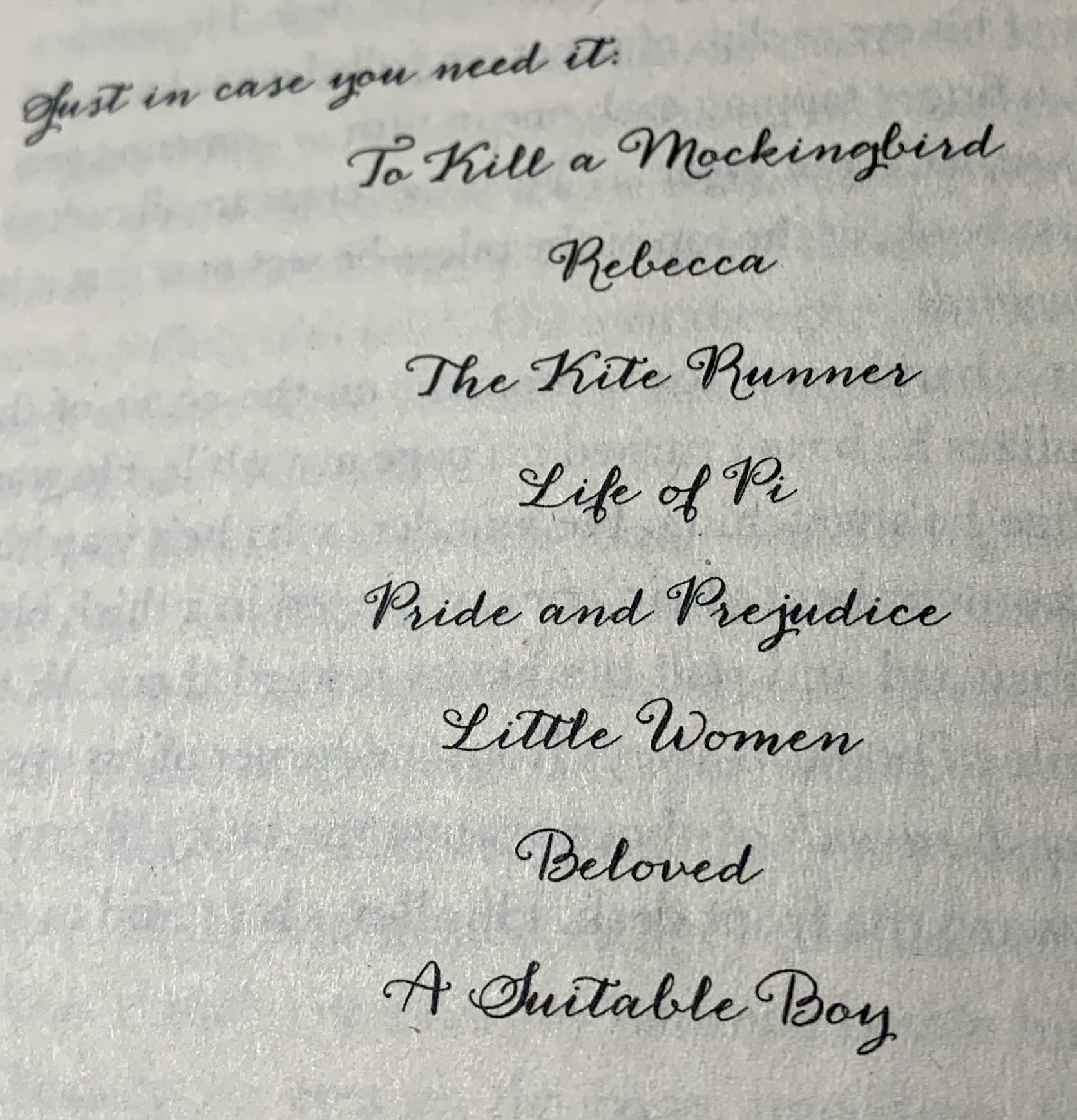
The book centers around the relationship between two people: Mukesh, a widower who lives in West London and Aleisha, a student who has a job at the library for the summer holidays. She has her own grief because her mother is dealing with a severe mental illness. The other character is a reading list that Aleisha finds in a copy of To Kill a Mockingbird as she is putting books away. “Just in case you need it,” the list begins and then names To Kill a Mockingbird, Rebecca, The Kite Runner, The Life of Pi, Pride and Prejudice, Little Women, Beloved, and A Suitable Boy. I should mention that The Time Traveler’s Wife also plays a role in the book. (I should also say I have not read all of those and the novel still made sense.)

When Mukesh comes into the library looking for a book because he is trying to feel close to his wife who was a voracious reader, Aleisha gives him the first book on the list and also begins reading them herself. The circle of those involved in the story and affected by the books grows as the novel moves along and it is a wonderful journey.

One of the things that struck me was the was the characters’ view of life and even themselves was affected, or even altered, by the book they were reading. Part of the story was what they began to notice because of what they were reading.

Besides inviting me into the lives of several folks I will miss now that I have finished the book, the novel made me think about what books have altered the way I look at the world. The short answer, I suppose, is all of them; isn’t that the point of reading? Then I stepped back to think of novels, in particular–those stories that offer invitations into other worlds so we can get a better view of our own.

I decided to offer my own list tonight. In doing so, I am not claiming this to be a definitive list. These are the books that first came to mind. Also, I went with eight of them because that’s how many were on the list in the book. Last, they are presented in the order they came to mind.

Just in case you need it:

Frankenstein
Mary Shelley was a teenager when she wrote the story in response to a challenge to write the scariest story she could think of. I loved reading it with students when I was a high school teacher. The narration moves from the sea captain so driven to prove himself that he gets his crew stuck in the ice to the doctor so driven to prove himself that he creates a being out of spare human parts to the creature who is desperate to get the approval of his creator, and then it moves back out again. I could talk about this story all day. And into the night. Bring whiskey.

Cry, the Beloved Country
This South African novel was written before apartheid took hold, but the structure was already there. Alan Paton, the author, was a white South African who was an activist and advocate for racial equality. The story is beautiful and heartbreaking. Stephen Kumalo, the pastor whose son is chewed up by the system, may be my favorite character in literature.

A Wrinkle in Time
Ms. Reedy, my fourth grade teacher, read this book to my fourth grade class in Lusaka, Zambia in 1964, a couple of years after it was published. It was the first time I knew that a book could change your life. I still read it from time to time. And Meg Murry is my second favorite character in literature.

Dinner at the Homesick Restaurant
This was the first Anne Tyler novel I read and I found myself in the story because it is about trying to find home. Ezra, a boy who grows up without a sense of home, opens a restaurant and cooks what others are homesick for, hoping to create the home he never knew. Gee, I wonder why this book stayed with me?

The Illusion of Separateness
Simon Van Booy’s novel may be one of the most beautifully written books I have ever read. Some of the sentences are breathtaking. The story is one of connection where there seems to be none, as the title implies.

A Mapmaker’s Dream
Fry Mauro is a monk in Venice who dreams of making a perfect map. The thing is, he never leaves his cell. He creates his map based on the stories travelers tell him as they come through town. The more he learns, however, shows him how much he doesn’t know.

The Bluest Eye
Toni Morrison’s novel is another I read with high school students. Pecola Breedlove is an eleven year old Black girl who prays for her eyes to turn blue so that she will be beautiful, so that she will be noticed, and so her world will be something other than it is.

A Prayer for Owen Meany
The first time I read John Irving’s book, it was my subway book when I was on the T in Boston. I had to read it at home because I would get so involved that I missed my stops repeatedly. It is laugh out loud funny and ugly cry sad as well.

As I said, the list is not definitive nor exhaustive, but they are stories that have helped to shape me in various ways. I’d love to know what stories have shaped you.

Peace,
Milton

bread and water

The sermon below is one I preached for a church on the other side of New Haven to candidate to be their Bridge Pastor for the next five or six months. I started not to post it because it is kind of “teachy” (as I described it to Ginger) and, therefore, felt like it might not have much reach beyond those in the room Sunday, or on their Facebook feed. I came across an article—“Here Be Sermons”—written by a non-church person who saw a sermon as saw the audience as a community. He contrasted them this way:

Suppose you and I are listening to a physics lecture. Although we share the same goal — learning physics — we’re pursuing it more or less independently from one another (and from all other students in the lecture). If you happen to fail the class, it’s no real skin off my nose, and vice versa.

In contrast, suppose we’re listening to a sermon — on the virtue of kindness, say. In this case, I do have a stake in whether you learn the lesson, because unlike physics, if you fail at kindness, I’m going to suffer. Put differently, there are positive externalities to the act of listening to a sermon. When you internalize a sermon’s message, I stand to benefit, and vice versa.

The other reason I started not to post it is I’ve said pretty much all of it before. Then I read a Billy Collins interview where he said the most important thing about teaching is repetition. Even though a sermon and a lecture are different, I think what he is saying still applies. I know you’ve heard this before, but it’s good to hear it again: we are wonderfully and uniquely made in the image of God and worthy to be loved—and we’re all in this together.

Shoot, now you don’t need to read the sermon.

__________________________

We don’t know how long John had been baptizing people when Jesus showed up. All we are told is that John was at a part of the Jordan River that felt like it was out in the middle of nowhere–some twenty miles from Jerusalem–telling people it was time for a change. A big change. If they wanted to be a part of that change, they could demonstrate it by being baptized. “Repent” is the word he used: turn around, go in a new direction. He was a person literally and figuratively on the fringe of society telling people that business as usual was not the way God wanted them to live their lives.

In Matthew’s description, John comes across as rather righteously indignant. He goes hard after those who supported the political and religious establishments. John was talking not only about personal change but also, and perhaps more importantly, systemic change. When we think of what it means to repent–to go in a new direction–we think first about personal changes and decisions we can make individually, but we are also called to explore the choices we make together.

We can infer that John had been out there for a good while when Jesus showed up wanting to be baptized. We can also infer that this is not the first time they had met. John recognized Jesus and his understanding of Jesus made him hesitant to baptize, but Jesus said, “We need to do this to bring about God’s justice in the world.” So, John walked with Jesus into the river and baptized him. It was an act of consecration and an act of solidarity. It mattered to Jesus that he was baptized. He was making a public statement about who he was in the world.

Many years ago, I got to visit Israel and Palestine. I stood on the bank of the Jordan River with a group of UCC folks from a church in Massachusetts. We knelt at the water’s edge to “remember our baptism” as the ministers sprinkled water from the river on our foreheads. In the middle of our quiet, reflective moment a bus pulled up and from it flowed a group of Pentecostal folks in white robes who came running down the hill led by their pastor who was shouting, “Gloria a Dios!” over and over at the top of his lungs. When he reached the small landing at the water’s edge, he didn’t stop. He took a flying leap and belly flopped into the water, robe and all, closely followed by pretty much everyone else behind him. They splashed in the water as they sang and laughed and cried. I think I can speak for many in our group when I say we looked over and wished that was the way it felt to remember our baptism.

Jesus didn’t jump into the river shouting, but he was making a bold public statement. Alongside of that, his baptism was also a personal affirmation. Matthew says Jesus experienced the Holy Spirit like a dove landing on him and he heard a voice say, “This is my dearly loved son in whom I delight.” It does not appear that anyone else heard the voice or saw the dove. John went on baptizing, people kept coming, and Jesus went further out into the wilderness to fast for forty days.

We mark Jesus’ baptism as the beginning of his public ministry. The event is so significant that it has become one of the two sacraments of our denomination, along with Communion, which grows out of the last meal Jesus had with his disciples before his execution. The two sacraments are bookends to his time on earth, in a way. Today, thanks to New Year’s Day falling on a Sunday and pushing our monthly observance of Communion back a week, we get to look at the two of them together.

Baptism, for us, has taken on a different look than what Jesus experienced. John didn’t sprinkle water on Jesus; he dunked him. Over the centuries, the sense of blessing and affirmation that Jesus received has been translated to baptizing infants as a way of affirming that we are all wonderfully and uniquely created in the image of God and worthy to be loved. Likewise, our Communion table is open to anyone who wants to share in the meal as another way of affirming that God’s love does not require prerequisites.

Both sacraments are communal acts—things we do together as tangible reminders of something we need to hear again and again: nothing can separate us from the love of God.

Over the centuries, our sense of the magnitude of both things has led us to make them formal and solemn, when neither of them were, in their inception. Jesus waded out into a river in the desert and was baptized by a guy who wore animal skins and ate bugs. He shared the bread and the cup from the meal he was eating with his disciples that last night. It was more improvised than instituted.

When we come to the table together in a few minutes you will hear me talk about re-membering, as in putting ourselves back together in Jesus’ name, following Jesus’ words, “As often as you do this, remember me.” One way to hear the words “as often as you do this” is that he was talking about any time we sit down to eat. Similarly, I read one person this week who said they take the daily act of washing their face as a chance to remember their baptism and to remember they are God’s beloved child. I thought about that as I walked in the rain on Friday and the water hit my face.

We don’t observe the sacraments as a way of being more holy or more worthy of God’s presence. We don’t follow these rites because the form has some sort of magical power that protects us, or because they are some kind of initiation ritual. We reenact these scenes as tangible reminders to us that we are God’s beloved ones and as tangible promises to God that our lives will reflect God’s presence.

It’s a bit puzzling to think that Jesus somehow needed to go into the water and then hear that God delighted in him. He wasn’t just going through the motions of joining the club, he was aligning himself with John’s call to live into God’s justice and inclusion. At the end of Matthew’s gospel, just before the meal, Jesus talked about how those who followed him would be recognizable: “I was hungry and you fed me. I was thirsty and you gave me a drink. I was naked and you clothed me. I was imprisoned and you visited me.” Another set of bookends, this time with words. At the end of his ministry, he was saying the same things he heard John say at the beginning.

The sacraments of baptism and Communion pull us into the middle of each other’s lives and the lives of those around us to find any way we can to remind each other that we are wonderfully and uniquely created in the image of God and oh, so worthy to be loved.

We may not be jumping in the river this morning, but that doesn’t mean we can’t come to the table full of joy as we re-member Christ in the waters of our baptism and in the meal that is before us. Jesus said the bread represented his body; the apostle Paul used the Body of Christ as his favorite metaphor for who we are together. In the middle of a world that feels torn apart, let us move to the table to re-member ourselves in Jesus’ name—to put the Body of Christ back together again. Amen.

Peace,
Milton

Thanks for reading. I write a free weekly newsletter, mixing metaphors that comes out every Tuesday. I would love for you to subscribe. If you would like to support my writing, you can become a sustaining member or buy me a cup of coffee.

piece work

The afternoon that they moved my mother into hospice her doctor came to check on her. Although we all knew she would never leave the hospital, her death was not imminent. She looked at the doctor and said, “If my goal is heaven, what do I have to do?”

He smiled and said, “Stop eating and drinking.” And then he said, “I want you to know you have made a decision of courage and hope and not despair.”

By the time we got to January 8, 2013 she was beginning to tire, but she was also just four days away from her eighty-fourth birthday. She never said out loud that she wanted to live until then, but that’s how it felt as I sat in the room with her. On January 12 we sang to her and she had some cake, which was the last thing she ate. After that night, she didn’t drink anything. She died on January 15.

Aș we prepare to mark the seventh anniversary of her death, I have found solace in doing some of her favorite things. One of those, of course, is cooking. Saturday, I made her version of Taco Salad, which comes with its own story.

My mother was willing to give up lots of things to move ten thousand miles away from her Texas home and live in Africa, but I think the thing she missed most were Fritos corn chips. After three or four years, she wrote the president of Frito-Lay, which was headquartered in Dallas, and said who she was and where she was and then asked what it would take to get Fritos to Zambia. A few weeks later we  received two big boxes that contained twenty-four vacuum-packed tins (think coffee cans) of Fritos.

She gave two each to my dad, my brother, and me for our personal consumption and kept the rest in the kitchen to make Taco Salad, which we had every Saturday until the chips ran out.

When we moved back to Houston for good, we had it every Saturday.

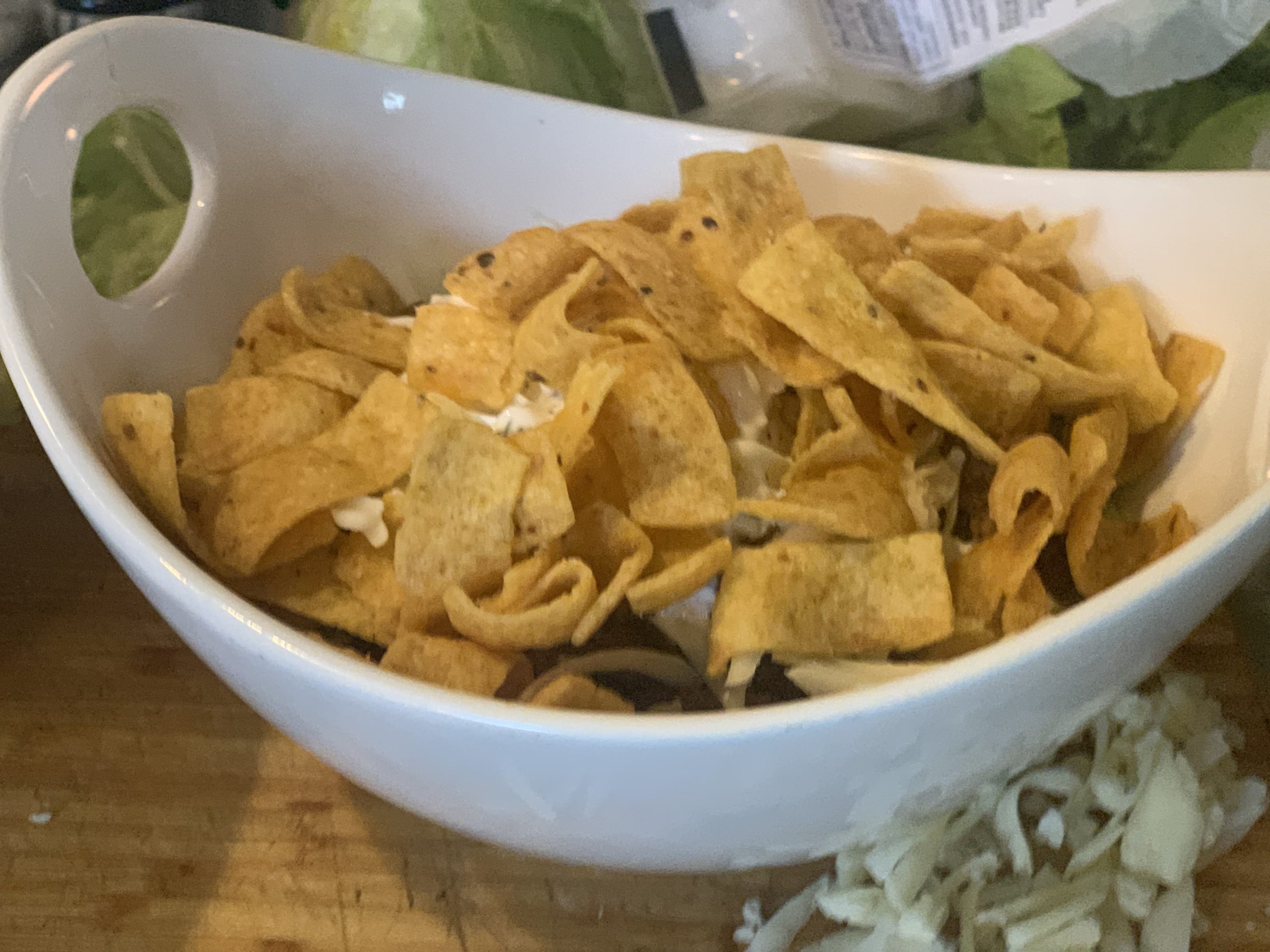
The recipe is not hard: ground beef seasoned with taco seasoning, kidney beans, cheddar cheese, shredded lettuce, ranch dressing, and Fritos. I made it Saturday and we ate it all.

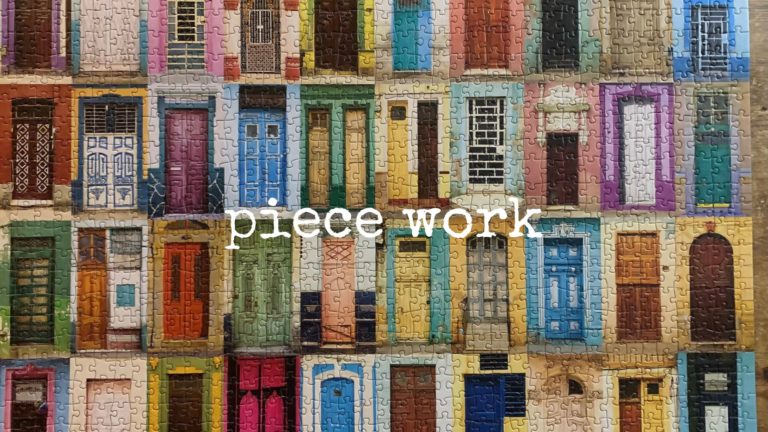
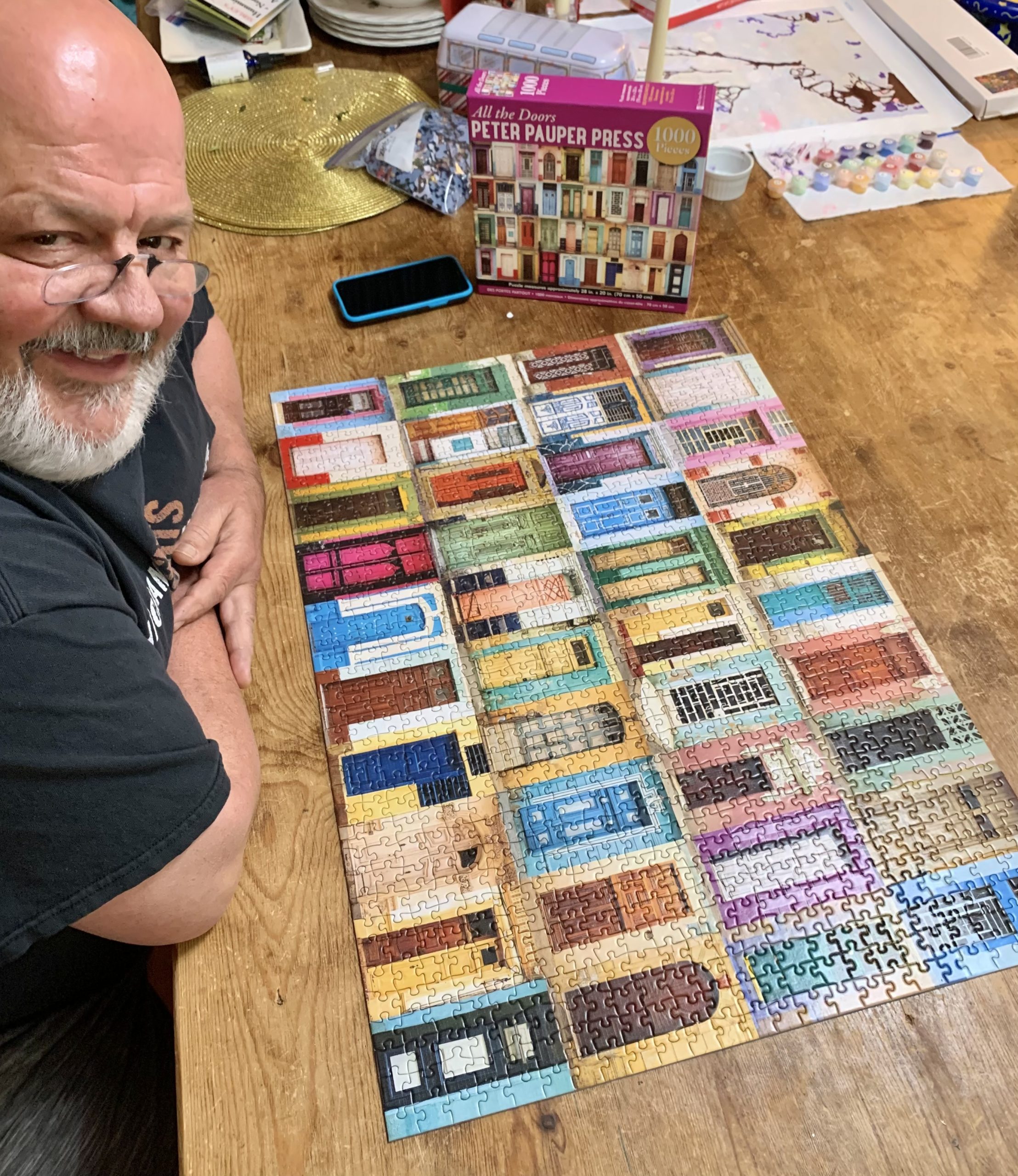
The other thing I have done this past week is puzzle. My mother liked jigsaw puzzles so much she made it a verb. Ginger gave me a puzzle of a VW bus for Christmas that came in a tin shaped like a VW bus because I have always wanted one. I did that puzzle last week. When I posted it on Facebook, a church member brought me a couple of others. Last night we started working on a puzzle of the doors of Paris–1,000 pieces–and I finished it tonight.

The two puzzles brought back memories of the card table in our den in Houston that always had a puzzle working. I can remember coming in at night after being out with friends and then staying up way to late because I would get pulled in to trying to find just one more piece. Sometimes, Mom would join me. Both the kitchen and the card table were places where she met me and I felt at home.

I wrote a poem last week saying that a puzzle is not a good metaphor for life because there is more to living that getting all the pieces to fit. When I finished the VW puzzle, I rethought my poem because one piece was missing. I didn’t lose it. It was never in the box. I finished the puzzle and had to live with it being incomplete. I thought, “Maybe sometimes life is like a puzzle.”

But the puzzles this week have not been metaphors; they have been a way to live with my grief that has led to gratitude along with the sadness; in their own way, I suppose, an act of hope and not despair.

Peace,
Milton

send in the clown

For the last seven years the first two weeks of January have belonged to my mother. She went into hospice just after New Year’s Day 2016 and died on January 15, three days after her eighty-fourth birthday. I got to spend all of those days with her.

Tonight, this story came back to find me.

In the summer of 1971, we came back to Fort Worth, Texas on leave from Africa. I was going into the tenth grade. My ninth grade year had been my favorite year of school to date because of the friends I had made and also because of the “folk group,” as we called it–a bunch of us who got together to play guitars and sing. That fall, I went to Paschal High School (Go, Panthers!) and became a part of the youth group at University Baptist Church. The group was welcoming and vibrant and pulled me in like I had been there the whole time. I loved being a part of it because I felt kind of lost.

Once I learned to name my depression, I look back to that year and can see it was with me then. For all of the good things happening, I can remember sitting on the edge of my bed and looking in the mirror and wishing I was anyone else but me.

That October they had a Halloween party at church, which meant costumes. My mother went all in on things like parties and costumes. She said she’d help me figure out a great costume. She had the sewing chops to make it, too. I decided I wanted to be a clown. We found some fabric to make a good outfit, a nose, and some makeup as well, but we couldn’t find a wig. Since I was a teenaged boy in 1971, I had long hair. Mom said, “We’ll just curl yours.”

And so we did.

Early that Saturday afternoon, she took a whole bunch of little rollers and put them all over my head. I couldn’t really go anywhere, so I sat on the couch to watch football with my dad, as we had done most Saturdays that fall. Dad was fidgety and kind of grumpy. It was weird–and I took it personally. I got up and went into the kitchen, where Mom usually was. I was visually upset. When she asked what was wrong, I said, “I don’t think this is masculine enough for Dad.”

I knew it wasn’t. We already were at odds over my hair. Now I was wearing curlers and already carried my own sense that I was enough, period.

Mom rolled her eyes. “Listen,” she said. “You don’t have to be masculine enough for him. This is a great costume. You’re going to be great. Ignore him and go have fun.”

I made it through the afternoon, got dressed and went to the party. My hair looked like a clown wig. The makeup completely disguised me. Mom dropped me off around the corner so no would recognize the car, and I decided not to speak and see how long it was before anyone recognized me. Nobody did. I finally spoke up after a half hour or so, excited because I had pulled it off. When I got home and told Mom, she was elated.

None of us ever revisited that afternoon because that was not our family way. As I have often said, we talked about our feelings every fifteen years or so, whether we needed to or not. The sense that I wasn’t the man Dad wanted me to be didn’t begin that afternoon. Over time I learned to see at as different perspectives on what masculinity meant. At different times I was also aware of expectations that my mother had that I didn’t fulfill, but the woman who taught me to cook and curled my hair one October afternoon helped to give me a sense of myself that I have not forgotten.

Peace,
Milton