Home Blog Page 15

lenten journal: life goes on

My sermon this week is about the resurrection of Lazarus and wondering about what he might have felt about coming back to life, among other things.

_____________________

It is hard to turn a life into a coherent story–or, maybe the better way to say that is it is hard to turn a life into a single story. In this memoir-laden age, people try to do that all the time, but the reality of life is that it doesn’t conform that easily. Some things have to be left out, some things perhaps ignored or untold to keep the theme going, some things get forgotten.

At different points, the gospel writers drop hints that they knew they were not able to paint the whole picture of Jesus’ time on earth. John, whose gospel we have followed through much of Lent, said that if all the stories about Jesus were written down, the world wouldn’t have libraries enough to store all the volumes of information. So John chose the moments that help him paint the picture of Jesus he wanted most to be remembered, as did Matthew, Mark, and Luke.

That doesn’t mean they were being dishonest or careless, they were doing what it took to make a coherent story out of a human life. John, the more poetic of the quartet of gospel writers, built his biography around what biblical scholars call the seven “I am” statements of Jesus

I am the bread of life (6:35)
I am the light of the world (8:12)
I am the door (10:7)
I am the good shepherd (10:11, 14)
I am the resurrection and the life (11:25)
I am the way the truth and the life (14:6)
I am the true vine (15:1)

as a way to convey Jesus’ world-changing presence as the embodiment of God in the world, which is not an easy thing to do. Neither is preaching on this passage.

We talked last week about Jesus’ miracles being “parables of event,” meaning there is more to them than just a spectacular healing or a spontaneous banquet. John calls them signs, rather than miracles, as a way to highlight that point. After Jesus healed the blind man, he said, “I am the light of the world.”

Get it?

John may be a poet, but he is not particularly subtle.

In our story for today, Jesus says, “I am the resurrection and the life” before he calls Lazarus back to breathing. But if we reduce the blind man and Lazarus to object lessons or props for a point Jesus wanted to make, the accounts don’t match with Jesus’ consistent commitment to humanizing–to noticing and caring for–the people around him.

After the formerly blind man caused all sorts of commotion with his vision, Jesus and the disciples went back out into the wilderness–back to where he was baptized, which was also near where he fasted and was tempted with all the ways he could use his power for his benefit. You may remember: turn the stones to bread so you can eat; throw yourself off the temple and let the angels catch you; sell your soul to gain political power. The baptism site was also where he heard the voice say, “This is my beloved Son in whom I delight.”

While they were out there, Lazarus became deathly ill. His sisters sent word to Jesus asking him to come, but he waited two days before they started walking back to Bethany. No one knows why he waited. When he gets there and both sisters lament that he waited too long, and as he is surrounded by those grieving Lazarus’ death, he got angry. Our translation says, “troubled and disturbed,” but the word means agitated or indignant, so much so that his anger brought him to tears.

Jesus wept–and then he called Lazarus out of the tomb, even though his body had begun to decay and he was rather odiferous; even though he was wrapped up in grave clothes. We have no record of him saying anything, or Jesus speaking to him. After Jesus tells the people to unbind him, John’s story takes a different turn and focuses on some of those who wanted to kill Jesus.

I said earlier that this is a hard passage to preach about. The main reason is I keep wondering how Lazarus felt when he came stumbling out of the tomb after four days of death. I wonder if he was glad to be alive, or if he thought about having to die again, or if he was angry also. One ancient tradition says that the bits of decay that had begun on his body never healed after his resurrection, and he lived with the scars until he died again. There’s not really anything in the story that supports that, but it does seem like Lazarus would have lived with some trauma after they unwrapped him. After all, he had no say in what happened; life just went on.

There is not a cohesive explanation of this story that ties everything up in a nice bow–perhaps made from the cloth that ensconced Lazarus–and leaves us all feeling good like we do at the end of a hopeful novel or movie. This is not that kind of tale. It’s another messy miracle like the one we read last week, because life is messy. Mary and Martha both said, “If you had only been here, this wouldn’t have happened.” Our lives are full of contingencies like that. We are a part of circumstances beyond our control most every day. We share in the grief that Jesus, Mary, and Martha knew; we understand Jesus’ agitation when we face circumstances that leave us feeling cornered; we may even identify with Lazarus as one who needs someone to say, “Unbind them and let them go.”

And life goes on.

The hope of our faith is not that life–any life–leads to a happy ending, but that in the middle of the mess God is with us. Jesus said, “I am the resurrection and the life”–whatever lies beyond death, life is happening right now, and Christ is present in our contingencies.

We are two Sundays away from celebrating Jesus’ resurrection, an event that is central to our faith, that gives us hope that love is stronger than death, and, even so, people have died every day since Mary first found the empty tomb. And in all of it, God is with us.

In times of peace, in times of trauma—God is with us.
In times of heartache and times of hope—God is with us.
In times of confusion and times of exhaustion—God is with us.
In times of laughter and in times of grief—God is with us.

Whatever the circumstance, life goes on and God is with us. Amen.
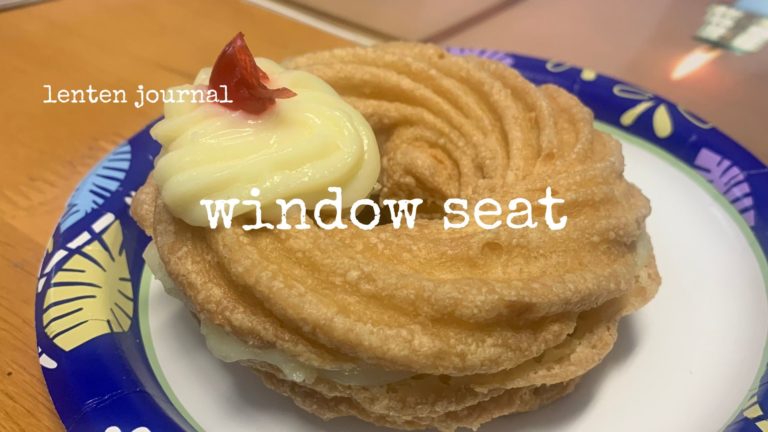
lenten journal: window seat

On Tuesdays and Thursdays I go to the office at my church in Hamden. Today was special because our office manager, who is of Italian descent, told me he was bringing Zeppole to celebrate the Feast of St. Joseph, one of the traditional foods made for the celebration in Italy and Sicily.

I didn’t know what a Zeppole was, but I wasn’t going to miss it since it involved the words Italian and pastry. I learned there are several variations, but the kind he brought we sort of like profiteroles (except bigger–think donut-sized); the pastry was cut in half and filled with a custard reminiscent of a Boston Cream Pie (my favorite). He stopped at a bakery on Wooster Street in New Haven, the heart of the Italian neighborhood there, and bought the bundles of deliciousness we all shared together. They were the real deal.

When we first moved to Boston in 1990, the only viable Protestant congregation was the Episcopal church in our Charlestown neighborhood, so that’s where we went. We had moved there as church planters and had yet to grow any gathering. (We were spectacular failures at church planting, but that’s a story for another time.) The priest in charge there, Franklin, knew everything about Episcopalianism–every knot in his garments, everything on the altar, and most everything about church history. From him we learned that the feast days (like the Feast of St. Joseph, which is March 19 and always falls in Lent) served as “windows in Lent,” which was a way of making room not only to venerate the saints but also to have weddings should the need arise, since weddings were not allowed during the season. If someone (say an unmarried person of noble descent) were to show up pregnant during Lent, to have to wait until after Easter for the wedding might make things awkward if not difficult.

So they opened a window . . .

There is some theological irony, I suppose, that Joseph’s day would be one that might provide cover for someone who was unexpectedly pregnant, but the whole point of the celebration is not quite that cynical. The Feast of St. Joseph dates back to the eleventh century when Sicily experienced a major drought. The people prayed for rain, promising to honor Joseph with a feast if the rain came to save their crops, one of which was fava beans. The rains came, and so did the feast (meatless, because it’s Lent). How the Zeppole became part of the meal I don’t know, but I think he would have liked them.

It was starting to rain today as the five of us who gathered to share in the Zeppole Fest. I was the new one in the group; the others came with knowing anticipation. We sat and talked and ate and wiped custard off our chins as we told stories about foods that mattered and meals we loved. Someone asked everyone’s favorite pastry and it took fifteen minutes for everyone to answer because of the additional responses each time someone named a favorite.

On this next to Last Thursday in Lent, no one spoke of what they had given up, and no one confessed any guilt in eating the Zeppole. Instead, our faces dripped with gratitude for our office manager’s willingness to share the view from his window–to gather us together, to tell stories, and to serve really good pastry.

We use the word Lent sometimes as though it were some kind of sentence for bad behavior. The root of the word means “to lengthen,” and is more about the ways the days grow longer than it is about doing without. The season does carry a long tradition of spiritual focus and discipline, but it, like Spring, has layers of life and death, of mud and sunshine. Spring is when we can begin to sleep with our windows open, at least for some of the nights–unless it’s pollen season, of course.

Joseph has always been one for whom I have felt a great deal of compassion. When the angel finally came to him, Joseph was confused and troubled, but he was still present. Name the child Emmanuel, the messenger said–God with Us. Though I have no basis from which to draw this conclusion other than our coffee break today, I think Zeppole might translate the same way.

After all, what better way to lean into that name than to share good food together.

Peace,
Milton

lenten journal: slow art

Because I went to the gym this morning, I saw the message on my dashboard that my car was due for servicing and I remembered to make an appointment when I got home. The Honda dealership had an opening this afternoon, as did I, so I told them I would be there around 2 o’clock. When I told Ginger my plan for the day, she said, “Eli’s is across the street. I’ll go with you and we can have lunch.”

And so we did.

Eli’s on the Hill is one of six restaurants with the same name dotted across southeastern Connecticut. It’s good food in a comfortable atmosphere. The bar at the restaurant in Branford is large and U-shaped. It was not crowded when we got there, so we sat at one bend in the U and ate and talked until the car was ready. The scene, for us, was familiar. We spend a lot of time eating and talking together, in a variety of settings.

At one point, Ginger asked, “What are your favorite things to do with me?”

I thought for a moment, and I answered something I don’t remember now because it wasn’t the best answer. Then I said, “This. Sitting and talking with you when we hadn’t planned for it.”

She agreed it’s one of our best things.

As I sat down to write this evening, I came across an article at 3 Quarks Daily titled “Patience With What Is Strange: In Praise Of Slow Art” by Chris Horner, which talks about the power of taking our time to ingest or digest things that seem strange, and it was that word–strange–that took me back to our lunch at Eli’s because, years ago, we found one of the Story People that said:

“You’re the strangest person I ever met,” she said
& I said, “You are too”
and we decided we’d know each other a long time

The article is full of good things not the least of which is the closing paragraph, which includes an incredible

Slow art has layers. And this is why it requires time and effort. We should see this as a good and necessary thing. If this is a kind of obstacle in the way of easy assimilation then it is an obstacle that is integral to the value of the thing itself. The mind is calmed, or disturbed, or made exultant by the art that rewards us for our goodwill and our capacity to take our time.

Then he closes with an incredible Nietzsche quote:

One must learn to love.— This is what happens to us in music: first one has to learn to hear a figure and melody at all, to detect and distinguish it, to isolate it and delimit it as a separate life; then it requires some exertion and good will to tolerate it in spite of its strangeness, to be patient with its appearance and expression, and kindhearted about its oddity:—finally there comes a moment when we are used to it, when we wait for it, when we sense that we should miss it if it were missing: and now it continues to compel and enchant us relentlessly until we have become its humble and enraptured lovers who desire nothing better from the world than it and only it.— But that is what happens to us not only in music: that is how we have learned to love all things that we now love. In the end we are always rewarded for our good will, our patience, fair mindedness, and gentleness with what is strange; gradually, it sheds its veil and turns out to be a new and indescribable beauty:—that is its thanks for our hospitality. Even those who love themselves will have learned it in this way: for there is no other way. Love, too, has to be learned.

We don’t always have the luxury of taking the afternoon to hang out, but one of the things I have learned about love is to take any opportunity that presents itself, or better yet, make space where there doesn’t seem to be any. We have been intentional about learning that “we should miss it if it were missing.” And Nietzsche is right: it does continue to enchant us relentlessly.

The chorus of the first song I ever wrote with Billy Crockett says,

it’s an open heart
it’s a work of art
it’s the basic stuff
that makes another
picture of love

Thirty-four years on, I’m still finding layers and I am still enchanted by the slow art of love.

Peace,
Milton

lenten journal: taking time

It’s been a little over five weeks since Loretta came to live with us.

Tomorrow (Monday, that is) will only be six weeks since Lila died, and we are still grieving Ella who died in late October. Even with the presence of both absences, Loretta is making room for herself with unabashed energy and affection.

We know so little about her. She was found on the streets of Waterbury, Connecticut and ended up in a shelter in East Hartford, where we got her because, well, she couldn’t get back to where she once belonged. We think she is around two (or that’s what we were told), so we made March 13 her birthday. We can tell by looking at her that she is part Schnauzer–and her behavior confirms that–but the rest is still up for discovery. We know nothing of her history other than where she was rescued. She knows some commands, though I hope I can teach her that “Get back, Loretta” means stay. She also lives with a pretty high base line of fear, particularly when people come to the house. Stranger Danger.

A dog trainer came by the house to give us some advice and talked about the “two days, two weeks, two months” phenomenon: a dog’s behavior will change at those markers as they get used to their surroundings. Unlike the movie title, everything everywhere can’t happen all at once. She showed us how to get our guests to offer treats by throwing them at a bit of a distance first and then dropping them closer. We have also had folks meet us on the Green so Loretta is not as protective of her home. It is still a work in progress.

The Atlantic has an article whose title is incredibly straightforward–“A Cognitive Revolution in Animal Research”–that helped me understand a bit more about what our sweet pup is going through, as well as a bit about myself as well.

Christian Ruiz studies New Caledonian crows. In one experiment, he gave them a log with drilled holes that had food hidden in them. For the crows to get the food out, they had to bend a plant stem and use it as a tool. When they first did the experiment, they gave the birds ninety minutes to figure things out; if they didn’t the birds weren’t included in the study. The article continues:

But, Rutz says, he soon began to realize that he was not, in fact, studying the skills of New Caledonian crows. He was studying the skills of a subset of New Caledonian crows that quickly approached a weird log they’d never seen before—maybe because they were especially brave or reckless.

The team changed their protocol: They gave the more hesitant birds an extra day or two to get used to their surroundings, then tried the puzzle again. “It turns out that many of these retested birds suddenly start engaging,” Rutz says. “They just needed a little bit of extra time.”

For the first couple of weeks, Loretta’s nub of a tail stayed down. She would come to us, but then cower a bit when we got close. She was more comfortable if I was sitting down. We try to walk her and Lizzy! on the Green daily and we have seen both Loretta’s confidence and tail rise on our trips. But yesterday Ginger took her down streets she did not know and she was wary once again.

She just needs a little bit of extra time. Maybe a lot it.

Much of that time needs to come from Ginger and me in the form of patience and compassion as we work to move beyond her fear to find the affection that other people want to offer her. That doesn’t sound hard to do until she starts barking when someone comes over as though they were sent by Vladimir Putin. But five weeks on, she knows her name, she knows we are her people, she knows how to use the doggy door, and she knows when it’s time to eat.

It’s just going to take a while for her to begin to recognize all the love she cannot see.

She’s not the only one. At sixty-six, I am also one who has needed extra time to learn, sometimes because I had to get used to my surroundings, but mostly because I had to come to terms with myself. Regardless of the backdrop, I have been pretty good at getting in my own way. But when I read about New Caledonian crows needing time to settle in and I watch Loretta as she makes her way in her new world, I am grateful for the grace of time that makes room to figure out that we belong.

Loretta is teaching me as well.

Peace,
Milton

lenten journal: beyond blame

The passage for my sermon this week is John 9:1-11, which is part of the story of Jesus healing a blind man. There are a lot of sermons to be found in this passage, but I got caught by the question the disciples asked: “Who sinned that this man should be born blind?” I hope it speaks to you.

_________________________

Our passage this morning is a great example of the adage, the answers we get are often only as good as our questions. The best example I know is from what is now a really old movie–The Pink Panther Strikes Again. The bumbling Inspector Clousseau is checking into a hotel and sees a little dog sitting next to the reception desk.

Clouseau: Does your dog bite?
Hotel Clerk: No.
Clouseau: [bowing down to pet the dog] Nice doggie.
[Dog barks and bites Clouseau in the hand]
Clouseau: I thought you said your dog did not bite!
Hotel Clerk: That is not my dog.

Had he asked a better question, he might have avoided a puncture wound.

One morning, my mother-in-law, Rachel, came into the kitchen and asked me, “Are you making cinnamon toast today?” (She loves cinnamon toast.)

“Not today,” I responded; then, as she just stood there looking rather forlorn, I realized what she asked was not her true inquiry.

“Would you like some cinnamon toast?” I asked.

“Yes, please,” she said–and then we had a discussion about asking for what she wanted. And we laughed.

The question the disciples asked as they passed a blind man says a lot about the way they thought about the world and how God works in it: “Whose sin caused this man’s blindness–his or his parents?”

In a way, it’s a question that presupposes an answer–the man’s blindness was someone’s fault; they just wanted to know who to blame. And, though it is not an uncommon question, it is a damaging one. The man was born blind, which was no one’s fault–but that is not what they asked.

Across the centuries, the way Jesus’ answer has been translated has created some issues as well. Look back at our reading this morning:

Jesus answered, “Neither he nor his parents. This happened so that God’s mighty works might be displayed in him. While it’s daytime, we must do the works of the one who sent me. Night is coming when no one can work. While I am in the world, I am the light of the world.”

It comes close to sounding as though his blindness was a setup for Jesus to show up, as though our difficulties have to have a purpose. The Greek manuscripts had no punctuation; sometimes, they didn’t even separate the words well, which means translators had to decide how to divide sentences and create phrases. Listen how different it sounds with a repunctuation:

Neither he nor his parents. So that God’s mighty works might be displayed, we must do the works of God who sent me.

The Message translation communicates it even more effectively:

Walking down the street, Jesus saw a man blind from birth. His disciples asked, “Rabbi, who sinned: this man or his parents, causing him to be born blind?”

Jesus said, “You’re asking the wrong question. You’re looking for someone to blame. There is no such cause-effect here. Look instead for what God can do. We need to be energetically at work for the One who sent me here, working while the sun shines. When night falls, the workday is over. For as long as I am in the world, there is plenty of light. I am the world’s Light.”

The miracle that followed is interesting for a couple of reasons. The first is that the blind man didn’t ask for anything. He is silent in the story until after he can see. The second is it’s messy. Jesus spits in some dirt and makes mud, smears it on the man’s eyes, and tells him to go wash it off. The man finds his way to the water, washes his face, and can see–all without ever seeing Jesus.

Had Jesus been willing to let the disciples’ question direct the conversation, the man would have stayed blind, because the disciples weren’t thinking about how they could help, only who they could blame.

It’s a posture that is far too easy to take, particularly when the problem we see feels too big to change.

Not everything happens for a reason.

Let me say that again: not everything happens for a reason.

Life is not as simple as an equation of cause and effect where everything balances out, or a ledger that records assets and debts, or a scorecard that keeps track of who’s winning and who’s losing. My depression is not a sin. If you see someone in a wheelchair, that doesn’t mean they are responsible for their condition–whatever it is–anymore than it means God is going to use them to make a point.

Who can we blame for this? is never a good question because it doesn’t create room for healing. It’s a dead end.

I don’t mean that we have no responsibility in life, or that there are not situations when the consequences of our choices or words or actions do damage that we need to shoulder. If I back into your car in the parking lot—like the time I backed into the storage Pod in our driveway (but that’s a story for another time)—I’m responsible for the bent fender. But bearing responsibility and placing blame aren’t the same thing.

For me to place blame is a way for me to make sure I had nothing to do with it. If we can blame racism on people in the South, then we don’t have to take responsibility to make changes right here in our town. If we can blame poor people for making choices that brought their circumstances on themselves, then we can avoid facing our privilege. If we can phrase our questions so that the answers we get make us feel as though the needs around us are not our problem, then we don’t have to live compassionately.

I don’t know why the disciples asked about whose sin caused the man’s blindness, but the question was a dead end, as I said earlier. They were not asking because they were concerned with the man; they were dealing with an issue. They wanted to place blame, which would have done nothing more than satisfy their curiosity.

Jesus stopped and made it about the person. He moved beyond blame. He created a relationship. The man became the center of attention, which created space to see what God could do–with everyone involved.

When we think about our lives, or about our life together as a congregation, what are our questions? Are we asking things that die with one word answers, or open-ended queries that create possibility? Do we trust that God could do something with us in this place in these days?

Our answers are only as good as our questions. Amen.

Peace,
Milton

lenten journal: specifics

specifics

the way you call to check on me
the text that asks how are you

the time you left a note
the month you paid my bill

when you emptied the trash
while I was out of town

the day you came to see me
the night you drove me home

when you picked up the phone
long after your bedtime

when you stood with me
at the funerals

when you listened
when you called me out

the time you said you loved me
and the time after that

the time you sat with me
and said nothing

the gift in the mailbox
the food in the fridge

when you laughed at my jokes
when I cried and you did too

when I forgot what mattered
and you forgave me

the night you called
and said you needed help

your fingerprints on my heart
indelible evidence of love

Peace,
Milton

lenten journal: I’m glad we’re all here

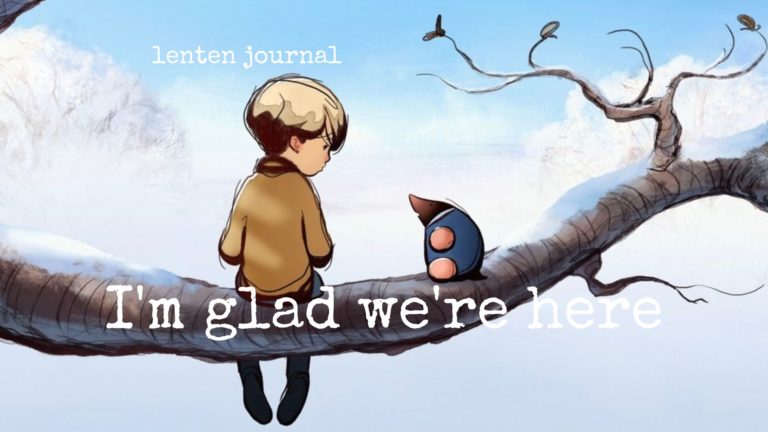
I’m late on getting to this story, but I am assuming I am not the only one who learned about The Boy, the Mole, the Fox and the Horse while watching the Oscars last Sunday night. I loved it, even though they didn’t use an Oxford comma in the title.

Over the past year or so, I have seen the book at friends’ houses, and even thumbed through it, but I still have not read it. I’m not sure why. The appearance of the book intimates a kinship with The Little Prince and The House at Pooh Corner–both favorites–but I never got past the cover. Though I still haven’t read the book (I will, shortly!), I watched the movie this afternoon. Twice.

The movie opens with a young boy walking across an unending snow-covered landscape with nothing in site, until a mole pops up through the snow to ask why the boy is there. He is lost, he says, and is trying to find his way home. The Mole befriends the Boy, and also expresses his love for cake. In fact, it feels like the Mole is searching for cake the way the Boy is looking for home. He asks the Boy what he wants to be when he grows up, and the Boy answers, “Kind.”

“Nothing beats kindness,” the Mole replies, “it sits quietly beyond all things.

He says a wise mole told him you could always get home by following the river and their journey begins. When they find a river, the boy wonders how to figure out which way to go.

The Mole answers, “If at first you don’t succeed, have some cake.”

As the tale unfolds, the meet the Fox, who has to be freed from a snare, and the Horse, who is also alone. There are plenty of reasons for them not to be together, but they choose one another as they navigate the landscape of lostness. They choose each other in profound and understated ways.

As the afternoon turned into evening, we went to our Lenten Supper and Discussion at church. We have been reading and talking about Forgive Us: Confessions of a Compromised Faith chapter by chapter. Tonight, Clara, one of our pastoral interns, led the discussion about how the American Church has treated Indigenous people. Home played a huge part there as well, since colonizers made a home here by taking way, well, destroying the home of the Native folks.

Though I wrote those last sentences in past tense, the displacement continues a way that is egregious and invisible at the same time. Unlike the quartet in the snowy forest, we have not chosen each other; we simply chose ourselves. We took what we wanted. We keep taking.

When the Boy and the Mole first meet the Fox face to face, he is in a snare. The Mole approaches him and the Fox stretches the ties that bind him as far as he can towards the Mole and says, “If I were free I would kill you.”

The Mole moves closer and before he chews through snare says, “If I don’t free you, you will die.”

If the story were rewritten as a fable of American history, the Fox, once freed, would have turned on the Mole and killed him, but he didn’t, which means we could have made different choices. We still can. We must, if we are to survive. Listen to this exchange:

The Mole: Sometimes, I want to say, “I love you, all.” But I find it difficult.
The Boy: Do you?
The Mole: Yes, so I say something like, “I’m glad we’re all here.”
The Boy: Okay.
The Mole: I’m glad we’re all here.
The Boy: We’re so glad we’re here too.

Our obsession with ownership is malignant. It is eating us alive.

There is enough. We are enough. I know it sounds simple–to simple for those who want to complicate it with greed and power–but “I’m glad we’re all here” is a pretty good way to say I love you.

Peace,
Milton

lenten journal: tree hair

Our last full day in Savannah began with the Gospel Brunch at the Good Times Jazz Bar and Restaurant, which is a few blocks from our hotel. The music, food, and conversation around the table were all nourishing. (I had a roasted boneless quail stuffed with collard greens over grits–and a side of catfish.)

Then we walked down to the River to meet Demetry, whom I mentioned earlier in the week, for him to tell us about himself, Savannah, and the art and sculpture in the hotel.

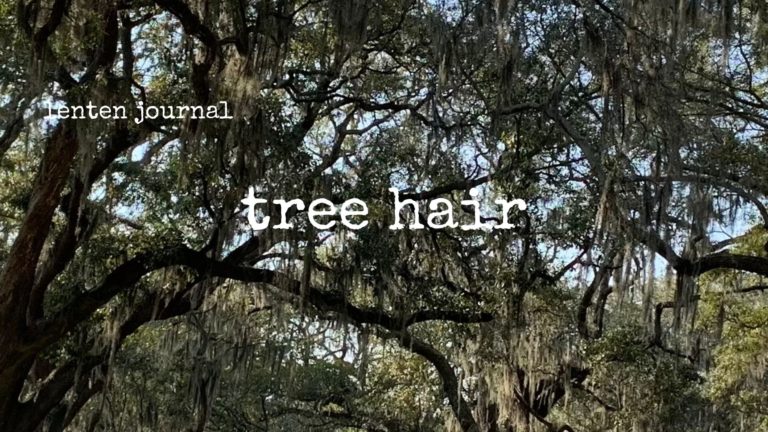
As he was telling us all sorts of interesting things, he mentioned, as an aside, that Spanish Moss needs trees to stay alive. If it is lying on the ground, it will die. Then he said, “If you see it on the sidewalk, put it back in the tree.”

The Indigenous name for the hanging curiosity translates as “tree hair,” but the colonialists changed that–mostly in jest. The French looked at the grey wisps as they dangled and called them “barbe espagnol,” likening them to the long scraggly beards of the Spaniards, who in turn called it “cabello francés” (French hair), but the French name stuck.

When I first saw how much of it hung from the majestic oak trees around here, I worried that it was a parasite–like kudzu–but it is not. It doesn’t take any nourishment from the tree it inhabits. The moss feeds on the dust and particles in the air, as well as the moisture, which is part of the reason it needs the tree to live: it gets to hang in the air where all the particles are. It also holds moisture until its host is ready to absorb it, which means it feeds the tree during dry spells.

The tree hair is a good metaphor to describe how I feel about our time here. We have hung around for a few days, feeding on particles–stories, conversations, encounters, surprises, food–not as parasites, but as epiphytes: those who need others to grow. We have also had an opportunity to give back to Savannah in a small way, I suppose, though that was not our primary intent. But good relationships are mutual ones. Mark Knofler wrote (and sang) “sometimes you’re the windshield, sometimes you’re the bug.” Perhaps there’s another version that would sing, “sometimes you’re the oak tree, sometimes you’re the moss.”

After dinner we sat in a circle in the lobby of our hotel and talked about what was on our minds these days. Members of our group range from age seven to those in their late seventies. We took turns being the moss and the tree as we listened to one another. Not everyone in the group knew each other well before we got here. Some of our sharing tonight was gratitude for new connections, some was gratitude for the chance to deepen relationships that are as well-rooted as the oak trees.

Tomorrow we go home to trees that don’t know about tree hair. I hope we can remember how to continue to nourish one another.

Peace,
Milton


lenten journal: small stories

Tonight we ate dinner at 2 Chefs Gullah Geechee restaurant in Savannah. Morolayo Akinrinnola and OriBemi Adetutu are the chef owners (and are married to each other), and they were the ones in the kitchen cooking all the goodness that graced our plates. Mine included fried chicken, collard greens, macaroni and cheese, and rice with gravy. Oh–and a cinnamon roll right out of the oven that was legendary.

But I am getting ahead of myself. That’s how we finished the day.

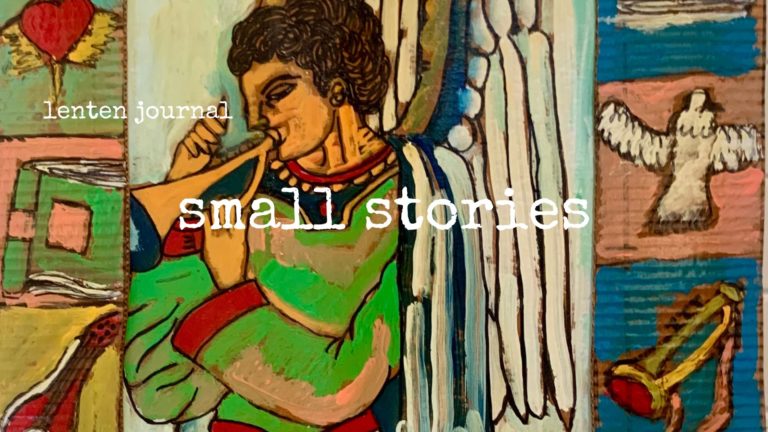
We began by letting Johnnie Brown take us on a two-hour Black history tour of Savannah, which included a number of stops and an incredible amount of information, but the highlight was visiting the Beach Institute, which was founded in 1865 as the first official school for African-Americans in Savannah. Today it is Savannah’s flagship museum for African-American arts, history, and cultural preservation. We saw exhibits showcasing the art of Rudolf Valentino Bostic, a folk artist who painted on cardboard with discarded house paint because he didn’t have money to buy supplies, and the wooden sculptures of Ulysses Davis, a barber who “whittled” in his spare time to create amazing work.

From there we went to lunch at Rancho Allegra, a family-owned Cuban restaurant that started in a house twenty years ago and now offers not only great food but is an important live music venue in the city. The food was flavorful and interesting. The people were friendly and kind. It was good to be there.

We then drove about eight miles out of town to the Pin Point Heritage Museum, which is located in the old A. S Varns and Sons Oyster and Crab Factory. We sat in the rooms where they had picked crab and shucked oysters hour after hour and listened to Gail, a woman who had worked in the factory as a child, tell us about how the people who worked there found ways to buy the land and establish their community, in large part around the Sweetfields of Eden Baptist Church. The community dates back to 1896. The land has remained in the hands of the descendants of those folks ever since, making it the largest amount of Black-owned waterfront property in Georgia, and one of the most cohesive Gulla-Geechee communities left in America.

We watched a documentary about the oyster and crab factory, looked out across the Moon River (named in honor of Johnny Mercer, who was from Savannah) and the marshes, and listened to Gail tell stories as we stood in the places where folks had done such backbreaking work for very little pay. The spirit of the people shone through in all of it. Gail also told us some of her story–how her mother and father got her through college, and how she found her way back to work in the museum because she wanted people to know the story.

Then we went to dinner. I’ve already told you about the food–well, my food. Others had fried shrimp, red rice, smothered shrimp, and most all of us had cinnamon rolls. After dinner, I asked Chef Morolayo if they could come talk to us for a minute. She told us about Gulla-Geechee food and how she had learned to cook from her grandmother. She also talked about Pin Point, and when we said we had been to the museum earlier, she said, “Did y’all meet my cousin Gail?”

That also seemed to open her up to share more about their life and how the restaurant came to be. She had a catering business that she had to close. Her husband was also struggling. They had lost everything, she said. They both decided to go to a culinary school they saw advertised on television, both got scholarships, and both got their certifications. Then they opened the restaurant. The other astonishing detail was they had eleven children, ranging from age thirty-one to five. Through all her story, it was clear that this was a woman who loved her life, as hard as it might have been, which was also what it felt like to look at Bostic’s paintings, or Davis’ woodwork, or hear Gail talk about why Pin Point mattered so much.

Some of our group were talking after we got back to the hotel, and it struck me that it’s not so much the actual circumstances of our existence as it is how we tell the story of our lives. None of the places we were in today are thriving in the sense that they feel secure about their future. Neither of the restaurants have webpages. Though the works of both Bostic and Davis have gained in value, both men died without their art doing much for them financially. Each one of their stories could be told as though their presence on the planet was incidental to humanity, just as the story of our trip from Connecticut could be told as though it won’t make a difference in the quest for equity and belonging in our country.

But that’s not the way the people we met told their stories. They told their small stories like they matter–and they do. Fame is not the same as significance any more than wealth and intelligence are synonyms.

The world is made of small stories of significance, of lives built of cardboard and wood chunks, of oyster shells and cinnamon rolls, all of them reminding us there is enough love–enough of everything–to go around if we are willing to share it.

Peace,
Milton

lenten journal: why are we here?

We decided to walk to breakfast this morning instead of eating at the hotel. When we walked outside and it was raining lightly, we were undaunted. The place we were going was about a mile and a half down MLK Blvd. in a direction we had not gone before, so we got to see some new parts of Savannah, some of which were those that are not benefitting from the city’s prosperity.

The place where we had hoped to go wasn’t opening for breakfast today, but we did make arrangements to go there for dinner tomorrow. I’ll save my review until then. Our next destination was supposed to be Forsyth Park for the Greening of the Fountain, so we meandered in that direction and found Blue Door Coffee and Waffles, which was a quirky little gem of a coffee shop in a changing neighborhood.

The little building had two or three rooms with random tables and chairs. The walls in the room where we sat were covered with Arnold Schwarzenegger memorabilia. Other spaces had Star Wars stuff, and the bathroom was covered with Marvel comics. The breakfast sandwiches were made with mini waffles. The woman who served us moved from the country outside of Athens, Georgia. She had found a home working there.

We ate and then continued down Bull Street until it ran into the park and then we walked yet another tree-lined sidewalk until we got to the fountain. I did not know, until we got here, that Savannah had such an Irish connection. Nine of the original settlers of the city were Irish, and soon after the founding, a ship of Irish indentured servants bound for New England wrecked near Savannah and James Oglethorpe, who imagined a city that welcomed everyone, took them in. They were still indentured servants, but they got to stay. That was 1734.

When Irish immigration began to explode, in part because of the Potato Famine, Savannah remained a welcoming port when cities like Boston and New York were doing all they could to keep the Irish from getting in. The immigrants were crucial in building the infrastructure of the growing city.

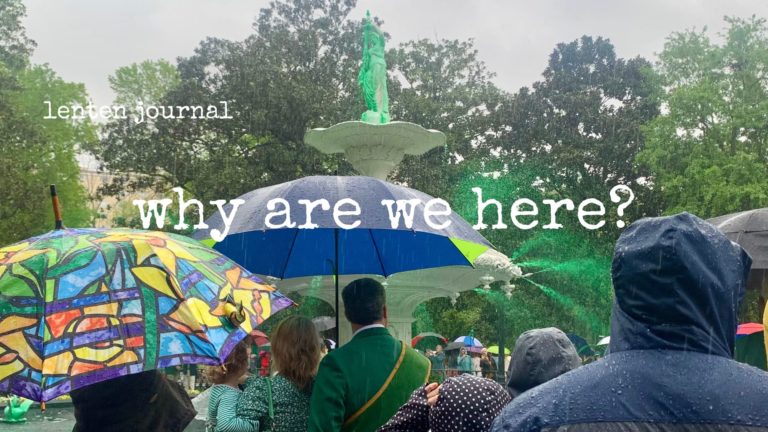
With St. Patrick’s Day just a week away, we have noticed increasing bits of green everywhere. We will be back in Connecticut when the parade happens, but today we went to watch them “green the fountain.”

The festivities were to start at noon; we got there about 11:30, and the rain arrived soon after. As we watched people gather, I felt like they could be put in three general categories: those who made the event happen (men in green suits or kilts, lots of hats, Catholic school kids, a bagpipe player), those who knew about the event and came on purpose (both locals and visitors), and those who stumbled into it while walking through the park.

One of the last group was walking with a friend and was quite disoriented as she took in the crowd. She turned to the people sitting on the bench near me and said, “Why are we here?”

I thought it was a great question.

As those of us who were spectators waited, we watched three or four city workers carry small (green) pitchers of dye to the properly dressed folks on the other side of the fountain. Then, as the rain fell in earnest, many of them moved inside the fence that surrounds the fountain and the emcee began to speak. Though the sound system wasn’t adequate, you could glean by the posture of the people who could hear him that they said a prayer and the Pledge, and then some other stuff. One by one, with casual ceremony, they began to pour the dye from their pitchers into the water and we could see it begin to spread unit it finally got pulled into by the pump and the whole fountain sprayed green.

We cheered as though that was why we were there, and it struck me that, Irish or not, we gravitate to things that enhance our connectedness. As I sat down to write, I searched for the word “gather” on this blog to make sure I wasn’t reusing a title and found this post from last December about the Tree Lighting in Guilford. I wrote, “I walked home in wonder that we, as humans, are built to need each other, to think up reasons to be together.”

I mean, someone said they were going to throw green dye in the fountain and hundreds of people showed up–in the rain! As I read about the history of the event, which goes back to the 1980s, I learned of Fred Elmgren, who has participated in it since the beginning.

“I was there for the beginning, but I didn’t know it,” he said. “The origination of it was hooligans, dying the fountains, or people with good intention, maybe not even just hooligans dying the fountains and making it cool for St. Patrick’s Day. All of a sudden the realization, this stuff could ruin our fountain pumps. They knew they couldn’t stop it so they started dyeing it themselves.”

One of the things I loved about the event was the passer-by who asked, “Why are we here?” didn’t leave. She and her friend found their place in the crowd and stayed until green sprayed from the fountain, as did the old men in green coats with fancy sashes whose blood is probably as green as the dyed water, and me, who loved looking around at another gathering of people who can take something silly or accidental and turn it into a ritual of belonging.

The best definition of ritual I know is that it is meaningful repetition. What I saw today is that the meaning doesn’t have to be the same for everyone for it to remind us we are together. It just takes someone–like Fred Elmgren–to say, “This is going to happen anyway, so why don’t we mean it?” Who knows where it goes from there. As he said, he was there in the beginning and didn’t realize it. Forty years later, there we were standing in the rain, cheering for green dye because this is why we’re here.

Peace,
Milton