Home Blog Page 85

ash wednesday: dust

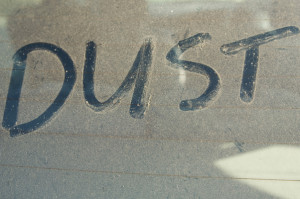
When I was in seminary, I pastored Pecan Grove Baptist Church, which was outside of Gatesville, Texas. To be more specific, the little white church sat next to a creek off of FM The word 'DUST' written on car rear windscreen following Saharan sand deposited in England by strong south easterly winds107 between Oglesby and Mound. Now you know right where it was, or is—it’s still there. When I went drove down from Fort Worth on the weekends, I stayed with Alene and J. T. Davidson. My brother was the music minister at Live Oak Baptist, which was further up FM 107 as it came into town. On the weekends he stayed with a man named Mike Poston. One Saturday afternoon I went up to visit my brother and Miller introduced me to Mike. When I asked him if he knew J. T. he said, “Know him! I help carry the dirt to make him.”
The story came to mind this evening as I read Ragan Courtney’s story about his experience as a young pastor on Ash Wednesday when he blurted out at the first one to come forward, “YOU CAME FROM DIRT AND YOU ARE GOING BACK TO DIRT.” I smiled along with him at the scene because it was not what he meant to say.
Dust, not dirt. We came from dust and to dust we shall return.

Dirt: any foul or filthy substance, as mud, grime, or excrement; earth or soil, especially when loose; something or someone vile, mean, or worthless; moral filth; vileness; corruption.

Dust: dry fine powdery material, such as particles of dirt, earth or pollen; a cloud of such fine particles; the powdery particles to which something is thought to be reduced by death, decay, or disintegration.

Though we may use variants of these words interchangeably, they are not theological synonyms. When we bow our heads and feel the thumb of the minister mark the sign of the cross in ash on our brows, the point of saying we are dust is to remind us of our impermanence, not our worthlessness. The dust, once infused with the imaginative love of God, sprang into being. We are born of love, and to love we shall return—that’s the larger story. Before there was any dust to form, there was Love. After all we know is gone and the universe has been swept clean, there will be Love. From Love we have come and to Love we shall return, dust and all.

Down the fifteen or sixteen millennia that Lent has been observed in one form or fashion, it has been accompanied by a lot of theology intended to remind us we are fundamentally flawed. We do not only sin, we are sinful. Damaged goods, almost from the start. Too easily, then, Lent becomes the season where we try to shed ourselves of what shackles us, hoping that our giving up will make us feel less like dirt. We are preparing for the Resurrection, for what can breathe new life into our tired bones and offer us hope beyond these dusty days. To focus on how we can shed ourselves on what shackles us is a good thing, but our worth as human beings is not at stake. We are wonderfully and uniquely created in the image of God and worthy to be loved. Period.

“To repent,” said Frederick Buechner, “is to come to your senses. It is not so much something you do as something that happens. True repentance spends less time looking at the past and saying, “I’m sorry,” than to the future and saying, ‘Wow!’”

We are dust, not dirt. We are temporary, more than tainted. We are beginning of focus not flagellation. Over these next few weeks, we are making room, creating space in our lives to acknowledge our griefs and losses alongside of our hopes and dreams. Life has not turned out as we expected, for most of us. Grief has become a primary color. We are in need of forgiveness for things we have done and left undone. And we walk these forty-odd days on our way to the Resurrection to allow the Spirit room to remind us we are more than dust: we are children of God.

I have always been drawn to John’s description of Jesus as he prepared to wash the feet of the disciples. He says, “Knowing he had come from God and was going to God, Jesus took a towel and washed the feet of his disciples.” I imagine that John knew Ecclesiastes 12:7—“and the dust returns to the earth as it was, and the breath returns to God who gave it—and I wonder if he was not illuminating a wider arc. Beyond the scope of dust to dust, there is God to God, Love to Love: the One who imagined us and breathed us into being is the One to whom we belong and shall return.

Dust, not dirt. Loved, not lost.

Peace,
Milton

advent journal: we are the sunshine

Tonight Ginger, Jay, and I sat at Geer Street Garden and, among other things, talked our way through the litany of sadness and grief that grips our world both far and near. We remembered people close to us who are learning to live without those they love, those we are getting close to the end of their days, those who are struggling because they are invisible to much of society, and those who are the victims of violence. None of it was new information. Though the days are beginning to grow longer, the darkness is persistent.

As I drove to work this morning listening to NPR, I was thinking about the same things. These are heavy days. My mind moved to music, thanks to something a friend posted last night on his Facebook. He is facing his first Christmas without his wife. Over the course of the day he posted lyrics from songs they had shared. One of the lines came from James Taylor’s “Something in the Way She Moves.” The remnants of his posts brought to mind another JT song as I wrestled with the weight of the world:

ain’t no doubt in no one’s mind
that love’s the finest thing around
whisper something soft and kind . . . .

Many years ago, Ginger quoted Philo of Alexandria in one of her sermons. The quote is one I have heard many times since, but that Sunday it was fresh and new across all the centuries:

Be kind because everyone you meet is fighting a great battle.

At the time, I worked for a very difficult and mean man. I felt persecuted and righteously indignant at the same time, which set me up to get caught in power struggles. Taking the quote to heart meant working to understand more of who he was, which was a broken, defensive, and troubled person. My understanding didn’t make him less mean, but it did change me.

By the time I parked my car in the employee section of the mall parking lot and began my hike to the computer store, I was flipping through the juke box of my mind for kindness songs. The first was one by Jesse Colin Young from my high school days that is seared in my memory because it was one of the first I learned on my guitar. The opening lines say,

love is but a song to sing
fear’s the way we die

For a nation as privileged and powerful as we are, we are a society gripped and driven by fear. The messages that come from much of the media and many of our elected officials play on that fear, even foment it. What they fail to remind us, for the most part, is that fear is a choice, and a lousy one at that. Fear does not bind us together, draw us closer, or help us to grow. Fear tells us there is no way out.

Love trumps fear. Even Jesse Colin Young knew that (even when he knew little of inclusive language)

come on people now
smile on your brother
everybody get together
try to love one another right now

When we first moved to Boston we had a chance to hear David Wilcox sing several times. One of his oldies but goodies is a song called “Sunshine on the Land.” That was my next parking lot hit because when he did it live in those days he would tag on the chorus to “Get Together.”

I went to see an old friend
who was soon to pass away
he said, “My life has been so good to me
now I’ve still got one more day”
now he said that as he watched the morning sun
and then he smiled my way
because he said that every morning
he’d lived his life that way

he said, “I am the sunshine
you are the sunshine
we are the sunshine
help me understand
we are the sunshine on the land”

Here in the darkness, we are the sunshine. I met a woman yesterday at the computer store whose company is called The Giving Child. When she became aware that mothers on food stamps or WIC were not allowed to use their assistance money to buy diapers for their infants, she decided to do what she could. She started a clothing company with the commitment that for each piece of clothing she sold she would donate a week’s supply of diapers to someone who needed them. We are the sunshine.

Tonight I found another song from one of my favorite prophets, Billy Bragg, who leaned into some old words he found. I’ll let him take us out.

in the Bible, we are told
God gave Moses in the days of old
ten great commandments
for his people to hold true.
but the greatest commandment of all
is in the book of Luke as I recall.
do unto others as you would have them do to you.

now baby you don’t believe
in the story of Adam and Eve,
who called up on science
to prove it’s all untrue.
but in the cold light of the day,
peaceful words still point the way.
do unto others as you would have them do to you.

so just lift up your eyes,
don’t pass by on the other side,
don’t be bound by what you think others may do.
put just a little bit of faith,
and that’s all it really takes.
do unto others as you would have them do to you.

now the way the world is run
too many people looking after number one
don’t seem to notice
the damage that they do.
no, it’s not widely understood
there is, there is a greater good.
do unto others as you would have them do to you.

Be kind. Here in the darkness, we are the sunshine.

Peace,
Milton

advent journal: listen . . .

Today was dark and cold here in Durham. I drove to work in the dark early this morning and drove home in the dark this afternoon. In between I heard snippets of stories that passed for news that were mostly people yelling. Listening does not often get reported as being significant. Yelling makes for good headlines: yelling at the other side, whoever they are.

Every time I started to try and put in my two cents, I couldn’t find the words. All I could hear were lines from Philips Brooks’ Christmas carol:

how silently
how silently
the wondrous gift is given . . . .

There was a lot of listening going on that first Christmas. Perhaps that was what made room for the Christ child to be born.

Peace,
Milton

advent journal: percussion

love is the drum
that beats in our bones
even in our broken
melodies of grief
our symphonies of
sorrow and sadness
relentless resonance

in the late night club
of all that could have been
the hope of the high hat
the syncopation of surprise
the gentle jazz of joy
put your hands together
love is the drum

Peace,
Milton

advent journal: the way it is with love

I will tell it to you as it was told to me.10404142_10100323342261441_6290334583224348449_n

Somewhere early in my day I read these words from my friend Olivia, who lives in Boston. She is someone in love with life who looks for ways to feel connected to the world around her. Here’s what she found:

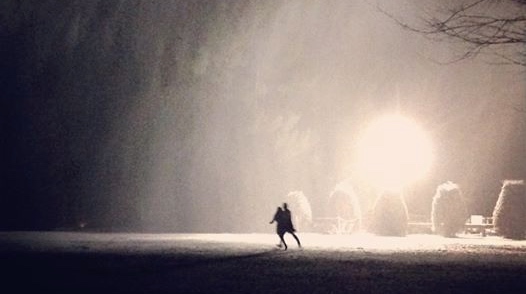
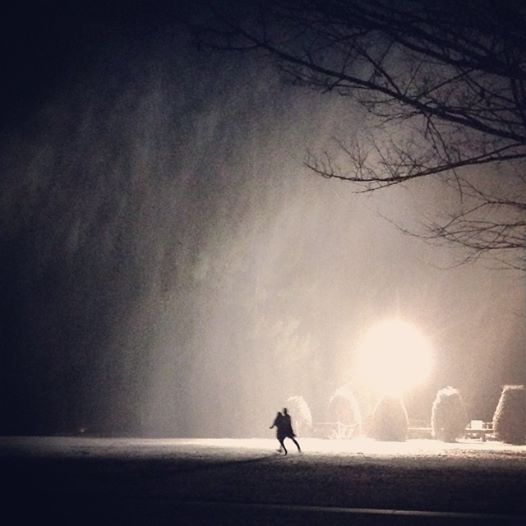
I spotted this on my drive home tonight. A local golf course was making snow and a young couple parked on the side of the road and ran toward it, holding hands. I watched them run around in the artificial snowing, hearing their laughter and sharing their joy. They ran back out a few minutes later, covered in snow and still holding hands. For that is the way it is with love.

A little later in the day, I received an email message from Maggie, a church friend and another New Englander, who had a story of her own. They had gone to dinner with a couple who have been married for a long time. The husband is in the last stages of cancer and is under hospice care. Though his death doesn’t appear to be immediate, it is imminent. Maggie spoke of eating dinner and then sitting down on the sofa afterwards and then she said:

On her coffee table was a sleigh full of Christmas cards.  The outermost card had a beautifully painted winter woods picture.  She told me the story of an old friend of theirs who is an artist.  Every Christmas he sends a card that is a different one of his paintings.  Sixty-five Christmases — sixty-five cards, and she has them all.  I turned the card over.  On the back it said, “This is our last Christmas card.  We hope you have enjoyed them as much as we have enjoyed sending them.” Sitting there with our friends knowing this is surely their last Christmas; it was sobering to say the least.  But beautiful as well.  She mentioned they had been married sixty-five years as well.  “Sixty-five years, sixty-five cards.”

I imagine the couple in the snow have close to six decades to catch up with the couple who has shared a lifetime together and yet both know something about the way it is with love, from stopping by a golf course on a snowy evening to keeping promises down to the very last day. From somewhere in between those two points, I wrote a song for Ginger some years ago (that has yet to be recorded) that tried to imagine a lifetime from the vantage point of two who had collected only a few years together. The chorus says,

this is the story of two common hearts
that started out young and grew old
they have practiced a lifetime
the waltz of a well-worn love

The trajectory of life moves from beginning to end. In between there is time to chase snowflakes and collect Christmas cards, to make fools of ourselves, hang on for dear life, and think of every possible way we can to say we love one another.

That is the way it is with love.

Peace,
Milton

advent journal: good measure

I can show you a cup of flour,
or a pound of sugar, and

I’ve gotten pretty good at
scooping a two ounce cookie,

but I am at a loss to quantify
how heavy grief is,

how long a heart stays broken,
the depth of damage done,

how far it is to forgiveness,
the speed of the sound of loneliness —

even as I strain to comprehend
how a heart like yours

can hold a galaxy of grace,
how sorrow becomes weightless

in the gravity of your love,
how home is as close as you

calling my name in the dark
calling my name . . .

Peace,
Milton

advent journal: dinner together

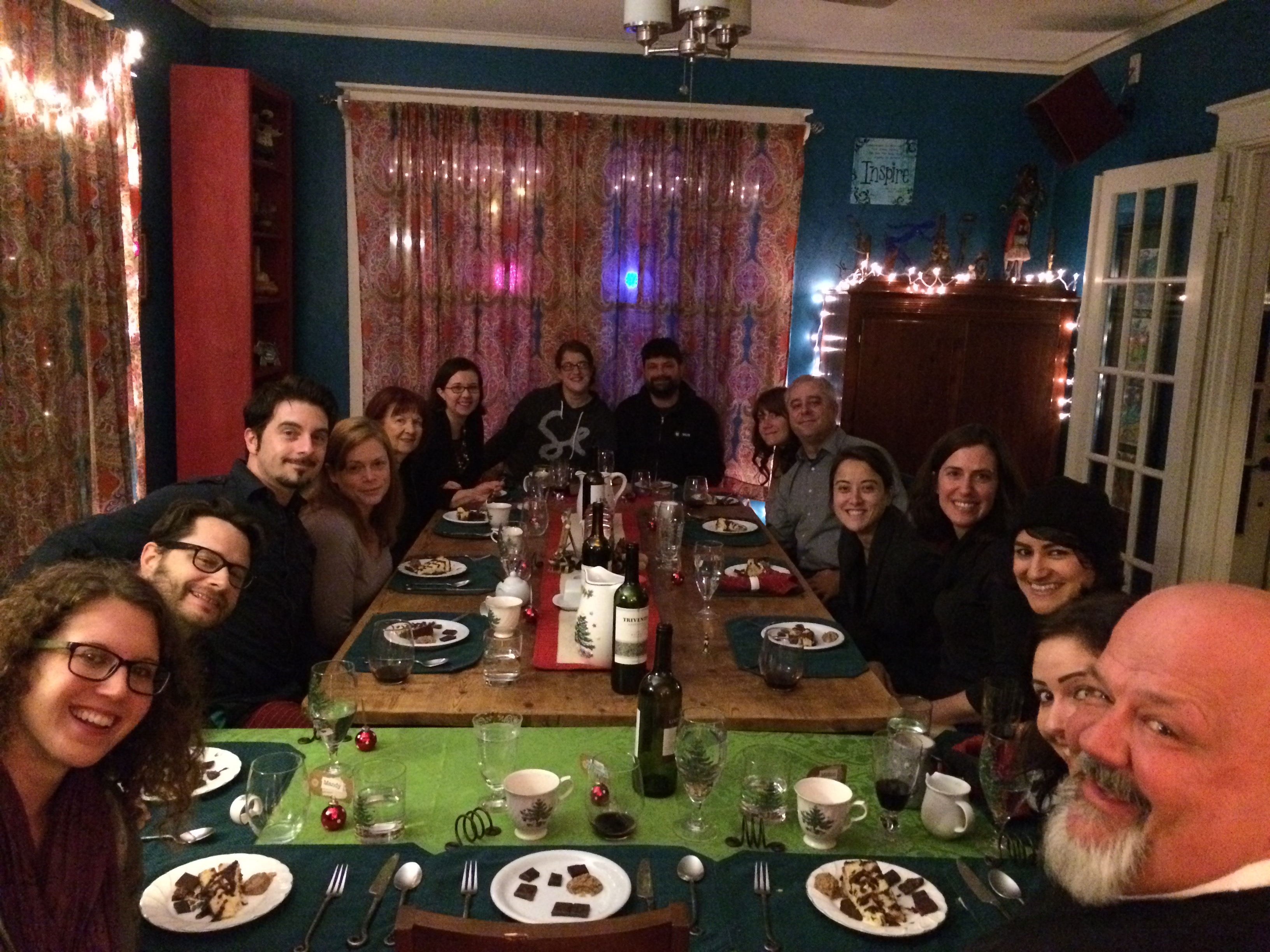
If you have followed this blog for any length of time, or if you have read Keeping the Feast: Metaphors for the Meal, you know about Thursday Night Dinner. We gather each week with friends around our table for no other reason than to be around the table together. OK, so it also gives me a chance to try new things and have fun in the kitchen since I don’t cook in a restaurant any more. But even the cooking is aimed at us being together. The point of a good meal is to create a memory.
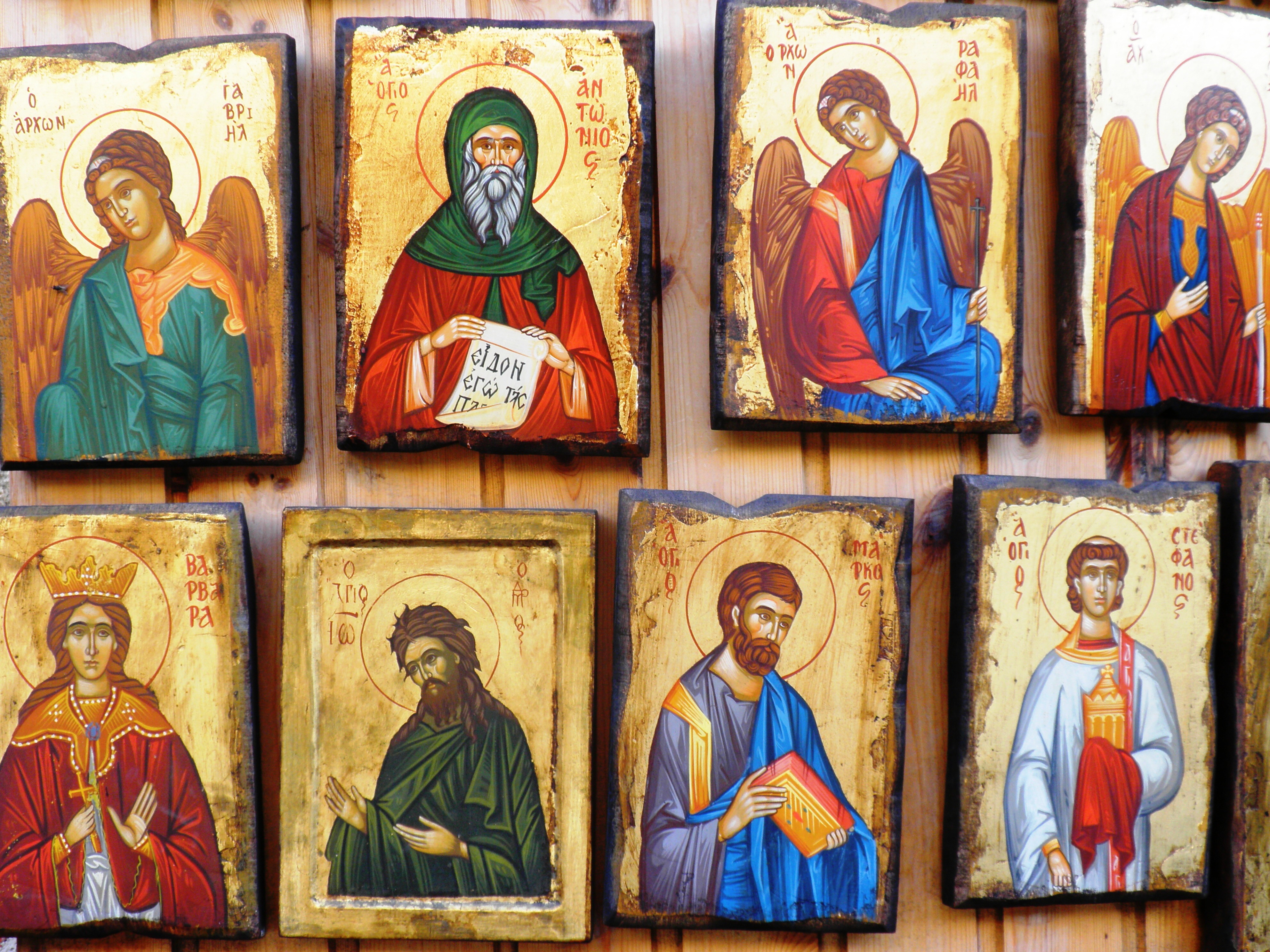
Ginger and I have had some kind of dinner gathering once a week for most of our marriage, and mostly on Thursday nights. In our years here on Trinity Avenue the dinners have taken on a new life. Some of it, I think, is because of Durham. This is a town filled with people for whom being together is a primary value. As I have said many times, it is the most encouraging place I have ever lived. Some of it is our big old house that feels as though it was built with open arms. From our first night in this place we felt at home. But most of it has to do with who sits around our table from week to week. Our dream has always been to have an open table where we can invite new people into the circle. Alongside of that dream, we have a Durham family of regulars for whom Thursday Night Dinner is as much a part of their lives as it is ours. They come early to help cook, they stay late to wash dishes, and in between we sit around the table and share our weeks and our lives.

We have gathered together to celebrate and to grieve. I suppose I would do better to find a way to say both of those are ongoing activities. We celebrate and grieve together on a weekly basis. John Berger says, “It is on the site of loss that hopes are born.” Around our table each week we have become midwives of hope. When we clear the table and everyone goes on to whatever tomorrow holds, I feel as though we have helped to give birth to more hope in our world.

As this Thursday night comes to an end, I feel as though if all I had to show for this week was I cooked for and ate dinner with my friends around our table that would be enough. I only wish the table were bigger.

Peace
Milton

advent journal: without

One of my favorite Pierce Pettis songs begins, “The presence of your absence follows me.” The song has played in the background of my week because tomorrow, December 18, will mark five years since my dear friend David Gentiles died.

I could say many things about David, but maybe this will give you an idea: after five years, his Facebook page is still active because those he loved and encouraged have continued to talk to him. And those he loved and encouraged are legion. I am one of them.

For most of the month I have thought we were marking four years, but the other night as I was digging back through memories I realized it has been five years without him here on the planet. Life has gone on. All of his family and friends have waked up and lived and loved and hurt and missed him. And we are not alone. Most everyone we meet is living through the day after and the day after that, stringing together weeks and months lived in the presence of a palpable absence. The more days we live, the larger the cloud of witnesses, the more of those with whom we are without.

Tonight there are Pakistani parents who are living without their children, alongside of parents in Sudan, Sandy Hook, and Ferguson. A colleague at work who is in her twenties spent today at her father’s memorial service. One of our church members was back Sunday from her father’s funeral. The longer we live, the more grief becomes our most common currency.

We have much in my life for which to be grateful, not the least of which are the friends, family, and even acquaintances that fill each scene, that give us a chance to feel connected, challenged,and loved. Everyday we are called to be together, to invest ourselves in one another, to connect, to love, to be with each other, even as we understand one day we will be without.

Such is the risk, the cost of love.

It’s worth it.

Peace,
Milton

advent journal: singing in the dark

Going to the mall each day means being inundated with holiday music — well, the same ten songs. I thought tonight I might offer a soundtrack that has found me in these days. Talking about Patty Griffin’s “Mary” a couple of days ago set me to thinking. My list is by no means exhaustive, nor is it traditional, as far as Christmas music is concerned, but these are songs to learn and sing. Together.

Paul Simon’s most recent album holds a song called “Getting Ready for Christmas Day.”

Getting ready, oh we’re getting ready
For the power and the glory and the story of the
Christmas Day

To say Steve Earle has a Christmas song might be surprising to some. He actually has two. “Christmastime in Washington” remains powerful and current, but tonight I want to point to “Nothing but a Child.”

Nothing but a child could wash these tears away
Or guide a weary world into the light of day
And nothing but a child could help erase these miles
So once again we all can be children for awhile

Somewhere along the way I picked up Over the Rhine’s record, “Snow Angel.” One of the songs is called “Here It Is.”

somewhere down the road well lift up our glass
and toast the moment and the moments past
the heartbreak and laughter, the joy and the tears
the scary, scary beauty of whats right here
I’m wrappin’ up my love this Christmas
and here it is

Though it is not a Christmas song, James Taylor’s setting of Reynolds Price’s text, “New Hymn,” is hauntingly comforting, even as it is disquieting.

Till our few atoms blow to dust
or form again in wiser lives
or find your face and hear our name
in your calm voice the end of night
if dark may end.
Wellspring gold of dark and day,
be here, be now.

Emmylou Harris’ record Light of the Stable has long been one of my favorites. The last verse of the title track says,

Come now, there it shines so bright
To the knowing light of the stable
Lean close to the child so dear
Cast aside your fear and be thankful


Hallelujah.

Peace,
Milton

advent journal: saints of diminished capacity

I have been going back through some poems I wrote several years ago. My intention was not to repeat them, necessarily, but a couple of them have taken hold in new ways and feel as though they are worth bringing to light once more. I needed these words tonight. I hope they find you, too.

saints of diminished capacity

I only saw the words written,
requiring me to infer tone;
to assume either compassion
or conceit; to decide if the poet
mimed quotation marks when
he said, “diminished capacity,” —
or saints, for that matter —
if he even said the words out loud.

Either way, the phrase is
fragrant with failure, infused
with what might have been,
what came and went,
what once was lost . . .
and now is found faltering,
struggling, stumbling,
still hoping, as saints do,
failure is not the final word.

Forgiveness flows best from
brokenness; the capacity for
love is not diminished by
backs bowed by pain, or
hearts heavy with grief.
Write this down: the substance
of things hoped for fuels
those who walk wounded:
we are not lost; we are loved.

Peace,
Milton