Home Blog Page 79

advent journal: bethlehem road

the road between here and there
is familiar; we’ve taken it so many times
the car could drive itself, as they say —

we’ve come this way so often
I no longer think in the chapter
and verse of exit signs . . .

instead, I mark our progress
by landmarks — mostly song, food,
and fuel: what it takes to keep going

some time this morning we passed
halfway without much fanfare, except
for Joni singing about cutting down trees —

for now that’s as close as I can get
to carols; i sing along and trust the road
and the stars that call my heart

like a homing beacon; I don’t feel much
like a wise man, but I know this
is the road between here and there

paved with stories and sorrows,
the climbing way we know all to well . . .
oh, my — look at all the stars

Peace
Milton

advent journal: legacy

At certain intersections of my life I have been aware of a clear memory of my father at my age. When I turned forty-one, I could sc005224bd03 - Version 2remember Dad at that age because of one the persistent fragments of memory was the birthday card I wrote for him that year:

life begins at forty

at least that’s what they say

so look on the bright side of things

you’re one year old today

Yes, I’ve always been a poet. Tomorrow I turn fifty-seven and this memory of my father is perhaps clearest of all because of what that birthday meant to him: his father died at fifty-seven as the longest living Cunningham male to date. All of them had died young and died of heart attacks. Dad could hear the bell tolling. That fall he drove up to Fort Worth by himself to visit me, which was not a regular occurrence. He traveled to places that mattered to him and to see people he loved as though he was on a farewell tour. Fifty-seven came and went, as did fifty-eight and sixty; he died a little over a month shy of his eighty-fifth birthday. I am grateful on many levels.

That all the Cunningham males died so early meant I never knew any of my relatives beyond the generation that preceded me. My dad’s mother, Bertha, died a month after he was born; my grandfather (Milton I) died two years before I arrived. To this day I don’t know where either of them is buried. My dad had some great almost Paul Bunyanesque stories about his father, but even he knew little about his mother. When my folks moved from their house in Waco into an apartment, Ginger and I became the recipients of dishes and glasses, which now grace our table as often as possible, which feeds me in ways I had not expected. I try to imagine what it must have been like for my grandfather at my age, eating off dishes meant to be shared with his wife who had been gone for years and years and years. He did remarry. Marie, the woman I knew as “Grandma C” was a good woman who managed to live to be one hundred, but, as the stories go, they struggled in their lives together. Yet she is the one who saved everything of Bertha’s to pass down. Her fingerprints are on the glasses and plates as well. Family is often a difficult recipe to describe.

If my dad were still here, he would call me today and say, “Well, this is the last day in your fifty-seventh year,” making sure to remind me the birthday number marked the end of a year rather than the beginning. Then he would ask, “How does it feel to start your fifty-eighth year?” as a way of sending me off on a new adventure. His Fifty-Seven Farewell Tour not withstanding, he never seems to fear growing old; I think he just saw it as growing. Over the past several years, we had a recurring conversation where he would tell me he was going somewhere as an interim pastor and he would say, “I think this may be the last time I do this. I’m getting old.” Before too long, he would be telling me of his next church. He preached up until the Sunday before he had his stroke.

If it weren’t for my family history, Fifty-Seven would come and go as one of those birthdays that matter most as markers but don’t call for the kind of notice that the ones that end in fives and zeros demand. It’s a Rest Stop Birthday: relax, enjoy, keep going. Though my father is not here to see my turn fifty-seven, I’m grateful that he took the sting out it by living as long as he did. It is no longer a wall to be climbed, but simply a day to mark and, as I said, keep moving. I’m also grateful I like feel I’m on the cusp of new things and not making the club house turn. I’m grateful. More than ever.

Sing a long, won’t you?

for the harvests of the spirit, thanks be to God

for the good we all inherit, thanks be to God

for the wonders that astound us

for the truth that still confounds us

most of all, that love has found us

thanks be to God 

Peace,

Milton

advent journal: the art of the matter

The day has been grey, cold, and rainy here in Durham. If I were in Boston, there would be snow on the ground, adding a little poetry to the gloom. When I arrived at Cocoa Cinnamon I had a hard time finding a seat because the little room was packed with people who had brought each other in out of the cold for coffee and conversation. There was one empty chair at the table, so I was able to find my place.

I wanted to come here in particular today because it felt like the best place to come to continue my conversation with Wendell Berry’s book What Are People For?. (At this rate, perhaps, I should start wishing you a very Berry Christmas.) Since the book is a collection of essays, I’ve bounced around a bit, rather than reading cover to cover, and I have been struck by the recurring themes, even though the collection was written over a number of years and for a variety of publications, as far as I can tell. He answers the question in the title by describing how we thrive in community, which includes not only one another but the rest of creation and those who have come before us. The purpose of our existence is to connect.

In three different essays, Berry pushes hard against the tendency for a writer to see the surrounding world as “raw material” for whatever he or she wants to do rather than the real thing. He bounces off of a quote from an article written by William Matthews who says,

A poet beginning to make something needs raw material, something to transform. . . . For [the poet] subject matter is not important, except that it gives her the opportunity to speak about something that engages her passions. What is important instead is what she can discover to say. It is not, of course, the subject that is or isn’t dull, but the quality of attention we do or do not pay to it, and the strength of our will to transform. Dull subjects are those we have failed.

And Berry replies,

This assumes that for the animals and humans who are not fine artists, who have discovered nothing to say,the world is dull, which is not true. It assumes also that attention is of interest in itself, which is not true either. . . . Mr. Matthews’s trivializing of subjects in the interest of poetry industrializes the art. He is talking about an art oriented exclusively to production, like coal mining. Like an industrial entrepreneur, he regards the places and creatures and experiences of the world as “raw material,” valueless until exploited. (84)

Berry goes on to say whatever we say with our art —words, paints, you name it — has to be connected to real life, to “the territory underfoot.” Art for the sake of art misses the point, even as I may have lost you by this point in the post.

Here’s why I was taken by his discussion of “raw material”: I find art to be a meaningful metaphor for faith. I think of God as an artist when I look at all the wonders of creation around us; I think God calls us to be artists, filled with the imagination of the One in whose image we are made. What hit me today in my reading during Advent are the ways in which the Incarnation provides an example of “the territory underfoot” that Berry describes. To read Genesis is to see a Master Designer at work who first creates the raw material and then breathes and speaks and shapes things into existence. The birth of Jesus puts God right in the middle of things, down in the dullness, in the middle of what Berry calls “the beloved community”:

common experience and common effort on a common ground to which one willingly belongs. (85)

As much as anything else, the birth of Jesus is God’s way of saying being human is a good thing, or as Ginger says every chance she gets: we are wonderfully and uniquely created in the image of God and worthy to be loved. We were not put here as props for God’s special effects, or so Jesus would have someone to save; we were created to live in beloved community with God, created to tell the story of our days in whatever way we can as an invitation to one another to share both the blessings and the burdens.

Life and art and faith are all team sports.

This post, I fear, is headier than I hoped or intended. I feel what Berry is saying in ways I struggle to get on the page. At the heart of the picture of a poor teenage girl giving birth to a baby boy in a barn behind a motel in a town that wasn’t her own is God right down in the middle of us saying, “You are not alone; you are loved and you are not alone. We are in this together.”

Gloria in excelsis deo.

Peace,

Milton

advent journal: farewell, mandiba

My day began early after ending late the night before because I made a mistake and scheduled two catering gigs — lunches — at the same time in two different places. Thanks to my friend Laura, who has been a sous chef on several projects, both events went well. But after leaving my journal and the book I’m reading at work yesterday and a couple of other dropped details, I’m mindful of one of the ways my grief is affecting me. I have to slow down and pay extra attention.

As we were preparing to leave Massachusetts, our friend Jay came to say goodbye. As he was leaving, I followed him out because I had some errands to run. He drove off and I got into my Cherokee Sport and started out of the driveway. Just as I got to the street, I realized I had left something in the house, so I put the car in reverse and got out. I didn’t stop the car; I just got out and then stood and watched as the car slowly rolled back into the door of the Pod we had sitting at the back of the drive. Once they crunched, I got back in the car and put it in park. The windows to the house were open and I heard Ginger say, “Well, that doesn’t sound good.”

I felt like I heard the same crunch in my life in a couple of different ways this week.

I was a kid in Africa during the Sixties, which means I was growing up as many of the nations were growing into independence. We were living in Zambia when freedom came in 1964 and Kenneth Kaunda became president. It was an amazing night. The leaders I came to respect first in my life were the people who did their best to help their continent recover from the damage of colonialism including Kaunda, Julius Nyerere, and Nelson Mandela. Tonight, in the midst of my fragmented life, I sat down to write only to find that Mandela is dead. One of the great lights of my lifetime is gone.

The world is full of politicians, but we have only had a handful of true leaders. Mandela is one of those who did more than take care of his own agenda. I remember watching as post-apartheid South Africa came into being and Mandela went from prisoner to president. After twenty-seven years, a certain amount of righteous anger would have been understandable. The former oppressors braced for what was coming to them only to see the creation of the Truth and Reconciliation Commission. Mandela helped his country incarnate a spirit of compassion and forgiveness. His determination and leadership strips the members of our houses of Congress of any excuse for their selfishness and intransigence. They are choosing to use violence and arrogance as their primary currency; it does not have to be that way.

Yes, I do realize that neither Mandela nor the transition to an independent South Africa was perfect and I am grateful — deeply grateful — to have been alive while he lived. In fact, I am amazed to think I have lived while Martin Luther King Jr., Nelson Mandela, Stephen Biko, Rosa Parks, Jimmy Carter, Vaclav Havel, Oscar Romero were also living. My list is by no means exhaustive; these are the ones who came to mind sitting here at the coffee shop. As I think about them, I am reminded that many around the world are working hard to do justice, love kindness, and walk humbly — and calling us to do the same by their actions.

Rest in peace, Mandiba. Thank you.

Peace

Milton

advent journal: grace with a face

Friday night I am going to see John Prine.

It’s an early birthday present, and a great one at that. My friend Terry is picking me up from work and we are driving over to Greensboro to soak up one of my songwriting heroes. Today at work at the computer store, I told a couple of people (much younger than I) what I was going to get to do and they asked, “Who is that?” Even after I mentioned “Angel From Montgomery” they still stared blankly. Not that I was surprised. The song had been out twenty years before they were born.

Last week, one of the managers came in beaming because he had been to see Third Eye Blind the night before and all I could think was, “How many times could they sing ‘Semi-Charmed Kind of Life’ to consider it a concert?” I told Dan, one who is closer to my age, what had happened and he and I spent the next hour talking about Prine and John Hiatt and Kris Kristofferson and Joni Mitchell and Nick Lowe and — well, you get the picture. When I left work, I said, “I’m going to have to go home and listen to old records.”

In one of the quiet moments in the store tonight toward the end of the evening, I heard the piano of “Linus and Lucy” drift down from the speakers in the ceiling and it made my heart smile. Everyone in the room knew the melody — and it’s probably older than “Angel from Montgomery.” Perhaps the musical connectedness, or lack thereof, stood out for me because I was looking for connections. Today was a heavy day. That’s the best word I know. The sadness sat on me like chainmail, like a lead coat. I was grateful for work because it gave me something to do, something to bounce off of. During my lunch hour, I read an essay from Wendell Berry’s What Are People For? in which he talked about the necessity of connectedness, of community to live with and live through tragedy and grief. In isolation, we are left bitterness and anger; in community we find the grace to keep going.

I came back to the store with about fifteen minutes left of my lunch hour and was sitting alone, by chance, in the break room when one of my coworkers who is both young and acquainted with grief came in and sat down beside me. “I know yesterday was four months,” she said, “and I just wanted to tell you I can see your sadness, and you’re getting through it better.” I found comfort in her words because she talked about getting through the day rather than getting over something.

Soon after Dad died, I got a note from another friend who spoke of her “fifteen minute life” after the death of her father. The grief was so heavy she found she could only cope in fifteen minute segments, so that’s what she did. Over time, her life grew to twenty minutes, then thirty, an hour, and a day. What I am learning over and over again is I need the companionship of John Prine and those who have never heard of him, of those who know the road I am walking and those who don’t yet know to get through the day.

The insidious lie of depression is that I am alone. The fundamental truth of grace is that I am not. Grace always has a face. And that I can hold on to, even when to believe in this living is such a hard way to go.

Peace

Milton

advent journal: kitchen question

I have spent the evening

baking, not writing.

I have swirled my sadness

into the mix of

butter, sugar, eggs

because I know

what to do with

butter, sugar, and eggs.

Baking the same cookie

doesn’t feel repetitive;

why does writing

about grief feel

as though I am saying

the same thing

over and over and over?

I think I’ll have a cookie.


Peace

Milton

advent journal: where’s home?

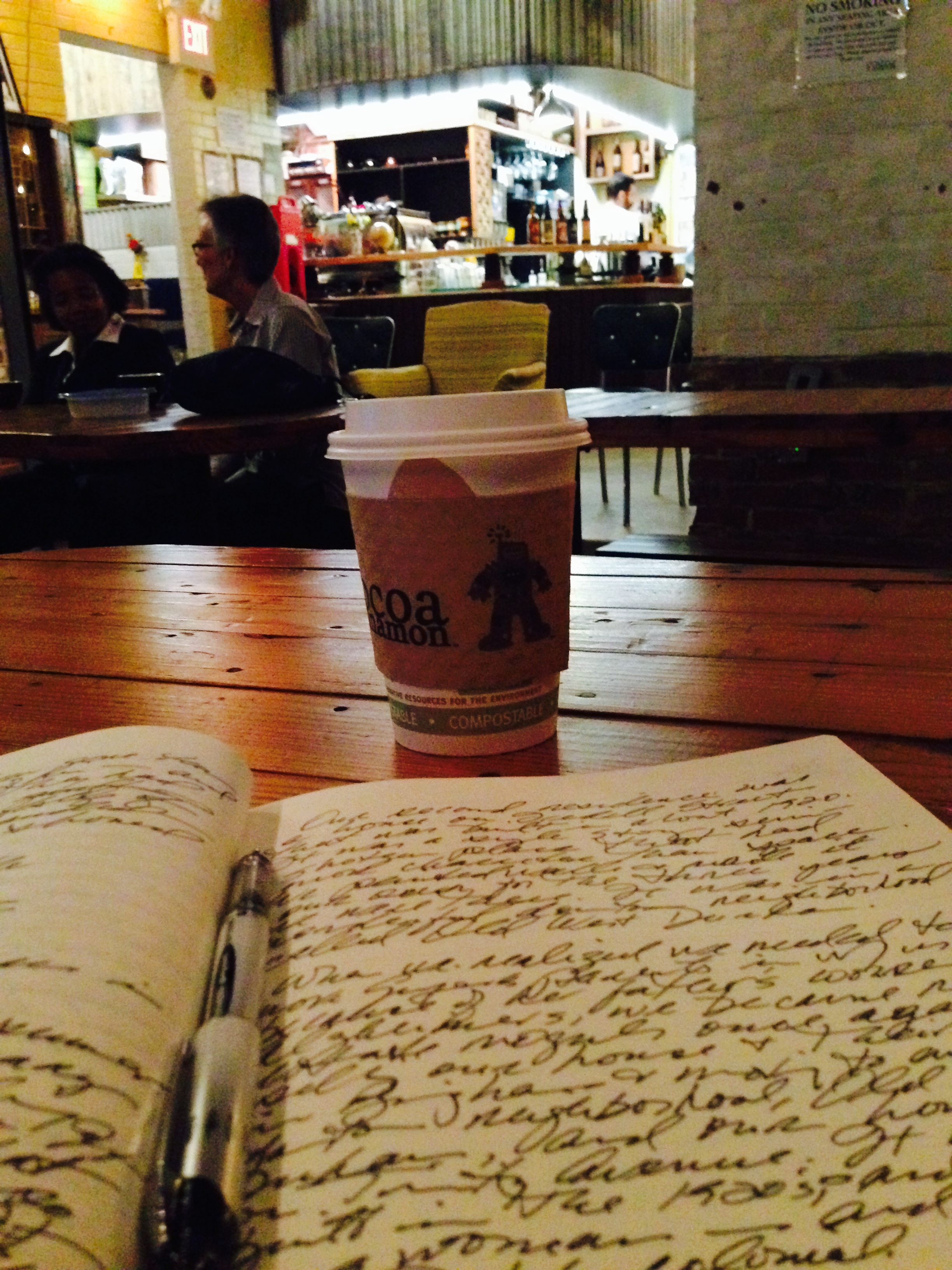
Over the past several weeks, I have been working towards another book. What that means for me is a string of almost daily photos from Cocoa Cinnamon, our neighborhood coffee shop, of my coffee, pen, and notebook because I find it best to write in longhand in the early stages. I like thinking through the pen rather than the keyboard, and my journals don’t have internet access. I still don’t know exactly what kind of shape the book is going to take, but I do know it’s about home.IMG_2911

Home.

For someone who has spent most of his life moving around, it’s an elusive target. I have a growing collection of songs and poems, of quotes and quips, each one offering its take on what home is. It is safe to say you will hear more about both the ideas and whatever they become in the days and weeks ahead, but tonight, as I was sitting here in my favorite coffee shop thinking about Advent, a new thought crossed my mind as I imagined Mary and Joseph packing up to go from Nazareth to Bethlehem.

In those days a decree went out from Emperor Augustus that all the world should be registered. This was the first registration and was taken while Quirinius was governor of Syria. All went to their own towns to be registered. Joseph also went from the town of Nazareth in Galilee to Judea, to the city of David called Bethlehem, because he was descended from the house and family of David. He went to be registered with Mary, to whom he was engaged and who was expecting a child. (Luke 2:1-5)


Joseph and Mary were the first ones who had to go “home” for Christmas.

Though they lived in Nazareth, the census required them to register in Joseph’s hometown, so they hit the road, third trimester and all, so they could be counted in the place that mattered. Though Joseph’s family heritage was there, they had no relatives to count on for lodging and support. Still, they went as they were told and it came to pass that Jesus was born in Bethlehem. Even today, the birth city gets much more attention than the place where Jesus grew up. No one goes to Nazareth on Christmas Eve. And I wonder if they ever took Jesus back and said, “Well, son, there’s the barn where you were born.”

Home.

When I was in sixth grade we lived in Fort Worth, Texas. I had not been in America since my kindergarten year. I walked home from my first day at Hubbard Heights Elementary School and said, “Mom, I met the weirdest kid today. He’s lived in the same house his whole life.” (By that time in my life, I had lived in four cities, three countries, and gone to four schools. I, like Jesus, had moved quickly after I was born.)

My brother said, “There were three or four kids like that in my class.”

And my mother said, “I hate to tell you boys, they aren’t the weird ones. Lots of people live that way.”

I was in the country of my birth, but I wasn’t at home. When I went back to Africa, I wasn’t sure how to feel at home there either. As I sit here in the coffee shop, I feel at home and yet also know that my roots run about as deep as the potted plant on our porch that looks settled there as well. One good pull and that all changes.

Jesus spent a couple of years in Egypt running from Herod before he finally got back to Nazareth. I can picture Mary and Joseph sighing with relief, “Home!” and Jesus wondering what all the fuss was about. To him, it was just another new town, except this time with a few more relatives.

Home.

Yesterday in church, I accompanied my friend Jennifer as she sang,

I am a poor wayfaring stranger

a-traveling through this world of woe

but there’s no sickness toil or danger

in that bright land to which I go . . .

She sang after our time of prayer requests, when we had voiced our joys and concerns, our grief and pain. The song carries an odd comfort for me because I have sung it for so many years and it also calls me to claim I want to be more than a passing stranger in these days I am on the planet. Today I spent part of my afternoon walking with my friend Tim as we both are working for there to be less of us on the planet; before I walked with him, I spent some time reading from a  book of Wendell Berry essays he loaned to me called What Are People For? In one of the essays is about Huckleberry Finn, Berry defines what it means to be a part of a beloved community, which could be a name for home, and he says it is where we go to hurt together. Hurting in isolation leaves us strangers; sharing our grief, our tragedy in community creates the room for redemption and forgiveness.

Home.

My morning started here at Cocoa Cinnamon. I met an artist here named Jim. He is a metal sculptor, among other things. We were meeting to talk about spiritual direction and how I might study with him to help me figure some things out. Tonight as I came in, I saw Leon, the owner with his wife Areli of this wonderful place,  and we talked about when we might share a meal together. In between I walked with Tim and with Ginger, which we have done together in several places, and ate dinner with Melinda who traveled from Birmingham to surprise my mother-in-law, Rachel. Though I am traveling through this world of woe, I am not a stranger.

When the alarm goes off at 6:30 in the morning, it will be almost exactly four months to the minute that the phone rang in August to tell me that Dad had died. My traveling through this day will remind me I do not bear my grief alone. I am surrounded by many hearts and hands willing to share the load, even as I do what I can to help carry theirs as well. Roots or not, they treat me like I’m home.

Peace,

Milton
advent journal: o come, o come . . .

We gathered this morning in our church, along with Christians around the world, to observe the first Sunday of Advent, our intentional, patient walk to the birth of Jesus. Our tradition on this day is a service called “The Hanging of the Greens” (needless to say, we are not alone) where we decorate the sanctuary as we tell the stories of where many of our Christian traditions around Christmas came from: wreaths, holly, poinsettias, trees, and lights. At the same time, we were following our usual liturgy, which begins with a note of praise and then moves to a prayer of confession. Following the prayer we have a time of silence before we are reminded that we are forgiven by the very one whose birth we await. Today, that silence was followed, first, by music. My friend, Terry — who is an amazing harmonica player — joined with his friend, Roger, who plays the upright bass to offer “O Come, O Come, Emmanuel.”

The piece began with Roger bowing the bass and offering a deep and aching musical phrase that felt mournful and resolute at the same time. Terry joined in with what felt like the opening melody of the carol, but he didn’t finish the line. The two of them swirled around each other, one high and one low, incarnating the pleading anticipation of the carol even as they began to play the notes I recognized. No one sang a word, yet both their rehearsed notes and their improvisations spoke more than any lyric. Deep called to deep, as the psalmist said. As they played, I scribbled in my notebook,

I’m not ready for this. Advent, that is. The long walk to a first Christmas without Dad.

I’ve almost dreaded sitting down to keep my promise of a daily journal during Advent, which has been my spiritual practice for many years now, because I still don’t know how to write about much more than my grief, as I have done over the past four months in my less than regular posts. A couple of years ago, I wrote for several days one spring about what it felt like to live with my severe allergies and had someone write and asked to be removed from receiving the posts by email because they were tired of hearing about my pain. Though I was still stopped up, changing subjects was not so difficult; this time around, however, I find few circumstances in my life that aren’t affected by my father’s death. I am not merely congested; I am changed.

The song helped me this morning. As Roger drew the bow across the stand-up bass, I recognized the melody, not of the carol, but of grief. As Terry breathed into the harmonica the breath that became the swirling minor chords of longing and loss, I felt known and even gathered up. They were playing not just my song, but a hymn deep from the heart of humanity: O come, O come . . . . While they played, I remembered I could write my own words to the hymn, if you will. I remembered I needed to write as they played: not trying to speak for all eternity, but to make my offering on this day. And what I have to offer is my grief.

For all but the last few days of this Advent season, the darkness will keep growing as the days get shorter and shorter. Even as far south as we are in Durham, the sun feels like it calls it a day in the middle of the afternoon. I learned when dealing with my depression a few years ago that I dealt better with the setting sun if I was outside of the house — something about being inside when night settles shuts me down, so Ginger and I do our best to go walking about dusk so we are out on the streets as it gets dark. The last light of the day is rich and deep — photographer’s light — as though it were streams of stories reflecting off of the bricks and mortar and falling into the shadows. I find consolation being out and about in the fading day, to be together in the dark.

As Terry began to play the melody I recognized, I heard the words in my head: O come, O come, Emmanuel. Emmanuel: the name spoken to Joseph as he struggled with how to come to terms with Mary’s pregnancy, and with an angel in his room. Emmanuel: God With Us. I love the encounter as it is described in the gospels, because the name of the child doesn’t offer a solution, but a presence. God with us.

O come, O come and find us in the dark. We are here. Together.

Peace

Milton

coffee house

a year ago, this room
was filled with reclaimed
lumber and pregnant dreams;
now I sit in my spot,
trying to give birth to
new ideas as though
I have always come here.

the path from then
to now is not mapped,
but discovered — looking
back into the woods
of hope and friendship,
of late nights and failures,
of sweat and smiles and stories

in which we live and
draw our circles — the paths
that keep coming back
to this clearing,
this prayerbook of a coffee shop,
where they call our names
when all is ready.

20131116-112421.jpg
Peace,
Milton