I was one of the words that showed up when I crowd-sourced my Lenten Lexicon. Tonight I figured out why.
My plans for the evening have been laid out for a week: cook and watch basketball. I’ve been looking forward to it. I was flipping back and forth between the early games when Ginger walked through the kitchen and said, “Check out channel 256.” I followed her instructions and found one of my favorite movies, Man of La Mancha. My attachment to the musical goes back to my family stopping in London on our way back to Texas from Africa. It was 1967 and I was going into sixth grade. My parents took us to see the show because it was one of my father’s favorite stories. I figured out later we saw the original London cast before it ever came to Broadway and Robert Goulet turned “The Impossible Dream” into a lounge lizard cliché.
As a kid who, like his father, struggled to feel worthy, to feel good enough, the story of Don Quixote wrestling with reality and finding the courage to dream burrowed its way inside of me. In a world before YouTube, my father could quote most of the show. As I sat on the couch with Lizzy, our youngest Schnauzer, curled up beside me, I quoted most of the movie myself, and sang along as well. I was hardly through the first chorus and I could feel the tears running down my cheeks. The words and music opened a passageway to my memories and to my father. Even as I missed him I could feel him close.
I am grateful tonight to have found the thin place, the connection, the passageway that connected my life from sixth grade to high school (when the movie came out) to tonight, where I could remember once more
that the world will be better for this that one man torn and covered with scars still strove with his last ounce of courage to reach the unreachable star.
Saturday when I arrived at work I met one of my colleagues who was wearing a t-shirt that said,
“Stories Matter.” Naturally, I wanted to know the story behind the shirt. He told me it was for something called the 12×12 Initiative that is a twelve week road trip across country, starting yesterday from Raleigh to highlight twelve nonprofits across the country. They describe themselves this way:
We believe in the power of stories to motivate action and inspire compassion.
The 12×12 Initiative exists with the hope of connecting people with causes through the power of story. We want to see individuals get involved in their own communities, embracing the stories around them, and becoming part of one themselves.
Here is their video.
And here is the link to their Kickstarter campaign, which has only hours left and is so close to their goal. (I love that they drove out of town not knowing if they were fully funded.) And I love the quote I found in the middle of their page:
“[Stories] make us more humble, cause us to empathize with people we don’t know, because they help us imagine these people, and when we imagine them—if the storytelling is good enough—we imagine them as being, essentially, like us.” — George Saunders
One of the lessons I learned about preaching fairly early offered a bit of a paradox: if I wanted to say something that applied to most everyone I had to preach to someone in particular. To make global statements was to miss most of the crowd; to preach thinking of individuals who needed a word of comfort or even challenge meant a whole bunch of people came out of church saying, “I felt like you were talking to me.” The truth is shared best in stories rather than grand statements.
bell hooks speaks about the power of “particular”—telling our specific stories rather than proclaiming the broad strokes—and she used her story of life with her grandmother, Baba, to make her point.
We have too often had no names, our history recorded without specificity, as though it’s not important to know who—which one of us—the particulars. Baba was interested in particulars. Whenever we were “over home,” as we called her house, she let us know “straight up” that upon entering we were to look at her, call her name, acknowledge her presence. Then once that was one we were to state our “particulars”—who we were and/or what we were about. We were to name ourselves—our history. This ritualistic naming was frightening. It felt as though this prolonged moment of greeting was an interrogation. To her it was a way we could learn ourselves, establish kinship and connection, the was we would know and acknowledge our ancestors. It was a process of gathering and remembering.
Story: the process of gathering and remembering. That’s as good as any dictionary.
My friend, Paul Soupiset, who tells stories through both words and pictures, offered a link—What’s So Special About Storytelling for Social Change?—last night that has kept me thinking about the power of narrative. The author, Simon Hodges, is looking at the way storytelling has taken hold in our time, focusing on a storytelling community in Amsterdam called Mezrab. As he talks about the need for new narratives, he says:
[C]limate change, inequality, violence and other challenges can’t be solved by doing more of the same. We need new narratives that connect with peoples’ deepest motivations and promote more radical action. Stories engage people at every level – not just in their minds but in their emotions, values and imaginations, which are the drivers of real change. So if we want to transform society, we must learn to tell—and listen to—a new set of stories about the world we want to create.
He then goes on to tell what he learned listening to the group in Amsterdam, and he echoes what hooks learned from her grandmother.
So far so good, but what actually makes for a good story in this sense? That’s where my visits to Mezrab were so instructive. For one thing, the storytellers that got the most attention were not necessarily the funniest or wittiest. Instead, they were the ones that were most prepared to put their skin in the game, to state something that was uncomfortably close to how they saw the world. This radical subjectivity—perhaps the basis of all great art—is a crucial lesson for anyone who wants to communicate a complex topic. When we allow our own insights to organize the telling of a story, we give a more compelling account of events. Why? Because our deepest values are closest to what we share with others.
And then he mentions another community that used storytelling to bring healing:
A more local example came in the wake of the killing of British soldier Lee Rigby by two self-proclaimed Muslims in Woolwich, southeast London, in 2013. This event outraged the far-right English Defense League (EDL) who organized a protest outside a mosque in York. Knowing of this plan and anticipating violence, members of the mosque invited the protestors in for tea and biscuits. In the discussion that followed, both parties realized that they had a common interest in ending extremist violence. The protestors’ anger was successfully defused, and the day ended in an impromptu game of football.
The leader of the mosque, Mohamed El-Gomati, initiated a dialogue to identify elements of a shared culture among members of both the EDL and the Mosque. We can do the same with our own stories. Whenever there’s a situation in which we tempted to label one group as ‘the other’, telling a story that reveals shared values aids in the creation of new communities. The narrative ceases to be the property of one side’s rightness over another side’s error. Instead it becomes a story of co-creation and mutual responsibility.
Hodges talks about the power of stories to undermine belief systems. I love the sentence, even as dangerous as it sounds, because the truth is belief systems are constructs, walls that divide us; stories are relational tethers, the stuff communities are made of as we gather and remember, as we come together to tell the story of Love that is at the heart of what it means to be human.
Once upon a time . . . .
It was a dark and stormy night . . . .
In the beginning, God . . . .
No wonder one of my favorite hymns begins, “I love to tell the story . . . .”
Look it up and you will see the dictionary doesn’t deal with the word too kindly:
of no special quality or interest; commonplace; unexceptional; plain or undistinguished; somewhat inferior or below average; mediocre; customary; usual; normal.
And yet, I’m happy to report today was an ordinary day—and it was good.
According to the same dictionary, the part of the Catholic Mass that is repeated every time is called ordinary. In that context, the word carries some sense of essential, of ritual: meaningful repetition. I also think of the season of the church year between the end of Pentecost and the beginning of Advent that we refer to as Ordinary Time. I have come to see it as the time where we get to tell our part of the gospel story. From Advent to Pentecost, we follow the life of Jesus and then the beginning of the church; in ordinary time we have room to figure out what the story means on a day to day basis.
Today was a beautiful day here in Durham. Spring is a season that actually follows the calendar in this part of the world, so there was a cool breeze to accompany the sunshine. I had time this morning to read and write, had lunch with a good friend, picked up a few groceries, read and wrote some more, took a nap with the pups, cooked a little, listened to some music, and read a few email messages. One of them came from an old friend who introduced me to a new poet—Mark Nepo—with this quote:
My efforts now turn from trying to outrun suffering to accepting love wherever I can find it.
The words sent me searching and I found these words of his as well:
The further I wake into this life, the more I realize that God is everywhere and the extraordinary is waiting quietly beneath the skin of all that is ordinary. Light is in both the broken bottle and the diamond, and music is in both the flowing violin and the water dripping from the drainage pipe. Yes, God is under the porch as well as on top of the mountain, and joy is in both the front row and the bleachers, if we are willing to be where we are.
I did a little bit of searching and learned Nepo is a cancer survivor, poet, teacher, and seeker. His journey has brought him to a profound sense of the importance of daily life, from what I read. I am grateful for the resonance I found there.
Maybe ordinary does mean all of those things the dictionary says, but not today. The dailiness of our lives is distinguished by how well we pay attention to the details, how well we turn habits into rituals, how deeply we sink our roots into the commonplace. We live ordinary lives shot through with love and grace and mercy, and we have the chance in our comings and goings to offer those things to one another when we meet over meals, in grocery lines, or just passing on the sidewalk, if we are willing to be where we are.
One of the people who has mentored me through her writing over many, many years is Madeleine L’Engle, going all the way back to Ms. Reedy at the Lusaka International School reading A Wrinkle in Time to us at the end of the day if we finished our work. One of the sentences that has stuck with me from her nonfiction work, and that rises to the surface every so often is her observation that during wartime our vocabulary shrinks. I’m haunted by the sentence I think because I feel as though our American vocabulary, particularly in public discourse, has continued to shrink over my lifetime. We have lived as a people constantly at war, if not with someone or something else, then with ourselves. As a nation, war comes close to be our defining metaphor.
I thought about L’Engle’s observation when I read this paragraph from bell hooks:
This is why it has been difficult to honestly talk about race. We are surrounded by a profound silence about race. And the talk we hear, the public talk about race is usually a pouring of gasoline on the fire. Most of it does nothing to end racism. It’s the profound silence that we live within because we lack a language that is complex enough. Our task as people who love justice is to create that language.
To wage peace requires a more versatile vocabulary than us and them. For justice to be restorative, we need to expand the language of forgiveness and reconciliation. To create community, we must work together to find a more expansive articulation of inclusion.
Accordionated (ah kor’ de on ay tid) – adj. Being able to drive and refold a road map at the same time. Bovilexia (bo vil eks’ e uh) – n. The uncontrollable urge to lean out the car window and yell “Moo!” every time you pass a cow. Exaspirin (eks as’ prin) – n. Any bottle of pain reliever with an impossible-to-remove cotton wad at the top.
I spent many an afternoon with the kids from my youth group trying to come up with sniglets of our own. Though our intent was frivolous and humorous, the practice of looking for what needs to be named matters. John begins his gospel by saying, “In the beginning was the Word, and the Word was with God, and the Word was God.” As people created in the image of the Creator, we are called to create and make things more complex, to find the words we don’t have and speak them.
In another section of the book hooks says,
Creativity is not quiet . . . . The root meaning of the word ecstasy is to stand outside—that’s what creativity does, it allows the creator to move beyond the self into a place of transcendent possibility—that place in the imagination where all is possible. And in that process one is both moved beyond measure and awed.
It’s true that our dictionary grows every year. Some of the words are created to explain technological advances, others are slang or cultural colloquialisms. Many in the media and in politics have mastered the art of the euphemism, which has less to do with being creative than it does providing something to hide behind. The business world often fashions words into new usage (I almost wrote they bully the words) in an attempt to make the language more pragmatic. (Please tell me why we now “gift” someone something, when we have been able to give it to them all along.)
None of that is what I am talking about. To move to a place of transcendent possibility is to move together, to talk together, to listen to one another. We have etymological work to do as well, learning from one another what connections we make between words—normal, gender, dominant, equality, to name a few—as well as the history of the words’ impact. If I am going to speak the language of love and justice, then I must think about what my words mean to my hearers and not assume they understand them the same as I do. Here in lies one level of the messy, deliberate, frustrating, hopeful, galvanizing work of building community and making peace.
And I think it is less about making up new words than it is coming to terms with words we have and learning how to speak the truth in love. To learn those words, I have to step out of my circle, read books that do more than affirm what I already know, listen to those whose presuppositions about life and faith and race and whatever else are not the same as mine, and leave a few of my questions with them. These are not conversations that are going to take place on the twenty-four hour news channels; their vocabularies are shrinking on purpose. We must share our words in coffee shops and churches, around dinner tables and on street corners. We must become subversive vocabularies determined to learn and share a language worthy and capable of the community we want to create.
As King Lear said,
The weight of these sad times we must obey; speak what we feel, not what we ought to say.
My friend Claudia is an artist and graphic designer here in town. We get together about once a month for lunch. Besides just hanging out and catching up, she brings some sort of drawing and I bring a poem and we swap them with each other. The idea is then she goes home and paints whatever she sees in the poem and I write about what I find in the painting. We still don’t know where the project is taking us, but we are having fun on the journey together, which was our intention.
We meet for lunch at the same place each time: Old Havana Sandwich Shop, which is one of my favorite places in Durham not only because of the amazing pork dishes, but also because of Elizabeth and Roberto who own it. They are good at what they do and they are good people. Their restaurant is a labor of love, and they have worked hard to make it one of Durham’s treasures. This past week, they planted their first crops on their farm that will be connected to the restaurant. The journey has not always been easy, yet they have kept moving forward with grace and focus.
I went a bit early for lunch because I was hoping to get to talk to Roberto, mostly because I love talking to him. He has a kind and dedicated spirit, always ready to offer a hopeful word. I also love to talk to him because he is usually trying something knew, or has something to share that he has learned, and that usually means I get to taste something really good.When I got there he invited me to come back into the kitchen so he could keep working while we chatted. He slow roasts about one hundred and fifty pounds of pork a day, and roasts the whole hog. While we talked, he was taking the meat from the bones and preparing it to go to the service line.
He worked deliberately and carefully, handling the meat with gentleness and even regard. He kept a steady pace, but was not in a hurry. And there was a place for everything; he wasted nothing. As he worked, he answered my questions about how he used the bones, the rendered lard, and even the skin. He told me one of the women who worked in the kitchen was Mexican and showed him how to make salsa de chicharrones, or pork skin sauce, which requires to take the cooked skin and boil it down with tomatoes and other things until it becomes the consistency of paté. It was a part of the sandwich I had for lunch, and it was so rich and flavorful.
During most of the days this Lent, I have not decided on the word for my Lenten Journal, but as he worked and told stories, I knew today’s word would be intention and I would tell you about Roberto, who infuses his life and his cooking with it. He is a man intent on making his best offering.
After lunch, I met Ginger so we could spend the afternoon reading and writing together, though on separate projects. I went back to bell hooks’ belonging: a culture of place, which I have set aside for a few days, picking up where I left off. The essay I read was about her grandmother, whom she called Baba and who was a quilter. hooks described her and her work:
She was a dedicated quiltmaker—gifted, skillful, playful in her art, making quilts for more than seventy years, even after her “hands got tired” and her eyesight was “quitting.” It is hard to give up the work of a lifetime, and yet she stopped making quilts in the years before her dying. Almost ninety, she stopped quilting. Yet she continued to talk about her work with any interested listener. Fascinated by the work of her hands, I wanted to know more, and she was eager to teach and instruct, to show me how one comes to know beauty and give oneself over to it. To her, quilt making was a spiritual process where one learned surrender. It was a form of meditation where the self was let go. This was the way she learned to approach quilt making from her mother. To her it was an art of stillness and concentration, a work which renewed the spirit.
In the margin next to that paragraph I wrote, “cooking”—and I thought once more about Roberto because how she described her grandmother’s connection to quilting is how I felt watching Roberto cook: it was an art of stillness, concentration, and renewal.
The Latin root of intention is intendre, which means “to stretch toward.” I love the image that creates in my mind. To live with intention is to stretch toward wholeness, toward grace, toward connection, toward excellence, toward love. To watch Roberto cook with intention stretched me to see my day differently, as did hooks telling me about her grandmother incarnating the “ongoing practice of patience, combining spirituality with creative imagination” in her quilting.
With our monthly meeting, Claudia and I are stretching toward being better friends and better artists by creating interdependence, even as we are being fed by Roberto, who cooks with patience and kindness and whose dishes taste like invitations. From both of them I am reminded we are called to stretch toward one another, to live with the intention of creative community.
Before I left for work today I perused the shelves in my office to find a book to accompany me at lunch. I picked up The Poet’s Notebook: Excerpts from the Notebooks of Contemporary American Poets, which I have had for a long time. I looked to see when I bought it and the inscription said, “October 2000. On the way to Marshfield,” which means I rode with Ginger when she was interviewing at the church there and must have picked it up along the way. I’m guessing I got it at the Borders at Braintree. It’s no longer there.
The premise of the book was to print from the notebooks poets carry with them to jot down ideas, observations, and whatever else they choose to collect. The list of contributors includes Stephen Dunn, Donald Hall, Carolyn Forché, Charles Simic, Mary Oliver, and William Stafford. I flipped back and forth, following no particular order, and then continued the practice when I sat down to write tonight. I stopped when I came to this question in the middle of Mary Oliver’s musings:
Which would you rather be, intellectually deft, or spiritually graceful?
My mind went two very particular places. The first was a scene from Fight Club:
Narrator: Tyler, you are by far the most interesting single-serving friend I’ve ever met… see I have this thing: everything on a plane is single-serving… Tyler Durden: Oh I get it, it’s very clever. Narrator: Thank you. Tyler Durden: How’s that working out for you? Narrator: What? Tyler Durden: Being clever. Narrator: Great. Tyler Durden: Keep it up then… Right up.
The second was a song by The Story, a now defunct duo that was Jennifer Kimball and Jonatha Brooke. It is called “Grace in Gravity.” It was the title song to their 1991 album.
what we are and what we were once
are now far estranged
coming to the biggest city
in the dead of summer
you were chosen ’cause you
would not close your eyes.
you danced among the finest–
black and blue in revelation,
a melancholy nothing could describe.
this is grace in gravity
grace in gravity
touring in South Africa
the mountain roads one day with a friend,
visions to the ocean off the coast.
(so blue, so green)
he was white and you are black and
this makes some vague difference after
twisted fire and glass and steel,
you’re silent as they try to explain…
this is grace in gravity
(in another world now)
grace in gravity
and what we are and what we were once
are now far estranged
what we are and what we were once
are now far estranged
your friend is cared for promptly now
but you must travel further to
another saving grace that takes your kind.
this journey marks a step
that no one knew was irreversible,
you say there is forgiveness
and they say you’ll never dance again…
this is grace in gravity
grace in gravity (don’t know where you’re going)
grace in gravity (going, going)
grace in gravity
and what we are and what we were once
are now far estranged
what we are and what we were once
are now far estranged
I heard them sing at Club Passim in Harvard Square soon after the album came out. They said the song was based on a true story of a black ballet dancer who, after a car accident in South Africa, was paralyzed after the ambulance drivers chose to take the dancer’s less gravely injured white companion to a better hospital before they took her for treatment.
you say there was forgiveness . . . .
Deft is a shield; graceful is an invitation.
Deft is a power move; graceful is a risk.
Deft aims to rise; graceful is how you fall.
Deft is alone; graceful is together.
Which would I rather be, intellectually deft, or spiritually graceful?
The question feels like a prayer.
Of all the gifts Ginger has given me over our quarter century of living gifts to one another, one that sits high on the list was a iconography classes. Thanks to her ingenuity and thoughtfulness, I got to go once a week to Andover Newton Theological School and work with Christopher Gosey, who was artist in residence as well as both an amazing iconographer and teacher. The gift came while my depression was at its worst and Ginger saw it as a way to offer me a chance to learn a new way of spiritual practice and prayer. She was right.
Chris offered an experience that connected with me on several levels. In the vocabulary of the craft, icons are written, not painted. (I know—tonight’s word is paint; I’m coming back to it.) Icons are also intended to be copied and not signed. The call was to trace from a “cartoon”—a line drawing of the saint or of Jesus—and then paint the icon just as it had been done for centuries. Icons are not intended to be worshipped or revered in the Byzantine tradition. They are “windows to heaven,” intended to create a thin place for prayer and worship. We mixed our own colors, adding natural pigments to acrylic medium in such a way that the paint was almost translucent. Every line on the icon had to be painted twenty to forty times to get it to the right level; the brush movements became a means of prayer and focus.
I loved the stories, the history, the preparation, the conversations, the CDs of random Russian church bells he played in the background, and the icons I finished, which hang in our dining room. After the class was over, I kept working with him until we moved south of Boston and he moved to New Hampshire. I thought about him and our afternoons tracing the lines of faith and prayer because of something Ginger said in her sermon this morning. She was preaching from Ephesians 2:1-10, but her focus was particularly on the last verse: “We are God’s work of art, created in Christ Jesus for the good works which God has already designated to make up our way of life.” (New Jerusalem Bible) As she drew to the end of her sermon she said, “We are dust, which becomes pigment in God’s artwork.” We are paint.
I thought of Chris explaining to me that the black pigment was actual ash, the brown was actual dirt, and on he went through our jars of colored powders explaining how they came from earthy substances, just as we do. When I got home, I went back to some of my New Testament Greek resources to find the word translated as “work of art” is poiema, which even my spell check knows is the root word of poem, and that took me back to the sermon and Ginger’s quoting of Mary Oliver’s “Poem”:
The spirit likes to dress up like this: ten fingers, ten toes,
shoulders, and all the rest at night in the black branches, in the morning
in the blue branches of the world. It could float, of course, but would rather
plumb rough matter. Airy and shapeless thing, it needs the metaphor of the body,
lime and appetite, the oceanic fluids; it needs the body’s world, instinct
and imagination and the dark hug of time, sweetness and tangibility,
to be understood, to be more than pure light that burns where no one is —
so it enters us — in the morning shines from brute comfort like a stitch of lightning;
and at night lights up the deep and wondrous drownings of the body like a star.
The word paint was added to my Lenten Lexicon by my friend Claudia, who is a wonderful artist. She and I challenge each other by swapping paintings and poems: I write about what she paints; she paints about what I write. Poetry and painting are very connected for me because of our friendship. When Ginger made her statement about dust being pigment, I thought of an artist’s palette, the array of collected and created colors that create the options and opportunities for the painting, in the same way I look for words and phrases to join together in a poem. Both types of art are collections, gatherings of the elements it takes to make a whole picture.
I went back to the verse in Ephesians to notice the sentence says, “We are God’s work of art.” Not I. We. Not works. Work. We become the artwork together. We are saved together, even because of each other. Grace is incarnated in the context of community; faith becomes a verb as we learn to trust one another.
As Ginger was preaching, one of the notes I wrote was, “God is not Bob Ross.” Tonight, I looked him up on line and was reminded his old PBS show was called “The Joy of Painting.” Though I am willing to stand by what I wrote, I had to smile because the Creative Artist who imagined us and breathed us into being is the source of joy, the one who colors this world with an amazing palette of people who were made to be mixed and mingled, scattered and gathered: we are God’s artwork, God’s poem.
I’m not a mathematician. I know enough to explain what pi is, but that’s about it. I didn’t even make it to the end of the book The Life of Pi. As I said yesterday, Pi Day is Pi(e) Day: an excuse to make and eat pie and invite people over to eat with us.
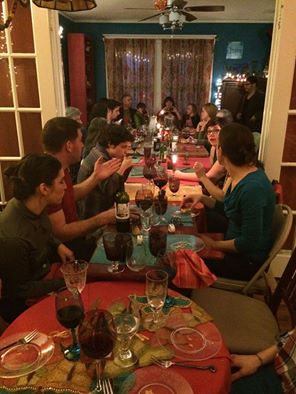
As the day has approached, Pi(e) Day has come up in conversation more than once and we have said, “You should come” without keeping track of just how many folks we had invited. When we sat down for dinner, twenty-five of us were gathered around our dining table and every other table we could find in our house, along with most every chair. Ginger did an amazing job imagining how everyone could fit and then setting up the room—well, two rooms.
For the first course, I made beef samosas, much like those I used to buy from the street vendors in Nairobi when I was in ninth grade. Then we had two small tarts: one with asparagus and cheese and the other with apple, gruyere, and roasted beets. The third course was a tamal pie served in a small mason jar. For dessert we had three choices: key lime pie; dark chocolate, salted caramel, and Oreo pie; and avocado pie with an Oreo and Frito crust. We ate and talked and laughed and then sat at the table and kept laughing and talking long after the food was gone.
One of the words offered for my Lenten Lexicon is sacred space. Okay—two words. That’s the way the house felt tonight. A thin place. A connected place. A birthing place for hope and memories. A fortress of friendship.
Two years ago it struck me that March fourteenth—3/14—was as good an excuse as any for an all pie dinner, so we had our inaugural Pi(e) Day. Now pie holds an important place in our home, particularly at Thanksgiving, or—as we like to call it—Pie-a-palooza. Some years ago I fell into the ritual of baking as many pies as I could the week before Thanksgiving—some for us and most for Ginger to travel around and give away. It is one of the things that makes Thanksgiving my favorite holiday. To find a reason on the other side of the year to focus on pie is awesome.
I am actually fairly clueless as to the significance of Pi when it comes to math. I’m better at cooking so on Pi Day I am more concerned with the ratio of flour to butter than anything that relates to 3.14. Since the menu is a surprise for those who are coming to dinner, I can’t tell you yet, but the day has reminded me how much joy there is in the preparation. One of the things I miss about working in a restaurant is preparation was a part of most every day because our creations were incredibly temporary. We made things we knew wouldn’t last, which meant we had to come back the next day and do them all over again.
There is something centering about preparing the mirepoix for a soup, slicing potatoes, and stocking your station before the meal service begins, just as today I found great pleasure in getting things in place for an afternoon of cooking tomorrow. By tomorrow night what we will have to show for our work will be mostly memories and the bonds between us that will be fed by being at the table together.
This evening I have been mindful of the basketball games in the background as teams work their way through their respective conference championships, all of them hoping for that “one shining moment.” As I know I have said before, I love the NCAA Tournament and am always amazed by how some of these folks rise to the occasion and give us some incredible games to watch. Life, however, is made up of much more preparation than performance, much more dailiness than shining moments. If the payoff were only in the winner’s circle, this would truly be a miserable existence.
In the living of these days—the routines and rituals—we prepare ourselves for those moments that create room for us to make our offering. The preparation tunes our hearts, hones our skills, sharpens our senses, and reminds us that whatever shining moment may come may feel critical but will not be lasting. Win or lose, we will be called back into the dailiness of grace, of gravity, of getting ready, and that dailiness is where eternity lies.
Since the first day I asked for suggestions for my Lenten Lexicon, I have stopped at this one and wondered what to say.
Shame.
As a noun, its something we feel: humiliation, dishonor. As a verb, it can be something we inflict on someone else: we shame them. Maybe that’s why the word came up for me today. I saw an article by Al Mohler, the President of one of the Southern Baptist seminaries, who has developed a new tactic in his crusade against the LGBT community and equal marriage by referring to their “erotic liberty,” a crass choice of words that reduces humanity to sex acts. He’s attempting to use shame as a weapon.
His article pointed me to another word on the Lexicon List: zealot because it brought to mind a quote from a friend from years gone by when those who made the guy president of the seminary were making their first moves: “Never trust a zealot with a clear conscience.”
What he did in his article reminded me of a white family we knew when we lived in Zambia who were a part of the American diplomatic corps. They had a big German Shepherd named Tammy whom they had trained to be a rather vicious watch dog, or at least to sound like one, because they were frightened of black people. Tammy knew how to do her job. However, when Tammy did something wrong, the woman would bark, “SHAME, TAMMY. SHAME,” and the dog would melt into a puddle of fear and regret. It was horrible to watch. I always felt sorry for the dog.
By coining his phrase “erotic liberty,” he seems to be attempting a similar move, which is a dehumanizing one, and one that won’t work, regardless of what laws get passed or overturned. His words sent me looking for an old Wendell Berry poem that I would offer in response.
Do Not Be Ashamed
You will be walking some night in the comfortable dark of your yard and suddenly a great light will shine round about you, and behind you will be a wall you never saw before. It will be clear to you suddenly that you were about to escape, and that you are guilty: you misread the complex instructions, you are not a member, you lost your card or never had one. And you will know that they have been there all along, their eyes on your letters and books, their hands in your pockets, their ears wired to your bed. Though you have done nothing shameful, they will want you to be ashamed. They will want you to kneel and weep and say you should have been like them. And once you say you are ashamed, reading the page they hold out to you, then such light as you have made in your history will leave you. They will no longer need to pursue you. You will pursue them, begging forgiveness. They will not forgive you. There is no power against them. It is only candor that is aloof from them, only an inward clarity, unashamed, that they cannot reach. Be ready. When their light has picked you out and their questions are asked, say to them: “I am not ashamed.” A sure horizon will come around you. The heron will begin his evening flight from the hilltop.
What I love about Berry’s poem is his call to say, “I am not ashamed.” I will tell my story. I will live my life. I cringed when I read his article because I think of a whole host of people whom I love who could be hurt by his words. And then I remembered their strength, their love, their tenacity, their inward clarity. I thought again of the stories I know of people who have lived lifetimes together, who incarnate love wonderfully. No decree or media-savvy sound bite can bury love, no matter how loudly it is screamed.
John Berger says,
The powerful can’t tell stories: boasts are the opposite of stories, and any story, however mild, has to be fearless; the powerful today live nervously . . . . Stories are one way of sharing the belief that justice is imminent. And for such a belief, children, women, and men will fight at a given moment with astounding ferocity. This is why tyrants fear storytelling: all stories somehow refer to the story of their fall.
His gospel of shame and derision may rally the troops around his castle of self-righteousness for one last stand, but it crumble in the face of the story of Love.
Love is patient; love is kind; love is not envious or boastful or arrogant or rude. It does not insist on its own way; it is not irritable or resentful; it does not rejoice in wrongdoing, but rejoices in the truth. It bears all things, believes all things, hopes all things, endures all things. Love never ends.
Now that’s a story worth telling.
Peace,
Milton
P. S. — Since I linked to Mohler’s article, I feel compelled to link to something more redemptive. Here is a video of Wendell Berry reading “A Poem on Hope” on Moyers and Company.