Home Blog Page 64

advent journal: links in a chain

Two Sundays ago, one of the men in our church stopped me after worship and asked if I wanted IMG_0408to be on the Christmas Tree Committee. Before I committed, I asked what it involved and he said, “Meet here next Saturday morning to go cut down the tree and put it up in the front of the sanctuary.” So I did. Six or seven of us went to a local tree farm that gave us access and cut down a sixteen-foot tree, brought it back on a truck, and installed it in the front of the church. Then we had coffee and donuts together. I love this committee. I think I’ll be a lifer.
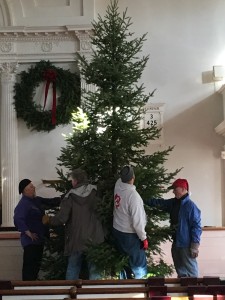
The church traditionally decorates the tree with mittens and gloves and hats and scarves that are then taken to shelters and places where people who need them can find them. This morning we had some an additional adornment: a large paper link chain made by our children. Our children’s minister explained that every kid had been given the opportunity to write specific one thing they were going to do in the coming year to show God’s love to other people. Then they made the individual strips into the ornament chain that graced our tree.

Our church has two pastors, Ginger and Sarah, who alternate preaching responsibilities. Today Sarah preached from Luke 1 and the surrounding John’s birth. The more she spoke about Elizabeth and Zechariah, the more I was moved by the particularity of the story. I love the poetry of John’s first chapter—“In the beginning was the Word . . .—but the story doesn’t really get going until there are names and faces. Sarah spent some time talking about names and their meanings. She mentioned that John is the second most popular boys name, and it means gracious. Then she said, “Would it be nice if being gracious were ordinary?”

She then spent some time with the questions in Luke’s account. Zechariah asked, “What will this child become?” When Mary got word that she, an unmarried teenager, was pregnant, she asked, “How can this be?” Then Sarah added, “God’s ways are rough in this world.” The real story behind our pageants and Christmas card scenes was not easy on the participants. It is no exaggeration to say it cost them their lives. The Incarnation is more than a theological idea. It is real people encountering God in their particular lives and leaving themselves open to the reckless raging fury that we call the Love of God.

Neither Mary nor Zechariah got answers to their questions, yet somehow they both end up singing because they found Love in their particular situations. They were willing to live with love rather than answers. Then Sarah asked another question: “What lessons have you had to learn or unlearn or relearn along the way?” The one that came to mind this morning is the one I relearn most every year during Advent: as we tell the story of Love’s arrival at one particular point in one particular time, I called to remember that is the only way love comes—with hands and feet, with words and deeds. In the flesh.

In the opening song of Jesus Christ Superstar, Judas asks,

why’d you pick such a backward time
and such a strange land?

Why Elizabeth and Mary? Of all the people in the world, why these two cousins? Why Zechariah, or Mary Magdelene, or Peter? Why Judas, for that matter? Then I think of the people in my life who made love real to me and I wonder why they were at that particular place at that particular moment? Could life really be that infused with grace that the people who showed up were the ones I most needed? I don’t mean to sound as though things were engineered, or that they were somehow mysteriously led into my life. I think in those moments those people had the grace to respond to the need in front of them, and that our lives are filled with moments where either incarnate love in the particular or we don’t.

Most all of the significant relationships in my life began as incidental contact. We didn’t know where it was going, but we gave ourselves room to ask, what could this become? In similar ways, I have some important relationships that lie dormant because somehow we quit asking that question for one reason or another. Love lives in the particular, in the possibility or what might grow, of what might become of an encounter.

Zechariah could have demanded answers. Mary could have told Gabriel to pick someone else. In their own ways, I suppose, they wrote their replies and made their links in the chain. Who knows how things might have rolled out had they not chosen to say yes to Love. In the moments tomorrow, when we are called to add another link to the chain, may we continue to decorate our world in all the colors of Love.

Peace,
Milton

advent journal: we . . .

He did what they told him to do. He would have done anything they told him to do. He hid inside the pronoun we. (The Illusion of Separateness 189)

Life is a team sport. If I had a dollar for every time I’ve uttered that sentence I’d have enough to take us all to dinner. Being together is a fundamental human value: we were made to live in community. Yet tonight I find myself looking again at my metaphor. Part of the reason is the quote from the amazing novel I finished today on my lunch hour. That last sentence has haunted me for the rest of the day.

He hid inside the pronoun we.

The problem with a sports metaphor is it holds in implicit competition: the we is defined by a them. We join together to win, to defeat, to crush. The verbs only escalate. Yes, there is something wonderful about winning together, even as a fan. When the Red Sox came back from a three-games-to-none deficit to defeat the Yankees and go on to win their first World Series in eighty-six years, it felt great to be together. I also remember in those days there was a local entrepreneur who created a clothing line of “Yankee Hater” hats and t-shirts. The logo laid the Y and the H over one another in a way that mocked the New York logo. They sold well briefly and then died out. We wanted to be drawn together by more than hatred or dislike. We weren’t Yankee Haters as much as we were Sox Lovers—those who were deeply connected by our failures and disappointments and near misses, and then by the almost improbable taste of victory. I remember how the cemeteries in Massachusetts filled up with Red Sox paraphernalia. The tombstones of parents and grandparents who had died before the Curse of the Bambino was broken were decorated with pennants and hats. We was a good thing because it was about the team we loved.

All the shouting about the data breach and Bernie Saunders over the last couple of days, and the subsequent infighting within the Democratic Party alongside of the divisive and, well, toxic proclamation from Trump and others in the midst of the street fight that is the race for the Republican nomination leads me back to the quote that began this post. Choosing teams in our current cultural climate leans toward the dangerous side of we, because that we is being defined by them: the enemy, the danger, Those of Whom We Should Be Afraid. And the sport is winner take all.

A disclaimer here: I have not watched any of the presidential debates and I don’t intend to do so between now and next November because I don’t think they offer anything other than the political equivalent of roller derby or professional wrestling. (Apologies to both of those sports.) I’m sure at some level most of the candidates have ideas they want to communicate beyond inciting a mob mentality against any number of designated enemies, but the debates are about winning a fake fight. There is nothing there to help build consensus or true community.

When the decree went out from Caesar Augustus that all the world should be taxed, it seems as though the cultural climate shared similar weather to life in our time. Palestine was occupied, Pilate had all the backbone of a member of Congress, and the poor were taking it in the teeth so that the economy could feed the rich. Through most of Jesus’s earthly ministry he kept having to deal with questions—from both his friends and his enemies—that pointed to Them as a way of defining who We would be. Why do you eat with Them? Why do you listen to Them? Why are you seen with Them? Shouldn’t We do something about Them? Jesus’s response erased the lines. He ate dinner with the rich, the arrogant, the pious, the poor, the outcast, and the faithful. And then he told a story about a great banquet where the instructions were simply to fill the room with whomever would come.

For all my love of food, I keep talking about a team and the metaphor is right in front of me: Life and Faith are meals together where everyone is fed.

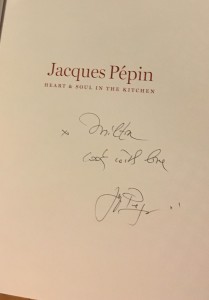
Last Sunday on my way out of church, one of our members said to me, “Would you like to meet IMG_0432Jacques Pépin?” My answer was a quick yes. Jacques Pépin is one of the great chefs of our time. Turns out he lives in Madison—the next town up from Guilford—and he was signing his new book this morning—the day after his eightieth birthday—at an amazing local bookstore, R. J. Julia Booksellers. Our church members picked Ginger and me up before I had to go into work and I stood in line to have him sign my copy of his memoir. Ginger snapped a picture. On the title page he wrote, “To Milton, Cook with Love. Jacques Pépin.”

Indeed. Life is a dinner party. Life is a team sport. Whether baseball or breakfast, life is wasted if it is not fueled by love. To be driven by conquest or fear or hatred or even righteous indignation turns life into little more than some sort of cosmic demolition derby where no one is left standing and everyone is damaged. We is not a place to hide or a bunker from which to lob bombs on Them. We is not a place to justify our sense of superiority or fortify our privilege. We is not a place to protect what’s ours or make sure things go our way at all cost. We is a banquet table with an open invitation. We is a ball park on the best summer afternoon you can imagine. Sit here at the table. Sit here in the bleachers. Bring whomever you can find.

And turn off the television.

Peace,
Milton

advent journal: what words can do

In the last few minutes before we had to leave the house in order for me to catch the 8:32 train to New Haven, I realized I needed a new book to accompany me on the journey over the next few days. I perused the bookshelf and pulled out a novel suggested to me by my friend Claudia in Durham. The book is called The Illusion of Separateness. I remember reading the first couple or chapters, but I could not recall what happened or what I read and its been a while since I read a novel, so I thought it would be worth taking along for the ride.

The epigraph is a quote from Thich Nhat Hanh: “We are here to awaken from the illusion of our separateness.”

So far, nothing has happened in the book. Each chapter’s title offers a name, a place, and a date: Martin, Los Angeles, 2010; Mr. Hugo, Manchester, England, 1981; Sébastien, Saint-Pierre, France, 1968; John, Coney Island, New York, 1942. Each chapter offers a vignette, a picture of a certain time in the person’s life, with little attempt to connect it to what has gone before and what comes after. And the language is stunningly beautiful. I have to share a couple of examples.

Martin decided not to go back to college, so his father revealed the mysteries of flour, water, heat, and time. (8)

He realized this early on, and realized too that what people think are their lives are merely its conditions. (12)

She was from Nigeria and spoke English gently, words handed, not thrown. (26)

But Sébastien is not looking through the window, but through the scrapbook of things that have pierced his heart. (48)

Then a moment before the snap of the shutter—a gust of wind lifted John’s hat. Harriet screamed and couldn’t stop laughing. Behind her, people on the Ferris wheel and the roller coasters were screaming too. You could hear them up and down the boardwalk, lost forever in that last great afternoon of their lives. (57)

Rain says everything we cannot say to one another. It is an ancient should that willed all life into being, but fell so long upon nothing. (62)

I know I am offering a lot of quotes, but each one of those—and several others—stopped me in my tracks on the train, if you will; I was awed by the power of the author’s intentional expression. I have to give you one more—my favorite.

But for a moment the old man doesn’t realize he is dead. He can feel Martin’s heart and mistakes it for his own. (20)

I read fiction most consistently in my life when I was teaching English at Charlestown High School in Boston, and then at Winchester High School, a little farther north. Alongside of multiple readings of Of Mice and Men, The Scarlet Letter, Frankenstein, and The Great Gatsby, I read for myself as well. In those days, I also imagined I had my own great American novel to offer and that quest helped me learn how to write as well. I love the moment when a writer takes my breath away with his or her choice of words. I never tire of reading as Gatsby realized the green light across the water is Daisy’s house and the narrator says:

His count of enchanted objects had diminished by one.

The sentence offers room for resonance, space to stop and understand, rather than simply saying, “When he figured out the light was at Daisy’s house, he kind of lost interest.”

While I’m geeking out on quotes here, I do actually have a point. I’ve been thinking this evening about the lines from scripture and from carols that help me get to the manger. Some are sentences, some whole stanzas. Here is are a couple of examples.

and ye beneath life’s crushing load
whose forms are bending low
who toil along the climbing way
with painful step and slow
look now for glad and golden hours
come swiftly on the wing
oh rest beside the weary road
and hear the angels sing

the hopes and fears of all the years
are met in thee tonight

And so it was, that, while they were there, the days were accomplished that she should be delivered. (Luke 2:6)

Though I rarely bust out my King James Version, the poetry of Luke’s description of the birth of Jesus comes alive in ways that more contemporary translations do not, for me. The verbs in the last half of this verse are where it all happens—and they are both passive tense: the days were accomplished, and she should be delivered.

I know the language is four hundred years old. I know the words, as I understand them, don’t mean exactly the same thing as they did in those days. And that the days accomplished what they needed to do to deliver Mary to that moment in the manger is just too good. Two millennia later, we can’t read the story without some sense of its cosmic significance, yet this is a small story, like Martin holding the dead man so close that he mistook Martin’s heartbeat for his own. The shepherds represented no one other than themselves. The Magi were not a huge diplomatic contingent. We’re talking a handful of people in a hayloft, marveling at a manger.

My job at the computer store these days is to help people get their phones and tablets back in working order. Today, I helped a woman who is a visiting hospice nurse get her phone back in working order. When it came back on, she teared up because her families, as she called them, could get in touch with her. Another didn’t know a password because it had been her husband tablet and he had died. Tonight at church we had a “Service of Reflection and Hope” as a way to make room for the grief and sorrow—both personal and global—that we carry through the holidays. People had a chance to come up and light a candle, or write a name on a place card and put it on the Communion table, or be anointed with oil as a sign of healing, awakening us from the illusion of separateness and reminding us of the reality of our connectedness.

How silently, how silently, that wondrous gift was given.

Peace
Milton

advent journal: our best work

The train ride into New Haven was significant this morning because I finished my rereading of Walking on Water. It will go back on the shelf for another couple of years. In the closing pages, L’Engle talked about the importance of editing and revising for an artist. Honing one’s craft does not necessarily make it easier. As you improve, you raise your standards and your goals.

As a writer struggles to grow, more and more work becomes necessary. (186)

When I was an English teacher, one of the hardest things to communicate was the importance of editing. Students would turn in their first drafts as if they were finished pieces. I remember reading someone’s account of a professor who, when she turned in a paper, would ask, “Is this your best work?” She took it to mean the professor didn’t want the paper, so she would go back and revise it. After the scene played four or five times, when he asked she said, “Yes.” He took the paper and replied, “Good. Now I’ll read it.”

These nightly offerings are not as edited as I would like, but they are not the first thing I wrote down either. Editing is what makes writing good. It’s hard work. It takes time. And it’s painful. My students in Winchester audibly groaned when I told them their essays could not be longer than seven hundred and fifty words. My point was to teach them how to revise and distill and focus. I would offer Blaise Pascal’s words:

I would have written a shorter letter, but I did not have the time.

What I wanted my students to see was there was almost always room to grow, to see new things. To read back through an essay on a different day and a different time meant to see it with different eyes. To ask someone else to read it and give feedback was an exercise in both artistic and relational growth. We can’t see it all in one trip.

L’Engle shifted her focus as she made the final turn toward home, talking about coming to terms with all we don’t know in the world. The point of our faith is not that we have The Answer, or any answers for that matter. The point of our existence is not to be in control. One of the sentences I underlined in an earlier simply said, “Love, not answers.” There is more to being human than a mere intellectual encounter with the world. She wrote,

Despite our technology there is far more that we do not know than we know. (191)

I reached into my pocket and pulled out my pen and wrote in the margin, “A revising life.” As we gain new perspectives, we need to go back, revise, and rewrite. I’m not talking about jettisoning what came before, or throwing things away. In some sense, everything matters. The faith of my childhood looks very different from the faith that feeds me today and yet there is a progression, a connection. I am deeply grateful for how I grew up; it has helped me to get to where I am now. My faith matters to me today because I have kept revising. I have let God grow up with me, if you will.

Some years ago, I read an article stating that the body of knowledge in our world doubles every five years. One article I found tonight said that doubling occurs in just twelve months; another said it will not be long before it is down to twelve hours. When I was a kid I was fascinated by the idea of a Renaissance Man—someone who could know everything about everything. During the Renaissance, it took over a century for the body of knowledge to double. A person could master a good portion of it all. Not any more. We cannot know everything. We can’t even put together a group of people who know everything.

How should we then live? As we struggle to grow, more and more work becomes necessary. To decide we know all we need to know, or that we’ll leave the task to others in forsaking our calling as human beings. In the Incarnation, God gives us an example of how we can choose to continue to grow. However we picture God, coming to earth in the form of a human was growth, a new experience—even for the Supreme Deity. If God can continue to grow and change, are we not called to go and do likewise?

As we follow the star to Bethlehem, are we doing our best work?

Peace,
Milton

advent journal: joy to you and me

My birthday trip to the Mark Twain House and Museum has given me a lot to think about—pertaining to both the house and the man. When Twain sold the residence in the early twentieth century, he was broke and needed money. He was also grief-stricken. The house changed hands several times and was a residence, a boy’s school, and a public library; by the mid-seventies it was slated for demolition. It was not until his centennial approached that someone stepped up to renovate and preserve it. By that time, most of the original furnishings had been lost or sold, and whatever the interior had looked like was not always easy to discern. After a great deal of money and research, the curators did their best to make the house look and feel as it did when the Clemens family called it home.

Today Ginger preached from the story of Ezra (ch. 1-3) and his leading the people back from Persia to Jerusalem to rebuild the Temple. Like the folks in Hartford, none of the Hebrews had seen the previous edifice. They, too, were drawing from stories and tradition, from details passed down. When they laid the foundation, the story says:

All of the people shouted with praise to the Lord because the foundation of the Lord’s house had been laid. But many of the older priests and Levites and heads of families, who had seen the first house, wept aloud when they saw the foundation of this house, although many others shouted loudly with joy. No one could distinguish the sound of the joyful shout from the sound of the people’s weeping, because the people rejoiced very loudly. The sound was heard at a great distance. (3:11-13)

On this third Sunday of Advent, we light a candle signifying joy. In many churches, this is the one pink candle among purple ones, and this Sunday is as close to the halfway point as we get, I suppose. Here in the darkest and longest nights of our lives, we light a candle for joy.

The entry way to the Twain house was intended to impress. The woodwork was intricate, the space captivating. Yet it was quite dark. Our docent pointed to the two light fixtures in the room, which were ornate in their own right, and he reminded us that in Twain’s time they would have been gas lanterns. He then directed our attention to the walls and the small silver geometric shapes painted in a pattern that looked almost Egyptian, so artful and intricate as to give the impression that they were inlaid mother-of-pearl, or the like. He went on to say that the gas lanterns flickered in ways their electric counterparts do not, so not only did the silver shapes on the wall brighten the room, they also picked up the flicker of the flames and made the whole room seem as if it shimmered in the darkness.

Tonight we had our Lessons and Carols service at church. All the various aspects of our music ministry participated: adult choir, handbells, childrens’ choir, soloists, and congregation. As the readers moved us from Creation through the Prophets to the Gospel passages that make me wish for Linus’ reading from Luke 2, I was reminded how many times the angels have to say, “Don’t be afraid.” They gave the same instructions to Mary and Joseph and the shepherds, just to name a few. As the angels proclaimed The Glorious Impossible, the fear of those receiving the message moved from fear to joy as the shimmer of the angels’ words and wings brought new light, new insight, new hope to the darkness: good tidings of great joy.

Thanks to the new movie titled Joy, a Google search was not very productive when I typed in the word, but down at the bottom of the page was a link for “biblical joy,” implying it might be something different. When I clicked there I found several sites whose definition centered around God’s being in control, as if joy required some sense of certainty. That’s not how the stories felt tonight as I saw the shepherds move from shielding themselves from the spectacle of the angels to sprinting into town to see the child. At a couple of places in Walking on Water, Madeleine L’Engle quote a theologian who says, the opposite of sin is faith not virtue. In the same manner, the opposite of fear is joy—not certainty, but comfort. Here in these dark days, the sounds of weeping and joy may seem indistinguishable because our grief is not the antithesis of our joy. Our memories carry both together. When we re-member one another, we give birth to Love once again in our time and in our circumstance, and our fears—that we are not enough, that we cannot survive, that love is not the last word—fade into the darkness. In his book Following the Equator, which he wrote after his daughter died, Mark Twain said: “Grief can take care of itself, but to get full value of a joy you must have somebody to divide it with.”

Rejoice, we are not alone. God is with us. And we are together.

I’ll close with the benediction another minister said he used at his church this morning:

joy to the world, all the boys and girls
joy to the fishes in the deep blue sea
joy to you and me

Peace,
Milton

advent journal: I love to tell the story

When it comes to my birthday, I can count on three things: one, Ginger will make sure I feel very celebrated; two, that they day will involve something I have never done before; and, three, that I will not know what’s coming until it happens. Today stayed true to form, with the added layer of our being in a new place and faraway from those who have been a part of our celebrations over the past several years.

We were not far into the day before I was doing something that was new to me: I joined the “Christmas Tree Committee” to go out and cut down a sixteen-foot tree and set it up in the front of our church. Shortly after, Ginger and I set out on the highway looking for adventure and ended up at the Mark Twain House and Museum in Hartford. The tour through the mansion and corresponding exhibits revealed a man with a big heart, a strong mind, a mischievous spirit, and someone acquainted with grief. The time there made me want to come home and read his books, one of which–A Connecticut Yankee in King Arthur’s Court–was first published on December 12, 1889.

The whole first floor of the house was dedicated to entertaining guests. They had extensive 12360317_10153338249299716_4883207025415180972_ndinner parties several nights a week, even though they couldn’t really afford it. So here was a guy who loved to write and thrived on being with people, who stayed in his study from eleven to six or so everyday and then came down to a dinner party. No wonder I felt resonance. I found another extroverted writer. The other thing that attracted me to him was the way in which he kept growing as he aged. His disdain for racism and inequality was not something he learned from his childhood; he learned from the world he observed, from the way he traveled, from a willingness to not stay the same.

We drove about halfway back from Hartford and stopped in Middletown, a beautiful place along the river, and spent a few hours reading and writing–another gift. I went back to Walking on Water and found these words: “Our story is never written in isolation.”

A continuing joy throughout the day has been the shower of love coming from people all over the place, down through all the layers of my life, reminding me of all the ways I have been supported and shaped, cared for and challenged, held and hoped for at every turn, helping me to figure out what story I have to tell.

Those very connections are the story. As we mark the days until we celebrate the Incarnation with a capital I, my story is full of love made real to me through words and actions across the nearly six decades of my existence. The best thing about aging is an expanding capacity for gratitude. The grief is more profound, yet so is the joy. These are not easy days, but they are shot through with grace because of the handmade love that has shaped my life.

I love to tell this story.

Peace,
Milton

advent journal: train of thought

The fog was so thick on the ride into New Haven this morning I felt like I was on a ghost train. Between Guilford and Branford, the train runs through the marshes and right along the coastline. Most mornings, I can look out across Long Island Sound; today, our carriage was wrapped in the soft white blanket that left us with little to do but trust the tracks. My eyes turned from the fog to the book that has been my traveling companion this week: Walking on Water by Madeleine L’Engle.

I have been reading Madeleine L’Engle books since I was in fourth grade, beginning with A Wrinkle in Time and continuing on through most of her catalog. A good many of them I have read more than once. She is the person who first got me fascinated with time, so I perked up again when I returned to passages, both familiar and forgotten, that talked about we mark our days and how we think about what has both preceded us and what will follow. I came home with four passages that hung with me all day.

As Ginger and I both approach another Christmas without our fathers, and I think of how many other people I know whose parents have died in the last year, I stopped and read this next paragraph three or four times.

We are not as meant to be as separated as we have become from those who have gone before us and those who will come after. I learned to know and understand my father far more after his death than during his life. Here were are on the border of a tremendous Christian mystery: time is no longer a barrier. (80)

We are taught to think of time as a line, where we walk farther and farther from where we began. In some cultures, they think of it as a circle, where things keep coming round again and again. L’Engle thinks in layers, as though all of the ages we are, have been, and will be somehow stack up on each other. Her images have helped me grasp the Celtic concept of a thin place, where whatever barrier there might be between layers, between us and God, between earth and heaven, become permeable and palpable.

And as I set down the word mediate, I realized that it is part of the word immediate, that place of now, where past and future come together. (84)

As many times as I have seen the word immediate and as many times as I have read Walking on Water, I missed that mediate makes up most of the word, save a prefix. I love her understanding of what that means for immediate, and for our definition of the present tense.

She went on to tell a story of a village who lost track of time when their clockmaker died. Since no one was there to repair the clocks, most abandoned their timepieces. When a new clock maker finally came to town some time later, he announced he could only repair the clocks that had continued to be wound because they were the only ones that remembered how to keep time. L’Engle continues,

So we must daily keep things wound: that is, we must pray when prayer seems dry as dust; we must write when we are physically tired, when our hearts are heave, when our bodies are in pain. . . . We may not be able to make our “clock” run correctly, but at least we can keep it wound, so that it will not forget. (96)

Maybe it was her word play with immediate that let me see it, but I realized the word wound means one thing when it’s connected to clocks and another when it describes how we hurt in these days. The daily rituals that keep our clocks wound come out of the wounds with which we live on a daily basis. The grief that has played out over the last two and a half years since Dad died has happened one day at a time. Tomorrow I will mark the end of my fifty-ninth year on the planet and every one of those years happened in days, even in moments, that have stacked up on themselves to create a lifetime—which is not yet over, by the way.

As I sit here tonight, I can think of a number of people whom I love dearly who are hurting deeply. Some have walked wounded for many years. Some have lost traveling companions—spouses, parents, friends, siblings. Some are reeling from pain so fresh that they are hard to reach. I look up and beyond those close to me to find concentric circles of hurt and hopelessness that reach around the globe, and with all of them in mind I offer the last quote, which was one of the first things I read this morning:

We are tempted to try to avoid not only our own suffering, but that of our fellow human beings, the suffering of the world, which is part of our own suffering. But if we draw back from it (and we are free to do so), Kafka remind us that “it may be that this very holding back is the one evil we could have avoided.” (63)

It was dark for the train ride home. Most people sat quietly. One man did chin-ups on the luggage rack from his seat. Another talked on the phone as if he were sitting in his own living room. I read until I got to Branford, then I shut my book and looked out into the night, where the fog had once been, grateful for the love I know that will not let me go.

Peace,
Milton

advent journal: sing to the night

We got our Christmas tree up today, along with the candles in the windows in good New England fashion. And it’s halfway through Advent. As I was working on things this afternoon, I listened to my friend Billy Crockett’s  song “Coasting Into Christmas” and found a helpful and hopeful resonance, which led me to think this might be a night to share some of the songs that feed me through the season. We’ll start with Billy. The song, by the way, is found on this wonderful record, A Very Blue Rock Christmas.

Coasting Into Christmas

coasting into the holiday season
why don’t we drive around and see some lights
buy some eggnog for no good reason
singing carols may be up all night
this year we’ll take it slow
and savor every part
feel the ancient wonder
as it penetrates our heart
but the lines were so long
and the car was so dead
and the mystery thing happened
with the pumpkin bread
and we’ve got extra second cousins coming over
can we find them a bed
and I know this holiday can handle
all things great and small
but I guess we won’t be
coasting into Christmas after all

coasting in with the holiday spirit
I think I’ll sharpen up the turkey knife
but they’re killing each other down at the galleria
but here at our house it is a wonderful life
this will bring the season in with perfect flow
champagne and candlelight
and Mr. Perry Como
but the credit cards maxed
and we still don’t have a tree
and the packages came back
with a postage fee
and grandma’s been detained
by airport security
and they are skating right now
at Rockefeller Plaza as I recall
but I guess we won’t be
coasting into Christmas after all

and just by chance I glance
at these small figures in the round
and think about the story
that’s been so long handed down
how the pregnant girl takes to the road
on a rented donkey with her boyfriend Joe
and there ain’t no inn in Bethlehem
seems to have gotten the memo
now they’re hunkered down exhausted
in some two bit barnyard stall
and they said, I guess we won’t be
coasting into Christmas after all
no I guess we won’t be
coasting into Christmas after all

James Taylor at Christmas gets a good bit of play around here, and the song that seems to have particular meaning this year, in the face of so much xenophobia, is “Some Children See Him.”

Some Children See Him

some children see Him lily white,
the baby Jesus born this night.
some children see Him lily white,
with tresses soft and fair.
some children see Him bronzed and brown,
the Lord of heaven to earth come down.
some children see Him bronzed and brown,
with dark and heavy hair

some children see Him almond-eyed,
this Savior whom we kneel beside.
some children see Him almond-eyed,
with skin of yellow hue.
some children see Him dark as they,
sweet Mary’s Son to whom we pray.
some children see him dark as they,
and, ah—they love Him, too

the children in each different place
will see the baby Jesus’ face
like theirs, but bright with heavenly grace,
and filled with holy light.
o lay aside each earthly thing
and with thy heart as offering,
come worship now the infant King.
’tis love that’s born tonight

If you’ve followed this blog through other Advents, you know one doesn’t pass without me mentioning Patty Griffin and “Mary.”

Mary

Mary, you’re covered in roses
you’re covered in ashes
you’re covered in rain
you’re covered in babies, covered in slashes
covered in wilderness, covered in stains
you cast aside the sheet, you cast aside the shroud
of another man, who served the world proud
you greet another son, you lose another one
on some sunny day and always you stay, Mary

Jesus says, “Mother I couldn’t stay another day longer”
he flies right by and leaves a kiss upon her face
while the angels are singing his praises in a blaze of glory
Mary stays behind and starts cleaning up the place

oh Mary, she moves behind me
she leaves her fingerprints everywhere
every time the snow drifts, every way the sand shifts
even when the night lifts, she’s always there

Jesus says, “Mother I couldn’t stay another day longer”
he flies right by and leaves a kiss upon her face
while the angels are singing his praises in a blaze of glory
Mary stays behind and starts cleaning up the place

Oh Mary, you’re covered in roses
you’re covered in ruins
you’re covered in secrets
you’re covered in treetops, covered in birds
who can sing a million songs without any words
you cast aside the sheets, you cast aside the shroud
of another man, who served the world proud
you greet another son, you lose another one
on some sunny day and always you stay
Mary, Mary

The next song is another repeat performance, this time by Steve Earle.

Nothing But A Child
once upon a time in a far off land
wise men saw a sign and set out across the sand
songs of praise to sing, they traveled day and night
and precious gifts to bring, guided by the light

they chased a brand new star, ever towards the west
across the mountains far, but when they came to rest
they scarce believed their eyes, they’d come so many miles
and this miracle they prized was nothing but a child

and nothing but a child could wash those tears away
or guide a weary world into the light of day
and nothing but a child could help erase those miles
so once again we all can be children for a while

now all around the world, in every little town
every day is heard a precious little sound
and every mother kind and every father proud
looks down in awes to find another chance allowed

and nothing but a child could wash those tears away
or guide a weary world into the light of day
and nothing but a child could help erase those miles
so once again we all can be children for a while
nothing but a little baby
nothing but a child

“The Peace Carol” is a song I first learned from John Denver on his Christmas Special with the Muppets (you can watch the whole thing here). Beth Wood offers a wonderful version that is also a part of A Very Blue Rock Christmas.

The Peace Carol

the garment of life, be it tattered and torn
the cloak of the soldier is withered and worn
but what child is this that was poverty-born
the peace of Christmas Day

the branch that bears the bright holly
the dove that rests in yonder tree
the light that shines for all to see
the peace of Christmas Day

the hope that has slumbered for two thousand years
the promise that silenced a thousand fears
a faith that can hobble an ocean of tears
the peace of Christmas Day

the branch that bears the bright holly
the dove that rests in yonder tree
the light that shines for all to see
the peace of Christmas Day

add all the grief that people may bear
total the strife, the troubles and care
put them in columns and leave them right there
the peace of Christmas Day.

the branch that bears the bright holly
the dove that rests in yonder tree
the light that shines for all to see
the peace of Christmas Day

I’m going to send you off with one more video from James Taylor that doesn’t need lyrics. All you need to do is share the joy.

Peace
Milton

advent journal: finding the words

I finished a book and started a book today. It was a good day.

The first was Bandersnatch: An Invitation to Explore Your Unconventional Soul by Erika Morrison, which I began reading before we left Durham, packed it by accident, and just got back to it this week. By redefining four words—avant-garde, alchemy, anthropology, and art—she issues a rather vibrant call/invitation to engage God and the world in some fresh and challenging ways. As I reached the final pages, I found myself glad to know she lives in New Haven. I hope we can find some time for conversations that might serve as sequels to my reading.
Morrison reframes anthropology as

a radical way of seeing everyone as if you lived inside their skin and everything else for its full potential. . . . The kingdom anthropologist will always see the stuff of earth as an artery to the kingdom of heaven. The stuff of earth and the stuff of heaven were made for each other. Each gets us to the other. (126)

I love the last sentence in particular. The interconnectedness. And she continues,

The most fundamental premise a kingdom anthropologist holds is this: We are all connected. . . . I start to wonder if most of society lives under the basic assumption that we are all separate, that we are not connected at any level, let alone fundamentally. . . . The anthropologist sees that all people are instrinsically linked not just with one another, but with the entire created order, and seeks to generate a spirit of connection instead of division throughout the land. (153-54)

She then spends some time talking about the food pantry where she and her family volunteer, and she says:

Somehow we all know we’re chained into one another’s lives, stale dreams and broken seams and all. Our individual ships are sinking, but together we manage to stay afloat one more day. (166)

Another last sentence to fall in love with. Knowing I would finish her book on the train to New Haven this morning, I grabbed an old friend off the shelf to read once again: Walking on Water: Reflections on Faith and Art by Madeleine L’Engle. As I started the section on Art in Morrison’s book, she quoted from the L’Engle book that was sharing space in my backpack. I put one down and picked up the other. A chapter or so into reading, I came across a section I have quoted on several occasions without being able to remember exactly where it was:

But I am a story-teller and that involves language. . . . When language is limited, I am thereby diminished, too. . . . In time of war language always dwindles, vocabulary is lost; and we live in a century of war. . . . The diminution is world-wide. (37-8)

Then she moves to a powerful warning:

We think because we have words, not the other way around. The more words we have, the better able we are to think conceptually. . . . We cannot Name or be Named without language. If our vocabulary dwindles to a few shopworn words, we are setting ourselves up for takeover by a dictator. When language becomes exhausted, our freedom dwindles—we cannot think; we do not recognize danger; injustice strikes us as no more than “the way things are.” (38-9)

Though I love a good hashtag, the combination of war as common circumstance, technology, and social media have caused our expectations and understanding of language to dwindle. One of my favorite episodes in Ken Burns’ The Civil War was the one that contained Sullivan Ballou’s articulate and heart-wrenching letter to his wife. Today his letter might be reduced to “luv u 4ever. #windonyourcheek.”

The awareness that our vocabulary is shrinking even as our world becomes more complex alongside of the challenge to reclaim and reinterpret words we have know a long time has been energizing to me. One of the things that gets lost when our vocabulary is reduced is a way to express the ambiguity and nuance at the heart of what it means to be human. There is more to life, and to most any issue or topic, than two polarized extremes. L’Engle quoted the Spanish philosopher Unamuno:

Those who believe they believe in God, but without passion in the heart, without anguish of mind, without uncertainty, without doubt, and even at times without despair, believe only in the idea of God, and not in God himself. (32)

My mind is going in a number of different directions with all of this swirling around. The tether between them all goes something like this: the stuff of heaven and the stuff of earth were made for each other—we are all connected—our individual ships are sinking, but together we manage to stay afloat one more day—we cannot Name or be Named without language—and then I ended up at an old Bee Gees song from a record I bought in 1969: its only words, and words are all I have to take your heart away.

One of my brother’s maxims is “the one who frames the question wins the argument.” Morrison pointed out that the perspective that we are all connected runs counter to the societal claim that we are different and at odds with each other. Rather than framing life as a conflict fed by the language of exclusion and division, let our chosen words shine a light on all that connects us. Rather than allowing war to be our primary metaphor and fear our chief currency, let us choose words that paint a picture of the world as a giant artists’ colony, exploding with creativity and cooperation. Rather than using words as weapons, let us choose a healing vocabulary.

Come. Let’s find the words.

Peace,
Milton

advent journal: finding the grace

When the worst of my depression hit in the fall of 2001, I quit reading the newspaper. For years my morning ritual was to go from front to back, soaking up as much as I could. As I worked to learn how to live through the darkness visible, one piece of advice I found was to give myself a break from the daily news. I did, and it helped. Before too long, my daily reading was replaced by a daily listening to NPR, which kept a kind tone in its reporting and did more than repeat headlines.

At our house in Durham, I had a radio/CD player that lived under the wall cabinets and gave me the chance to listen everyday. I could tell you the name of pretty much every host for every show on NPR’s playlist. When I installed the radio, I stripped the screws, so it stayed behind when we moved north and I replaced the technology with a portable Bluetooth speaker that allows me to play music from my iPhone. NPR does have a station in iTunes, but I have chosen not to tune in because these days are heavy enough. I have a lot of contact with media in different forms, and I have decided to let the news find me, rather than seeking it out. Find me it does, and I am finding a respite—some room to think and reflect on things other than the standard diet offered by the twenty-four hour news cycle.

I’m not trying to hide from it. I just want some space. We are bombarded with so much that we are expected to somehow be able to respond immediately and move on to the next thing. We hardly had a week to figure out what Ferguson meant before we were on to the next thing. There are ways in which I feel now is the time we should be talking about the implications of what happened in Charleston, but that is ancient history to the news cycle. We will be fortunate if anyone is mentioning any of the recent mass shootings in January or February. The world may be getting smaller, but we are not being offered a global view. We have allowed ourselves to be convinced that we are a nation constantly at war, and that we are the Ones Who Are Right.

In her book The Rise, Sarah Lewis recounts a Yoruba myth of the trickster diety Eshu-Elegba.

Disguised as a man, Eshu-Elegba strolled through town in a cap topped with a crimson parrot feather, half painted white and the other half red, bisected by a line from the middle of his forehead to the top of his spine. Some in the town thought that they saw him walk by in a red cap. Others thought it was white. One person who had swept through the entire town knew that the cap was both colors. Chinua Achebe described the lesson of the myth in reference to an Igbo festival masquerade: “If you want to see well, you must not stand in one place . . . If you’re rooted to a spot, you miss a lot of the grace.” (187)

I keep reading Achebe’s words again and again: if you’re rooted to a spot, you miss a lot of grace. If we are hunkered down in fear we won’t find any sense of true perspective.

My current train book is Bandersnatch by Erika Morrison, who happens to live here in New Haven. On the ride in this morning, as she reacquainted me with one of my favorite passages from Frederick Buechner:

If the world is sane, then Jesus is mad as a hatter and the Last Supper is the Mad Tea Party. The world says, Mind your own business, and Jesus says, There is no such thing as your own business. The world says, Follow the wisest course and be a success, and Jesus says, Follow me and be crucified. The world says, Drive carefully—the life you save may be your own—and Jesus says, Whoever would save his life will lose it, and whoever loses his life for my sake will find it. The world says, Law and order, and Jesus says, Love. The world says, Get and Jesus says, Give. In terms of the world’s sanity, Jesus is crazy as a coot, and anybody who thinks he can follow him without being a little crazy too is laboring less under a cross than under a delusion. (112)

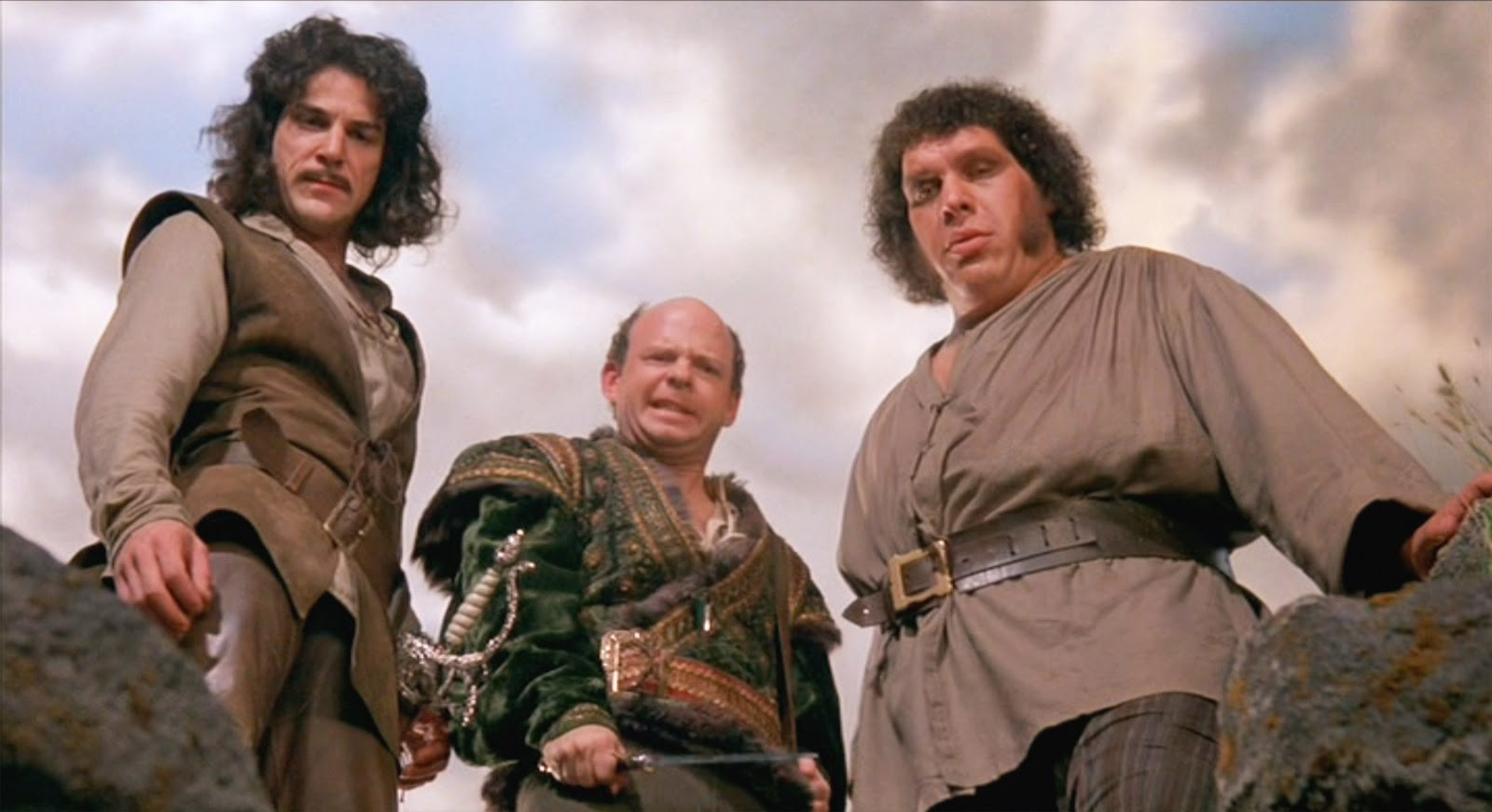
Most all of Jesus’ words were invitations. He took stuck in people like the woman at the well and let them find the room to move so they could also find the grace they needed. In our time people like Donald Trump and Jerry Falwell, Jr. and Franklin Graham are using the language of faith as an incendiary device to frighten people to root themselves in hatred; their invitation is to a graceless existence. I am not making a political point here. We cannot lose these words to war. To paraphrase Indio Montoya, these words don’t mean what they say they mean. Words are not meant to be weapons.

When I started writing tonight, I went looking for the clip from the movie with Indio saying those words. It was, as you can see, quite short. The next clip that began playing almost automatically was one of Mandy Patinkin talking about his favorite lines from the movie and he told a story of seeing the movie many years later and hearing a line in a way he had not before. When they get to the end and the Man in Black is talking with Indio about become the Dread Pirate Roberts, Indio says, “You know, I have been in the revenge business so long, now that it’s over I do not know what to do with the rest of my life.” Patinkin goes on to say he loved the line because the purpose of revenge is “completely worthless and pointless” and the purpose of existence is “to turn the darkness into light.”

I know—from no newspapers to Yoruba legends to Buechner to Indio Montoya: it’s a meandering path. Then again, if we’re rooted to a spot, we miss a lot of the grace. Let us side and far in the name of Love. Finding and sharing the grace. Let’s do that with the rest of our lives.

Peace,
Milton