Home Blog Page 49

advent journal: memorying

My dear friend David Gentiles died on December 18 nine years ago. I am still conscious of both his absence and his presence. Going through some old poems tonight I found this one that I wrote after he sent me a note to say he was listening to his John Denver records, a musical love we shared. That old poem heightens my awareness of what his life and legacy means to me.

memorying

it was a short note
an old friend wrote
all he said was
he was “vinlying”
John Denver records
that’s all, yet
the mere mention
of the melodies
sent me “memorying”
across layers of time
to long ago nights
when we played
and sang and talked
of poems, prayers
and promises
and things that
we believed in
I still know the chords
and the words
and the feelings
they have aged
right along with me,
as have the friends,
and I’m grateful
for them all

Peace,
Milton

advent journal: wait here

One of my favorite Advent songs comes from Tom Petty.

the waiting is the hardest part
every day you see one more card
you take it on faith, you take it to the heart
the waiting is the hardest part

Though the baby he’s talking to in the song has nothing to do with Bethlehem, his chorus is right on target. What follows here isn’t so much a song as a collection of verses, if you will—quotes—that will use our chorus as the cognitive tissue to make it an advent hymn of sorts. Sing along where you can.

I know we often talk about waiting as expectation during this season, but in days like these, it feels like the scene that comes to my mind is from The Lion, the Witch, and the Wardrobe, where Mr. Tumnus describes the Winter Queen to the children who have just arrived in Narnia and says, “It’s she that makes it always winter. Always winter, and never Christmas; think of that!”

the waiting is the hardest part
every day you see one more card
you take it on faith, you take it to the heart
the waiting is the hardest part

In Fiddler on the Roof, Motel, the tailor, speaks just after the villagers of Anatevka learn they are going to have to leave their home for no other reason than they are Jewish.

MOTEL: “Rabbi, we’ve been waiting for the messiah all our lives. Wouldn’t this be a good time for him to come?”
RABBI: “We’ll have to wait for him some place else.”

Sing it again–

the waiting is the hardest part
every day you see one more card
you take it on faith, you take it to the heart
the waiting is the hardest part

Howard Thurman wrote, “Patience, in the last analysis, is only partially concerned with time, with waiting; it includes also the quality of relentlessness, ceaselessness and constancy. It is the mood of deliberate calm that is the distilled result of confidence.” (Deep is the Hunger 54)

the waiting is the hardest part
every day you see one more card
you take it on faith, you take it to the heart
the waiting is the hardest part

These words from Meister Eckhart find me every year: “We are all meant to be mothers of God. What good is it to me if this eternal birth of the divine Son takes place unceasingly but does not take place within myself? And what good is it to me if Mary is full of grace if I am not also full of grace? What good is it to me for the Creator to give birth to his Son if I also do not give birth to him in my time and my culture? This, then, is the fullness of time. When the Son of God is begotten in us.”

the waiting is the hardest part
every day you see one more card
you take it on faith, you take it to the heart
the waiting is the hardest part

Peace,
Milton

advent journal: you say it’s my birthday . . .

I didn’t write yesterday because it was my birthday. I turned sixty-two.

If my father were still alive, he would have told me I was beginning my sixty-third year. I like both marking the accomplishment—and turning sixty-two is an accomplishment—and seeing it also as a beginning so something new, even as I acknowledge that there are fewer years ahead of me than are behind me. I’m not in any hurry to leave, but I have no desire to live to be one hundred and twenty-four.

Birthdays at our house are days of discovery, at least for the celebrant. All I ever know is Ginger has things planned for the day and I am expected to participate. Since we have celebrated close to thirty of my birthdays together, I trust her.

The day started with a lie. She came in as I was getting dressed to say plans had changed. She and forgotten that Rachel had an early doctor appointment and she had just dropped her off, so we had an hour to grab breakfast at Sunnyside Up, our favorite breakfast spot in town. We got over there to find Rachel and a circle of friends waiting for me, along with a stack of pancakes with a candle on top.

After breakfast, she drove me to Madison, the next town east of us, lead me to the Susan Powell Art Gallery, who was having a holiday art show. “I just thought you needed some time to look at beauty,” Ginger said. I did, I found out.

A half hour or so later found us back on the road, this time to Branford, which is west of Guilford. She meandered around to make sure I was confused and then ended up at Beach Donuts, who have the best Boston Creme donut there is—my preference for a birthday cake. When I got my donut, Ginger said, “Save that for later. Where we are going next, you are going to want to eat.”

And then we drove. We went across New Haven, on to Ella T. Grasso Boulevard (perhaps my favorite street name), and then along the Naugatuck River until we got to Ansonia, Connecticut, an old manufacturing town. We parked and started walking. When we passed Warszawa, a Polish restaurant, Ginger asked if I had ever eaten in one. When I said know, she suggested we picked something up on the way back. (We did—perogies.) Our destination was Crave, an incredible Latin fusion restaurant. Our friend Jeanette joined us. We had all kinds of good things: grilled pulpo (octopus) with chorizo and potatoes, yucca croquettas, chicken croquettas, grits con queso with pulled pork, dates stuffed with goat cheese and wrapped in bacon, fried brussels sprouts—you get the idea. Birthday or not, we will be driving back to Ansonia.

We drove back to Branford in time for the early evening showing of Bohemian Rhapsody, the movie about the band Queen. A big part of the story was about Freddie Mercury’s incredible talent and confidence juxtaposed against his profound sense of feeling like an outsider who wanted to belong. So many of the songs brought back faces that had nothing to do with the movie. I saw kids from my youth group in Fort Worth and camps across a couple of decades. I remembered our friends Brent and Sarah’s wedding where “We Are the Champions” was the recessional. As I watched Freddie sing for his life, I was mindful of the scores of people in my life who remind me that I belong. I am deeply grateful.

This morning I searched for “things to do at 62” and learned I am at an age that unlocks several benefits from early Social Security to hotel discounts to cheap lifetime passes to our national parks. But the biggest benefit is a sixty-two years of connections. I have not maintained them all, but I feel incredibly rich for all those ties that I can feel in my life. Reading through my Facebook feed was like an archeological dig of my life, all of the layers of my life in front of me at once.

I realize this post is somewhat self-indulgent and I hope that there is more here than my reliving a wonderful day. My last post was about connections. I have more of those to come, some of which come out of my birthday messages. I feel incredibly fortunate to feel both known and loved.

I went to New York today for work, as I do one day a week. For about the last two years, I have gone into the same Dunkin’ Donuts on Madison Avenue because I wanted to feel like I had a place in the big city. After about a month, the young woman behind the counter looked up and saw me about four people deep in line. She smiled and when I got to the front she already had my coffee poured. We have played that same scene almost every week since. When I get to Grand Central in the afternoons, I usually walk into the market there to unwind before I get on my train. There is a woman at the seafood stand that offers samples. I usually try them, unless its something I am allergic to. She and I recognize each other and enjoy talking. I do not know her name, nor she mine. Today, she was serving shrimp, so I said, “I’m allergic to the samples, but I mostly came by to wish you a happy holiday.” She put down the food and hugged me.

“Oh, merry and happy and everything,” she said. I smiled and went on to my track.

Sam Wells says the most important word in the Bible is with. I think he’s on to something. Being with you certainly makes this life worth living as I start my sixty-third year.

Merry and happy and everything.

Peace,
Milton

advent journal: connections

Kenny Chesney followed me on Twitter this week. I have no idea why. But Kenny, if you’re reading this, would you mind promoting my books at your concerts?

But seriously . . .

I continue to be amazed by how we are connected. I met my friend Vijaya when we both were new teachers in the Winchester, Massachusetts school system. I go to know Floyd when my friends Joy and Todd were pastors in Cambridge, Mass. He and I were in a production of Godspell together. Today I saw he liked one of her posts. I have no idea how they know each other.

Several years ago now, my friend Anita in Texas introduced me to a friend of hers through Facebook. A year or so later, her friend commented on one of my posts and Anita asked how we knew each other.

I first met Mark in sixth grade at Hubbard Heights Elementary School in Fort Worth, Texas. My family was on furlough from the mission field. When I got to Baylor, I saw him again, and also when I got to seminary. My second year of CPE at Baylor Medical Center in Dallas was his first. In October, I went the the Dodge Poetry Festival in Newark, New Jersey. After one of the sessions, I went up to speak to the poet. A man was already talking to her. It was Mark. We had dinner together.

When we came to Guilford for Ginger to preach her candidating sermon, I met a woman named Marjorie who had lived in Zambia, which was an interesting connection on its own. When we moved here, she found me at coffee hour and said, “I was in your home in Lusaka. Your father’s name was Milton and your mother was Barbara. I have the cookbook she put together. I was in your home. I remember you and your brother running around the house.” She now likes to say she has known me longer than anyone in the church.

My friend Burt called me tonight on his way home from work. He lives in Waco. We met in Waco, when he was a freshman and I was a junior. That was 1976. In 1986 I called him to say he was the first friend that I had had for ten years where I had known where he was all ten years. With all the moving I had done, and before there was any kind of social media, I had left a lot of people behind. It has been over thirty years since 1986, and he’s still calling.

Annie is also an MK (that’s missionary kid), though she grew up on the other side of Africa from me. My father traveled there, so she knew him. We found each other on Facebook and then, when her husband Chris was sick in Winston-Salem, I drove over from Durham to see them. She and I share a deep love of poetry, among other things.

Amy and Christian live in the Dallas Fort Worth area, but they used to live in Portland or Seattle—I don’t remember which. We met at the very first Wild Goose Festival. They ended up spending the night with us after it was over.

Last year, Ginger and I went to the Minister’s March for Justice in Washington DC. As is my custom at events like that, I was people watching. I saw a woman standing in a purple robe dancing to the music. I tapped Ginger on the shoulder and said, “There’s your friend.” A few minutes later, Ginger walked back and told her the story. It turned out she was working on her PhD and her dissertation was on the role of the translators in the Amistad case. She came to Yale regularly because Yale has all the documents. Since then, she has stayed with us three or four nights a week while she finished her doctorate, which she finished a couple of weeks ago.

I could keep going.

I was writing this evening for a book that will come out next year. (More about that later.) Here’s part of what I wrote:

Grace. It’s the name for the prayer we say at dinner when we pause and realize all the connections that got us to the table. We pause to remember that we would not be here if it weren’t for the unearned connections that keep reminding us that we belong. I picture the movie scene where the jewel their who is trying to break into the museum and has to figure out how to cross the room full of zig-zagging lasers. The thief may get to the gem without getting caught, but the lines that connect us are so thick that we can’t help but bump up against them. Yet, they can become invisible. Circumstances can dull our vision, or even blind us to all that tethers us. We have to be intentional about reminding each other of the ties that catch us. We have to practice staying connected. We have to choose to do so. We pay attention: that’s the cost of meaningful relationship. We have to come by everyday and lay down a fresh coat of grace for one another, offer an unearned reminder that we are all really, really loved. Salvation is not a cosmic gesture as much as a constellation of small actions that carry love. We are saved one day at a time, one day after another.

Tonight I am grateful for all the ties that bind.

If you have a story, share it in the comments.

I will leave you with one of my favorite songs by my friend Billy. We made a connection at a youth camp, thanks to our friend Gene, and ended up not only being friends but writing songs together.

Peace,
Milton

advent journal: hail mary

We talked about Mary in church today, as I am sure many did.

Growing up as a Baptist boy, I was not taught to hail Mary. In a theology that did not have much regard for women in general, Mary was little more than a holy container for the Christ-child. But if one of the points of the Incarnation is to humanize Jesus, it seems only right that we humanize his mother as well. Had she not welcomed Gabriel’s message, our Decembers might look quite different.

For many years now, part of my Advent soundtrack is Patty Griffin’s song “Mary,” part of which says,

Mary, you’re covered in roses,
you’re covered in ashes, you’re covered in rain
you’re covered in babies, you’re covered in slashes
you’re covered in wilderness, you’re covered in stains
you cast aside the sheet, you cast aside the shroud
of another man who served the world proud
you greet another son, you lose another one
on some sunny day and always stay—Mary

In our culture of extended adolescence, it is difficult to imagine a young teenage girl—maybe thirteen—engaging an angel with such clarity and courage. “Let it be just like you say,” she said. Being the founding member of the Unwed Mothers of Jesus could not have been the role she was expecting for her young life, and yet what mattered most was that she knew she belonged to God.

I was thirteen the summer that I first heard Paul McCartney sing,

when I find myself in times of trouble
Mother Mary comes to me
speaking words of wisdom, let it be

The gospel writers give us a picture of Mary and Jesus when he is twelve and in the Temple in Jerusalem, coming into his own, and then there is gospel radio silence for about eighteen years, when Jesus begins his intentional ministry. Patty Griffin articulates the moment:

Jesus says, Mother I couldn’t stay another day longer
flies right by and leaves a kiss upon her face
while the angels are singing his praises in a blaze of glory
Mary stays behind and starts cleaning up the place

Whatever Jesus did those eighteen years—and there are lots of ideas about that—he spent the time becoming his full self in one way or another. Again, some of the teaching in my Baptist upbringing led me to believe he always knew he was the Messiah somehow, but I think that begs the question of why he didn’t get to it sooner, particularly if he knew they were going to kill him, which I was taught as well. My music library reminded me of John Prine’s musings in “The Missing Years.” But whether he stayed in Nazareth and worked as a carpenter with his dad, went out with John the Baptist and the Essenes to learn his theology, or went to India, as some suggest, he took time to become the Jesus we know in the gospels.

I say all of that to contrast him with his mother, who was minding her business, getting ready for her wedding, and just living in a sleepy little village when Gabriel arrived with his life-changing pronouncement. She didn’t have time to grow into anything. Faster that she could become a wife, she became a mother—and she did so wholeheartedly. She felt called by God, not used.

Before you read this as intending to make some particular theological argument, read it again as someone who is thinking out loud. I’m not looking for a debate. I am three days away from turning sixty-two, just three years from living thirteen years five times over, and I still feel like I am becoming, or at least changing. I have not lived my life with a singular certainty of purpose like Mary did. I haven’t seen an angel either—except for Ginger. I am hopeful about my life and my work, even as I wrestle with my depression and my hearing loss. In my hour of both hope and darkness, she is standing right in front of me, speaking words of wisdom.

Peace,
Milton

advent journal: songs to sing to the dark

You’ve put up with a lot of poetry this week. Tonight I offer the words—and music—of others that moves me. The list is not exhaustive, but these are the ones that pulled me tonight. I noticed, as I got to the end of my selections, that they are all male voices this time around. As I said, the list is not exhaustive. There are a couple of old favorites, but most of these are songs that found me this year.

Phil Cook is a friend from Durham, North Carolina who writes songs with a heart that has a wide-open smile, even as it breaks for the world around him. His song “Another Mother’s Son” juxtaposes the birth of his child with the unnecessary deaths of so many black sons in these days.

Frank Turner’s “Be More Kind” is a good follow-up to Phil. This song is so simple and true:

So before you go out searching
Don’t decide what you will find
Be more kind, my friends, try to be more kind

John Prine put out a new record this year and it is some of his best work, which is saying something. Here is “Boundless Love.”

surround me with your boundless love
confound me with your boundless love
I was drowning in the sea, lost as I could be
when you found me with your boundless love

A dear friend introduced me to Gregory Porter this year and his song “Take Me to the Alley.” The video below is a one-mic-one-take a cappella version that is riveting.

The last two are prayers, or a sort. Jason Isbell sings “Something to Love.”

David Ramirez’ “Find the Light” will be the benediction on this Advent night.

I wish upon you an easy life
I wish upon you hard times
I hope you know that both joy and pain
each need their moment to shine
I wish you ears that are quick to listen
that you’re slow to use that tongue
but most of all I wish upon you love
as the sun sets the moon begins to rise
so even in the darkness you’ll find the light

Here’s to lights and friendship.

Peace,
Milton

advent journal: thank you note

thank you note

the certainty of cynicism
has no room for gratitude
power never says thank you
we are a culture short on
courage and long on loud

to choose to be thankful
requires the tenacity
of a heart
broken open and willing to sit
silently on a starlight night or in
the shadow of a bee’s wing

where we can be reminded
of our appropriate insignificance
and the sparkles of uncertainty
that fill our lives with hope
the opposite of fear 
is thank you

Peace,
Milton

advent journal: do you hear what I hear?

I was born two weeks before Jesus.

Since I had a December birthday, my mother worked hard to make sure it didn’t get lost in our Christmas celebration. She didn’t put up any decorations until December 13, the day after I was born. My father had some unexplained need for all of the decorations to come down on December 26, so Christmas didn’t last long at our house.

In my twenties I began to learn about Advent and the liturgical calendar, which changed the way I celebrated the season and how I thought about my birthday in the middle of it. That my birthday falls in the middle of this season of anticipation doesn’t make it feel lost to me. As I wait to give birth to Christ in our time each year, I have a chance to reflect on what it means that I am still walking the planet.

One question that comes to mind as I stack up the years is I wonder what Jesus would have learned about being human had he had the chance to grow old. Can you imagine if he had been able to be around for three or four decades beyond his baptism? Beyond the questions about his ministry, my aging body makes me wonder how he would have navigated the aches and changes that come with age.

I am also wondering how I am going to navigate them. Specifically, my hearing is continuing to deteriorate and I am not sure what that is going to mean. As an extrovert, I draw energy from connecting with people. More and more, if there are more than two or three folks, I struggle to hear what anyone is saying. It is not just an inconvenience. It is changing who I am and how I see myself in the world. I have spent a lifetime working with young people. I am not a mentor for our confirmation class this year because I can’t hear to understand a roomful of teenagers. How am I supposed to be Milton if I’m not hanging out with kids?

My audiologists and the woman from the hearing aid company are working hard to figure out what else they can do. We have reset settings, changed earpieces, and tried everything they can think of. I still spend most conversations saying, “Say that again,” over and over. I feel like I am listening to the world through blown speakers.

My point here is not to elicit sympathy. I go back to my original question: what would Jesus have learned about being human had he been able to age? What if he had been around long enough for the disciples to have to tap him on the shoulder and say, “That woman in the crowd is calling your name and asking to be healed.”

Maybe I wonder these things because I am learning more about what it means to be human as I am challenged to redefine myself as some of the things I thought defined me are no longer things I can do. I am still Milton and I am learning how to be Milton in my sixties. I am Milton learning how to be me, even if I can no longer hear well. Milton, who loves to sing and listen to music. Milton, who loves to be in a crowd. Milton, who has still spent more summers at Youth Camp than not.

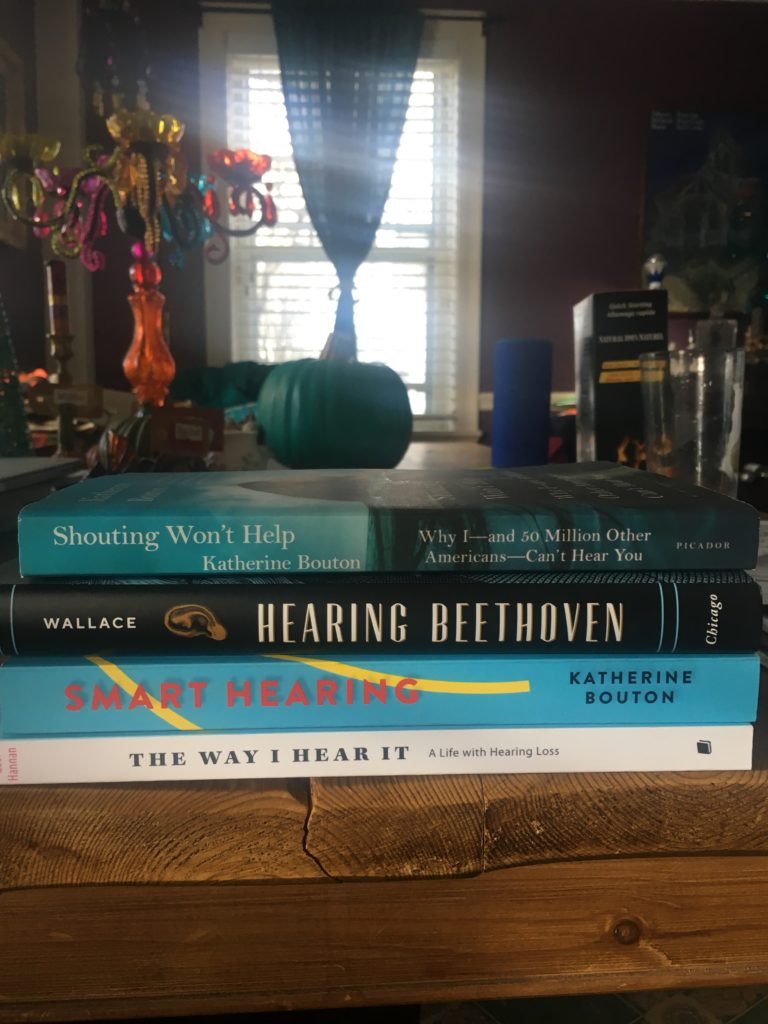
I am not the first to grow old, nor am I the first to lose my hearing. In fact, one of the books I picked up today—yes, reading is a coping mechanism—is Hearing Beethoven: A Story of Musical Loss and Discovery. Beethoven wrote symphonies after he went deaf. I figure he has something to teach me. Ginger even wondered if this meant I was going to write a symphony.

When I was in college, I had a hard time imagining myself old. As I have aged, I have enjoyed it. I like the ways in which life has called me to learn how to be less of an expert and more of a fellow traveler. I like letting go of the pressure to change the world, even as I like learning that I am changing the world in small motions. I love pouring my life into my marriage.

Now I have a hard time imagining how to live without being able to hear well. I am planning to be around awhile. My ears are not going to last as long as the rest of me. Again—I am not the first one to walk this road. I read a quote from Hellen Keller this week. She was responding to questions about whether the loss of sight or hearing was more profound. “Blindness cuts us off from things, but deafness cuts us off from people,” she said. I’m not deaf, but my hearing is getting worse quickly. I do feel cut off, often. And I feel incredibly supported and loved.

Life is a chronic condition. That’s another one of those things I am not the first to learn. As my friend, David Finnegan-Hosey likes to say, grace is a preexisting condition. Regardless of what happens to my ears, or any of the rest of me, I will be able to feel the rhythm of God pulsating in my bones and hear the melody of grace one way or another. And I’ll keep wondering what Jesus might have been like if he had had the chance to be sixty-two, or seventy.

You’re right. “Blessed are the cheesemakers” is way too easy of a punchline to end on.

Peace,
Milton

advent journal: do not be afraid

When I was a boy living in Lusaka, Zambia, one of our neighbors was an American woman who had a large German Shepherd named Tammy. The dog was trained to sit in the middle of the front yard and look and sound menacing, since the woman was frightened of people who didn’t look like her. Tammy was most inclined to bark at those who didn’t look like her, as well.

The dog scared me. When we did go to her house, I was hesitant to approach her at all. One day, the dog did something she wasn’t supposed to do and the woman turned on the dog and yelled, “Tammy—shame!” The ferocious animal crumbled. She didn’t move. I felt incredibly sad for her.

Ginger worked late last night, trying to wrangle her sermon into its final form. The story for today is about Elizabeth and Zechariah learning that they would have a child who would grow up to be John the Baptist. The story became more complicated for her when she read one commentator who pointed to the line about the “disgrace” or “shame” Elizabeth felt for being childless. Luke notes that she remained secluded for five months after she found out she was pregnant and would say, “How good the Lord is to me,” she would say, “now that he has taken away the shame that I have suffered.” (1:25, Phillips) The commentator pointed out that for those who have struggled to have children, or who have not been able to do so, this is a difficult story, and that difficulty is lost on those who don’t walk the same road.

I love to tell the story, for those who know it best
seem hungering and thirsting to hear it like the rest

says one of my favorite old hymns, but when the way we tell the old, old story does damage, we need to look at how we tell it. The fact that Elizabeth and Zechariah could not have children was not their fault, yet they felt shame—the same life-crushing force that broke that German Shepherd into pieces in front of me. Too many times, we hear that the old, old story is one of God yelling, “What the hell is wrong with you?” rather than saying, “I am with you.”

Most every time an angel shows up in the story, they start by saying, “Do not be afraid.” I understand how that can be read simply as a response to the fact that an angel was suddenly in the room, but what if, as we tell the old, old story, we were to take it in a larger sense: the presence of God is not something to be afraid of. God is not mad. God is not our for revenge. The point of the Incarnation is not payback. God is not trying to get even.

The same Gabriel who talked to Zechariah told Joseph it was all in the name of his son: Emmanuel—God With Us.

Shame does not give birth to life. Only love creates life. Only love breaks through the barriers we build between ourselves. We are created in the image of God. We were not created to be controlled by shame.

Last week, we went to see Boy Erased. The movie is based on a true story about a young man who is the son of an evangelical preacher. The boy comes out to his parents and his dad sends him to conversion therapy. The boy goes willingly at first, until he begins to realize what is being done to him and the others there, which is they are reminded over and over that God hates who they are. The one running the camp might as well have been yelling, “Shame!” over and over and over. When we left the movie, I could not get away from the thought that if our theology does damage, then something is wrong with our theology. If we are not building relationships, building up one another, binding ourselves to one another, then we are not telling the old, old story as it was first told to us.

The best thing we could do this Advent is to tell the old, old story with clarity and simplicity, beginning with, “Do not be afraid.” Gabriel told Zechariah to not be afraid because God had heard their prayers. A few verses later, Gabriel appeared to Mary and said, “Do not be afraid. God loves you dearly.”

Let’s tell that story. Please.

We are not sinners at the hands of an angry God. Jesus did not have to die as some sort of cosmic payment for our sins. Jesus was killed because the religious leaders of his day thought they could be more successful if they aligned with the fear-based oppression of the ruling government. Sound familiar?

Yes, we have sinned. And we keep sinning. But that is not who we are. We are the beloved of God. We are created in God’s image and worthy to be loved. That is the oldest story of all. And the best one.

Advent began here with a dark and rainy day. Even with full sunshine, these short winter days mean we only get about nine hours of daylight. We have had to have the lights on all day. In the early verses of John’s gospel he says, “The light still shines in the darkness and the darkness has never put it out.” (1:5, Phillips)

In these dark days, those words are both hopeful and fantastic. Can the light really outlast these days when we see some much hate running unleashed, so much intentional divisiveness, so much that pushes to define people by what they have done wrong or how they don’t measure up?

The old, old story reads like contemporary news, as the Romans sought ways to control and crush the people of Palestine, whom they considered to be less than human. They had set up an economic system that played to the rich at the expense of the poor. And still, Christ was born.

The light does shine in the darkness. Period.

We are the beloved of God. Period.

Do not be afraid.

Peace,
Milton
this is us

I want to say something before the votes are counted. I want to say out loud that my hope is not defined by those who make the most noise or create the most confusion. I want to share the words of those who are speaking to my despair, who feed my hope, who remind me that “us” includes everyone.

Everyone.

I read a meme yesterday with a quote from Cornell West that read, “I am not an optimist. I am a prisoner of hope.” I found out the words were taken from his 1993 commencement address at Wesleyan University right up the road from me in Middletown, Connecticut. Twenty-five years later, the words feel even more powerful:

Last, but not least, there is a need for audacious hope. And it’s not optimism. I’m in no way an optimist. I’ve been black in America for 39 years. No ground for optimism here, given the progress and regress and three steps forward and four steps backward. Optimism is a notion that there’s sufficient evidence that would allow us to infer that if we keep doing what we’re doing, things will get better. I don’t believe that. I’m a prisoner of hope, that’s something else. Cutting against the grain, against the evidence. William James said it so well in that grand and masterful essay of his of 1879 called “The Sentiment of Rationality,” where he talked about faith being the courage to act when doubt is warranted. And that’s what I’m talking about.

This morning, Rebecca Solnit published an editorial in The Guardian and said,

You don’t have to be oppressed or come from a history of oppression to stand with the oppressed; you just have to have a definition of “we” that includes people of various points of origin and language and religious belief and sexual orientation and gender identity.

Solnit pointed to these words by Michelle Alexander:

If we pause long enough and consider where we stand in relationship to the centuries-long quest to create a truly equitable democracy, we may be able to see that the revolutionary river that brought us this far just might be the only thing that could possibly carry us to a place where we all belong.

Every leap forward for American democracy–from slavery’s abolition to women’s suffrage to minimum-wage laws to the Civil Rights Acts to gay marriage–has been traceable to the revolutionary river, not the resistance. In fact, the whole of American history can be described as a struggle between those who truly embraced the revolutionary idea of freedom, equality and justice for all and those who resisted.

Last night, I got to hear my friend Christopher Williams sing. His song “Gather” hits some of the same notes.

to be known, to feel safe
to be honest and unafraid
to leave the past, run into hope
to find together we are not alone
I need you
you need me
this is why we gather
to remember why we matter
this is why we gather

Go vote. Please go vote. And then, whatever the outcome, don’t believe for a minute that the divisive drivel that passes for much of our public discourse is normal. Don’t believe that there’s not enough to go around. Don’t believe that fear is the strongest force. As my friend Hugh Hollowell says, love will win in the end; if love is not winning, it’s not the end.

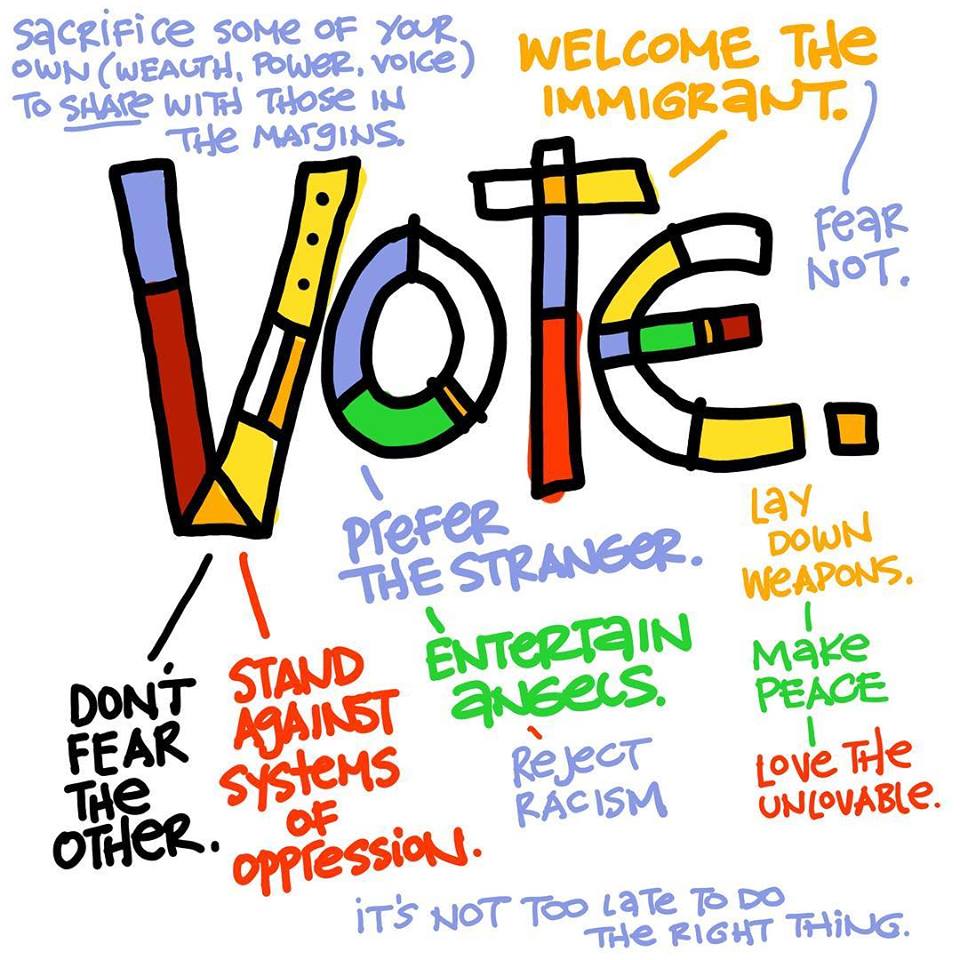
My friend Paul Soupiset, who is an amazing artist, put his thoughts into this image, which I hope you will carry with you to the polls tomorrow.

If I had a chance to get all of the people I have mentioned in this article to sit down at the same table, we wouldn’t agree on everything. To be together doesn’t mean to be in lock step. It does mean that my first move is to listen, rather that to demand to be heard. It does mean I trust that both life and faith are team sports and not individual events. There is no “them.” There is only US. That will still be true on Wednesday, regardless of the vote counts. We were built for each other. At the end of wedding ceremonies, I say, “What God has joined together, let no one tear apart.”

Exactly.

Peace,
Milton

Everybody sing along . . .