
This last Sunday of Advent leans into Christmas at our church since many folks will not be around Christmas Eve. This morning we looked at Matthew’s telling of Joseph’s side of the experience, brief as it is. I closed our service with my last Advent carol, “Knock Again.”
________________________
When I read the brevity of Matthew’s account of Jesus’ birth, it makes me think of an old Peanuts cartoon where Linus hands a book to Lucy and asks her to read him a story.
“A man was born, he lived, and he died,” she says before tossing the book aside. Linus then comments, “Kind of makes you wish you knew him better.”
I feel a bit like Linus when I read what Matthew says,
This is how the birth of Jesus Christ took place. When Mary his mother was engaged to Joseph, before they were married, she became pregnant by the Holy Spirit.
It, too, kind of makes me wish I knew them better. Then again, perhaps we know them better than we think we do, or at least we have more connections than we realize when we are looking at the traditional images of Mary and Joseph we see in manger scenes or hear in carols. Even to reread the two sentences I read a moment ago is to realize the birth of Christ begins with a good deal of heartache, which is to say Mary and Joseph were real people, not rosy-cheeked folks sitting for portraits to be hung in churches.
Mary and Joseph were engaged by not living together. When he found out she was pregnant, he had little choice to conclude that she had been unfaithful. He could have chosen to make a legal issue of out it, which meant Mary would have been stoned. Instead, Matthew says Joseph was going to dissolve the engagement quietly.
Though Matthew doesn’t mention her, we must remember that Joseph wasn’t the only one dealing with heartache or difficulty. Mary was a pregnant teenaged girl who could see the pain her fiancée was probably feeling and probably felt disheartened herself that he would question her love and loyalty even as she was growing more conspicuous and unexplainable to most everyone around them. We can fairly assume that she understood her future depended on Joseph’s choice.
Even if we skip ahead to the end of our passage to see that Joseph chose to go through with the wedding after the angel visited. I mean who wouldn’t? But that didn’t wipe away all of the difficulty. Their family was no more holy than any one of ours.
What Matthew describes tells us about the complexity, the confusion, and the frailty that attended this family, just like every other family. Indeed, there is nothing exceptional about Mary and Joseph, or even Jesus’ birth except that God comes through ordinary, mixed-up people in order to save ordinary, mixed-up people, and that God comes through a birth like all the billions of other births in the world to promise us peace and hope and joy and love as the children of God that we all are.
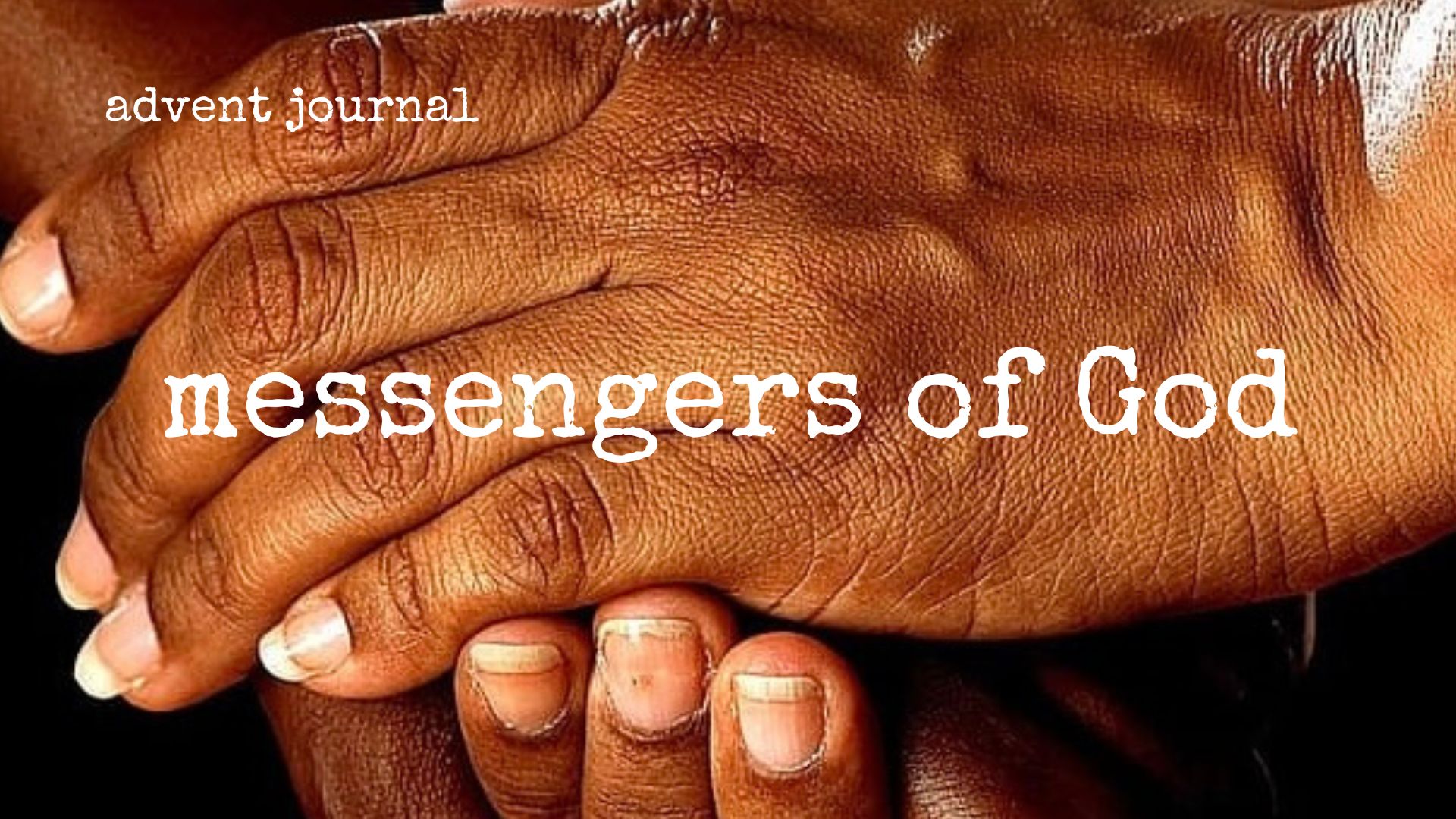
The birth of Jesus took place in the middle of a mess because that is how love works. Love, if it matters, has a face. It has a name. It has eyes and ears and fingers and toes. Love that is real has skin on it. And I mean actual skin. Love is not an idea or a concept. It is action. In the flesh word and deed.
In the middle of situations we don’t understand, griefs that feel too heavy to bear, problems that feel unsolvable, the message is in the name of the child: “God is with us.” Or, we might want to say, “God is really with us.” God is with us as we are, not as we know we should be, or we are trying to be, or we have promised to be, or we will be some day, but with us as we are now—today—in this moment.
In the gospels it took an angel—a messenger—to drive the point home. An angel told Mary what was happening to her and also woke Joseph up to help him see that God was in the middle of it all, which takes me back to Meister Eckhardt’s words about Christ needing to be born in our time and in our culture if the story is going to continue to matter.
Eckhardt finished his words by saying, “We are all mothers of God.” Matthew’s version prompts me to offer a paraphrase, or perhaps a companion thought: We are all messengers of God. We are all people capable of offering the word that God is really with us to one another in what we do and say. We are also capable of choosing not to do that. Whether Christ is born again in our time, in our moment, depends a good deal on how we choose to live. If we are willing to incarnate love, if we are willing to let God be near through, then love can be born again into our particular mess. Or not.
What a different story it would be if Joseph had awakened from his dream and decided it was not worth the risk or the trouble to go through with the engagement. What if Mary had told the messenger it was more than she could take? It’s safe to say we would not be sitting here because the story that connects us would have never been told.
The story of God—the story of love—continues because real people choose to let love be born in the middle of all of the mess, just like Mary and Joseph did. Those of you who are parents know that’s a choice they had to keep making, just as we have to keep making it in the middle of the mess we live in.
Our lives add up to more than being born, living, and dying when we choose to be messengers of God’s love in our words and actions. That is what it takes to make the Christmas story more than a memory. That is what it means for us to be mothers of God—and messengers of God.
May we live into our calling as we celebrate Jesus’ birth once again. Amen.
Peace,
Milton